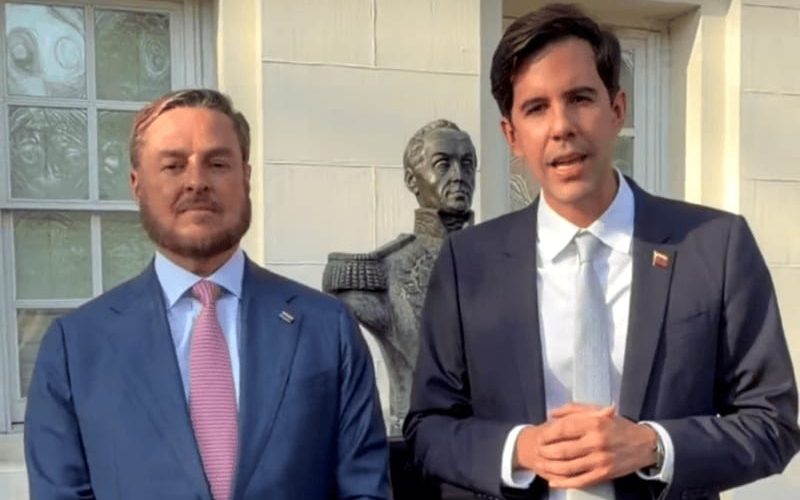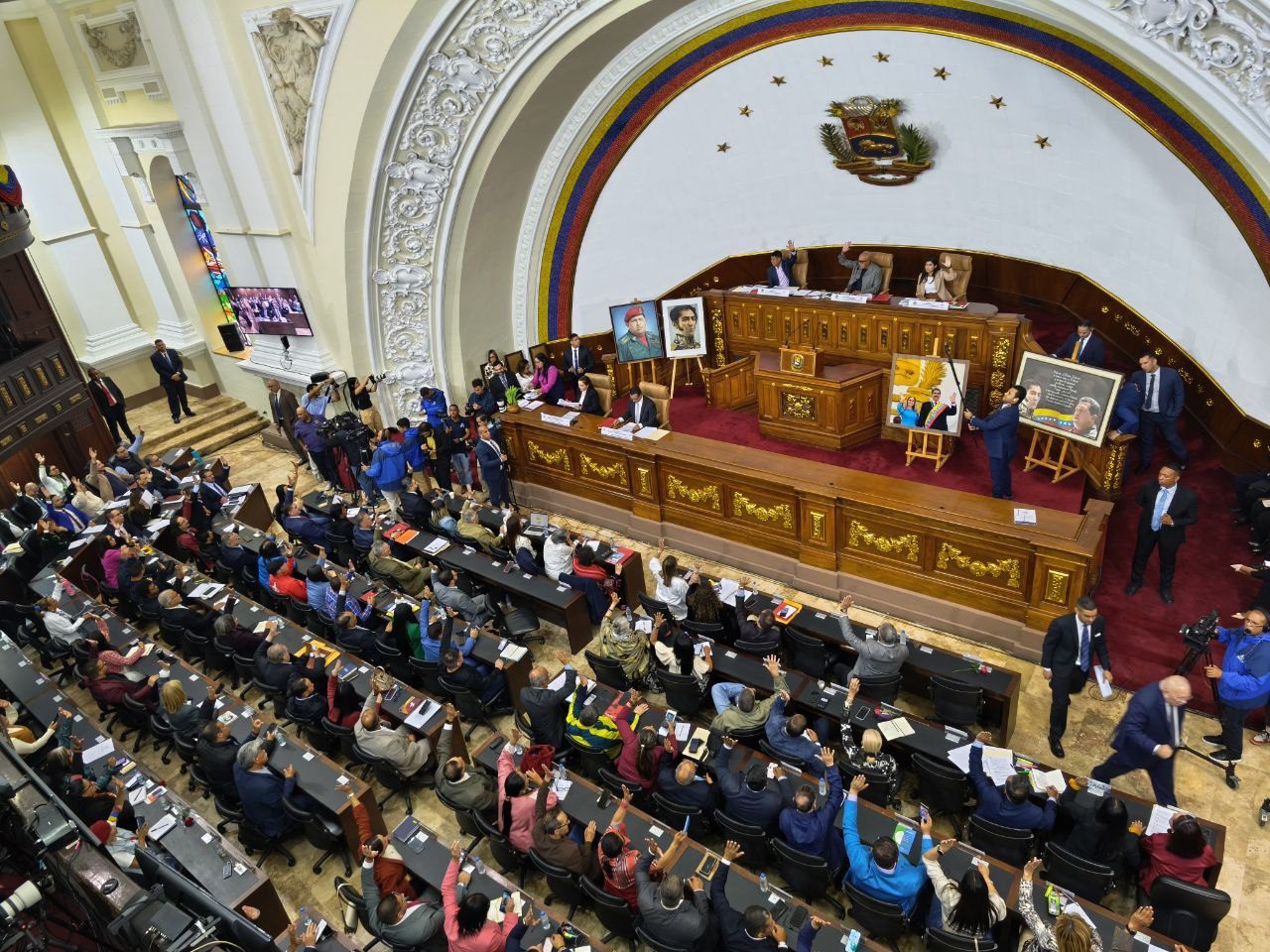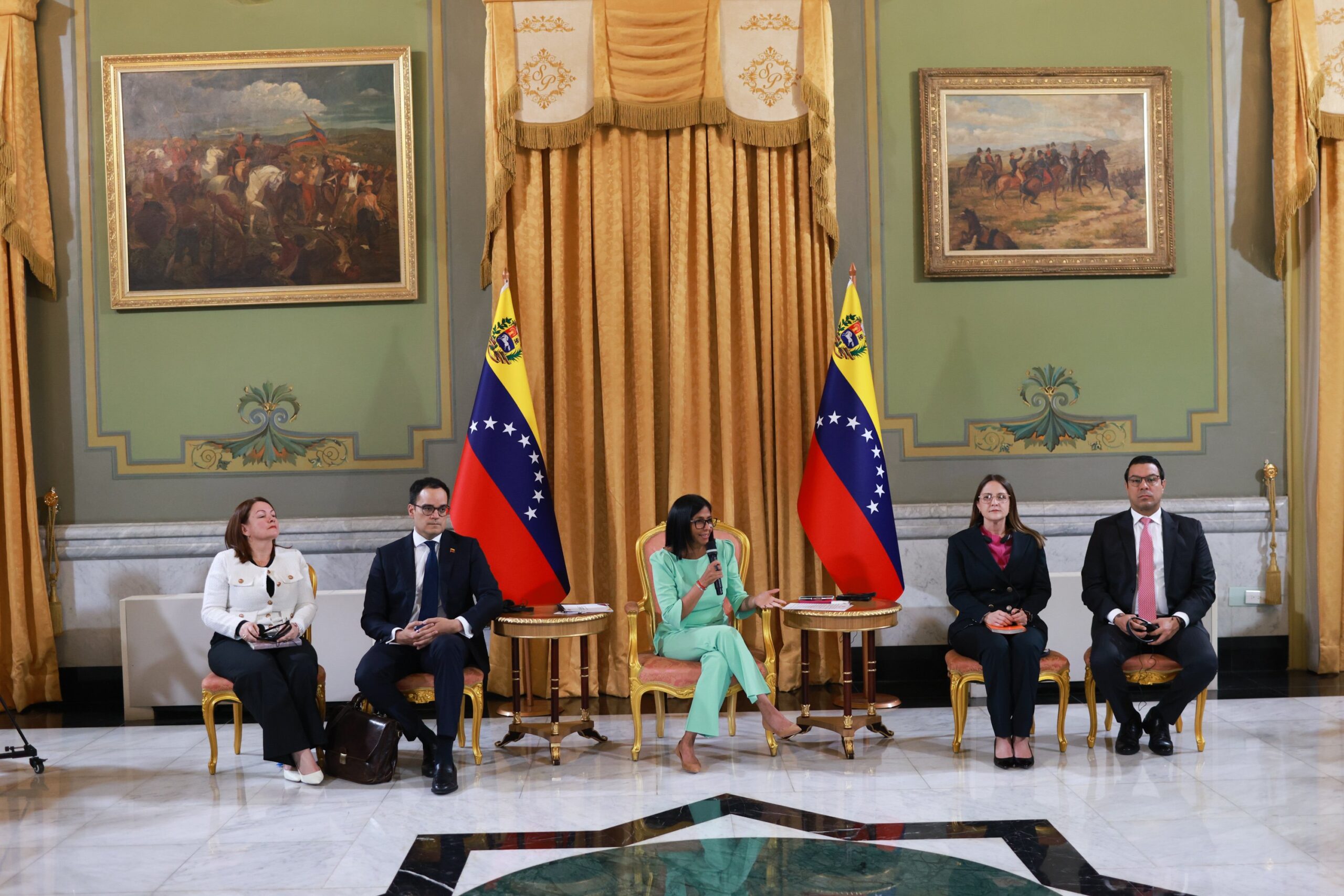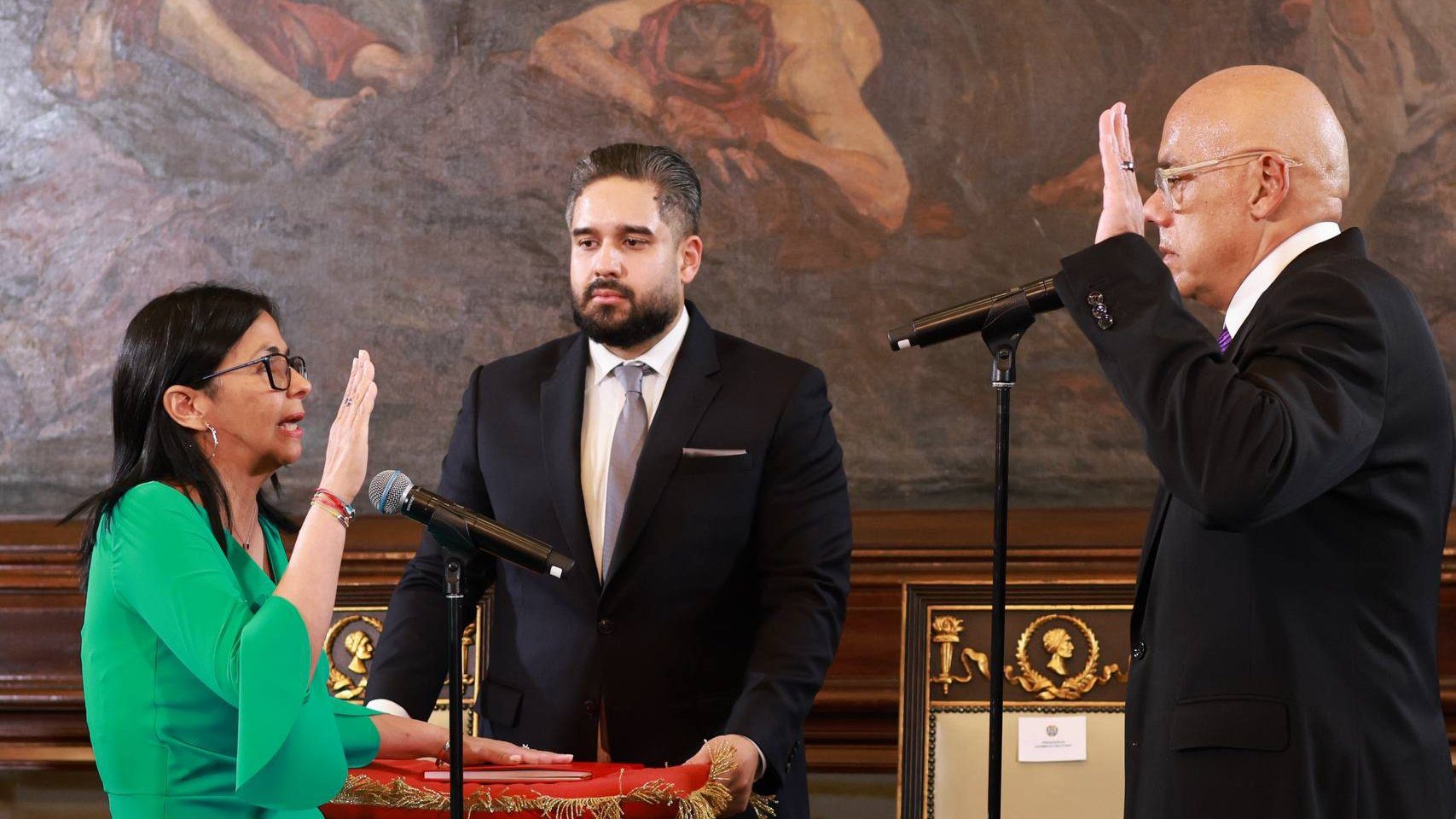
The new president assumed the leadership of the Executive in the capacity of caretaker in a ceremony held in the Elliptical Hall of the Federal Legislative Palace, in front of the new directive of Parliament, diplomatic representatives and members of the cabinet. Photo: @Asamblea_Ven (X).
Macaw, January 05, 2025. After the formal installation this Monday of the 2026-2031 Legislative Period of the National Assembly (AN), Delcy Rodríguez has been sworn in as president in charge of the Republic. The act was carried out after the decision of the Supreme Court of Justice (TSJ) that declared the temporary absence of President Nicolás Maduro, based on a “forced absence” after being taken from the country by US forces in the early hours of last Saturday.
Delcy Rodríguez’s words were enunciated in front of the re-elected president of the National Assembly, Jorge Rodríguez, who is her brother, and in front of Deputy Nicolás Maduro Guerra, son of Nicolás Maduro, who upheld the Constitution. The now highest authority of the Executive, appealed to a message full of emotion and rhetoric of resistance in the face of the new responsibilities to be assumed.
“I come with pain for the suffering that has been caused to the Venezuelan people after an illegitimate military aggression. I come with sorrow for the kidnapping of two comrades in the United States of America: President Nicolás Maduro and the First Lady of the country, Cilia Flores. But I also come with honor to swear, on behalf of all Venezuelans, by our liberating father Simón Bolívar, whose liberating blood runs through the veins of Venezuelans,” he said.
This act was held in the Elliptical Hall of the National Assembly, with the particular and notable absence of the bulk of the deputies who minutes before made up the formal session of installation of the new Legislative Period 2026-2031. Instead, representatives of the different Public Powers and members of the ministerial cabinet, as well as diplomatic representatives, were appreciated.
A Board of Directors without Surprises: Jorge Rodríguez at the Helm, Again

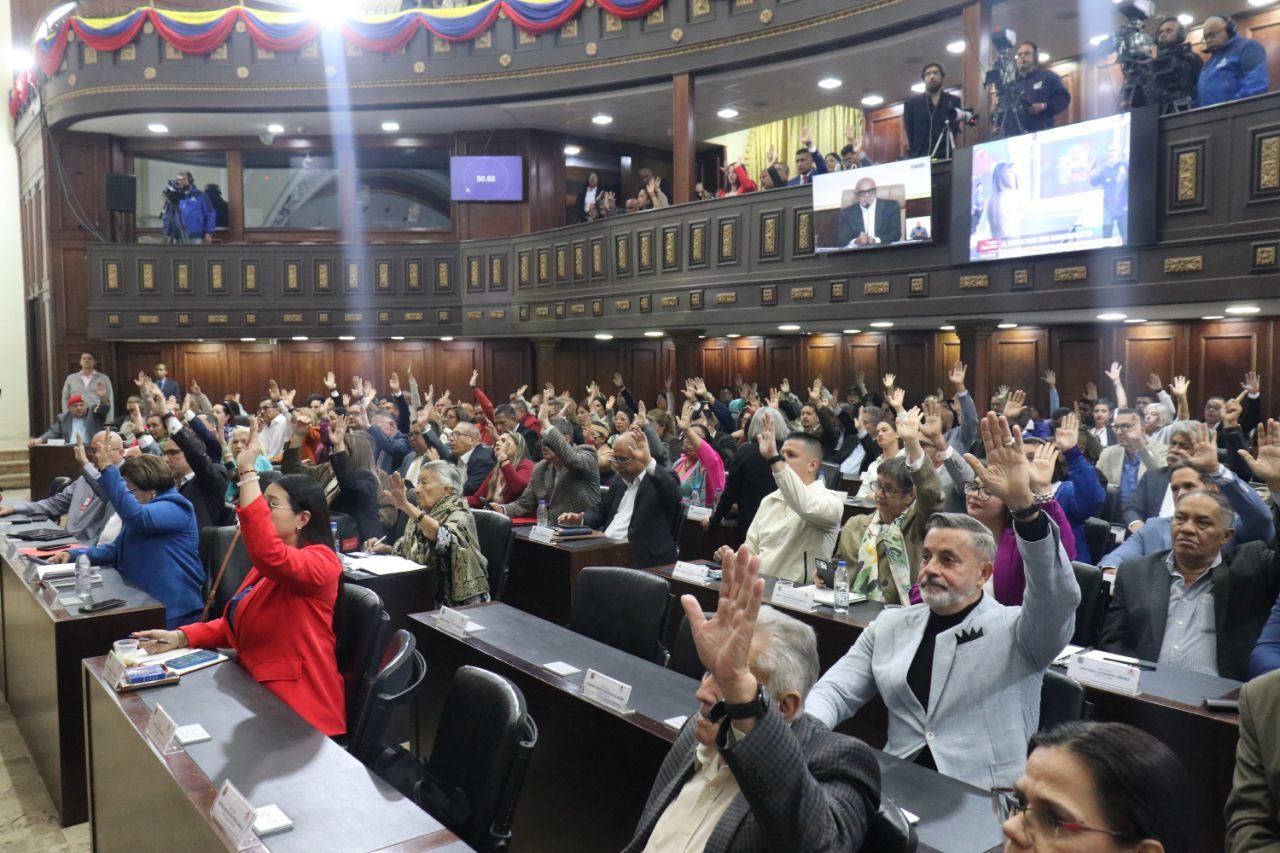
Previously and without any surprises for the ruling party, the installation session of the 2026-2031 Legislative Period of the National Assembly (AN) was formally held. At the event, the absolute hegemony of the Great Patriotic Pole (GPP) was ratified and the continuity of Chavismo in the Legislative Branch was consolidated. However, opposition voices, although a minority, raised criticisms that resonated in the hemicycle.
The new Board of Directors of the National Assembly was formed as anticipated, without variations with respect to the established power dynamics. Nicolás Maduro Guerra, son of President Nicolás Maduro and ruling party deputy, formally presented the proposal of the “Homeland Bloc”: Jorge Rodríguez as President, who will maintain his role; Pedro Infante as First Vice President; and Grecia Colmenares as Second Vice President.
Maduro Guerra defended Chavista unity with a messianic tone in the face of the situation that has his father, Nicolás Maduro, and his wife, Cilia Flores, facing a judicial process in the United States. “I have full faith, as a believer in our almighty God, that sooner rather than later they will be with us. We will witness that historic moment,” said the deputy in a brittle voice.
The approval of the new board was an express procedure. At 1 p.m., the presidency of Jorge Rodríguez was ratified by a “resounding majority,” followed by the first vice presidency of Pedro Infante and the second vice presidency of Colmenares. Subsequently, María Alejandra Hernández was appointed as Secretary and José Omar Molina as Undersecretary, proposed by the “Bloque de la Patria”.
The Democratic Alliance’s Proposal: Questioned and without Efficient Support
The alternative to this proposal came from the Democratic Alliance bloc, under the spokesperson of Timoteo Zambrano. The leader of the Cambiemos party proposed Ruben Limas (Acción Democrática judicialized) as President, José Brito (Primero Venezuela), as First Vice President, and Alfonso Campos (El Cambio) as Second Vice President.
In his speech, Timoteo Zambrano urged the National Assembly to support the transitional government of Delcy Rodríguez, and rejected the capture of Nicolás Maduro and Cilia Flores. “We always knew what Donald Trump was capable of, but we didn’t think he could carry out a dictatorship within our country. We warn him, he managed to enter Venezuela and kidnap President Nicolás Maduro and his wife,” he said.
Both the official proposal and the one suggested by the Democratic Alliance were openly questioned by the bloc made up of Un Nuevo Tiempo, Unión y Cambio and the Alianza del Lápiz (UNT-Única-Lápiz), whose spokesperson was headed by Deputy Stalin González. “We cannot accompany these proposals because in the last five years you have not legislated for Venezuelans. We come to make it different, we are the voice of millions who have been silenced,” he said.
González declared himself a “believer in voting” and demanded: “An immediate end to the criminalization of dissent and the release of political prisoners. Let’s see this moment as propitious to decree an amnesty, it is the gesture of State that Venezuela deserves.” In this fraction there are up to four former presidential candidates such as: Pablo Pérez, Henrique Capriles Radonski, Henri Falcón and Antonio Ecarri Angola, as well as Tomás Guanipa who has his brother detained, the leader Juan Pablo Guanipa.
Parliamentary Composition: GPP Hegemony and Fragmented Opposition

The National Assembly 2026-2031 has 285 deputies, of which 284 assumed functions due to the absence of Cilia Flores, captured in the U.S. military operation in Venezuela last Saturday. The correlation of forces in Parliament shows an abysmal difference between Chavismo and several non-official blocs that failed to achieve a unifying agreement.
In this way, Parliament is composed as follows:
- Great Patriotic Pole (PSUV + allied parties): 256 deputies (255 in office in the absence of Cilia Flores). They make up the absolute majority of the National Assembly. The head of the bench is Deputy Nicolás Maduro Guerra (United Socialist Party of Venezuela).
- UNT-Única-Lápiz: 12 deputies. It includes former presidential candidates such as Pablo Pérez, Henrique Capriles Radonski, Henri Falcón and Antonio Ecarri Angola, as well as Tomás Guanipa (brother of political prisoner Juan Pablo Guanipa). It is the majority opposition parliamentary fraction. His head of the bench is Deputy Stalin González (Un Nuevo Tiempo).
- Democratic Alliance: 9 deputies. Made up mostly of representatives of parties that have been judicially intervened and pointed out by public opinion as being “complacent” with the Executive. His head of the bench is Timoteo Zambrano (Cambiemos).
The parties Vamos Vamos Cojedes (6 deputies) and Fuerza Vecinal (2 deputies) did not reach a unifying agreement with other opposition factions and will represent the individual interests of their respective parties.
The installation seals the end of a cycle for Chavismo: a Legislative questioned for not having real counterweights, but which, with its renewal, still has ample capacity to endorse agendas in Economy, Society and Foreign Policy, now facing the presidency of the Executive of Delcy Rodríguez, in her role as head of office. The fragmentation of the opposition, with high-profile figures limited to a few seats, can reduce its impact to symbolic gestures, but, for many, necessary in the face of the crisis.