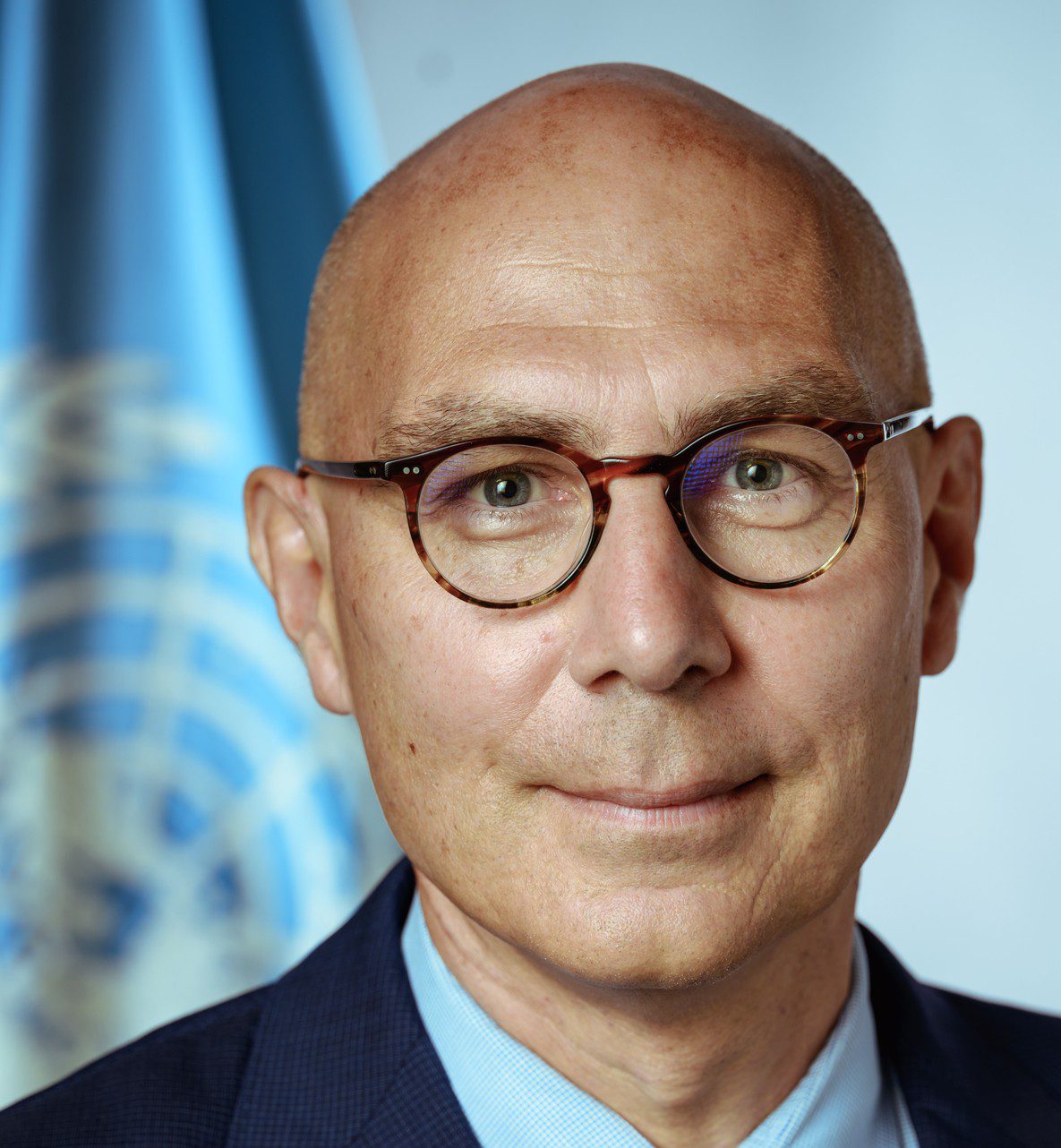
Volker Türk is the United Nations High Commissioner for Human Rights. He officially assumed his duties as High Commissioner on October 17, 2022. Photograph: website of the Office of the United Nations High Commissioner for Human Rights.
Guacamaya, December 16, 2025. In an oral update before the UN Human Rights Council, High Commissioner Volker Türk denounced the closing of civic space, arbitrary detentions, and forced disappearances in Venezuela, while calling for a review of sanctions and urging against an escalation of international confrontation that worsens the impact on the civilian population.
During his presentation before the United Nations Human Rights Council, High Commissioner Volker Türk described a marked deterioration of the human rights situation in Venezuela, characterized by the shrinking of civic space, persecution against journalists and defenders, and the use of arbitrary detention as a control mechanism. “The repression of civic space has intensified, suffocating people’s freedoms,” he stated.
Türk indicated that his Office has received testimonies about practices that encourage citizens to denounce each other through a state-sponsored mobile application, which—he warned—”generates fear, distrust, and self-censorship.” In this context, he noted that journalists, human rights defenders, opposition figures, and even humanitarian workers continue to face threats, harassment, and risk of detention “simply for doing their work.”
The High Commissioner warned that these conditions have forced many to leave the country. “When human rights defenders and journalists leave, truth and accountability leave with them,” he argued. He added that several journalists remain arbitrarily detained and that hundreds of people are still imprisoned for political reasons, highlighting that the recent detention of the general secretary of the main trade union sent “an alarming signal to workers throughout the country.”
Regarding deprivation of liberty, Türk reported that his Office has documented at least five deaths of individuals detained in connection with the 2024 presidential elections, all of which—he emphasized—must be investigated promptly and independently, including the death of opposition leader Alfredo Díaz. He also expressed concern over the increase in transfers of detainees to unknown locations, some constituting forced disappearance, and over the situation of incommunicado detention in centers such as El Helicoide, Rodeo I, and Fuerte Guaicaipuro.
In this regard, he urged the unconditional release of all individuals arbitrarily detained for their participation in civic space, mentioning Rocío San Miguel, Javier Tarazona, Carlos Julio Rojas, Eduardo Torres, and Kennedy Tejeda, as well as relatives and four adolescents. Furthermore, he called on the authorities to protect freedom of expression, guarantee a safe environment for the media and civil society, and investigate and provide redress for all human rights violations. He also expressed concern over attempts to strip the nationality of certain opposition figures, a practice he described as illegal.
Türk dedicated part of his intervention to the structural and external factors impacting the crisis. He reiterated the disproportionate impact of broad sectoral sanctions on the most vulnerable sectors and on the work of humanitarian and human rights organizations, and called for these measures to be re-evaluated and lifted. He described a socioeconomic situation marked by poverty, inequality, and sustained price increases, noting that the monthly minimum wage is more than a thousand times lower than the cost of the basic food basket.
On the international front, the High Commissioner expressed “deep concern” over the impact on human rights of the intensification of U.S. military pressure against Venezuela. “History has shown, time and again, that when confrontation intensifies, it is often ordinary people who get caught in the crossfire,” he warned. In line with this, he reiterated his call to Washington to use well-established law enforcement methods to combat illicit drug trafficking, and urged states hosting Venezuelan migrants, refugees, and asylum seekers to guarantee their protection.
One of the most delicate announcements was the confirmation that the Office of the High Commissioner no longer has international staff in Venezuela. “We have made every possible effort to re-establish our presence, including requesting visas and collaborating with the authorities, but unfortunately without success,” Türk told the Council.
Diplomatic crossfire and alignments in the Human Rights Council
The debate was marked by an evident geopolitical component. Venezuela registered to intervene in defense of Russia, which did not appear before the Council to respond to the High Commissioner’s report on the human rights situation in Ukraine. In turn, it was announced that Russia will intervene in the debate on Venezuela to support Caracas against Türk’s report, on behalf of the self-styled Group of Friends in Defense of the UN Charter.
This exchange reflects sustained political coordination between the two countries in the multilateral sphere, particularly in forums like the Human Rights Council, where they have coincided in questioning what they consider the selective or politicized use of international human rights mechanisms. For Venezuela, Russia’s support constitutes key diplomatic backing in the face of international pressure; for Moscow, defending Caracas is part of a broader strategy of building alliances with states that reject Western dominance in global governance.
Cooperation between Venezuela and Russia in these spaces is not limited to specific support in particular debates, but is part of a broader pattern of coordinated action in multilateral bodies, aimed at reinforcing principles such as sovereignty, non-interference, and the primacy of the UN Charter in international relations. In the current context of geopolitical tensions, this alignment gains additional relevance, intertwining human rights discussions with broader strategic disputes among major powers.
The representation of the Venezuelan government rejected the update of the report by the UN High Commissioner for Human Rights, stating: “We call on him to engage in deep reflection; otherwise, history will not absolve him
Context
Volker Türk’s intervention took place as part of what was his final oral update of the year on the human rights situation in Venezuela, presented to the United Nations Human Rights Council and followed by an Interactive Dialogue with member states of the body. This format allows delegations to formulate observations, express concerns, or state political positions following the High Commissioner’s presentation.
In such procedures, the Human Rights Council acts as the principal intergovernmental forum of the UN charged with examining national human rights situations of international concern. The oral updates of the High Commissioner do not constitute binding resolutions or decisions, but serve a central function: to bring to the attention of states the information collected by the Office of the High Commissioner, to alert about relevant trends, and to formulate recommendations addressed both to the examined state and other international actors.
The High Commissioner, in his capacity as the highest UN authority on human rights, presents these updates based on the monitoring, documentation, and analysis work carried out by his Office, which includes information from official sources, civil society, victims, and other international mechanisms. His mandate is not punitive, but preventive and oriented towards protection, accountability, and cooperation, even when formulating severe criticisms or urgent appeals.
Following the presentation, the Interactive Dialogue allows member and observer states to intervene to express support, disagreement, or nuances regarding the presented report. These interventions often reflect both human rights concerns and broader political and geopolitical alignments, making these debates a space where technical examination of the situation converges with the diplomatic dynamics inherent to the multilateral system.
In the case of Venezuela, these periodic updates have acquired special relevance due to the persistence of allegations regarding restrictions on civic space, arbitrary detentions, and conditions of deprivation of liberty, as well as the humanitarian impact of the socioeconomic crisis and international tensions. The presentation of the year’s final update also occurred in a context marked by the absence of international staff from the High Commissioner’s Office in the country, which adds complexity to monitoring the situation on the ground.