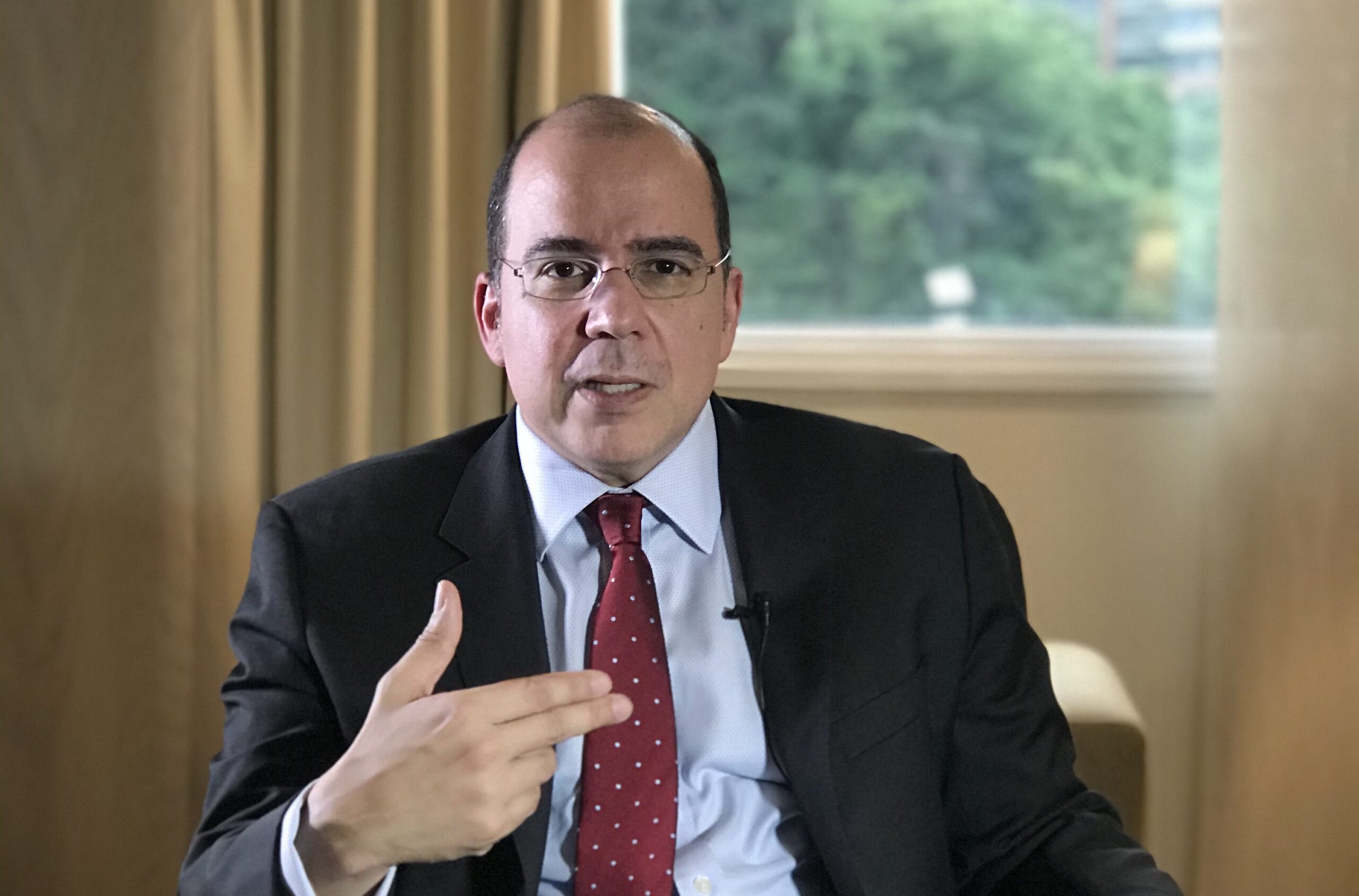
Francisco Rodríguez is a renowned Venezuelan economist and academic. He currently serves as a Senior Research Fellow at CEPR and an Affiliate Professor at the University of Denver. Photo: Arnaldo Espinoza.
Guacamaya, February 15, 2026. Francisco Rodríguez is a Senior Research Fellow at the Center for Economic and Policy Research (CEPR) and an Affiliate Professor at the Josef Korbel School of International Studies at the University of Denver. Originally from Venezuela, he is the founder of Petroleum for Venezuela, a non-profit organization dedicated to finding solutions to the profound humanitarian crisis the country has experienced.
Rodríguez earned his Ph.D. in economics from Harvard University and a bachelor’s degree in economics from Andrés Bello Catholic University in Caracas. He has taught at institutions such as the University of Maryland in College Park, the Institute of Higher Studies in Administration (IESA), and Wesleyan University. In the public sector and international organizations, he has held prominent positions, including Chief of Economic and Financial Advisory to the National Assembly of Venezuela (2000–2004), Head of the Research Team for the United Nations Human Development Report Office (2008–2011), and Chief Economist for the Andean Region at Bank of America (2011–2016). Additionally, he has been a Visiting Professor at the Stone Center for Latin American Studies at Tulane University, a Visiting Researcher at the Kellogg Institute for International Studies at the University of Notre Dame, and an International Economics Fellow at the Council on Foreign Relations.
Rodríguez is the author of four books and more than sixty research articles in peer-reviewed journals. In the interview, we discussed his most recent book, The Collapse of Venezuela: Scorched Earth Politics and Economic Decline, 2012–2020 (2025), and his study with Silvio Rendón and Mark Weisbrot in The Lancet Global Health. In the latter, he provides empirical evidence on the effects of international economic sanctions on public health, using data from 152 countries between 1971 and 2021 and statistical methods designed to identify causal relationships.
In addition to his academic work, Francisco Rodríguez has participated as a member of the Bologna Initiative for Sanctions Relief, a global effort seeking to generate standards and proposals to evaluate and reform the use of economic sanctions with a humanitarian perspective.
In this interview, Francisco Rodríguez analyzes the current situation in Venezuela in light of recent changes in international sanctions policy, the recovery of the oil sector, and the country’s economic growth prospects. We also address the new relationship between Washington and Caracas, the challenges of economic and political reconstruction, and the possibilities of generating a solid institutional framework to attract investment and strengthen governance, with the participation of both the public sector and civil society.
Q: In your analysis, what empirical evidence supports the claim that sanctions do coincide with the deterioration of well-being and the acceleration of migration? The bulk of Venezuelan migration occurred before the 2019 oil sanctions. Some politicians and economists even claim that sanctions have helped the Venezuelan economy by motivating changes in domestic policies.
A: I believe that when one evaluates the impact that sanctions have had and may have today, one must first do so within a global vision, understanding what led to the migratory phenomenon, the Venezuelan exodus, what the main contributing factors are, and how sanctions play a role in that.
It seems to me that the evidence is quite clear: Venezuela is experiencing the exodus it is due to the severe economic deterioration that the country has experienced over approximately the last decade. Between 2012 and 2020, Venezuela experienced the largest economic collapse documented in world history in a country outside of wartime: a 71% drop in per capita income. And this coincides in time with the departure of approximately 8 million Venezuelans.
So, when we look at those two time series, it’s very clear. That is, Venezuela was a country that had no net emigration; in fact, it was a country that had received migrants from many countries, and that continued until well into the 2010s. It is around the mid-2010s that you begin to see a growing outflow of people from Venezuela, and that coincides with the collapse of the economy.
So, let’s say, it’s very difficult to argue that the main reason people were leaving Venezuela wasn’t precisely the economic conditions, because this phenomenon occurs at the time of the economic collapse. Furthermore, we have evidence not only anecdotal but also from systematic surveys, where people tell you: “Well, look, the main reason I left is because you couldn’t live in Venezuela, because salaries had plummeted, because economic conditions had collapsed.”
So, all of this tells you, hey — and of course, I’m not saying at any point that the economy is the only reason everyone left. There are obviously a million decisions, literally, and all those decisions can have very individual and personal reasons. But certainly, we see a fairly significant pattern, which is also a pattern you see in other countries. There’s the work by Georg Goodman and co-authors, which precisely analyzes the effect of sanctions on migration in panel data from all countries for which statistics on this topic are available, where this same correlation is also found.
And we also know — and there is all the work I have done, which we can get into — to identify the contribution of sanctions to that economic downturn. That work, summarized in my book The Collapse of Venezuela, published by the University of Notre Dame last year, calculates that approximately half of the drop in Venezuelan GDP is due to sanctions and other foreign policy measures that sought to restrict the Venezuelan economy.
So, the channels are very clear. That is, sanctions affect the economy. They are not the cause of the entire economic decline, but that economic decline is the main driver of Venezuelan emigration.
Now, you point out something that is often mentioned in this debate, this discussion: that the crisis began before the sanctions or that emigration began to be seen before the sanctions. So, how can sanctions be the explanation? Notice there’s a problem with that argument. First, no one — or at least I am not — is saying, nor do I see anyone serious saying, that sanctions are the only reason for the economic crisis and, therefore, the only reason for emigration. No one has said that. That’s what’s known as a straw man argument, where in debates the opponent’s argument is often implicitly characterized as a very different one, which is easier to refute.
Of course, if I were saying that sanctions are the sole cause of the collapse and emigration, that would be clearly refutable. But the fact is I’ve never made that argument, nor has anyone serious. Here, the argument is that sanctions have contributed to the fall in Venezuelan GDP during this period and that they have done so to a significant extent.
What I explain in several articles I’ve published, and which is summarized in my book, is that the Venezuelan economic collapse is actually a mix of two crises; it’s like one crisis after another. The first crisis occurs between 2012 and 2016, and that’s the typical crisis of an overextended country, with populist policies, unsustainable spending, and debt, anchored in high oil prices. When those prices fell, the country wasn’t prepared, and therefore you have a whole series of adjustments that the economy has to make precisely to adapt to the fact that it couldn’t continue living under the conditions of a $100 barrel, to which it had become accustomed. When oil prices drop to $30, this is the economic crisis.
That is, between 2012 and 2016 we had a strong economic crisis, which is like the crisis Venezuela had during the 1980s, like the crises many Latin American countries have had, documented by Rudiger Dornbusch and Sebastián Edwards in their book on the macroeconomics of populism in Latin America.
But after 2017 — which is when the first financial sanctions come — a large part of my research has been focused precisely on showing that those 2017 sanctions also had a very significant effect, particularly by impeding the financing of the mixed companies that produced oil through the Orinoco Belt. From that moment on, you have another phenomenon: what used to happen with the Venezuelan economy — that oil prices would begin to recover and the economy would recover or, at least, stabilize — did not happen.
And why didn’t it happen? Because production began to fall. And when you start studying the production decline in detail, you realize there are several inflection points in that drop that are clearly associated with sanctions. This is where we can also discuss all the other research that has been done on this matter. But the reason the Venezuelan economy didn’t stabilize after 2017 was that production was collapsing. And there, sanctions did have a very significant effect. Again, they are not the only factor, but they are a factor that has significantly contributed to the economic decline and, therefore, to emigration.
“It is very problematic and regrettable to use studies with errors to justify political narratives, because the role we social scientists must fulfill is to inform public debate with research that is replicable, verifiable, and subject to debate.”
Q: You have been involved in an academic debate against economists Ricardo Hausmann and Dany Bahar. They argue that sanctions not only have not caused greater migration but may have even reduced it. You argued that their conclusion is based on a methodological flaw. Could you explain why Hausmann and Bahar’s conclusion would be erroneous?
A: The first thing is that when their study came out, it caught my attention. I was surprised because it was a study with counterintuitive results. Effectively, what that study was saying is that sanctions reduced migration. Basically, it said that as oil revenues increased — they don’t directly use a sanctions indicator; they actually use indicators of oil revenues — but assuming that sanctions affect oil revenues, they argued that when there were more oil revenues, more people emigrated.
I found it very strange. So, one does what is appropriate: start looking at the data, review their databases and results. At that time, together with my co-authors, Giancarlo Bravo and David Rosnick, we identified a very significant methodological error. They had used a wrong difference operator. They used a very complex operator — the twelfth difference — to try to calculate year-over-year variations. Essentially, it was a coding error. It’s an error they acknowledged and corrected in their paper.
However, they said their results did not change, and that is not true. Of course, one can interpret results however one wants, but it’s not true in a very concrete sense. Their initial paper had statistically significant coefficients. And generally, in social and quantitative sciences, that’s the standard: if you have a specification and find a significant coefficient, you say you found an effect. If you don’t find a significant coefficient, you usually say the data doesn’t allow you to identify any effect.
The original significant coefficient indicated that more oil revenues led to more migration. After correcting the error we identified, the statistical significance disappears. So, the normal thing in social sciences is to say: “Look, I can’t confirm this hypothesis; I have an insignificant coefficient, therefore, I cannot identify an effect.”
However, they shifted the interpretation context and said that what they were really trying to refute was the hypothesis that sanctions caused more migration, and that failing to find a significant coefficient — and that it still had a positive sign, not negative as would be expected under that hypothesis — constituted evidence against the idea that sanctions cause more migration.
In response to that, my answer is that there are two problems. One has to do with the data they use. They use a time series of Venezuelan oil revenues and cross it with migratory flows of Venezuelans to the United States, measured by the apprehension of Venezuelans crossing the border irregularly.
That is, the variable they use is Venezuelans crossing the border between Mexico and the United States. But we know that the vast majority of Venezuelans had already left Venezuela before the massive surge in those crossings to the US. Many of those crossing that border are not in Venezuela, but in Colombia, Peru, or Mexico. So, why would Venezuela’s oil revenues or the money Maduro has to repress make you decide to leave Colombia for the US? It’s not surprising you don’t find statistically significant coefficients, because what you have is statistical noise.
“Neither [Omar Zambrano’s] work nor Bahar and Hausmann’s underwent rigorous peer review.”
More recently, Giancarlo Bravo and I reviewed another methodological aspect and found an even more significant error, which essentially invalidates their entire estimation scheme. It’s an error in the application of the cointegration methodology. Interestingly, that same error also appears in a previous paper published by Bahar in the Journal of Policy Analysis and Management. That paper had already been corrected once for another error.
What they did was quite irregular. In time series, when you have two variables like migration and oil revenues, you cannot simply correlate them and claim there’s a causal effect. Not only because correlation doesn’t imply causation, but because of the phenomenon of spurious relationships: series with stochastic trends can be correlated without any causal link.
For example, you might find that Venezuelan migration to the US is correlated with the number of Bad Bunny downloads on Spotify. That doesn’t imply causality; it simply reflects trends over time.
Therefore, when working with time series, it’s necessary to perform a cointegration test to determine if a long-term relationship exists. That test is applied to the levels of the variables. They applied it to the first differences. Why? I don’t know. I imagine it was a confusion, because there are cases where you do need to difference the series, but cointegration tests are not applied that way.
By doing it that way, they found cointegration — that is, a long-term relationship — when there is none. We demonstrated that if you apply the test correctly, that relationship disappears. This invalidates all subsequent estimations because they lack methodological basis if cointegration hasn’t been demonstrated first.
Furthermore, we showed that the modification they made systematically biases the results toward finding a long-term relationship. We demonstrated it theoretically and through Monte Carlo simulations. The test, as they applied it, has a 100% false positive rate. That is, it will identify a long-term relationship even when one does not exist 100% of the time. It’s a completely invalid test.
This means that this work has no solid argumentative basis because it stems from a misapplied methodology. When you correct the error, the test simply indicates that you cannot apply those methodologies because they have no informative content.
It is very problematic and regrettable to use studies with errors to justify political narratives, because the role we social scientists must fulfill is to inform public debate with research that is replicable, verifiable, and subject to debate. Here we are not talking about differences in interpretation; we are talking about clear errors.
The debate on sanctions is highly politicized. Some sectors clearly advocate for the use of this instrument and selectively cite research favorable to their position. It’s a problematic pattern.
For example, there was another work by economist Omar Zambrano, from the Nova Group, which claimed that sanctions had led to an improvement in food and medicine imports. I published a paper showing there was a coding error that led to omitting 80% of food imports. The variable they used covered only 20%. When you correct that error, the results disappear.
However, these studies continue to be cited. In the case of Bahar and Hausmann, they corrected the first error but have not corrected the second. They might be in talks with the journal; I don’t know for sure. But the use of these works in the public policy debate is very problematic.
Here, there is an important role for the peer-review process. One must be very cautious when using non-peer-reviewed work. Neither the Ecoanalítica work nor Bahar and Hausmann’s underwent rigorous peer review. Even Bahar’s was published in a non-peer-reviewed section of the Journal of Policy Insights. That means they have not passed through peer control.
In academic practice, until a work is published in a peer-reviewed journal, it is not considered part of the literature. But political actors treat them as if they were.
For example, Americas Quarterly published an article based on the Bahar and Hausmann study. But that publication, in recent years, has not published any critical articles on sanctions. There are publications with a clear political bias.
Americas Quarterly depends on the Council of the Americas, which has had a very defined political agenda. The main mechanism through which that study was transmitted to the policy world was that publication. That, even after a correction admitted by the authors themselves, they have not made a rectification is very problematic.
We are facing serious problems of professional and academic ethics that must be debated and analyzed institutionally. It’s one thing to have differences in academic debate; it’s quite another to continue using research when clear methodological errors have already been identified. At that point, they should no longer be used in the debate or academic discussion.
“There is a signed agreement between the US government and Venezuela regarding the sale of all Venezuelan oil. But where is that agreement? Article 150 of the Constitution establishes that contracts of national public interest must be approved by the National Assembly. How can a contract of this magnitude have been signed without parliamentary approval or public debate?”
Q: Now that the United States intends to exercise control over Venezuelan oil revenues, it is pertinent to recall the precedent of the UN’s “Oil-for-Food” program to mitigate the humanitarian effects of sanctions imposed on Iraq in the 90s. What lessons do you consider fundamental for the current Venezuelan case? Do you believe the international community — beyond the United States — should try to rebuild multilateral decision-making spaces, even in a weakened Security Council, to prevent the management of the Venezuelan crisis from leading to a unilateral model with long-term political and humanitarian costs?
A: Despite — and admitting and recognizing — all the problematic ways in which this change occurring in Venezuela has come about, I think we can all agree that it is not right for differences between countries to be settled through military attacks, much less for them to take the form of one country acquiring guardianship over another.
Even those who agree with or celebrate what is happening can recognize that this is not ideal. We would all have preferred that the problem in Venezuela be resolved through an orderly transition and free elections, and that the country could export its oil without needing to be under external supervision.
However, since 2019, I have been suggesting the idea that, instead of imposing sanctions like those applied to Venezuela — which caused very strong economic damage to the country — if the goal was to control the misuse of resources by Nicolás Maduro’s government, then something in the spirit of the “Oil-for-Food” program should have been created.
The idea is very simple: if the problem is that Maduro was corrupt and used those resources for repression, the solution is not to strip the country of its oil exports and its ability to import the goods it needs for the economy to function. The solution would be to establish some type of international supervision — or even internal, with the participation of different political forces — to ensure that those resources are used solely to meet the basic needs of Venezuelans.
That’s what was done with the “Oil-for-Food” program, and through the Fundación Petróleo por Venezuela we presented a series of alternatives inspired by that idea.
Many people remember that program as something negative, and they remember it that way because there were errors and a very strong corruption scandal that reached the highest levels of the United Nations. There were investigations — two commissions, in fact — that tried to identify what happened and quantify the losses.
Now, the fact that the program was associated with corruption in its first implementation does not mean the idea should be completely discarded. What it means is that we need to identify the design problems that made it vulnerable.
In the case of Iraq, for example, one of the problems was that Hussein’s government maintained control over whom to sell the oil to. That’s where the corruption occurred: in the allocation of contracts to different trading companies, in exchange for commissions. The reports by Paul Volcker and other researchers quantified those losses. They were significant amounts, but relatively minor compared to the total magnitude of the program and, above all, much smaller than the estimated corruption in Venezuela.
Furthermore, what was determined is that in Iraq, living conditions improved: the economy recovered, caloric intake increased, malnutrition decreased. That is, they managed to largely reverse the humanitarian crisis caused by the sanctions.
So, if there were design errors, you learn from them. It’s not about “throwing the baby out with the bathwater.” It’s about asking how to redesign the program.
Now, getting to your question about the United States, my concern is that a similar system is being created, in the sense of allowing oil exports under supervision, but with several problems.
First, it’s not clear how that supervision is being carried out. According to Secretary Rubio, there will be an audit process, but it hasn’t been created yet. The legal authority under which the US exercises this control is also unclear. In a recent congressional hearing, there was a revealing exchange on this matter, where the legal basis for these actions couldn’t be clearly explained.
When there’s no clear legal basis, there’s ample room for discretion. For example, contracts were awarded to two companies — Vitol and Trafigura — but what was the criteria for selecting them? Why those and not others?
We could be facing a situation similar to Iraq, where corruption occurred precisely in the allocation of trading contracts.
That’s why I believe it’s necessary for both the United States and Venezuela to consider creating formal instances of supervision, accountability, and oversight over the use of these resources, to guarantee transparency.
Secretary [Chris Wright] also said there is a signed agreement between the US government and Venezuela. But where is that agreement? We’re talking about a contract for the sale of all Venezuelan oil. Article 150 of the Constitution establishes that contracts of national public interest must be approved by the National Assembly.
If anything is of public interest, it’s the sale of Venezuelan oil. How can a contract of this magnitude have been signed without parliamentary approval or public debate?
We all know the extraordinary circumstances in which this happened. But precisely in environments like this, there are extremely high risks of corruption and mismanagement of resources.
“Venezuela experienced an economic contraction close to 71%, one of the most severe collapses recorded outside a war context, and that did not bring about the ouster of the government. That experience shows that the ‘more crisis = more political change’ hypothesis was not confirmed in the Venezuelan case.”
Q: In various transition processes, such as in Spain, Poland, or South Africa, the middle class played a determining role. Its role has also been discussed in Iran, with the emergence of the Green Movement in 2009 and more recently the ‘Woman, Life, Freedom’ movement. However, a study by Iranian academics Mohammad Reza Farzanegan and Nader Habibi showed that the international sanctions imposed on Iran since 2012 did not weaken the regime but devastated its middle class. Venezuela, like Iran, is an oil-dependent country. Do you believe sanctions have had a similar effect on the Venezuelan middle class and, consequently, on the country’s politics?
A: Yes, look, the middle-class thesis is an interesting one and worth studying in greater depth in Venezuela. During the sanctions period, according to ENCOVI survey data, there was certainly a significant increase in inequality. Interestingly, in recent years this trend has begun to reverse slightly, and the Gini coefficient, according to ENCOVI, has started to decrease.
Now, an important caveat must be made here: if only we had official income distribution statistics published by the National Institute of Statistics (INE). ENCOVI is an extraordinary effort, but it is a survey of smaller size and scope than what the INE could conduct with public resources. Unfortunately, the government does not publish these figures, so we lack more robust statistics.
Beyond the strictly middle-class issue, I believe the relevant phenomenon is that of civil society, which cuts across different social classes. It’s not just a middle-class phenomenon, and I think it’s a mistake to interpret it exclusively in those terms.
Where there is very strong evidence is that impoverishment and the deterioration of economic conditions tend to weaken civil society in relation to the state. That is, the state becomes relatively more powerful when the population faces greater economic needs because it diminishes their capacity for resistance.
For example, the bonus programs associated with the carnet de la patria or the CLAP food boxes. In the midst of an economic crisis as profound as the one Venezuela experienced, most people do not have the capacity to reject a politically conditioned subsidy. If the government offers you a bonus in exchange for political support, participation in demonstrations, or activism, many people, out of necessity, cannot say no.
Both individuals and organized civil society have a greater capacity for resistance when there is a more robust private economy, where people can generate income without depending on the state. When someone can say, “I have my job, I earn my own living and don’t depend on the government,” then their margin of autonomy is greater.
It is very revealing that in Venezuela, the period of greatest economic decline — between 2012 and 2020, especially between 2016 and 2020 — coincided with a political strengthening of the government. Despite the international recognition of Juan Guaidó by 57 countries, the sanctions, and a much more hostile regional environment — with governments like Duque’s in Colombia and Bolsonaro’s in Brazil — the government did not fall. In fact, it consolidated itself.
Economic pressure did not bring about the ouster of the government. What ultimately displaced it was a US military action, not the economic collapse. This dismantles the thesis — held by many sectors, even within the opposition — that generating an economic crisis would automatically lead to political change.
Venezuela experienced an economic contraction close to 71%, one of the most severe collapses recorded outside a war context, and that did not bring about the ouster of the government. That experience shows that the “more crisis = more political change” hypothesis was not confirmed in the Venezuelan case.
That’s why I think the current strategy of the Trump administration and the Secretary of State makes a lot of sense. The idea now seems to be: first stabilize the economy, re-establish links with the world economy, and allow the recovery of export capacity; from there, generate growth.
If growth occurs and the private sector strengthens, that can translate into a strengthening of civil society. And a stronger civil society has a greater capacity to resist state control and, eventually, to drive more organic and sustainable democratization processes.
In that sense, what we are seeing is a correction of the previous US government approach. It is saying: yes, we are going to generate a transition, but first we are going to stabilize and recover the economy. It’s totally the opposite of what they were thinking in 2019.
Q: The Venezuelan government asked in 2020 for the International Criminal Court to investigate US sanctions against the country as “crimes against humanity.” This is now the case known as Venezuela II, which remains in the preliminary examination phase. How do you evaluate this action, and do you consider it feasible for the ICC to move forward with an investigation into this case?
A: Look, I’m not a legal expert, and these are quite complex issues of international justice. I understand the argument of those who maintain that unilateral sanctions can violate international law. However, the United States also has a counterargument: it maintains that it is free to trade with whomever it wants to trade. That is, it has a sovereign commercial policy, like any other country, and if it decides not to maintain a certain type of commercial exchange with Venezuela, it would not be obligated to do so. No country can be forced to trade with another.
From a legal standpoint, I think the issue is not one hundred percent clear. There are those who argue that, according to the UN Charter, sanctions can only be applied under Security Council resolutions, and therefore so-called “unilateral coercive measures” would be illegal under international law. But international law is a complex field: there is no international Supreme Court that sets a definitive interpretation. There are different readings and positions.
Furthermore, there’s the issue of the International Criminal Court. We’ve seen recent tensions — for example, in the case related to Israel — and even sanctions against the ICC Prosecutor’s Office. In the current US political climate, that institution does not seem to have much support. And it’s not just about the Republican Party; the Democratic Party hasn’t shown particular sympathy for the Court either. It’s largely a matter of state policy.
So, even if the International Criminal Court decided to rule and maintain that sanctions constitute a crime against humanity, it is unlikely that this would have significant practical effects on US policy. It could even generate a backlash.
Now, beyond the legal debate — which is not my specialty — there is a debate that I do consider fundamental: the economic and human damage caused by these measures. Sanctions cause real damage. In a paper we recently published in The Lancet Global Health, we identified causal effects of sanctions on mortality. That is, sanctions not only affect leaders or governing elites; they are also associated with increases in mortality among the civilian population.
This poses a very serious ethical and political problem. How does international law deal with this type of effect? But beyond the legal, how should the ethics of international politics deal with them?
Unfortunately, what we’ve seen in many cases is a tendency to deny or evade these effects. When US officials are confronted with evidence of the impact of sanctions, they often respond that the responsibility lies exclusively with the government of the sanctioned country: that it’s Maduro’s fault, Saddam Hussein’s, the Iranian regime’s, Gaddafi’s, or Assad’s.
That argument is weak. It’s possible that those governments committed serious abuses, but that doesn’t eliminate the fact that sanctions can have additional causal effects on the deterioration of living conditions. Both things can be true at the same time.
That’s why I think we need a more honest and evidence-based discussion on the use of sanctions. Foreign policy decisions should be made by rigorously considering the available data. If sanctions are causing severe harm to civilian populations, that cost must be a central part of the evaluation.
Perhaps the conclusion should be that general economic sanctions should not be used against countries, but only targeted sanctions against specific officials. Or perhaps the answer is to redesign them to minimize their impact on the population.
Therein reappears the idea of mechanisms like “oil-for-food” programs or schemes for international monitoring of export revenues, designed to ensure that those resources are not used against the population, but at the same time avoid a generalized economic collapse.
In any case, we need a more serious international discussion about this foreign policy tool. Because what is clear is that it is an instrument that can cause very significant damage to the populations of the affected countries, and that can no longer be ignored.
“When PDVSA is included on the OFAC list, and considering that PDVSA has a monopoly on Venezuelan oil exports, in practice this is equivalent to an oil embargo. Its effects are macroeconomic and widespread.”
Q: You are one of the co-authors of a study on the effect of sanctions on mortality, published in the British medical journal The Lancet. What conclusions did you draw, and how should they influence the international discourse on the use of sanctions as a foreign policy tool? Could humanitarian exemptions to sanctions be designed to minimize negative impacts on the most vulnerable groups?
A: Yes, precisely our proposal is that there should be a serious discussion about this. Some interesting initiatives already exist. For example, a group of researchers led by Professor George Lopez, from the University of Notre Dame, has worked on what they call a “humanitarian sanctions checklist.” The idea is to have a standardized system of prior evaluation for each sanction decision, to identify possible adverse humanitarian effects and establish corrective measures.
That is, the response is not necessarily to completely eliminate the use of sanctions. Some sanctions will probably always exist, and there are cases where they are justifiable — for example, sanctions against terrorist organizations like Al Qaeda or against individuals responsible for serious crimes. The key question is: how are they designed to minimize harm to civilian populations?
After the humanitarian disaster in Iraq in the nineties, a vast literature emerged on so-called “smart sanctions.” The intention was to move from general embargoes — like those applied to Iraq, South Africa, or Cuba, which broadly restricted trade — to targeted sanctions, aimed at specific individuals or institutions.
In fact, much of the current US sanctions architecture, based on OFAC (Office of Foreign Assets Control) designations, comes from that debate. In theory, these sanctions are designed to target specific individuals or entities, not entire economies.
The problem is that, over time, this approach has become distorted. Recent governments — including both terms of Donald Trump and also the Biden administration, which largely continued this policy — began to use so-called smart sanctions in ways that replicate the effects of general sanctions.
For example, when PDVSA is included on the OFAC list, and considering that PDVSA has a monopoly on Venezuelan oil exports, in practice this is equivalent to an oil embargo. Although formally it’s a sanction directed at a specific entity, its effects are macroeconomic and widespread.
Smart sanctions were designed precisely to avoid that kind of broad impact. It makes sense to sanction individuals — for example, freezing a official’s personal accounts. But it’s quite another thing to prevent an institution from functioning in its official capacity because its president is sanctioned.
Here there is a confusion — or perhaps an intentional ambiguity — in the application of sanctions. They are presented as personal, but at the same time, transactions with the sanctioned individuals are prohibited, even when they are acting in their institutional role. If the president of PDVSA is sanctioned and that prevents PDVSA from signing contracts, in practice the institution is being sanctioned, not just the individual.
There have been cases where officials were sanctioned for decisions made before they held office. So, who is really being punished? The individual or the institution? The original idea of smart sanctions was to avoid collective punishment, but in practice that principle has eroded.
That’s why I think part of the debate should focus on how to reverse this distortion. Can this be done at the international level? It’s difficult. The Security Council has vetoes, and countries that apply sanctions — like the US — would hardly accept limits imposed from there. Nor does it seem likely that institutions like the International Criminal Court could play that role in the current climate.
However, in open democratic societies like the US, I do believe in the power of public debate. Changes are not immediate, but in the medium and long term, academic debate, discussion in public policy circles, and the shaping of public opinion can influence government conduct.
History shows that important changes in US policies — for example, in civil rights — arose from transformations in public opinion driven by debate and evidence.
Therefore, it is essential that this discussion takes place in spaces where academics, policymakers, and public opinion can interact. As attitudes change and awareness of the humanitarian effects of sanctions increases, so does the pressure on policymakers to reconsider and redesign these tools.
“There is a problem of over-compliance. Between 2010 and 2021, there was a 99% drop in transactions carried out through foreign correspondent banks. Foreign correspondent banks said: we want nothing to do with Venezuela.”
Q: In “Over-Complying with U.S. Sanctions Hurts Peace Efforts,” Delaney Simon, a senior analyst at the International Crisis Group, outlines the need to create expanded exemptions for peacebuilding within sanctions regimes. What lessons could be drawn for the Venezuelan case in this new political phase after January 3, especially regarding the design of exemptions that do not hinder dialogue, stabilization, and peacebuilding efforts even if sanctions are lifted?
A: It seems to me we are moving towards a fairly significant easing of sanctions. However, there is indeed a very strong problem. If you allow, for example, Venezuela to sell oil, you still have a series of complications, and we are seeing these complications in practice.
For example, you still don’t have recognition of the government. Without government recognition, that was the reason Secretaries Rubio and Yellen gave to Congress for why these funds are being kept in Qatar: that if these funds enter the US financial system, neither the Central Bank of Venezuela, nor the government of Venezuela, nor PDVSA can handle funds from their institutions through that system, because those authorized to handle them are the representatives appointed by the interim government, by the opposition, the 2015 National Assembly.
So, you have oil sanctions, you have recognition problems, you also have financial sanctions. But furthermore, Venezuela is in default on its debt, of approximately $150 billion. There is no possibility of refinancing that debt, restructuring that debt, if you don’t lift financial sanctions or at least issue a very broad license to allow for debt restructuring. And then we get into another problem, the so-called over-compliance problem.
Between 2010 and 2021, there was a 99% drop in transactions carried out through foreign correspondent banks. Basically, foreign correspondent banks said: we want nothing to do with Venezuela.
And the problem is that these banks say: hey, how do I ensure that when I’m processing a transaction from Venezuela, I’m not processing a transaction from a sanctioned person? Obviously, I check that the person sending the transaction is not on the OFAC list, but how do I know? So banks have to be able to argue that they did very careful due diligence to try to identify that, where they basically have to investigate the source of each transaction.
That, first, is costly for banks. So some banks simply say: it’s not worth my doing it. But besides being costly, it’s risky, because the US regulator can always come and say: no, look, I don’t like your due diligence system, it wasn’t robust enough. That is, there are no clear patterns. This is an uncertainty that exists in US legislation, where banks effectively don’t know if they are breaking the law when they don’t know if they are doing enough so that a regulator doesn’t later tell them: no, I don’t think yours was solid enough.
So that leads them to simply say: well, we do nothing in environments where there are many sanctioned people. And that leads to things like we’ve seen where they close the accounts of many Venezuelans who have nothing to do with the government, even some of them clearly linked to the opposition.
I remember when I worked at Bank of America, I often had opposition deputies come to me — obviously I won’t mention names — but some of the most radical people you can imagine, saying: they closed my account, because the bank says “oh, Venezuelan, deputy, no.” That is, the bank doesn’t want to ask more questions, doesn’t want to start investigating which party they’re from, what the political position of that party is, and then have a regulator come along later and tell them they didn’t do it right.
So, how do you clean up all that toxicity that sanctions have generated? You see cases like Sudan, for example, where even after many sanctions are lifted, that toxicity effect remains.
There, Delaney’s proposal is a proposal that aligns, for example, with what was done at the time of the Syrian earthquake, which was that the United States granted a very broad exemption. That exemption was actually caused by a scandal, because when they began to collect money for aid through platforms like GoFundMe for assistance and rescue of victims in Syria, GoFundMe blocked them because they thought they were in violation of sanctions.
That led the Biden administration to issue a very broad license, where they were essentially reversing the burden of proof. They were saying: no, look, transactions of this type we are not going to question, period. And you can be sure that we will not question them. So, I do believe that type of exemption can play an important role, particularly if the United States decides that part of the sanctions regime still needs to remain in place.
With respect to the Bologna Initiative for Sanctions Relief, it’s something that has been emerging. In fact, the first meeting was in December in Bologna, with the support of Johns Hopkins, which has a campus in Bologna for international studies.
It was a meeting where there was a good number of us — I think there were about 40 or 50 sanctions experts from different areas and different fields — and we had a discussion at that inaugural conference on some of the most basic topics in the debate on sanctions design, on studying their impacts.
Now the discussion underway, given that there is an infrastructure to maintain this initiative over time, is how we connect with different debates at the national and international level to facilitate communication, research, knowledge dissemination, and support for specific, particular initiatives for sanctions reform.
It’s something that is in the works, it’s being created, and I think within a few weeks we will have a clearer, more public roadmap. But definitely, in the Venezuelan case, as you mention, part of the idea is precisely to have a connection with local institutions to be able to advance further in the study of sanctions.
Notice that Venezuela will now also become a very interesting case of sanctions lifting, or what is called sanctions termination, that is, how you dismantle sanctions systems and what is the most effective way to do it so that they help — in the Venezuelan case — to recover the economy, but also to help in terms of facilitating or promoting a political transition.
Part of what some of us have proposed is that when you are in a sanctions regime, the equilibrium that the United States had fallen into with Venezuela — which was the punitive equilibrium, the equilibrium of saying “if you do this, I punish you, and if you do this, I punish you more” — that equilibrium was not working. That tends to be a very problematic equilibrium.
But under certain conditions, you can flip that and turn it into an incentive. And the incentive, in my opinion, not only has to be the lifting of sanctions, which is the removal of a punitive measure, but also economic support for reconstruction.
This is where I think it would make a lot of sense — and there are some academics who talk about the responsibility to rebuild — for the international community to say: we are going to support a negotiated democratic transition process in Venezuela; let it be a process of inclusive negotiations, where there are guarantees for all parties; where a political system is created where the losers will not be threatened with political or judicial persecution if they lose the elections, which is something you need to create incentives for losers to accept election results.
The reconstruction of that system would, I believe, have very significant endorsement and support if the international community said: look, here the multilateral organizations — IMF, World Bank — we are willing to support this process of political and economic transition through an economic assistance program that helps rebuild this economy.
Then you create a dynamic in favor of re-institutionalization, in favor of democratization, and in favor of peaceful conflict resolution, where a national unity project can be created around that idea and that plan. And I believe that is the kind of thing we want to study in the Venezuelan case.
“You have the foundations for the Venezuelan economy to expand by around 60% […] over a horizon of two or three years.”
Q: There’s another question I need to ask you, more related to current events, which has to do with what expectations you have for the growth of the Venezuelan economy under the new licensing scheme and the United States’ control over Venezuelan oil. What investment expectations do you have for the country?
A: The Venezuelan economy should grow under this new scheme, it should grow at a fairly high rate over the next two or three years.
I think we would certainly be talking about double-digit growth, growth above 10%. It could even be much higher. The Venezuelan economy, precisely because it experienced such a large contraction, a contraction derived from the collapse of its oil revenues, if those oil revenues begin to recover, you are going to have a very significant expansion of income.
So, look. On one hand, we have the discount effect. Venezuelan oil was being sold mainly to China at a $15 discount. Now the information we have is that this discount — which was largely a result of the sanctions — has already been reduced, even in sales to China, by approximately $10.
So, we are talking about an increase of around 20% in Venezuelan oil revenues just from the reduction of the discount. That, right there, we’re talking about approximately $4 billion.
Now, we also have another effect related to the recovery of production. Imports of diluents have been permitted. These diluents can be mixed with oil. That was one of the major problems Venezuela had: difficulties with access to diluents to be able to mix it, to process its heavy oil and turn it into exportable oil.
This makes the production of certain barrels that could not be exported before profitable. And that also leads to growth in production. This production growth is estimated, over the next two years, even in the most conservative estimates, to be on the order of 40%.
So, if we combine that 20% with that 40%, we are talking about an effect greater than 60%.
So let me pick up from where I was. If we combine that 20% with that 40%, we are talking about an increase greater than 60%.
That means you have the foundations for the Venezuelan economy to expand by around 60%, because there is something very interesting, which is that the size of the Venezuelan economy in dollars has a basically linear, proportional relationship with oil export revenues.
I have studied this, and we have analyses of this where you can demonstrate that, using data from the last 100, 105 years — that is, since 1920 — you effectively have a long-term relationship, a cointegration relationship, between oil revenues and the size of the economy.
What that means is that if oil revenues expand by 60%, 70%, the size of the economy can also expand by 60%, 70%. And we are talking about a horizon of two or three years.
That means you are going to have very high annual growth rates in that scenario, which is a conservative scenario. We are not talking about oil production reaching 1.4 million, let alone 3 million. That is, if it reaches 3 million, we are talking about an even much larger expansion.
Definitely, the conditions are in place for the economy to experience an expansive process, a recovery process in the coming years.
Now, how can this recovery process be more solid, more sustained, go beyond that short-term rebound?
I believe that for that, we are going to need the construction of a more solid institutional framework that allows investors, both in the oil sector and the non-oil sector, to be willing to make long-term investments to take the economy beyond that increase of 400,000 barrels.
And for that, I believe we need a framework of legal stability. But I would say — and I wouldn’t want to fall here into the reductionism that some sectors have fallen into, saying: “well, that’s the reason we need to have elections so there is a democratic government and the democratic government makes these reforms” — because the reality is that I want that to happen, I think it would be very good for Venezuela.
But we must not delude ourselves about what the economic implications of that are. You can have a democratic country in which there is a very polarizing politics, as there is, for example, in the United States now, and in which investors are saying: “no, this country has a lot of political instability, because today one group is in power and tomorrow another group that has a totally different idea could be in power.”
For example, Ecuador is a democratic country, it has been a democratic country. But when Rafael Correa came to government, he effectively renegotiated the debt by declaring the external debt invalid and unconstitutional, which really scared investors a lot.
So, instability of property rights also exists in democracy. We must not fall into the illusion that it’s a simple equation: we have democracy, we have property rights.
I think the equation is different. It is: we have political agreement, and we have more stable property rights. Because if the political forces of the country agree to support a set of reforms and we turn those reforms into the product of a national consensus, of a project, of a national unity program, then that means that support for the reforms goes beyond political differences.
That is the environment in which investors would say: “yes, if I see that these reforms are being promoted by Chavismo, but they also have the backing of the opposition, or they are being promoted by a government of María Corina Machado, a government of Enrique Capriles, a government of Edmundo González, whoever it may be, but they also have the support of Chavismo from the opposition that agrees with this reform.”
If we can achieve that kind of political agreement — which would of course require a lot of negotiation — then we can indeed offer a more solid environment to investors, one that can attract those long-term investments that could allow us to sustain growth beyond the initial rebound.
“If the use of oil revenues is decided through a secret budget prepared only by the Government, without approval from the Assembly or participation from civil society, then the reconstruction process runs the risk of following a pattern that other countries with similar experiences have lived through, where none of those cases turned out positive.”
Q: What are your impressions of Scott Bessent’s statements in the Senate, where he now says there will be external auditors on the use of oil revenues, which in turn will be in Qatari accounts?
A: Yes, look. Well, we discussed it in part before when we were talking about the oil-for-food program. Certainly, having an external audit is better than not having one. However, I am concerned about the unilateral way in which this is happening, the lack of transparency.
There is a contract — according to Secretary Bessent — that was signed between the Government of Venezuela and the Government of the United States. But where is that contract? Because it has not been approved by the National Assembly and, therefore, it is not a contract of national public interest. We do not know enough. Secretary Bessent was even questioned by a legislator about the legal basis for the power that the US Government has to carry out these sales, and he didn’t have a clear answer.
I believe that in the discussion with the United States, there should be a proposal that does not come only from the current Government, but rather a national proposal. For example, a supervisory board for the use of these resources could be created, with representation from the government, the opposition, and civil society.
One of the problems that worries me a lot about what is happening is that these schemes of “tutelage” or protectorates have very negative precedents. The United States adopted them in Cuba, the Dominican Republic, Haiti, the Philippines, about a century ago, and more recently in Iraq. These schemes tend to generate distorting policies and corruption problems, but they also create perverse political incentives: local politicians specialize in lobbying in Washington instead of solving the problems of their own citizens.
If we review the history of Cuba in the first half of the 20th century, for example, the dependency relationship was so strong that a political class disconnected from the problems of Cubans was created. Important decisions were not made in Cuba, but in Washington, Miami, or at the home of the US ambassador.
Researchers like Daron Acemoglu and James Robinson have pointed to this problem: trying to impose solid institutions externally fails if there is no local participation. For effective institutions to be built in Venezuela, there must be local and national governance.
If the use of oil revenues is decided through a secret budget prepared only by the Government, without approval from the Assembly or participation from civil society, then the reconstruction process runs the risk of following a pattern that other countries with similar experiences have lived through, where none of those cases turned out positive.
In summary, external audit is better than not having it, but the way it is being implemented poses historical and political risks that must be addressed with national participation and local control.