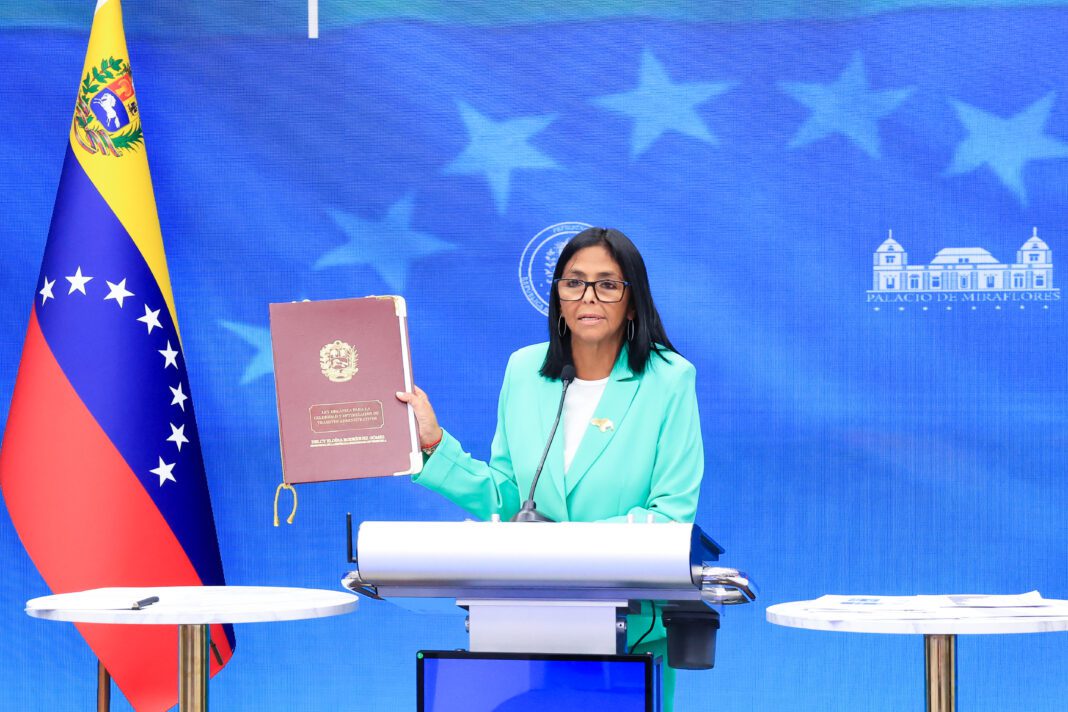
Delcy Rodríguez, acting president of Venezuela, together with the Law on the Simplification of Administrative Procedures approved by the National Assembly, announced a set of economic measures that could mark a significant shift in Venezuela’s traditionally statist economic model toward one with greater emphasis on private property. Delcy Rodriguez’s Telegram Channel
Guacamaya, April 9, 2026. In an extensive address to the nation, acting president Delcy Rodríguez outlined a roadmap for income recovery, state asset management, and foreign exchange stabilization following the capture of Nicolás Maduro in January, emphasizing what she described as a major economic shift.
A historical reference: the “Great Shift”
A key historical precedent of economic reforms with an emphasis on the private sector and an attempt to move away from Venezuela’s rentier-statist model is the so-called “Great Shift” promoted by Carlos Andrés Pérez during his second term. It sought to dismantle the rentier model through market-oriented reforms, including price liberalization, subsidy reductions, and opening to private capital amid a deep economic crisis. However, its immediate social impact triggered the outbreak of the Caracazo, leaving an ambivalent legacy. Today, although the context is different and the measures are not identical, renewed discussions around structural reforms and private sector participation inevitably evoke this historical precedent.
Salary increase and fiscal sustainability
Rodríguez announced that a new wage increase will take effect on May 1. While she did not specify the exact amount or whether it will apply to the minimum wage—frozen since March 2022—or to broader income schemes, she stressed that the measure will be guided by fiscal responsibility.
“I announce that on May 1 we will implement a responsible increase. As Venezuela gains more resources to ensure the sustainability of wage improvements, we will continue moving in that direction.”
She also warned against repeating past policies that fueled inflation:
“What we cannot repeat is the mistake we made in the past. There can be no increase in workers’ income without sources of financing.”
Labor dialogue and mobilization against sanctions
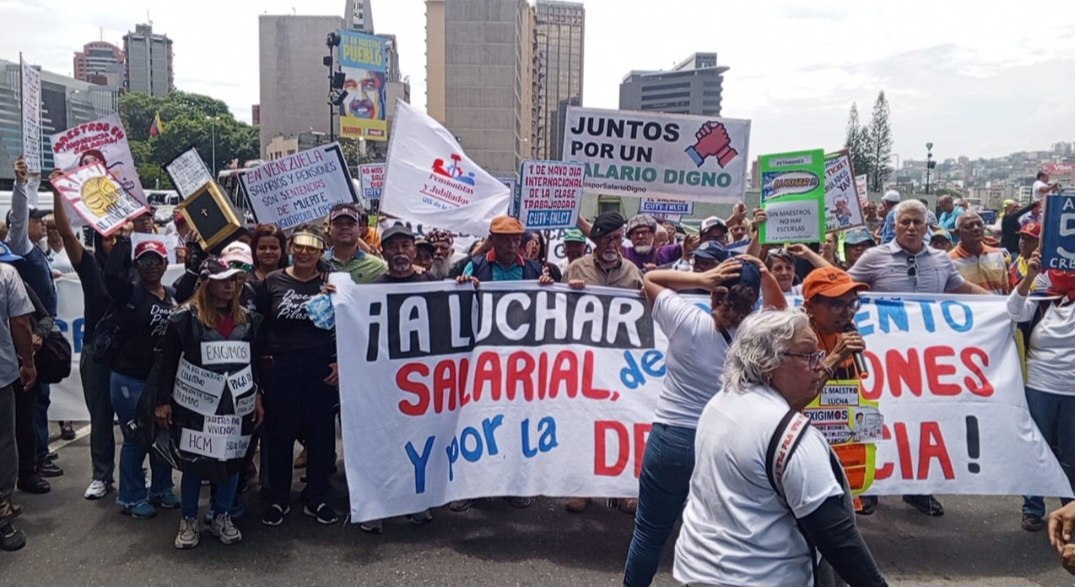
In response to recent labor protests, Rodríguez announced the creation of a Labor Dialogue Commission, which will include representatives from the state, private sector, active workers, and pensioners.
She also called for a nationwide mobilization from April 19 to May 1, culminating in Caracas, to demand the lifting of international sanctions:
“All economic, political, and social sectors must unite our voices in one call: an end to the economic blockade against Venezuela, an end to sanctions.”
Allocation of resources and new institutional framework
These announcements come three months after the January 3 U.S. military operation that resulted in the capture of Nicolás Maduro and Cilia Flores, after which Rodríguez assumed power.
She stated that recovered external assets will be directed toward:
- Basic infrastructure (electricity, water, roads, schools, hospitals)
- Productive investment in hydrocarbons and mining
- Wage and pension improvements
“The recovery of blocked assets belonging to the Venezuelan people will be used to rehabilitate our basic infrastructure (…) and productive investment to guarantee sufficient income for better pensions and wages.”
Rodríguez also emphasized the need for institutional modernization:
“We must build a new state: digital, transparent, modern, efficient, and professional. I call on young people to join this effort, and I invite those who migrated to return.”
State asset management and hydrocarbons
One of the most significant measures is the creation of a commission to determine which state assets are strategic. This body, composed of government, private sector, and “popular power” representatives, could open the door to transferring non-strategic assets to private investors.
However, Rodríguez firmly excluded the oil sector:
“Those who seek to transfer this sector to foreign powers are mistaken and will face a people determined to defend their strategic resources.”
Tax reform and simplification of procedures
Rodríguez announced the creation of a National Economic Council to design a new tax system:
“I hope this Council will produce a new tax model agreed upon by all economic sectors.”
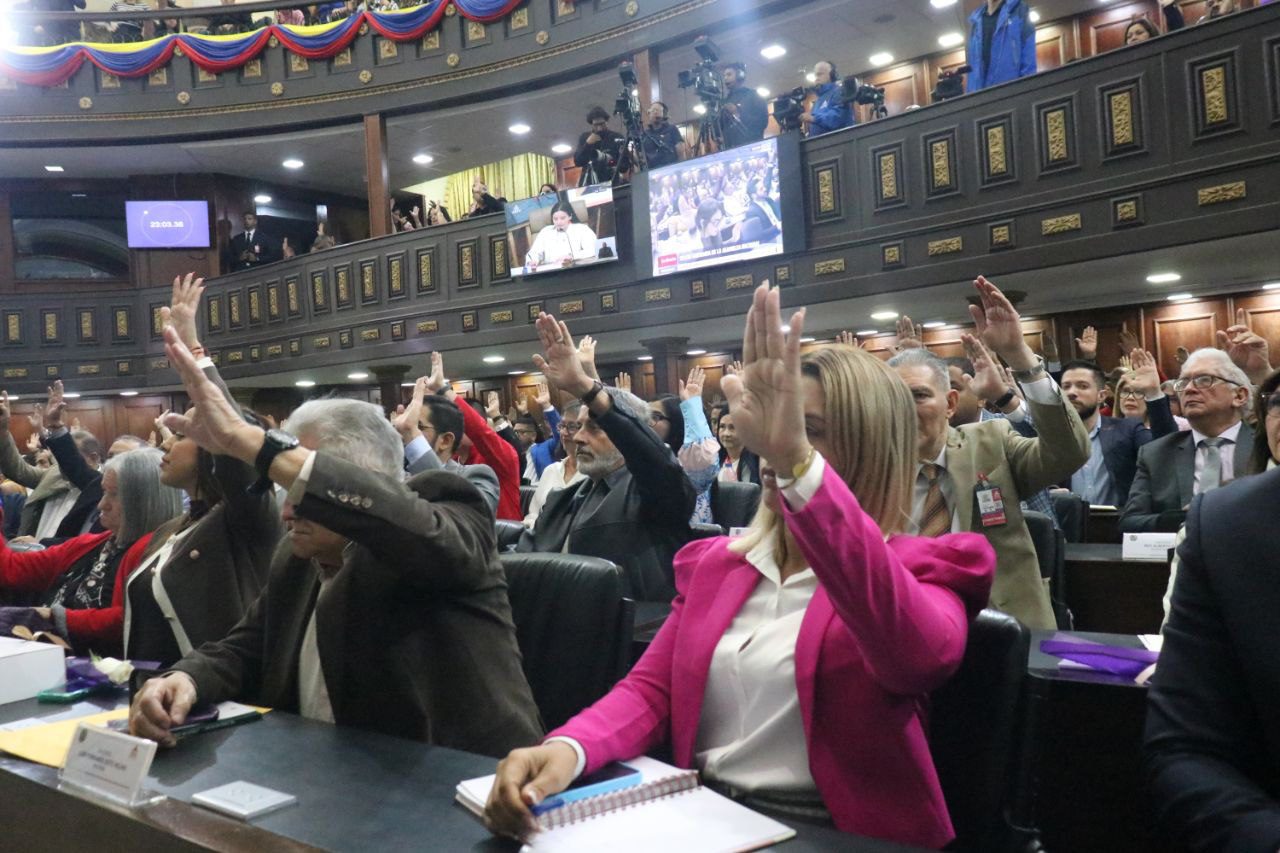
She also enacted the Law on the Simplification of Administrative Procedures, aimed at reducing bureaucratic barriers and facilitating economic activity.
Housing market reform and skills registry
To address the housing deficit and the impact of migration, Rodríguez proposed a legal reform to bring approximately 500,000 vacant homes back into the market:
“I ask that these homes be made available (…) so young people and families can access adequate housing.”
Additionally, she announced a national registry of skills and professions for youth, pensioners, and migrants to support state professionalization and workforce allocation.
Economic recovery and income figures
Rodríguez stated that Venezuela has experienced five consecutive years of economic recovery, presenting a timeline of minimum income:
- October 2021: $30/month
- May 2023: $45/month
- January 2024: $104/month
- May 2025: $161/month
- March 2026: $190/month
She also highlighted non-monetary income (subsidies for utilities, fuel, and food programs), estimated at $189 monthly.
Despite improvements, she acknowledged structural limitations:
“The GDP in 2025 represents only 36% of what it was in 2012.”
Currency intervention and bolívar stabilization
According to Bloomberg, the government has intensified foreign exchange interventions to stabilize the bolívar. Since March 31, authorities have sold approximately $330 million to the private sector.
The latest intervention occurred at an average rate of 660.5 bolívares per euro—over 100 bolívares above the official reference rate—highlighting efforts to close the gap with the parallel market.
This policy follows an unstable start to the year marked by irregular dollar auctions and renewed depreciation pressures.
What does all this mean?
The set of measures announced by Delcy Rodríguez suggests a significant shift in Venezuela’s economic governance toward a more pragmatic model following the January 2026 political transition.
Her emphasis on “sustainability” and “real financing sources” signals a break from past wage policies financed by monetary expansion, which contributed to hyperinflation. This reflects a move toward fiscal orthodoxy, tying social welfare directly to extractive sector performance and revenue generation.
The creation of a commission to classify state assets may lead to a broad transfer of non-strategic properties to private actors, aiming to reduce fiscal burdens and attract investment. However, the firm protection of the hydrocarbons sector underscores the state’s intention to retain control over its primary revenue source.
The proposed housing reform could both alleviate the housing crisis and reactivate a stagnant real estate sector, though its success will depend on legal guarantees for property rights—an area historically marked by uncertainty.
Meanwhile, heavy currency intervention reflects a costly but necessary effort to contain inflation, dependent on sustained foreign currency inflows. The gap between official and intervention rates suggests ongoing devaluation pressures.
Finally, the government’s call for lifting sanctions and mobilizing public support links economic recovery to external constraints, while efforts to project institutional modernization aim to signal a new phase of governance.
Ultimately, the success of this “new model” will depend on whether these measures evolve into deep structural reforms or remain short-term responses to Venezuela’s ongoing political and economic transition.