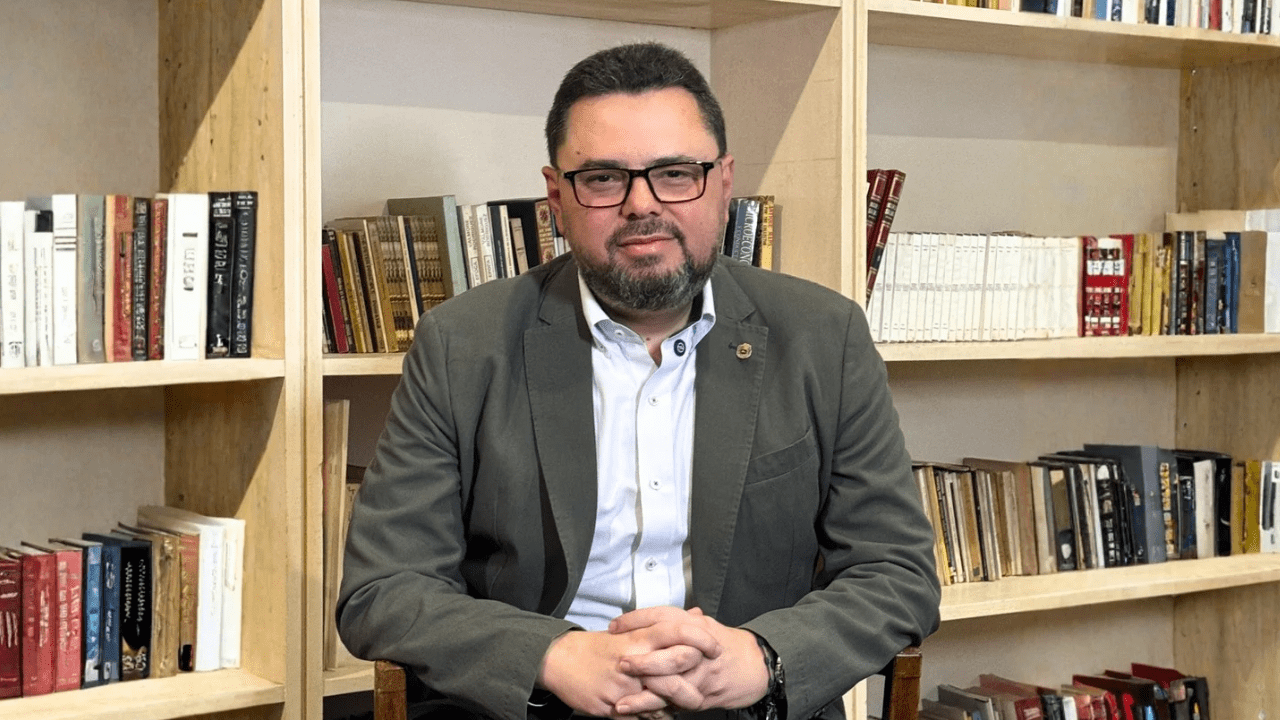
Antonio Ecarri Angola, leader of the Alianza del Lápiz, in the library of the Fundación Casa Arturo Uslar Pietri. Photo: Guacamaya.
Guacamaya, March 30, 2026. Antonio Ecarri is once again on the front lines of Venezuelan politics, now in the National Assembly. From the Libertad Parliamentary Fraction, he has been involved in debates to reform the hydrocarbons and mining laws, as well as on the follow-up commission for the Amnesty Law for Democratic Coexistence, approved on February 19.
He is the sole deputy from his party, Alianza del Lápiz. The 2025 legislative elections were marked by low turnout and irregularities, leading to the government winning 90% of the seats. According to the President of the National Assembly, Jorge Rodríguez, Ecarri won his seat “by a hair’s breadth.”
That parliament, elected with low expectations from a large part of the population, took on an unexpected new historic role after January 3. It was tasked with discussing and approving a long list of political and economic reforms, as well as electing key officials like the Attorney General. Despite the minority presence of opposition parties, compromises have been reached among parliamentary forces, as the interim government seeks to project an image of consensus.
According to data later obtained by Guacamaya, the amnesty commission is handling 11,600 cases and has already benefited more than 300 prisoners and nearly 8,000 people with precautionary measures. And as Ecarri tells us, the survival of this new institution cannot be taken for granted.
In this interview, we spoke with Deputy Ecarri about his vision for Venezuela’s new historical phase, the ongoing reforms, the follow-up commission for the Amnesty Law, and his opinion on various political figures in the country.
Question: I want to start with a question that is more of an opportunity for you to give your vision of this new political moment. How can we understand it, and what is your opinion on this moment that began on January 3rd of this year?
Answer: I want to begin by paying homage to the owner of this house, Arturo Uslar Pietri, who said that Venezuela is oil, and everything else is a subordinate matter. And evidently, Venezuelan society—the society that arrived in 1998, the society that arrives on January 3, 2026—is a society derived from oil. It is dependent on oil, a society where all its movements, customs, and culture revolve around oil.
January 3rd is not as important as the consequences of January 3rd. That is, when you start talking, for example, about the reform of the Hydrocarbons Law, it touches a very important nerve in Venezuelan history and, of course, that will generate incredible changes within the country.
However, this law arrives 27 years late. That is, Venezuela today should have oil production levels close to 7, 8, 9 million barrels per day to maintain what we once had before the statization of the oil industry, which was a grave error and led to all the political disaster we experienced. Because Venezuela was a society that was condemned, Elías, to live under dictatorship.
Venezuela was condemned to live under statization because it was designed for that. That is, the nationalization and everything that came with the statization of the oil industry, the statization of basic industries, the statization of the Central Bank of Venezuela led to a society entirely dependent on the state to live, not a state that depends on society to live.
When you have a country like Spain, like Colombia, like the United States, like Denmark, like Sweden, or like any other country on Earth, where governments depend on society to live, there is democracy. Instead, we did everything humanly possible to change that. To make it not that way. So, of course, the consequence was 27 years of backwardness.
But these 27 years of backwardness now come with a new political era that is accompanied by the worst sovereignty crisis of all time. But it is not a sovereignty crisis that comes only from the events of January 3rd, but rather as a consequence of the deterioration of the oil industry, the deterioration of the Venezuelan state, and of a society that begins to be reborn from this moment of January 3rd with these new laws we are enacting in the National Assembly. But regardless of who enacts them, there is already a consequence: in the next 50 years in Venezuela, we are going to live in a society where the private sector will evidently be stronger than the public sector, where the private sector has a primary voice that it hasn’t had in 50 years and is now beginning to have. That is a new factor, a new consequence of what January 3rd represents.
“We clearly see that there is an immobilist sector of Venezuelan society that believes January 3rd didn’t happen, and there is an opening-up sector of Venezuelan society.”
Q: I want to ask a question about the opposition in Venezuela today, because before, for example, the United States talked a lot about supporting democracy, sending aid to political parties or civil society organizations through USAID, NED. But now we have January 3rd: the United States, with a military action, takes Nicolás Maduro away and orders guidelines for a process, that there will be stabilization and then, after some time, elections and all that. So, what role can and should the opposition play in Venezuela?
A: We need to rethink ourselves completely. The opposition, as it has been for all these years, has been an immense failure. So, evidently, we must rebuild a viable opposition, loyal to the Constitution, but an opposition that has its own independent criteria, an opposition that adapts to the new Venezuela that begins on January 3rd.
And just as the Government has to adapt and the PSUV has to adapt, we clearly see that there is an immobilist sector of Venezuelan society that believes January 3rd didn’t happen, and there is an opening-up sector of Venezuelan society. That is, we must go towards a process of very serious political and economic opening. That’s where we coincide, and it’s the most important thing: both international interests and the interests of the United States align with many actors in Venezuelan opening-up regarding, for example, legal security.
There will be no stability for oil and mining investments in Venezuela if there is no legal security here, if there is no thorough reform of the Attorney General’s Office, which has been practically a criminal group. Half of the Attorney General’s Office is in prison, and they are looking for the other half. I mean, the truth is that Venezuelan institutions are a disaster, a product of the deterioration of the state.
So, you have an Attorney General’s Office that doesn’t prosecute, and an Ombudsman’s Office that doesn’t defend. Those are two of the most important institutions of the Citizen Power branch. But then you have the Judicial Branch. So, these are issues that are a priority for us for democracy, but they also have to be a priority for oil companies and investors. Why? Because without legal security, it’s not worth it.
We may have privileged resources, we may be on this same trade route, we may be in the same Western Hemisphere, but if we don’t reintegrate Venezuela into the Western Hemisphere, it won’t be possible; those businesses won’t be viable. So, where does that foreign capital coincide? Where do President Trump’s interests coincide with ours, with the opposition? Well, that there must be legal security, that there cannot be that monopoly on power that has existed for the last 27 years, and that reforms must take place.
I believe that democracy benefits industries. And democracy is a factor of stability for investment, not a danger for investment. Furthermore, the monopoly or the erosion of democracy can be kryptonite for investments. Why? Because the only way to guarantee a thorough reform of the Judicial Branch, the Attorney General’s Office, and the instruments of legal security for investments is definitively through democracy and through political plurality, which is part of this Latin American and Western model.
“PDVSA collapsed, PDVSA was assaulted, PDVSA was robbed, and PDVSA was left in absolute deterioration.”
Q: But returning to the question, what does the opposition do? For example, you are a deputy. What is it that you have to do at this moment?
A: Well, building consensus—that’s the most important thing. Being that voice. You can’t imagine the hard struggle we have given in, for example, the Amnesty Law. What does the Amnesty Law, the Hydrocarbons Law, and the Mining Law we are discussing have to do with the selection of the Attorney General and the Ombudsman? What do these four elements have to do with what we are working on right now? Everything. Everything is interconnected.
In the Hydrocarbons Law, we were there precisely to achieve greater transparency in the use of the resources that will come from the oil sector. Of course, I agreed with opening up the oil industry. In this house, we have been saying for years that the oil industry had to be opened up, because the truth is that this PDVSA can’t even change a light bulb. That is, PDVSA collapsed, PDVSA was assaulted, PDVSA was robbed, and PDVSA was left in absolute deterioration.
Now, are we going to close PDVSA? No. We can make it a great company again, like Aramco, like Petrobras, like Pemex. Those are great companies. That doesn’t mean it has a monopoly on national oil, but rather that it is the great coordinator of the oil industry.
There we were, proposing the issue of a National Hydrocarbons Agency. Because what is my criticism of the Hydrocarbons Law? What does it carry over? The excessive discretion of the ministry. That is, we can start with this new Hydrocarbons Law, but along the way, we are going to have to reform it. And we will have to reform it for what? To provide greater security to transnational companies and investment, because Venezuela needs private investment. We need oil investment, and there we will all converge.
But January 3rd just happened 60 days ago, so obviously this is a process that is moving very quickly. We were very slow for 27 years, but we have had two very fast months. I believe the progress has been very positive.
Then with the Mining Law, it’s the same: the excessive discretion of the state. There is the opposition, asking for what? That we return to statization? No, Elías. Because just because Chavismo corrected itself, are we now going to switch sides? That doesn’t exist. Rather, welcome to the opening, welcome to the fact that they finally understood that markets had to be opened. How wonderful that they understood. How wonderful that they saw the light.
But the truth is they still lack transparency and they still lack control. Chavismo doesn’t understand either of these two things. Regarding transparency, there’s a portal, and it was the commitment made by the President of the National Assembly and the acting president, made with us from the Libertad Fraction. There must be a single portal where Venezuelans know how much is coming in and where it’s going.
That is the thesis of open government, now with technology. But that also benefits Chevron. And it benefits any investor coming from the United States over here. That is, government transparency and transparency in public affairs. And the other thing is that excessive discretion. You cannot have such wide ranges for setting a tax.
Obviously, we are 12 deputies, but that need for consensus, amidst the weakness of the Republic, makes our role as an opposition a much stronger role, a role of building consensus. It’s not about opposing just for the sake of opposing, but a central role of agreements, of consensus, while presenting our arguments very clearly. Because our argument is to bring everything to transparency, to accountability, so that Venezuelans can for the first time have true institutions. Because that benefits everyone from Chevron to a retired teacher in Valle de la Pascua.
“Through granting amnesty, we have also been able to detect all the problems of legal insecurity.”
Q: Now I wanted to talk about the Amnesty Law. What has been your objective in the Libertad coalition, which Lápiz is part of? And what progress is being made, and where have you seen problems where objectives have not been achieved?
A: Look, the Amnesty Law is a great triumph. And a great triumph of the courage of consensus, of listening to each other, of the role played by the President of the Amnesty Commission, Jorge Arreaza. We have achieved freedoms. We have achieved, first, the cessation of repression. Second, a real amnesty process, because now everyone is carrying out political acts without any fear or repression. That’s the truth. That is happening in Venezuela today. No one imagined that would happen in December or November.
Also, the Amnesty Commission is a historic event, because it’s the first time there is a commission from the parliament itself that will monitor compliance with the law.
There’s one thing I love about the Amnesty Law, which is Article 2, concerning the purposes of the law. One purpose is to reintegrate all Venezuelans into public life, into political life, so there are no exclusions. That is one of the objectives of the law. And Article 15, which creates the commission, is the one overseeing that.
Now, what have we encountered? Well, a collapsed Public Ministry that didn’t prosecute, violations of due process, an immensely corrupt Judicial Branch—that is, a deterioration of the Rule of Law.
Now, what does this Amnesty Law even have to do with the Hydrocarbons Law? What the Amnesty Commission is ultimately achieving is the return of legal security and the Rule of Law. That is, through granting amnesty, we have also been able to detect all the problems of legal insecurity.
There is a very evident case, the case of the Ferreira family and Venezolana de Uniformes. It was a building taken over by a state security agency. They took the owner and the person who managed social media. Not only were they taken prisoner, but that security agency set up a store with practically the same name to sell the uniforms themselves.
But well, who controls that? So, it’s evident there is a very serious problem with the Judicial Branch, a problem with the Attorney General’s Office. That is, we must seek a thorough reform of the Judicial Branch, and that is one of the great objectives this law should have. What are we doing? Well, working from the individual to the collective.
Our citizen service sessions have gathered more than 250 cases, and more are added each day. What are we doing? Well, we are grouping these cases, not only to find an individual solution but also to see the collective effect on the Judicial Branch, on legal security, on the country’s Rule of Law. Why? Because what happened to Mr. Ferreira could happen to an American, a Portuguese, a Spaniard, anyone who comes to invest here. So, what do I want? For us to clean that up, because it will also benefit transnational companies, investment, and legal security.
But the great challenge we have today is to end fear in Venezuela, and that means the Rule of Law returns. This means we must carry out a profound reform of the Judicial Branch, which I believe is the great challenge for this National Assembly before there are elections.
Q: I’d like to ask more about this reform of the Judicial Branch, because clearly, what we are seeing there and in the state security forces is that they are the ones committing illegal acts. So the problem isn’t necessarily that a law needs to be changed. What needs to be reformed in that case?
A: There are two things that need to be done: First, there is an intervention within the Judicial Branch that must take place. I believe there is a national consensus around reviewing the Judicial Branch. I think there are also judges who are very serious people, who might be willing to start this reform process. Also, initially, the resignation of the Attorney General and the appointment of new prosecutors, a new ombudsman. There are great opportunities there to start this process. We would need to involve the national universities, the law faculties, the country’s law schools in this judicial reform process. I think that is very important.
And, of course, the repeal of the Torquemada laws. I mean, the Robespierre laws of “let’s cut off the head of the first one who thinks.” That Hate Law is barbaric. That Asset Forfeiture Law that allowed officials to do whatever they wanted. No, that can no longer happen in Venezuela. Obviously, I am against hate, but you cannot solve hate with more hate.
I believe Venezuela is faced with a great task of national reconciliation, but there must be justice. There were people tortured here, there were people held in prisons for a long time without judicial proceedings.
How does everything I’m telling you about the Rule of Law and legal security impact all that? In everything, because if you are not capable of respecting the human rights of a Venezuelan, how are you going to respect those of a foreigner, of someone who comes to invest?
So, all of this is connected, one thing to another. That is, either this is a great virtuous circle, where we all initiate a great change and push for a great change together, or it’s a vicious circle, where one covers for another, covers for another, and what we will have is an immense collapse, and we could reach an even worse situation.
So, today we are facing a great historical crossroads after January 3rd. Where we either initiate a process of opening, of building consensus, of courageous consensus—because reaching consensus doesn’t mean I surrender to you, nor do you capitulate to me. No, no, no, it means we both work hand in hand for the greater good of the country.
That reform of the Judicial Branch, depoliticizing the Public Ministry, making institutions function—that is saving the Republic and is the only way to truly recover national sovereignty.
What did Jesse Chacón have on February 4th when he stormed Channel 8? Did he have a toy or did he arrive with a peace pipe? No, he had a rifle. And civilians died.
Q: Since you are on the amnesty follow-up commission, could you tell us about some cases? Cases that have been resolved, and some case that hasn’t been able to be resolved through this commission.
A: I can tell you that there are many cases that have been resolved. The truth is that when you have a commission that receives more than 1,000 requests, well, that gives the commission enormous legitimacy. Of course, you see that there was a disaster in Venezuela, because if there are 12,000 amnesty requests, just imagine. And of those, more than 7,000 benefits have been granted, among people who were deprived of liberty and people who had some type of measure. Furthermore, the commission is now starting a new phase.
That new phase began yesterday [March 24], and it involves the recommendations the commission will make. That is, direct recommendations to the Judicial Branch and the Public Ministry in certain cases that are very complicated, because we have moved beyond, if you will, the simpler cases. Now come more complicated cases that require a lot of political courage.
Look, Elías, yesterday I mentioned two very important events in our history to the commission. There were guerrillas here, guerrilla commanders who, by the way, came to this house because Dr. Uslar was also a mediator in that Venezuelan guerrilla process in the 60s, who killed police officers. There was a civil war here in Venezuela, in the 60s, where there were kidnappings, there was everything.
There was the case of Iribarren Borges, which was a terrible case where a great Venezuelan was tortured, and it was the guerrilla. There were attacks like the one on the “Tren del Encanto,” but President Rafael Caldera had the vision, in his first government, to initiate a pacification process.
And when you are pacifying, you are forgiving. You are forgiving difficult, complicated things. But no one from Chavismo is going to come to me now and say, “Oh, but a girl or a woman can’t be released because supposedly she had a C4 in her purse.” Well, what did Jesse Chacón have on February 4th when he stormed Channel 8? Did he have a toy or did he arrive with a peace pipe? No, he had a rifle. And civilians died. So, faced with that, faced with that difficult circumstance, there was a political will on the part of democracy to forgive, because that’s what amnesty is about.
Besides a number of cases that were fabricated, Elías. Why? Because that deterioration of institutions led to cases being fabricated, and there are charges where you say, “No, it’s about drugs.” Drugs? No, they planted the drugs on him. But you have to determine if the drugs were indeed planted or not, because there are other cases where the drugs weren’t planted.
So, where is the most difficult work of the Amnesty Commission now? It’s there. Now, what is our pressure? That reforms happen. Again, I return to the same thing. Reform the Judicial Branch, the Public Ministry, the Ombudsman’s Office itself. For what? So we can thoroughly review all these cases. We, in the national deputation of El Lápiz—and I am very proud of the work done by our entire team, including volunteers—are starting to work case by case. We already have more than 200. I tell them, they aren’t cases; they are stories.
We have more than 240 stories. Each story is different. Very emblematic cases that we still have to resolve, like the Plaza Venezuela case, the Catatumbo case, and so many things they also invented to justify others from a political point of view. But well, there we will see the courage of consensus.
There are rectifications that need to be made, and now is when the work remains for the Amnesty Commission. But I agree that it is the most important commission for the next 10 years in Venezuela. That the parliament, from its legitimacy, from its plurality, can place all the eyes of the world on the Judicial Branch.
“The Amnesty Commission has become an element for dismantling fear in Venezuela.”
Q: I wanted to hear an emblematic case that you have heard, as you say, stories, in these sessions of the follow-up commission. So people can get an idea of what is happening.
A: Well, for example, I have a case very similar to the one I told you about Venezolana de Uniformes, or Universal de Uniformes. There’s the case of a resident of Vista Alegre who had a pharmacy. And the local police fell in love with the pharmacy. So they arrested him, fabricated a bunch of things against him, just to get their hands on his truck and motorcycle. He wasn’t a politician at all. This highlights the problems we have had in the Judicial Branch. But well, there are also cases we still have to resolve.
We achieved the freedom of Javier Tarazona, who for me is a very important leader from Táchira, and a leader of teachers throughout the country. That affects me directly, and I fought hard for Javier Tarazona’s freedom. They denied him amnesty. He has some protective measures, but they deny him amnesty. These are things we still have to review.
There are cases that have turned out very satisfactorily, the case of Meudys Reyes, for example, who was a candidate for councilwoman in Chacao for El Lápiz, and was imprisoned in El Valle unnecessarily. The case of our leader Jerry over there in Palo Negro, in Maracay, who was imprisoned because he was the coordinator of our community kitchens. He was also from El Lápiz, and was imprisoned in Tocorón. And we managed to get amnesty and got him out.
There are a number of blatant cases of immense injustice, where justice has been done, people have been released, and well, you see that the Amnesty Commission has an immediate effect and also a mediate effect. The immediate effect: we achieved a number of releases, including important politicians who are now free, like Juan Pablo Guanipa, like Enrique Márquez. Like many other Venezuelans who were the subject of the amnesty we worked on, we fought for, we discussed, we managed to get Article 15 approved with this commission. But it also has a mediate effect, a secondary effect, a “fear-removing” effect.
That is, the Amnesty Commission has become an element for dismantling fear in Venezuela. That is, for political coexistence to arrive. Because the law also has a very beautiful name, which is the “Law for Amnesty and Democratic Coexistence.” So, the Amnesty Commission is not only overseeing amnesty; it is promoting democratic coexistence.
So, there you see again that there are political acts in Venezuela, parties are meeting, an opening process is beginning that is still very timid. Yes. But only 60 days have passed. The amnesty in Spain took 2 years for Adolfo Suárez to carry out.
“And there are others, from the opposition, who accuse us of being illegitimate, accuse us of all sorts of things, but then they call on the phone to see how they can benefit from the Amnesty Commission.”
Q: And have you seen that this commission has been at risk at any point?
A: Yes, of course, obviously, always. The immobilists are after it. There has been sabotage against the Law and against the Amnesty Commission. There is even a campaign, and here the poles coincide—the opposition immobilists and the government immobilists—who are waging a war against the Amnesty Commission.
There are some government immobilists who don’t want anything to happen, who act like nothing has happened at all, that there have been no violations of due process, they are like blind.
And there are others, from the opposition, who accuse us of being illegitimate, accuse us of all sorts of things, but then they call on the phone to see how they can benefit from the Amnesty Commission. That makes me a little angry sometimes, but it’s my job, period. That is, I process it with all the pleasure in the world.
I saw an opposition leader, whom I prefer not to name, say that we were donated deputies. Then my phone rings, through one of my most trusted people, and it was that same person interested in amnesty. So, how does that incoherence work? But it doesn’t matter, that’s what we are here for. We are here for national reconciliation, even if there are people who want to play a double game and have a double face. But we have to understand each other. Period.
“Every cent that enters Venezuela, the Venezuelan has to know where it’s going. Clear accounts preserve friendships.”
Q: Now I wanted to move on to the economic topic. Delcy Rodríguez is announcing that investments are coming in hydrocarbons, mining, everything. They are talking about, thanks to the Iran war, oil rising to nearly 100 dollars per barrel, it has even exceeded it several days. So, clearly, there is an idea that money is entering the country. Now, there is an opening, but it’s not being noticed in people’s pockets. People are asking why salaries aren’t rising. So, do you think these economic expectations being generated can be met? Because it’s true we haven’t had much time. Or do you think we will end up seeing tension, a conflict over this supposed money that is or isn’t entering the country?
A: Look, there is a central element in our political thesis of El Lápiz, which is the dignity of the human being. And when you work for the dignity of the human being, you have to tone down political colors and differences. Venezuelans have already suffered too much, we have suffered immensely.
The separations, the crisis, the collapse of the oil industry, the bankruptcy of the Venezuelan state—there was a state bankruptcy. Now, this opening process has been going on for 90 days, 60 days, no more, not much against 27 years of disaster. Now, we must understand that it’s going to be a complicated process. All these processes are always very complicated, very complex. Now, what do they require?
One, what is the task of Delcy Rodríguez’s government today? Not only to promote, as it is doing, investments. And we in the opposition also have to promote investments. I have met with any number of investors promoting investments in Venezuela. Of course, I want transparent, healthy investments. For them to come to the country, to end the mafias, for it to be a private company instead, to be able to recover that rust belt we have in the center of the country, where there are thousands of poor people, whom I also have to prepare so they can return to industry again. I need to recover the industrial zone in the center of the country. We have to recover Guayana. There are many things to recover.
And that requires a consensus, so we all work for the Venezuelan and not for someone’s failure, because that is selfishness now. That’s why I wanted to start with the word dignity. But there is one thing that the president must make very clear, which is transparency. Because every cent that enters Venezuela, the Venezuelan has to know where it’s going. Clear accounts preserve friendships.
It’s true, there may be expectations, because President Trump is talking about millions he is going to give to Venezuela, but I want to know when he will pay those millions, when they come in, what will happen with those millions. And for that, there must be a single portal. We proposed it in the law, where Venezuelans know what comes in and where the money is spent.
That is, money here is key in this. Transparency is key for democratic stability. If there is transparency and the country knows what is coming in and where it is going, that is the best way for the Government to stabilize. That’s the only way. They first thought about the Bank of Qatar, and the transfer couldn’t be done. Now it’s being done through the United States Treasury to avoid embargoes, because we are also embargoed. That is, they have many actions, many bureaucratic procedures to navigate, we know that. But it is also time to account for things to the country. Because there has been a lot of theft, a lot of corruption, and a lot of darkness.
Q: I want to mention some names to you, and you can respond with one word. I’ll start with María Corina Machado.
A: A leader.
Q: Delcy Rodríguez.
A: A crossroads.
Q: Tarek William Saab.
A: Bad news.
Q: Actually, I wanted to ask you about him. Most people don’t know that you contested the election of July 28, 2024, and that as a result, there was an episode with Tarek William Saab.
A: Well, yes, indeed, July 28th was a very complicated day. I was a presidential candidate. I was not the beneficiary of the votes, obviously. Later, I had to go to the Supreme Court of Justice when I was summoned. And there we filed three appeals.
The first was for them to explain what I was doing there, because I didn’t know if I was a witness or what. Because the one who had to contest the election didn’t, and the one who didn’t have to contest it did. So this ended up being a disaster. But I had to contest that disaster that was being put together, and I did it in the name of Venezuelans and in the name of my convictions. I filed a constitutional review appeal against the decisions of the Electoral Chamber. Oh, well, let’s just leave it.
Well, it turns out that in the middle of the hearing, Prosecutor Tarek William Saab began to threaten me… The same thing he did for so many years, threatening people, he tried to blackmail me, and well, a brawl ensued. Well, obviously, I got upset, I got very upset. We ended up in a very serious conflict that bordered on personal; that is, it could have ended in blows.
I couldn’t stand the indignation of the prosecutor’s rude words, when being one of the co-drafters—because I was one of the co-drafters of the Organic Law of Citizen Power—I know the importance of the Public Ministry. So, the one who is supposed to ensure human rights during a trial for constitutional reasons, is going to come and violate them? No, you’re wrong.
Obviously, he stepped outside his functions. There was an abuse of power that day, and of course, I very nearly ended up in prison.
Q: I have two more names: Stalin González.
A: A great political operator.
Q: And Jorge Rodríguez.
A: Jorge Rodríguez is another great political operator. I believe they both have a very important function in parliament, trying to build consensus.