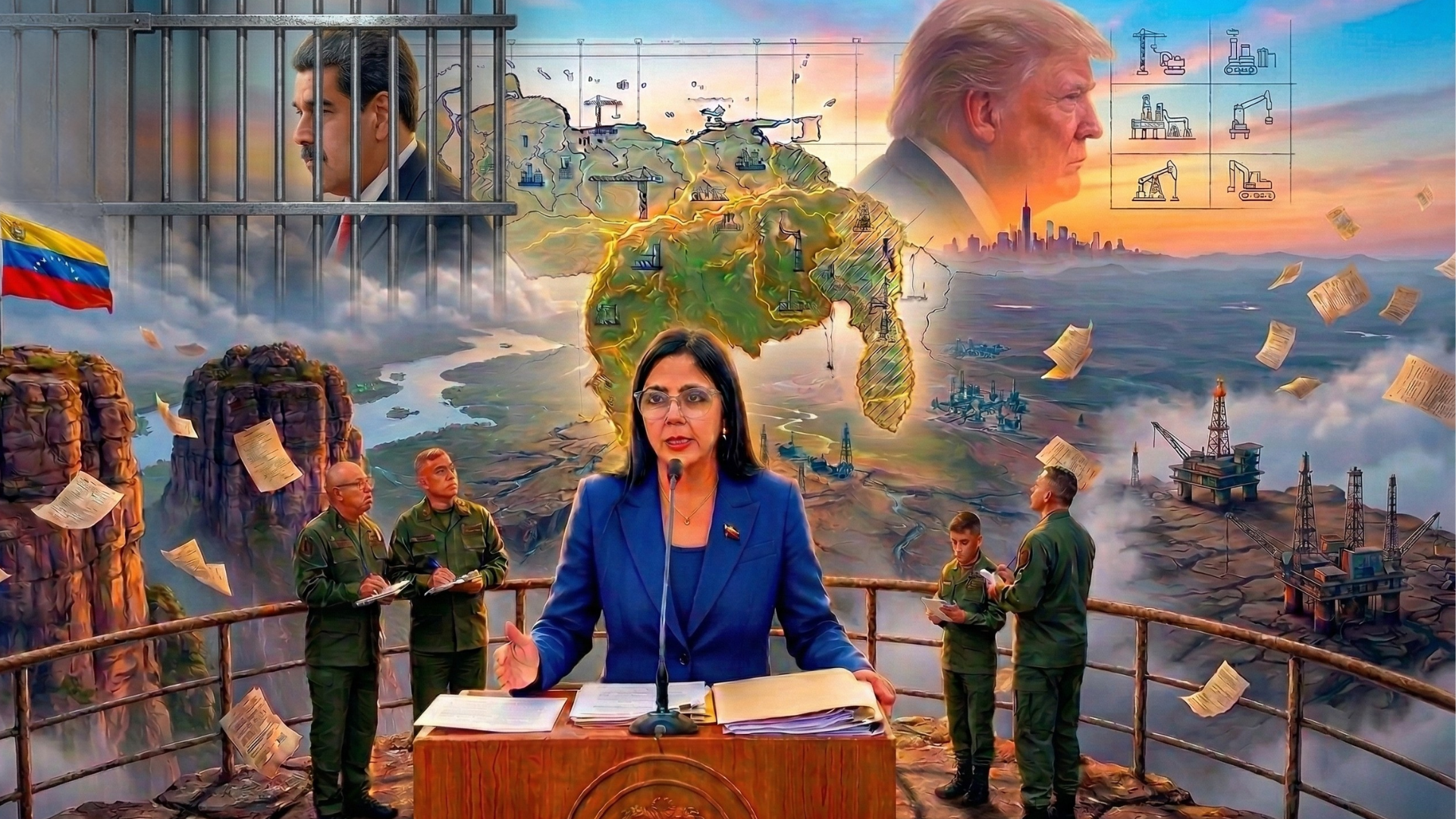
The new appointments could seek to keep military factors at bay, improve the provision of services, and organize the labor and social front. Image: Guacamaya.
Guacamaya, March 18, 2026. Interim President Delcy Rodríguez has once again moved the power board. This March 18, she announced up to six changes in the cabinet, among which a new appointment to the Ministry of Defense stood out. In parallel, changes in Public Works and Services, Electric Energy, Labor, Transportation, and Culture complete the round of adjustments that reconfigure the Executive Branch.
In general terms, a greater presence of actors close to Delcy and Jorge Rodríguez is noted, while technocrats have increased their proportion in the cabinet since her hasty swearing-in on January 5.
The most forceful appointment comes, of course, at the Ministry of Defense, now headed by G/J Gustavo González López, replacing G/J Vladimir Padrino López, who had held the position uninterrupted since October 2014. Padrino’s departure closes a cycle of almost 12 years as head of Defense, the longest in recent Venezuelan history.
Defense in the hands of González López: A new era
González López is one of the FANB officers closest to Delcy Rodríguez. Holding the rank of general-in-chief, he has extensive experience in State security agencies. He has been Minister of Interior, Justice, and Peace; director of Sebin on two occasions; and since January 2026, he commanded the Presidential Honor Guard and directed the Dgcim, the two most sensitive apparatuses for the protection of the central power, which will now be in new hands.
Interim president Delcy Rodríguez completed the readjustment of the power security ring with two movements that filled the vacancies left by González López. On one hand, she appointed G/D Henry Navas Rumbo as the new commander of the Presidential Honor Guard, while she designated C/N Germán Gómez Lárez as head of the General Directorate of Military Counterintelligence (Dgcim).
Both figures already come from important institutions in matters of security and sovereignty. Navas Rumbo was commander of the Special Brigade for Presidential Protection and Security (Bepap) within the Honor Guard itself. Meanwhile, Gómez Lárez served as president of the National Institute of Water Spaces (INEA) and Bolivariana de Puertos (Bolipuertos).
With these changes, Delcy keeps the new chain of command cohesive. First, with a close military officer with a background within the Honor Guard, and second, with a new director in counterintelligence with experience in tasks to neutralize internal and external threats. These movements close a circle of control over the most sensitive organs of the governmental defense apparatus.
Juan José Ramírez Ascends to Vice Presidency of Public Works and Services
The Minister of Public Works, Juan José Ramírez, was elevated to sectoral vice president of Public Works and Services, replacing Jorge Márquez in that coordination role. Under his leadership at Public Works, the project to restructure the El Helicoide detention center began, with the aim of turning it into a social, cultural, and sports center open to the public.
His functions now become articulated with housing, electricity, water, and other services under a unified sectoral command. With this move, Delcy keeps Márquez focused on Habitat and Housing, while placing a bet on Ramírez to secure an area extremely sensitive to public sentiment: transportation, electricity, water, housing, and basic services.
Jorge Márquez to Habitat and Housing
M/G Jorge Elieser Márquez Monsalve was appointed Minister for Habitat and Housing, replacing G/D Raúl Paredes. Márquez arrives in the housing sector after having been Minister of Electric Energy since April 2024 and, before that, general director of Conatel since 2017. Márquez will continue to lead the 1×10 System of Good Government and the Simón Bolívar Monumental Stadium Foundation.
He will now be tasked with “guaranteeing the right to dignified housing” and accelerating housing projects, at a time when Delcy needs to show tangible results beyond macroeconomic management. Although he maintains key responsibilities, he will no longer head the Sectoral Vice Presidency of Public Works and Services, now occupied by Juan José Ramírez.
Rolando Alcalá in Electric Energy
Replacing Jorge Elieser Márquez, Delcy appointed engineer Rolando Alcalá as the new Minister of Popular Power for Electric Energy. Alcalá is an electrical engineer graduated from the Simón Bolívar University, a specialist in electrical projects, with experience in executing infrastructure works in the national electrical system.
The political message is clear: placing a technical profile at the head of a portfolio marked by chronic failures, rationing, and strong international scrutiny, at a time when new foreign investments are being discussed to rehabilitate the National Electrical System. Delcy emphasized that Alcalá has “great national and international experience” and that he assumes the commitment to continue strengthening the electrical grid.
A Labor Magistrate to the Ministry of Labor
At the Ministry of the Social Process of Labor, Delcy appointed magistrate Carlos Alexis Castillo, from the Social Cassation Chamber of the Supreme Tribunal of Justice, replacing Eduardo Piñate. Castillo has a purely legal-labor profile, coming from the apex of the TSJ in social matters, specialized in labor conflicts and social security.
His arrival at the ministry comes amid intense debates over salary adjustments, union demands, and discussion about the real value of the minimum wage against the devaluation of the local currency. Placing a labor magistrate in this portfolio suggests that the government seeks to manage the relationship with unions, collective bargaining, and potential reforms with more technical and political care.
Transportation: Jacqueline Faría Returns to the Executive Branch
The sixth move is the departure of V/A Aníbal Coronado from the Ministry of Transportation and the appointment of engineer Jacqueline Faría as the new head. Coronado had arrived at Transportation less than two months ago, after going through Ecosocialism, and previously leaving the Office of the Presidency. He recently had to face a partial transportation strike in Greater Caracas, which weakened his political standing.
Faría was head of Government of the Capital District (2009-2014), Minister of Communication, and president of Movilnet, and until now served as a deputy to the National Assembly, president of the Permanent Commission on Ecosocialism, and even a member of the Special Commission for Monitoring the Amnesty Law. Her return to the Executive places her at the head of a portfolio key to daily life.
Raúl Cazal Enters Culture, while Villegas Prepares for the Ombudsman’s Office
In a different logic, but one that fits with the political rearrangement, Delcy Rodríguez has also appointed Raúl Cazal as the new Minister of Culture. His predecessor, Ernesto Villegas, leaves the cabinet due to his interest in running for Ombudsman, which forces him to disassociate himself from his political affiliations and responsibilities in the Executive.
Cazal arrives at the ministry from within the State’s own cultural structure. He is a journalist, and has been Vice Minister of Development for the Cultural Economy, president of the National Book Center (Cenal), in addition to being appointed director of the National Press and Official Gazette, as well as one of the visible faces of Filven and the book and reading policy in recent years.
An Executive in Constant Readjustment
These appointments confirm that Delcy Rodríguez continues to reassemble the Executive Branch with a logic of balance between political loyalty, technical expertise, containment of conflicts, and pragmatism. With the adjustments in Defense, she breaks with one of the most enduring pillars of the Maduro era, but does so by replacing him with a military officer who concentrates intelligence, counterintelligence, and presidential protection.
In the services bloc, the Márquez–Alcalá–Ramírez triad aims to show results in housing, electricity, and infrastructure. Meanwhile, the entry of Carlos Alexis Castillo in Labor and Jacqueline Faría in Transportation speaks of an Executive preparing for a cycle of greater social conflict. Specifically, they are bets to negotiate, contain, and, where possible, capitalize on those processes.
Together, these moves show a Delcy who does not administer a governmental inheritance but reconfigures it to her measure. This constant rearrangement presents itself as her main tool to sustain stability in a country where citizen patience and international margin are facts that suggest keeping under continuous supervision.