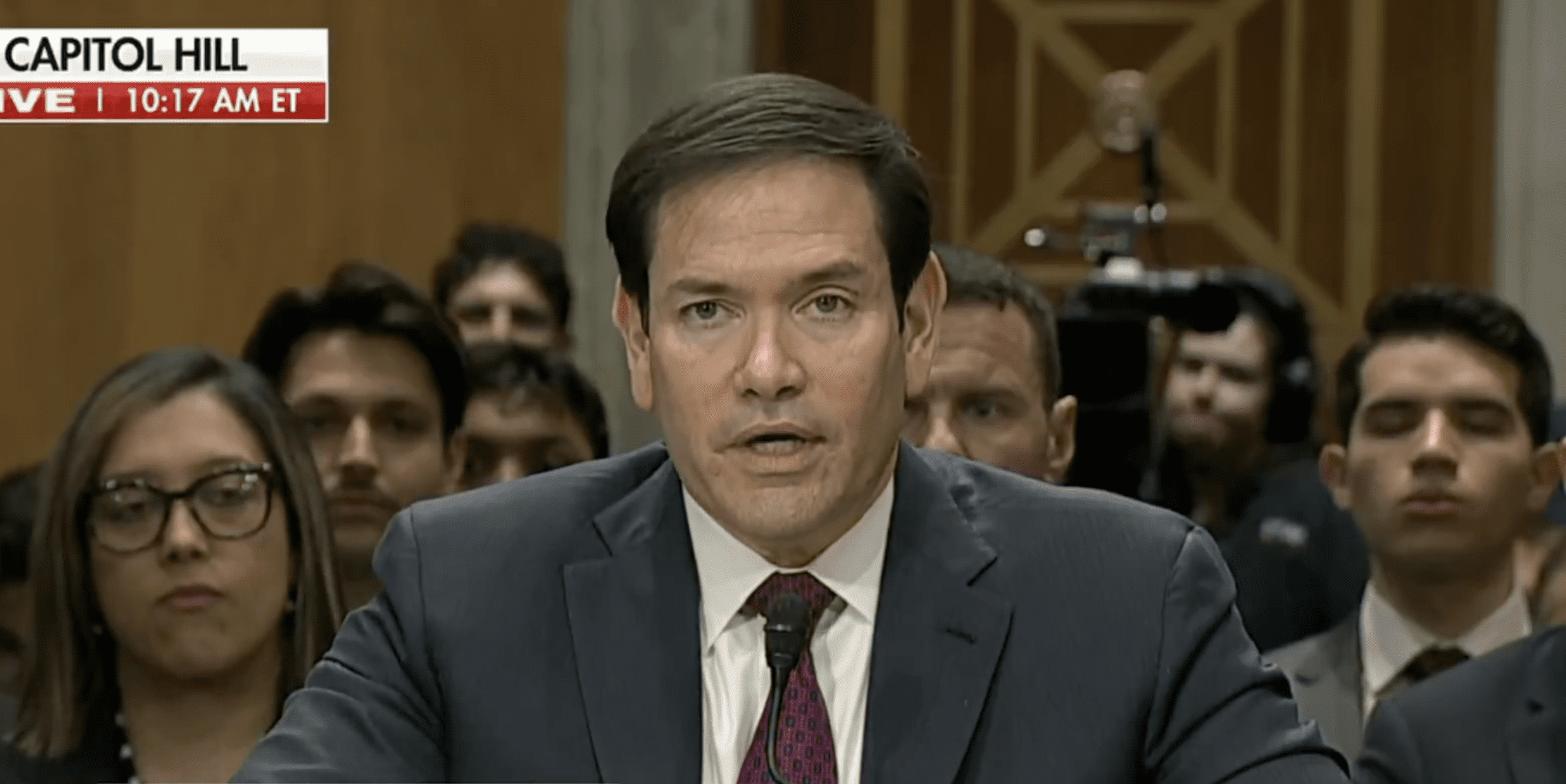
Marco Rubio, U.S. Secretary of State and National Security Advisor, during his appearance before the Senate on Wednesday. Photo: Fox News.
Guacamaya, January 28, 2026. The Secretary of State presented the January 3 operation as a “surgical” law-enforcement action, denied any military occupation, and said Washington is already working with an interim government in Caracas—amid growing scrutiny in Congress over the scope of presidential power.
Marco Rubio appeared Wednesday before the Senate Foreign Relations Committee to defend the Trump administration’s policy following the capture of Nicolás Maduro on January 3—an operation he described as a “selective law-enforcement action,” not an act of war or military intervention.
In testimony prepared for delivery and public release, Rubio insisted there is “no war against Venezuela” and no U.S. troops deployed on Venezuelan soil. He said the operation aimed to arrest “two fugitives from American justice,” Maduro and Cilia Flores, both accused of drug trafficking and now set to stand trial in the United States.
Rubio described Maduro’s regime as a “security threat” and a “massive strategic risk” to the Western Hemisphere, accusing it of turning Venezuela into a platform for U.S. adversaries such as Iran, Russia, and Cuba. In that context, he argued that Maduro was not a legitimate head of state, noting that more than 50 countries—including members of the European Union and Latin American nations—refused to recognize his reelection following the disputed 2024 elections.
The Secretary of State directly linked the Venezuelan government to the Cartel de los Soles, which he blamed for flooding the United States with drugs, looting Venezuela’s energy industry, and triggering a humanitarian crisis that forced more than eight million people to flee the country—what he called “the world’s largest migration crisis.”
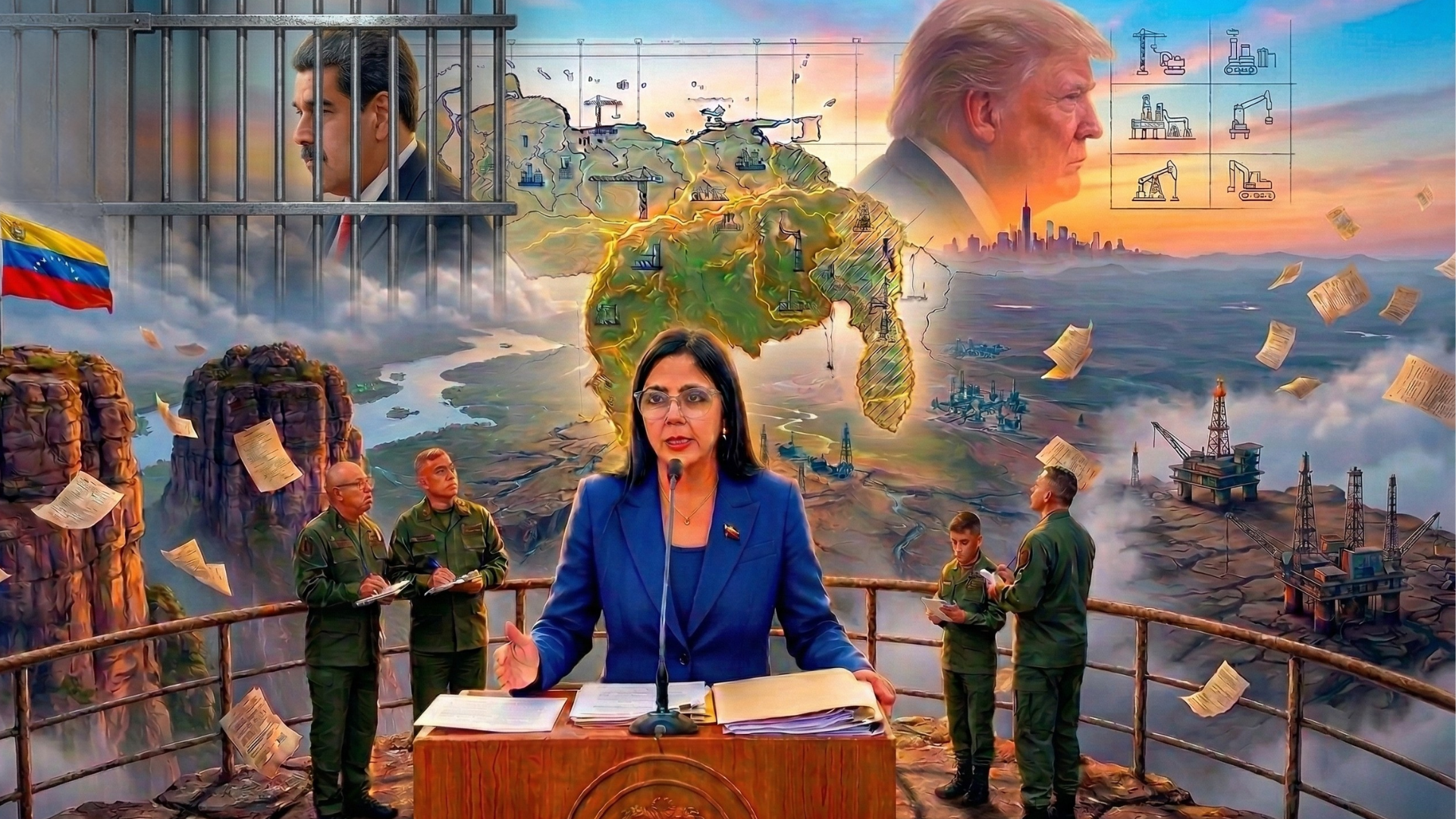
One of the most sensitive points of Rubio’s appearance concerned Washington’s relationship with the new interim leadership in Caracas. He confirmed that Delcy Rodríguez has assumed control of the transitional authorities and described the relationship as “productive and respectful,” while stressing that it remains conditional. According to Rubio, Rodríguez has committed to opening the energy sector to U.S. companies, granting preferential access to production, cutting off oil supplies to Cuba, and advancing a process of national reconciliation.
“We’re not going to make a 180-degree turn overnight, but we are making good progress. We are better off in Venezuela than we were four weeks ago,” Rubio said, making clear that the United States will closely monitor compliance with a phased stabilization plan.
At the same time, he issued an explicit warning: if the interim leadership strays from Washington’s objectives, the United States “is prepared to use force” to ensure cooperation. “We hope that won’t be necessary, but we will not shy away from our responsibility,” he said.
Rubio also emphasized that Washington is not betting on an open-ended tutelage over Caracas. “This is a transition,” he told senators, underscoring that the United States will not permanently support a political authority accused of corruption. In that context, he drew a key distinction, stating that to the administration’s knowledge Delcy Rodríguez is not under indictment—an assessment that, he suggested, leaves room for her to lead a provisional phase under strict oversight.
From there, the Secretary of State outlined a roadmap built around three broad objectives. The ultimate goal, he said, is a Venezuela that is “an ally, stable, prosperous, and democratic,” with free and fair elections in which all political sectors are represented. Rubio stressed that voting alone is insufficient if the opposition lacks real access to the media or if candidates are barred from running. At the same time, he acknowledged the limits of the short term: that outcome, he admitted, “will take time” and cannot be achieved in a matter of weeks.
On the economic front, Rubio announced that the Trump administration is willing to ease the sanctions framework to facilitate recovery. Specifically, he said the Treasury Department will grant OFAC licenses allowing U.S. companies to invest in Venezuela, particularly in strategic sectors. He also noted that legislation will be proposed in Congress to facilitate investment and help jump-start Venezuela’s economy as part of the stabilization process.
Finally, Rubio referred to opposition leader María Corina Machado, highlighting his long-standing personal acquaintance with her. He said he has worked closely with Machado, had planned to meet with her again in the near term, and that her participation is not ruled out in the transition—suggesting that democratic opposition figures could play a role in the country’s next political phase.
The hearing was also marked by legislative tensions. Rubio faced criticism from Democratic senators and some Republicans concerned about potential overreach of presidential authority. The debate follows a recent attempt in the Senate to limit President Trump’s military powers in Venezuela, an initiative that was blocked by a tie-breaking vote from Vice President JD Vance.
In addition, Rubio was questioned about U.S. attacks on vessels suspected of drug trafficking in the Caribbean—operations that, according to figures cited during the hearing, have resulted in at least 126 deaths since September 2025.
Despite the criticism, Rubio closed his remarks by reaffirming the Trump administration’s core doctrine: the Western Hemisphere as the United States’ “home.” “We will not tolerate criminality or allow our adversaries to use territory in this region to harm Americans,” he concluded, defending the Venezuela operation as a precedent of low military cost and high strategic impact.