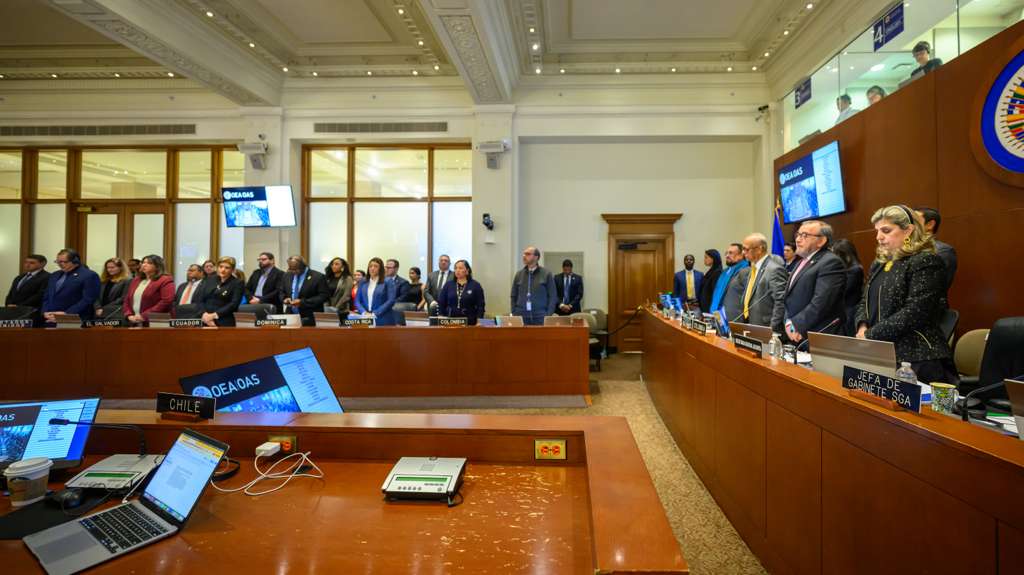
OAS Permanent Council meeting at the Simón Bolívar Hall. Photo: X / OAS
Guacamaya, January 6, 2026. The Organization of American States (OAS) held an extraordinary session, convened at Colombia’s request, to address the Venezuelan crisis following the U.S. military operation that resulted in the capture of President Nicolás Maduro. The development has triggered a deep regional divide between those who condemn the intervention as a violation of sovereignty and those who, while opposing the use of force, insist on the illegitimacy of the authorities in Caracas.
The Organization of American States (OAS) met in an extraordinary session to assess the situation in Venezuela after the U.S. military operation that led to the capture of President Nicolás Maduro. The debate exposed sharp divergences among member states, with positions ranging from condemnation of the intervention for violating sovereignty to rejection of the legitimacy of the government in Caracas.
Mexico
Mexico categorically rejected the U.S. military action, stressing that sovereignty is neither optional nor negotiable.
The Mexican delegation stated that the events cannot be justified under any circumstances, emphasizing that the international order is grounded in full respect for state sovereignty. It added that regime-change efforts imposed by external actors have exacerbated conflicts, and recalled that Latin American history shows foreign interventions have not brought democracy or lasting peace.
United States
The United States argued that what occurred in Venezuela did not constitute an invasion.
According to Washington, it was an operation aimed at arresting an accused individual so that he could face justice. The delegation said the decision was not taken lightly and that Nicolás Maduro had been offered different exit options.
The U.S. further asserted that Maduro led a structure linked to drug trafficking, corruption, and repression, and said its objective is to contribute to a better future for Venezuelans.
Guatemala
Guatemala reiterated its rejection of Nicolás Maduro’s regime, stating it has been consistent in that position.
The Guatemalan delegation reaffirmed its support for the Venezuelan people’s right to decide their future freely through genuinely democratic processes, underscoring the need for a transition that reflects the popular will.
Peru
Peru described Nicolás Maduro’s exercise of power as illegitimate and dictatorial.
It recalled that the July 28, 2024 elections did not proclaim him the winner, which is why Lima recognized Edmundo González as the victor of those elections.
The Peruvian government maintained that Venezuela’s democratic transition must be inclusive, involving all sectors of society, and conclude with respect for the decision expressed by the majority of the Venezuelan people.
Dominican Republic
The Dominican Republic said it does not recognize the “de facto regime” established in Venezuela following Delcy Rodríguez’s assumption of power.
The delegation noted that, just as it did not recognize Nicolás Maduro, it cannot grant legitimacy to a government seeking to perpetuate itself in power. Nonetheless, it called for facilitating a broad and credible political dialogue, warning that there is no single formula for a transition, but that it must be genuinely Venezuelan.
Colombia
Colombia expressed its rejection of any action that undermines Venezuela’s sovereignty.
The Colombian delegation said the events constitute a violation of international law and emphasized that Venezuela’s crisis must be resolved through dialogue, without external interference.
It also reiterated that Latin America and the Caribbean must be preserved as a region of peace.
Brazil
Brazil described the capture of Nicolás Maduro during the U.S. operation as a “kidnapping.”
It also announced the delivery of medical supplies and dialysis medications to Venezuela after the attack destroyed a distribution center for such equipment.
Health Minister Alexandre Padilha reported that Brazil is working with the Unified Health System (SUS) and private companies to mobilize humanitarian assistance, recalling that some 16,000 patients in Venezuela depend on dialysis treatment.
Padilha underscored Brazil’s continued willingness to provide aid and recalled that, during the COVID-19 pandemic, Caracas sent oxygen to the Brazilian city of Manaus. It was also reported that President Lula da Silva recently held conversations with Delcy Rodríguez.
Canada
Canada called on all parties to respect international law.
The Canadian delegation urged the search for a negotiated solution to the Venezuelan crisis and reiterated that the regime governing the country lacks democratic legitimacy.
Uruguay
Uruguay reiterated its firm commitment to international law and rejected threats or the use of force that undermine state sovereignty.
It held that the situation in Venezuela must be resolved through peaceful means, dialogue, and understanding among Venezuelans, and expressed its conviction that the restoration of democracy is indispensable.
Chile
Chile condemned the unilateral military actions carried out in Venezuela.
It warned that such actions set a dangerous precedent and put the civilian population at risk.
The Chilean government recalled that it had already stated that the July 28, 2024 electoral process was fraudulent, and therefore Nicolás Maduro’s investiture lacked democratic legitimacy.
European Union
Although not a member of the OAS, it became known that the European Union will maintain contacts with the government led by Delcy Rodríguez.
The aim is to defend the EU’s interests and principles in a context marked by political uncertainty, geopolitical interests, and humanitarian concerns in Venezuela.