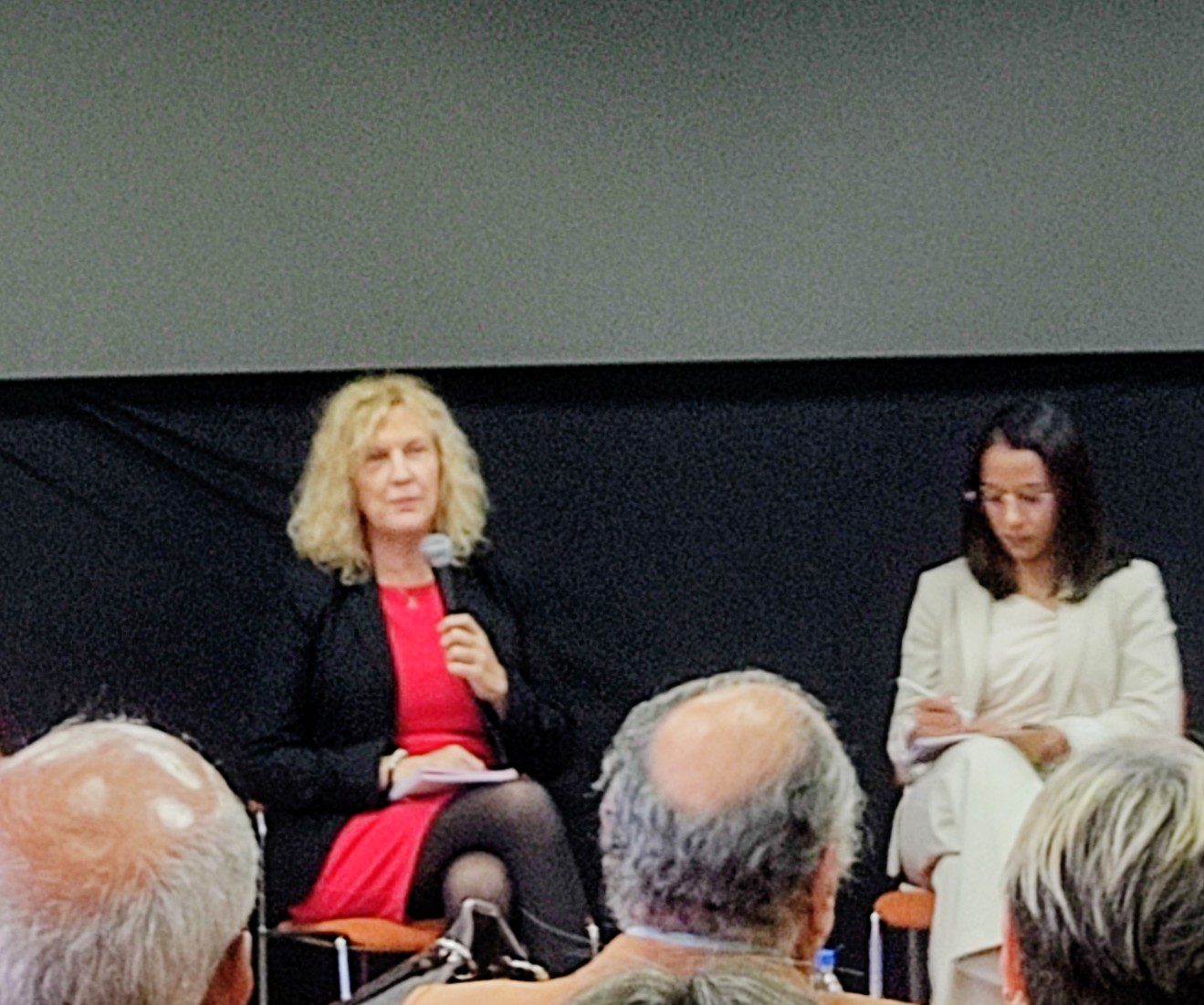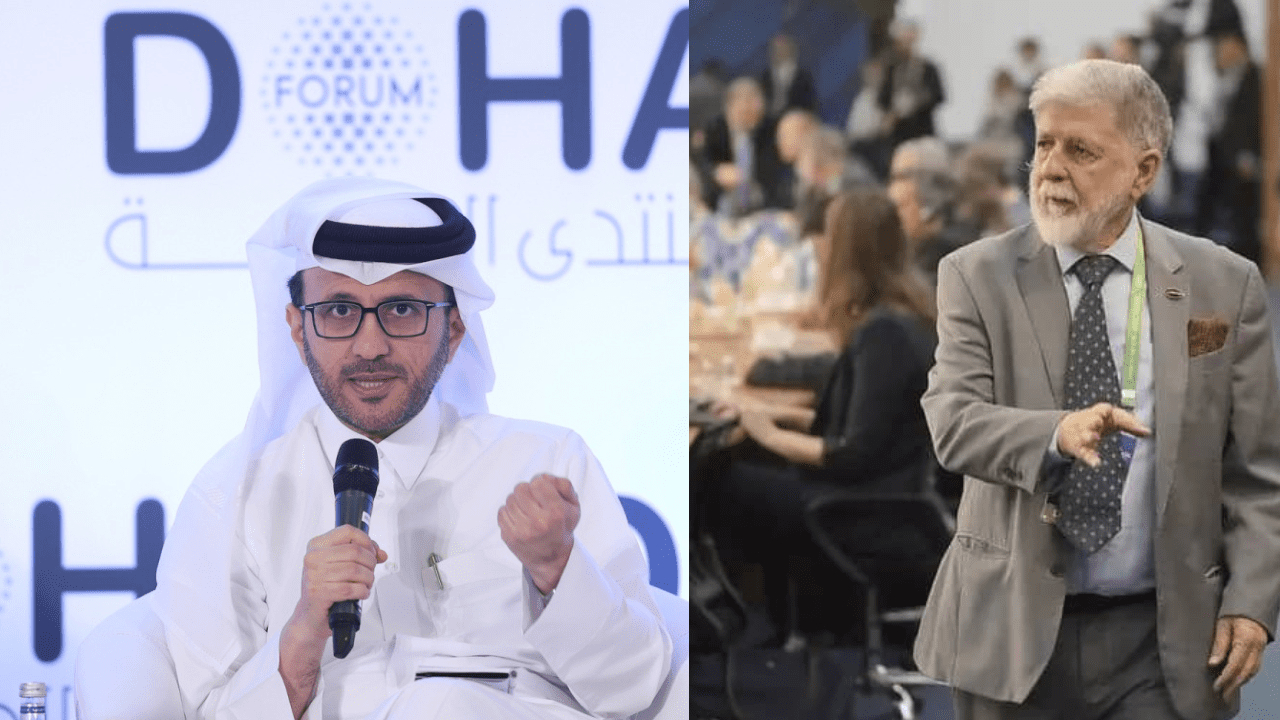
Qatar reiterated its willingness to mediate, while Türkiye and Venezuela accelerate the restoration of their air connections, and Brazil warns of a regional escalation. Left photo: Qatar’s Ministry of Foreign Affairs spokesperson, Majed al-Ansari. Photo: Doha Forum Press Office. Right photo: Celso Amorim at the G20. Photo: Ide Gomes.
Guacamaya, December 8, 2025. In a time of growing hemispheric tension, Qatar expressed its readiness to intervene as a mediator between the United States and Venezuela if requested, while Brazil warned of the risk that any U.S. military intervention could lead to a prolonged conflict in South America. Simultaneously, Türkiye and Venezuela agreed to reestablish the Turkish Airlines air route, suspended after the U.S. warning regarding Venezuelan airspace.
The spokesperson for Qatar’s Ministry of Foreign Affairs, Majed al-Ansari, stated that Doha is “waiting” for the parties or third-party states to formally request its mediation to facilitate a process between Washington and Caracas.
“We are waiting for someone to ask us,”he affirmed, insisting that Qatar maintains contacts with all actors, although there is no official initiative yet within the Doha Forum.
Qatar already has a history in US-Venezuela dialogue
In recent years, Qatar has established itself as one of the few credible interlocutors for both sides. Its role has developed in several phases:
Qatari diplomacy is once again emerging as a decisive resource in the crisis between the United States and Venezuela. This small emirate, which in 2023 already served as a bridge for a prisoner exchange between the two governments, could once again become a key player just as fears grow that tensions could lead to a direct intervention by Washington. Its potential involvement coincides with an intense week in Doha, a setting where negotiations are advancing between the Colombian government and the Gulf Clan—Colombia’s largest criminal structure—facilitated by Qatari authorities.
Accustomed to operating in conflicts of enormous complexity, from Afghanistan and Gaza to Ukraine, Qatar sees it as logical that a potential dialogue between Caracas and Washington would be part of its foreign agenda. In fact, Doha has already played a deeper role than publicly known: it hosted meetings between Juan González, then a key figure for Latin America within the National Security Council during the Biden administration, and the Venezuelan representative Jorge Rodríguez.
As recounted in the past, Juan González, the official in charge of negotiations with Caracas during the Biden era, told The New York Times that Qatar did not merely offer its diplomatic halls; they also: “Kept records of everything, helped us exchange documents, and when talks stalled, they sent someone to Caracas to press.” The American advisor summarized the emirate’s role thus: “They were incredibly helpful.”
During the Doha Forum, Panamanian Vice Minister of Foreign Affairs Carlos Hoyos added that his country is also willing to support, even by temporarily hosting Venezuelan officials if it contributes to “resolving the situation.”
Brazil: Celso Amorim issues stern warning over potential conflict
President Lula da Silva’s chief foreign policy advisor, Celso Amorim, warned in The Guardian that a U.S. intervention could turn South America into a “new Vietnam.” Amorim called former President Donald Trump’s decision to completely close Venezuelan airspace “an act of war.”
Celso Amorim was present in Venezuela during the presidential elections on July 28 and at that time offered his country as a mediator for the conflict that subsequently arose; however, the efforts did not yield results.
The diplomat stated that a foreign attack could generate a regional response—including Venezuelan opposition sectors—and revive anti-American sentiments comparable to those of the Cold War. He also described as “completely illegal” the measure that led most international airlines to suspend their flights to the country.
Although Brazil does not recognize the electoral victory Maduro claimed in 2024, Amorim insisted that his government opposes any forced regime change. As a possible way out, he proposed reconsidering a recall referendum, similar to the one in 2004, as a democratic mechanism to defuse the crisis.
Maduro and Erdogan Agree to reactivate Caracas-Istanbul route, a key piece in the geopolitical map
In parallel, Venezuela reported that President Nicolás Maduro held a telephone conversation with Recep Tayyip Erdogan and agreed to reestablish the Caracas–Istanbul–Caracas Turkish Airlines air route as soon as possible, canceled in November following the U.S. Federal Aviation Administration’s warning to “exercise extreme caution” over Venezuelan airspace and due to the revocation by the Venezuelan government.
The statement released by Venezuelan Foreign Minister Yván Gil highlighted that the reactivation will allow for the continued mobilization of thousands of tourists and investors who use this connection weekly.
Beyond operational aspects, this move has a clear geopolitical undertone. It must not be forgotten that Türkiye is a unique actor within NATO.
Although a formal ally of the United States, it maintains an autonomous foreign policy that allows it to dialogue with actors sanctioned or distanced from the West, such as Russia, Iran, or Venezuela.
Ankara has become a pragmatic intermediary, capable of speaking with Washington without breaking its channels with Caracas, positioning it as a bridge to de-escalate tensions or facilitate indirect contacts.
Turkish Airlines is a strategic instrument, with global operations that have allowed Venezuela to maintain a stable international air link despite the withdrawal of most Western airlines.
In his conversation with Maduro, Erdogan expressed “deep concern over the threats” against Venezuela and reiterated his willingness to support a negotiated solution to the crisis.
It must not be forgotten that in recent days Donald Trump and Nicolás Maduro held a telephone conversation.
As the U.S. military presence in the Caribbean increases and Brazilian warnings about a possible escalation persist, the reemergence of Qatar as a potential mediator and the active role of Türkiye as a political bridge within NATO outline a scenario in which intermediary actors could be crucial to avoiding a major conflict and opening negotiated paths regarding Venezuela’s future.
However, these efforts are isolated and unilateral, not part of a joint attempt to contribute to a diplomatic resolution, which could be key for actions to transform into tangible outcomes.