Guacamaya, March 19, 2026. Venezuela is the baseball world champion, a sport that has shaped the country’s identity and has been deeply intertwined with its oil history. This triumph arrives in a particular context for a nation that has endured decades of wounds, death, economic crisis, migration, and political confrontation. In 2026, Venezuela stands on the threshold of a possible process of transformation and reintegration with the United States, a country where, besides oil, baseball also holds a special place in its historical connection with Venezuela. Therefore, I allow myself to reflect on what this victory implies beyond sports, also revisiting its mirrors in contemporary history.
Introduced at the end of the 19th century and consolidated in the early decades of the 20th century, baseball quickly became Venezuela’s popular sport, especially in the coastal region and in the oil-rich cities of the East and Zulia, as well as in the capital, Caracas. It was not just entertainment; it was a space for socialization, where different groups could interact under common rules, developing a sense of teamwork, discipline, and cooperation.
Local leagues and national teams, which competed internationally from the 1940s and 1950s, allowed Venezuelans to project a modern and cosmopolitan identity by participating in a world that looked toward the United States and the Caribbean. Baseball, then, functioned as a framework for social integration, especially in urban and port contexts where internal migrants, oil workers, and foreign entrepreneurs intermingled.
Baseball as a cohesive element of our national identity and a product of our oil history
Although baseball was already played in Caracas since the late 19th century, with the founding of Caracas B.B.C. in May 1895—when the Franklin brothers, Amenodoro, Emilio, Gustavo, and Augusto, organized the first official game on a field in front of the Quebrada Honda train station, advertised in newspapers as “a new kind of chess”—it was the oil boom of the 20th century that truly ignited its flame across the country.
That first time, bats and balls arrived in Caracas through young people returning from the United States with dreams of modernity. But the mass diffusion of the game—its expansion beyond the elite and its arrival in every corner of the territory—occurred when the oil industry opened a bridge between Venezuela and the United States. Through the presence of oil companies, international workers, and the cultural connections they brought with them, baseball stopped being a cosmopolitan pastime for Caracas elites and became a national phenomenon, rooted even among those living in towns far from the capital.
Oil not only transformed the economy but also leisure and social interaction. In oil fields, worker camps, and port cities where the boom became evident, baseball diamonds appeared in open spaces under the scorching sun, among wells and trucks, with bases laid out and playing circles traced. There, men who shared exhausting workdays found in baseball a common language—a collective space where differences momentarily faded, and passions unified with each pitch and play.
The link between baseball and oil reflects the dialectic between work and leisure. On one hand, workers in refineries and oil platforms saw baseball as a space for recreation and community, where labor hierarchies softened for a while and the meritocracy of the game could symbolically substitute the structural inequality of work.
On the other hand, baseball functioned as a cultural and symbolic bridge, offering a common language for workers, entrepreneurs, Caribbean migrants, and foreign technicians. It was a space where the modernity promised by oil could be projected, even if imperfectly.
Miguel Otero Silva’s novel Oficina Nº 1 realistically portrays the transformation of a rural region into an oil field in eastern Los Llanos following the discovery and exploitation of crude oil around Well No. 1, the first drilled in eastern Venezuela. The work reconstructs not only the economic dimension of this process but also the human relationships woven around the social and cultural dynamism that accompanied the arrival of the oil industry in the country.
In that first major oil settlement, the explosion of economic activity brought together people from diverse backgrounds: local peasants migrating for livelihood, Venezuelan immigrants from other regions, foreign technicians and managers, skilled workers, unskilled laborers, and a constellation of emerging trades surrounding the field. Daily life revealed tensions, inequalities, dominance, and hierarchies, where foreigners and managers occupied positions distinct from national workers or native residents.
In Oficina Nº 1, Otero Silva depicts this human crucible where differences combined in complex ways, sometimes conflictive and sometimes collaborative, with locals coexisting with company employees, artisans, and informal workers alongside North American technicians, blending rural lifestyles with practices introduced by modern industry.
In many cases, workers lived in precarious barracks, earned far less than foreign technicians, and faced constant accidents with no protection in a system marked by segregation and discrimination.
The presence of baseball in these scenarios did not eliminate the intrinsic inequalities of the oil world—wage differences, housing separation, work hierarchies—but it functioned as one of the few public spaces where the normalization of everyday interaction could occur more horizontally than vertically. Games became situations of shared symbolic cooperation and competition, where peasants, laborers, technicians, and managers could first recognize each other as human beings before social categories imposed by a hegemonic system.
So much so that, in the heart of Zulia, one of Venezuela’s most important oil regions, amid the smell of crude and the constant hum of oil pumps, something unexpected emerged. It was not just a game; it was the promise of identity, community, and modernity. Maracaibo, with its immense lake and streets, saw the birth in 1913 of the first formal baseball tournament, an event that brought together workers, immigrants, merchants, and dreamers under the same sky, with the same bat and ball, under intense heat.
That league did more than organize games; it created rituals, memories, and bonds. Amid the buzzing of refinery engines and the comings and goings of cars, baseball taught cooperation, discipline, and pride.
Every pitch was an act of precision, every run a small shared victory, and every game a stage where Zulia’s social diversity transformed into community within a Venezuela that was starting to cohere rather than remain fragmented.
Over the years, this tradition solidified, and teams like Águilas del Zulia became regional emblems, reminding that the passion for the sport was born among oil, streets, and people dreaming big. There, in Maracaibo, it was understood early on—and is still celebrated today—that baseball does not just build champions but societies that learn to play together despite differences.
Baseball became an integral part of modern Venezuelan identity, linked to oil-driven prosperity. Every international success, from minor leagues to national teams in international tournaments, was perceived as a symbol of the country’s ability to compete globally, reflecting the wealth and projection that oil had provided to a society long trapped in internal conflicts and civil wars.
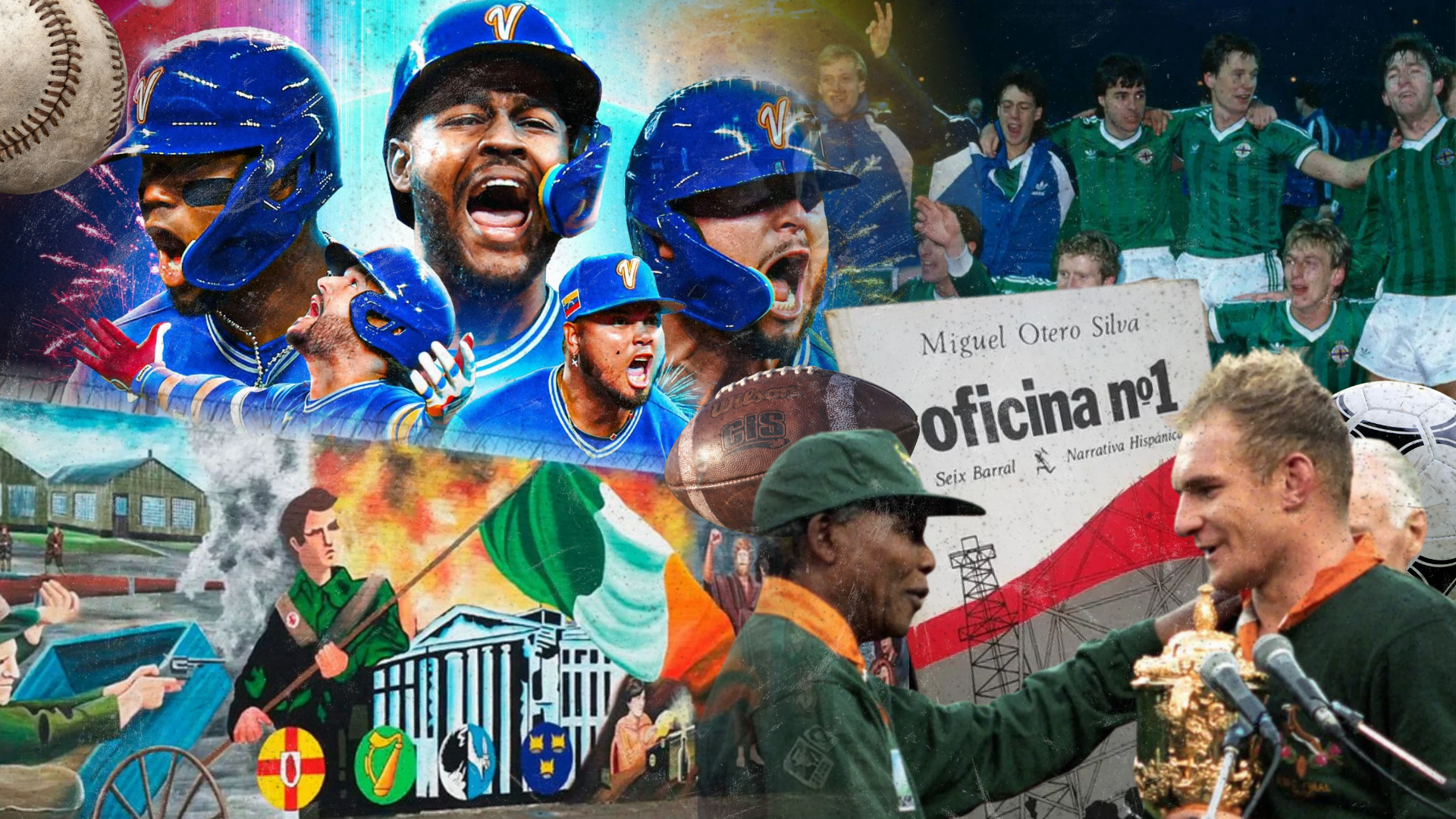
Amid the heat and crude, something was learned that was not written in company regulations or manuals: identity is also built in community, in the interdependence of action and shared joy, without erasing diversity or historical wounds. As in South Africa in 1995 or Belfast in 1986, baseball became a laboratory of coexistence, a place where playing together could teach more about humanity than any office or workplace hierarchy.
Today, when Venezuela’s national team wins a Baseball World Classic, it celebrates not only the sport but a history of interdependence between the oil industry and national identity, where baseball was a vehicle for social integration, modernity, and collective pride. The joy is not superficial; it is the faithful echo of decades where work, economy, and culture intertwined to construct what it means to be Venezuelan.
This capacity of sport—particularly baseball—to weave networks of coexistence in an environment marked by economic and cultural stratification recalls, on a local scale, what certain historical events have meant elsewhere: sports as spaces for emotional synchronization among diverse social groups. For example, rugby in South Africa or football in Northern Ireland.
In oil fields, baseball functioned as a relational context capable of temporarily minimizing differences and creating shared experiences where the common identity of participating in the game could foster closer coexistence than that imposed by labor structures or cultural stereotypes.
However, beyond the integrative power baseball has had, today I invite you on a journey back in time to discuss sport as a fundamental element for peace, trust-building, and reconciliation. It is not just about baseball; football and rugby have also played this role. Therefore, we will look at two historical experiences that demonstrate the transformative power of sport as a cohesion tool, even in moments of conflict, crisis, and difficulty: specifically, Northern Ireland in 1986 and South Africa in 1995.
Belfast, Northern Ireland, 1986: football among walls and rubble
Imagine Belfast in 1986. Not on a map, but in its frequencies.
On a street in Falls Road, a woman opens her window, and the murmur of a radio escapes. It’s Sunday Bloody Sunday by U2, resonating over walls painted with slogans and the names of the fallen. The drumbeat seems to echo the city’s pulses, the rhythm of a routine pierced by alarms and gunfire.
Just a few blocks away, in Shankill, a boy listens to Van Morrison; his melancholic notes soften, for a moment, the sound of the passing British military patrol. Music doesn’t change politics; it merely traverses realities.
Taxis and buses avoid certain streets after six o’clock. Pubs close early. Every step is calculated. The walls—the peace walls—delineate invisible territories, and the city moves to the rhythm of distrust among deeply broken and wounded people.
And in the midst of it all, there is football.
Not just any football. Northern Ireland’s national team travels to Mexico to compete in the World Cup. For many, it is just another tournament. For those left in Belfast, it is an act of silent magic, almost utopian: a team where Protestants and Catholics train together, rely on one another, trust passes that cross invisible lines of division.
In Belfast, on June 14, 1986, the city awoke to sirens and hurried footsteps on wet cobblestones; it was cold.
The walls, painted with slogans and the names of recent victims, seemed to watch every move. The IRA operated in the shadows, planning its next strike; the Ulster Red Hand paramilitaries erected barricades and set targets in Catholic neighborhoods; and every British military checkpoint on the street carried risk.
In this scenario, Radio Belfast cut through the routine with a grave voice:
“Good morning, Belfast. Reports of clashes between the IRA and British security forces: three injured on Falls Road. In Shankill, the Ulster Red Hand has blocked several streets. Keep your windows closed and ears alert.”
But through the transistor, another frequency emerged with a different tone—it was the commentary from the 1986 World Cup in Mexico. The commentator’s voice sliced through the tension:
“And there goes Norman Whiteside, beating three defenders and taking the shot—what a save by Algeria! Such reflexes, such confidence under the posts.”
Even as Catholics and Protestants clashed in the streets, people heard something different on the radio: Catholics and Protestants playing together, understanding one another, trusting each other. It was immensely powerful. There were no insults or labels; only the intention to play, to defend, to attack together under a common goal.
In homes along Falls Road and Shankill, Catholics and Protestants listened to the same narrative. Silence. For ninety minutes, the city changed frequency. The walls remained, the conflict remained, but within each home, the priority was different: football, excitement, and shared hope.
The names of Pat Jennings, Mal Donaghy, Jimmy Quinn, and Norman Whiteside resonated as symbols of a practical “we.” They did not resolve conflicts, but they demonstrated that cooperation and trust could work even amidst the deepest divisions. For a brief moment, the city learned to coexist.
The locker room becomes neutral territory. There are no political murals, no patrols, no slogans; only instructions, strategy—not to fix the next bomb, protest, or attack, but for the urgency of the next match. Identity, which on the streets dictates risk and survival, is reconfigured. For ninety minutes, what “we” means no longer depends on religion, neighborhood, or surname.
While matches are played in Mexico, radios in Belfast broadcast goals and saves, and for the first time in weeks, months, years, millions of people in different neighborhoods feel something similar. One rhythm, one tension, one shared emotion.
Conflicts are not resolved. The walls do not disappear.
But something happens.
Something that neither politics nor history can impose: a moment when coexistence is possible, when the common feels real, even if briefly, and when a football team can offer a rehearsal of community amid fracture.
The locker room as neutral territory and the echo of an era
There are historical moments in which different currents—political, cultural, philosophical—seem to converge without coordination. Northern Ireland in the 1980s was one of those moments.
While The Troubles continued to shape everyday life with a binary logic—us or them—other planes emerged where ideas questioned precisely that rigidity.
The national football team’s locker room, unknowingly, became a small laboratory where these tensions were put into question.
Thus emerges the crisis of grand narratives and a small step toward dismantling the stories that fuel conflict. Passes, fouls received, cleared balls—all were a challenge to the discourse of binary logics that prescribe conflict on an existential plane based on hatred and intolerance.
The crisis of grand narratives and the displacement of binary stories
In 1979, Jean-François Lyotard published his essay The Postmodern Condition. Its central thesis was simple and disruptive: grand narratives—religion, ideology, nation—were losing their capacity to organize reality.
In Northern Ireland, those narratives remained alive, even exacerbated. To be a Unionist or a Republican was not an opinion; it was a life structure.
But the football team introduced something different.
It did not replace these narratives, but it suspended them momentarily. On the field, the game was not played for a historical vision of the state, but for something much more immediate: the match.
This displacement—from the absolute to the contingent—is profoundly postmodern.
Identity as construction, not fate or absolute definition
At the same time, thinkers like Michel Foucault questioned the idea of fixed identities. For Foucault, identities are not immutable essences but historical constructions shaped by relations of power.
Both in Belfast and Venezuela, this idea seemed hard to sustain. Identities were crystallized, reinforced by decades of conflict.
Yet, in the locker room, something happened that resonates with Foucault: identities did not disappear, but they were reconfigured.
A player could be Protestant or Catholic outside the field. But inside, he was a fullback, forward, or goalkeeper. His function on the team temporarily reorganized his place in the world.
Identity was not erased. It simply ceased to be total, a framework of absolute definition.
Language, silence, and the shared
At the same time, Ludwig Wittgenstein—though of an earlier generation—was becoming increasingly influential in how language was understood.
His idea that meaning arises from use, from “language games,” helps explain what was happening with football.
Conflict in Northern Ireland was saturated with language: speeches, slogans, labels, and historical narratives that promoted the dehumanization of the other.
Football, by contrast, operated with another kind of language.
A pass.
A signal.
A coordinated movement.
There was no need to translate ideological positions. Meaning emerged from shared practice.
It was a simpler language, but also more accessible, requiring fewer prejudices and preconditions.
The literature of fracture
Meanwhile, Irish literature captured the same tension from another angle.
Seamus Heaney, Nobel laureate and born in Northern Ireland, wrote about violence without turning it into a slogan. His poems explored memory, land, and the weight of history.
They offered no solutions. They offered complexity.
In texts like Punishment, Heaney confronts violence without justifying or simplifying it. He acknowledges his own ambiguity as an observer.
That ambiguity was also present in the team.
The team was not “neutral” in an absolute sense. It was shaped by the same history as the rest of society. Yet, as in Heaney’s poetry, it moved in an intermediate space—uncomfortable, hard to classify.
Music: emotion before ideology
If philosophy questioned and literature nuanced, music amplified.
U2 offered no clear political program in Sunday Bloody Sunday. What it did was something else: transform violence into a shared emotional experience.
“I can’t believe the news today…”
The song did not resolve the conflict. But it made it audible in a way that transcended positions.
Something similar happened with football.
It did not eliminate differences, but it generated a shared emotion that needed no ideological translation.
Coexistence as experience, not theory
The most important point is that coexistence did not emerge as a discourse.
There were no manifestos.
There were no treaties.
There was practice.
Training together.
Trusting the other.
Representing something common without agreeing exactly on what that “common” meant.
This connects with a key intuition of many contemporary currents: social reality is transformed not only through ideas but through shared practices.
Thinking after playing
When the 1986 FIFA World Cup ended, the team returned to a Northern Ireland that remained deeply divided.
But something had remained.
Not a theory.
Not a solution.
But an experience that could be reflected upon afterward.
As in philosophy.
As in literature.
As in music.
The certainty that even in contexts where everything seems defined by difference, spaces exist where that difference can be reorganized.
Briefly.
Imperfectly.
But real.
And sometimes, in the history of conflicts, that is the beginning of something deeper and transformative.
An echo of history
Almost four decades later, in a completely different context—but with its own tensions—sport once again served as a stage for shared social experiences.
The hum of Belfast radios is still heard in memory, mixed with the echo of hurried footsteps on watched streets. Now imagine another scene, nearly forty years later, in Miami, March 2026. LoanDepot Park is full of lights, cameras, shouts, and tricolor flags. The heart of Venezuela—and its diaspora—beats in sync with that of the players on the diamond.
In Belfast, spectators listened to goals on shared frequencies; in Miami, Venezuelans watch every pitch, every swing, every slide to the base with the same collective astonishment. The stadium vibrates, social media erupts, phones transmit the same excitement to Caracas, Valencia, Maracaibo, or Maracay, and even to cities as distant as Madrid or Bogotá.
Names become symbols: Eugenio Suárez, Maikel García, and Ronald Acuña Jr. They are not just players; they are catalysts of a shared experience that suspends differences, ideologies,political parties. For a few minutes, the country’s internal cracks no longer matter. Disputes fall silent. The celebration is simultaneous, collective, unrepeatable.
The same happened in Northern Ireland with names like Pat Jennings, Norman Whiteside, or Jimmy Quinn.
As in Belfast, previous tensions are not erased. Economic crises, political polarization, injustice, sectarianism, and diaspora remain. But baseball creates what conflict cannot: emotional synchronization. A shared space where millions feel the same thing at the same time. Where “we” is not an ideological construction but a lived experience, felt in the chest, hands, and in the voice shouting Venezuela! in unison.
At the 2026 Baseball World Classic, held at LoanDepot Park in Miami, the Venezuelan national team won its first title in the tournament’s history, defeating the host team, the United States, 3–2 in a game filled with drama and passion.
For millions of Venezuelans inside and outside the country, this victory was not just a sporting achievement. It was a collective moment of identification and shared emotion—a moment when internal differences, social fractures, diaspora, injustices, and political polarization were suspended, if only for an instant.
In Caracas, Miami, Bogotá, and public squares in distant cities, the Venezuelan flag waved with an emotional synchronicity that transcended political discourse. Some celebrated setting aside daily disputes; others gathered in public squares with strangers to watch the game on big screens; and many felt simultaneously the same things: pride, hope, and belonging.
This moment of synchronization—even ephemeral—recalls the experience of Belfast in 1986. Not because the political or historical realities are comparable, but because both moments show how sport can generate shared experiences that interrupt, for a while, the fragmented narratives that dominate social life.
From “practical Us” to “emotional Us”
Northern Ireland’s team represented a practical “us”—a group that functioned as a team even if the environment did not. It was coexistence in action: training together, depending on one another on the field, coordinating without demanding agreement on everything else.
Venezuela in 2026, by contrast, generated an emotional “us” on a global scale. In a country deeply divided politically and socially, the victory did not resolve structural issues. It did not heal differences or close historical wounds. But it created a shared ground of joy, pride, and belonging.
This emotional “us” manifested in messages, spontaneous celebrations in streets and squares, and in thousands of voices simultaneously shouting Venezuela! as if that shout affirmed a common bond deeper than any discursive division or irreparable wound.
Northern Ireland taught us that coexistence is a rehearsal, that practice can precede theory. Venezuela reminds us that shared emotion can unite fragments of identity, temporarily suspending divisions.
Sport does not replace politics nor erase fractures. But it creates moments where “we” becomes tangible, and where emotional synchronicity demonstrates that, even if fleeting, unity is possible.
In Belfast, this was learned in ninety minutes of football; in Miami, in nine innings of baseball. In both cases, what remains is the same: the memory that coexisting and feeling together is possible, even in the most fractured contexts.
When the 1986 World Cup ended, Belfast returned to its sirens, gunfire, bombs, and walls; when the 2026 Baseball Classic ended, Venezuela returned to its polarization, survival struggles, and daily hardships. But in both places, a record of shared memories and emotions remained—a first step toward trust amid profound pain.
South Africa: Rugby and the Ubuntu factor
South Africa, 1995. Just one year after Nelson Mandela’s historic election, the nation was still deeply marked by decades of apartheid.
Imagine South Africa in the early 1990s: a country where skin color defined not only your identity but also your access to the world—neighborhoods, schools, jobs, even dreams. For nearly half a century, apartheid had woven a web of laws, customs, and violence that separated blacks and whites, rich and poor, oppressors and the oppressed. Every city was a mosaic of ghettos, walls, police checkpoints, and military patrols.
Daily life was marked by constant tension. For black South Africans, every step could be watched, every word punished. For whites, every social change was a reminder that privilege, built on segregation, was beginning to crumble.
And as the transition to democracy slowly advanced, the memory of fear remained alive, almost like a constant shadow over streets and homes.
In this context, the culture and philosophy of the era reflected on inequality and reconciliation. Writers like J. M. Coetzee explored in their novels the moral and psychological isolation of segregation, while social thinkers debated justice, identity, and historical memory. Art, theater, and literature interrogated the idea of “belonging” and the possibility of a we that was not determined by skin color. In music, resistance groups and community choirs sang anthems of unity, freedom, and shared memory, challenging the official historical narrative of the Afrikaner state.
In this landscape of fracture and hope, one unexpected element began to emerge as a social catalyst: rugby.
Traditionally, the Springboks had been a symbol of white Afrikaner power, a team representing exclusion and supremacy. But in 1995, history was about to offer a symbolic twist through a game that could become a stage for reconciliation, an emotional coexistence laboratory.
Ellis Park Stadium: A nation on edge
Ellis Park Stadium in Johannesburg was packed to the brim. Thousands of black and white South Africans shared the stands, though cautiously. The national team, the Springboks, had long been a symbol of white power and exclusion. For many black South Africans, it represented oppression. For many whites, it was national pride.
But Mandela had a plan: to use rugby as a tool for reconciliation. For weeks, his message was clear: the team was not just white, nor just black; it was South Africa’s. Diversity on the field could become a bridge between communities.
The match that stopped the country
The final of the 1995 Rugby World Cup pitted South Africa against New Zealand. In the city, news outlets broadcasted every play, and millions of South Africans followed the match on radio or television. The tension was tangible: it was not just a game; it was a social experiment.
On the field, black and white players of the national team depended on each other like never before. Every action required absolute trust. Every pass was a silent declaration of unity. There was no time for historical distrust; there was only the game, strategy, and a common objective.
In the stands and homes, people began to witness something that challenged decades of division: South Africans of different colors celebrating a try together, cheering loudly for the same players, sharing the same pride. Past tension did not disappear, but it was momentarily transformed into collective emotion.
A symbol of reconciliation
When South Africa won 15–12 in extra time, the country erupted in jubilation. Mandela, wearing the Springboks’ green jersey, approached captain Francois Pienaar and handed him the trophy. The image was powerful: a black man, the president, embracing a white player, a symbol of a fragmented nation attempting to unite.
Rugby did not solve the country’s structural problems nor erase societal racism. But it created a symbolic and emotional space where divisions could be suspended, where shared experience overcame prejudice. For ninety minutes, South Africa experienced a we that had previously seemed impossible.
The Ubuntu factor
In the Zulu and Xhosa languages of Southern Africa, there is a word that does not translate easily, but encapsulates a full vision of being and the world: Ubuntu—literally, “I am because we are”—umuntu ngumuntu ngabantu.
Ubuntu accompanied South Africa’s historical transition from the final years of apartheid to democracy: the conviction that no one is truly human in isolation, but always in relation to others, and that the common good is also one’s own good.
When South Africa lifted the Rugby World Cup in 1995, that philosophy was not just an abstract concept in books or political speeches. It was alive in the game itself, through passes between teammates, tactical cooperation, and the solidarity the team required to stay united against one of the tournament’s most formidable opponents.
That victory was not solely a sporting achievement. Practically speaking, it was a staged enactment of Ubuntu. A moment where people from different backgrounds, separated for decades and bearing individual wounds, came together under the same jersey—white and green—and felt that their victory was not just their own, but belonged to everyone watching from outside.
When Nelson Mandela, a living embodiment of Ubuntu in politics, handed the trophy to Afrikaner captain Francois Pienaar, what occurred was more than a sporting celebration; it was a symbolic representation that shared humanity could be a bridge even between those segregated by unjust laws, painful memories, repression, and death.
Ubuntu beyond South Africa
However, Ubuntu is not exclusive to South Africa or Africa. It is a philosophy that speaks of human connection as the foundation of existence, and for that reason it resonates with seemingly distant experiences—for example, with Venezuela’s triumph in the 2026 Baseball World Classic.
When millions of Venezuelans—inside and outside the country—celebrated that historic title, something similar happened collectively: for moments, internal differences, political tensions, and social contradictions were set aside, and what emerged was a shared frequency of emotion.
In that emotional terrain of celebration and pride—where millions felt the same heartbeat simultaneously—there is a glimpse of Ubuntu in the instant when people felt “one among many,” not through erasure of the self, but through recognition that their joy depended on the joy of all others celebrating with them.
That shared emotion does not dissolve structural differences nor replace politics, injustice, or human loss. But it generates—just as rugby did in South Africa in 1995, and football did in Belfast in 1986—a rehearsal of coexistence, a collective memory based on shared experiences in a space where humanity is experienced in plural, not in isolation. One person’s joy becomes everyone’s joy; one person’s pride feels like collective pride.
We must remember: we are because others exist, and our identity is constructed in the interdependence of human relationships. This understanding is not imposed, decreed, nor based on the erasure of diversity; it is a recognition that our humanity is realized in community, not in isolation.
Applying Ubuntu to venezuela’s future
Building on this idea—a resonance of Ubuntu, understanding humans as beings-with-others—Venezuela can face the challenges ahead. A country fractured by deep, irreparable wounds has the urgent task of rebuilding life and circumstances. It is about collectively learning that “the art of victory is learned in defeats,” as Simón Bolívar said, reminding us that triumph is not a destination but a constant learning born from facing adversity with humility and discipline.
For decades, Venezuelans have endured defeats—often like an endless game, blow after blow, loss after loss, fracture after fracture—where every advance seemed followed by a setback. Conflict, injustice, and social and economic tensions appeared endless; every attempt at progress encountered resistance, despair, loss of life, and pain.
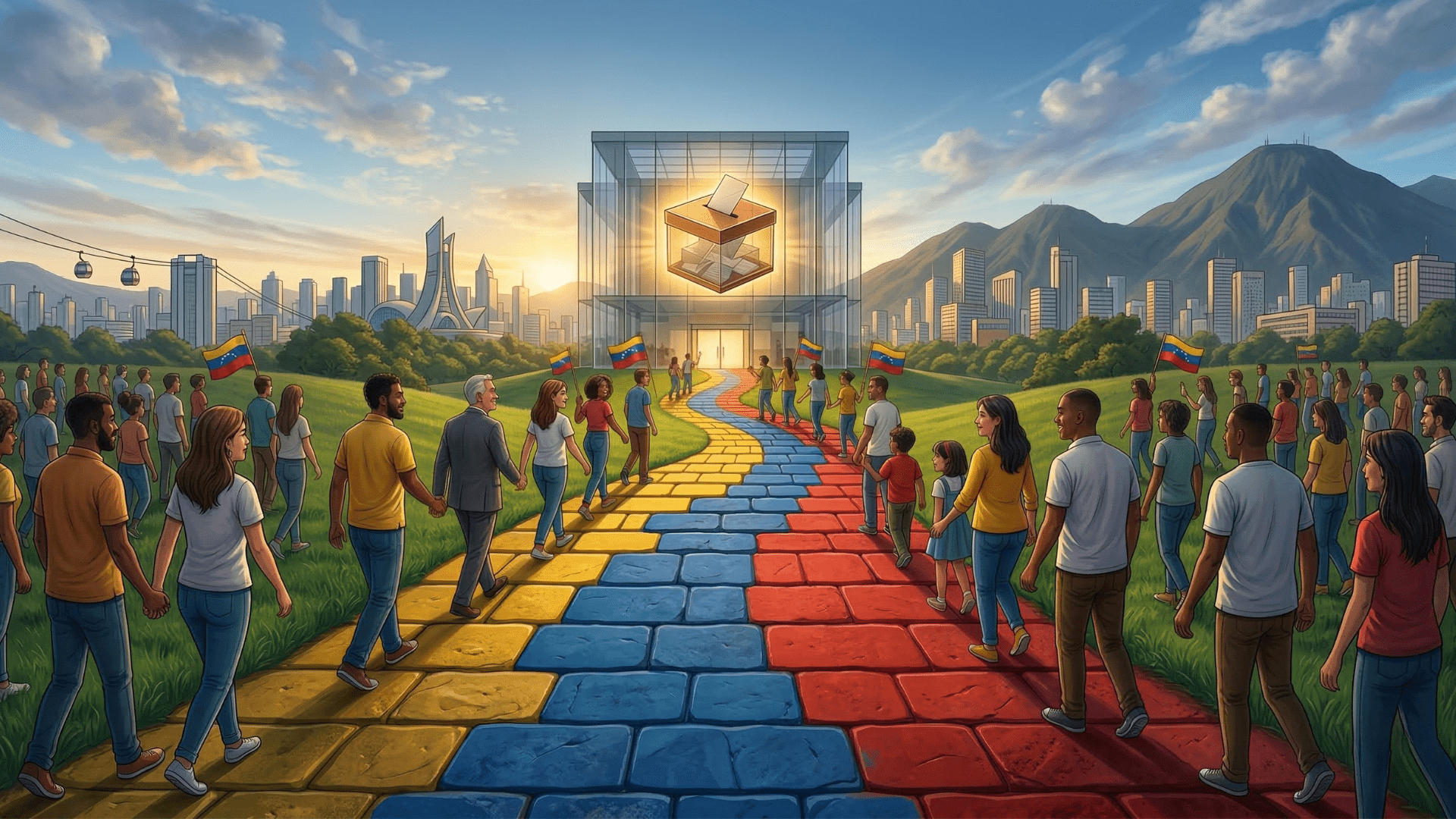
Perhaps now—after bombs, deaths, unjust imprisonments, injustice, and the precariousness of life—we have the opportunity to win our own championship. Not a literal championship, but a symbolic and profound one, aimed at building a society that can play together, collectively and creatively, without renouncing identity or beliefs, while overcoming its wounds.
As in the 1995 Rugby World Cup in South Africa, or in the coexistence forged by the 1986 Northern Ireland World Cup football team—where sport became a stage for people with conflict-marked pasts to experience a shared we—Venezuela can find in its diversity the strength to construct common sense without erasing what makes us different.
To renounce this would mean failing to play collectively—that is, failing to recognize that true victory is the one built in interaction, empathy, and acknowledgment of others as part of ourselves. This is not an invitation to homogeneity, but to creative coexistence where differences are not enemies, but necessary pieces of a common purpose.
Thus, Venezuela can face its challenges authentically, without denying its history, pains, or losses, learning from them to reinvent itself, collaborating instead of dividing, and understanding that victory is not an isolated strike, but the product of solidarity, resilience, and interdependence among its citizens.