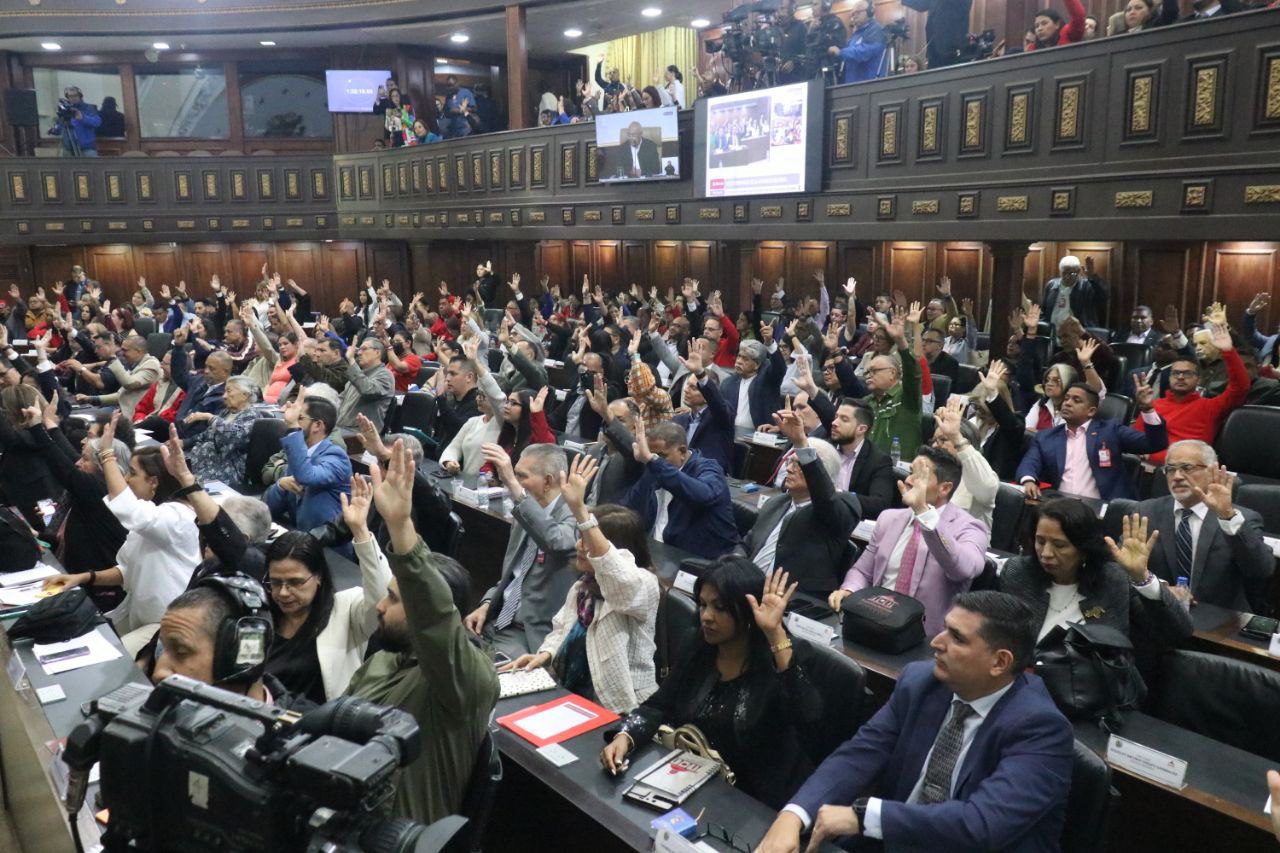
The second discussion of the legal instrument was postponed unanimously, after an intense debate in which the opposition parliamentary group pressed for consensus on fundamental legal principles. Photo: National Assembly Website.
Guacamaya, February 12, 2026. The National Assembly of Venezuela today approved only the wording of the first six articles of the Amnesty Law for Democratic Coexistence. The rest of the legal instrument will be deferred until the next ordinary session, following a heated debate marked by differences over Article 7. The unanimous decision, while supporting the agreements reached, reflects persistent tensions surrounding the Law.
The session stalled at Article 7, which regulates the Personal Scope. The opposition bloc, led by the Libertad faction, sought broader coverage for political prisoners and exiles, while the ruling party prioritized controls such as “submitting to justice.” In the context of historic protests, this law could free hundreds and prevent cycles of repression, but its success depends on full consensus.
During the debate on the article, Luis Florido (UNT – Libertad) demanded that the law be based on “the spirit of justice and freedom of the Constitution,” rejecting presumptions of guilt and insisting on equality for coexistence.
However, Rubén Limas (AD – Democratic Alliance) advocated maintaining the original wording: “There are no first- or second-class Venezuelans. Let us prioritize justice over protagonism to restore peace and the Rule of Law.”
The Libertad faction proposed deferring only that article due to discrepancies in its wording. The ruling party chose to extend the deferral to the rest of the articles, to avoid “emotions” affecting what had already been agreed upon in the report.
Unanimously, it was approved to postpone the discussion until the next ordinary session. “We will continue the discussion in the next ordinary session, next week,” announced AN President Jorge Rodríguez.
Consultation Commission Condensed “Thousands of Contributions” for the Law
The report of the Special Commission for Public Consultation, which presented the proposed modifications, was the axis of the session. The coordinator of this body, Deputy Jorge Arreaza, stated that in the debates with the various sectors involved, more than 2,700 contributions were gathered across the country. “As soon as we were appointed, we activated the process,” Arreaza emphasized at the start of the second discussion.
The consultation process included a meeting with relatives of detainees that lasted up to six hours, according to Arreaza. He added that in 2,266 communes, communal peace judges facilitated consultations with the participation of more than 25,000 neighbors. In his speech, he thanked the constructive participation of the Libertad, Democratic Alliance, and Vamos Venezuela parliamentary factions.
For her part, the Commission’s Vice President, Nora Bracho, highlighted the significance of the political moment the country is experiencing for this instrument. “It is a historic opportunity to heal the social fracture. It is not just about passing a Law, it is about dignifying history and ensuring that never again will someone be persecuted for thinking differently,” she emphasized in her intervention.
Deputy Antonio Ecarri, meanwhile, underscored the spirit of the legal instrument in favor of democratic coexistence. “What this Law seeks is to put an end to fear in Venezuela,” he said.
The Evolution of the Amnesty Law
The initial draft was more technical and extensive, with a catalog of crimes and detailed procedural measures. The second discussion report, following public consultation, transformed it into a more political law, focused on historical events of conflict, with clearer exclusions and a simplified procedure. The aim was to provide human rights guarantees and ensure institutional monitoring mechanisms.
This partial deferral does not halt the momentum of the law; on the contrary, it consolidates its foundations. The six articles approved, referring to the headings of purpose, objectives, principles, public order and general interest, principle of interpretation, and temporal and personal scope, establish a solid base, with emphasis on democratic coexistence and clear exclusions for serious crimes.
The elimination of criminal records and the monitoring commission provided for in Articles 14 and 15, respectively, strengthen the instrument’s operability. Pending are articles on specific events, exclusions, and procedures, which will be discussed next week. Meanwhile, contributions continue to flow, positioning amnesty not only as a legal framework but as a social pact.