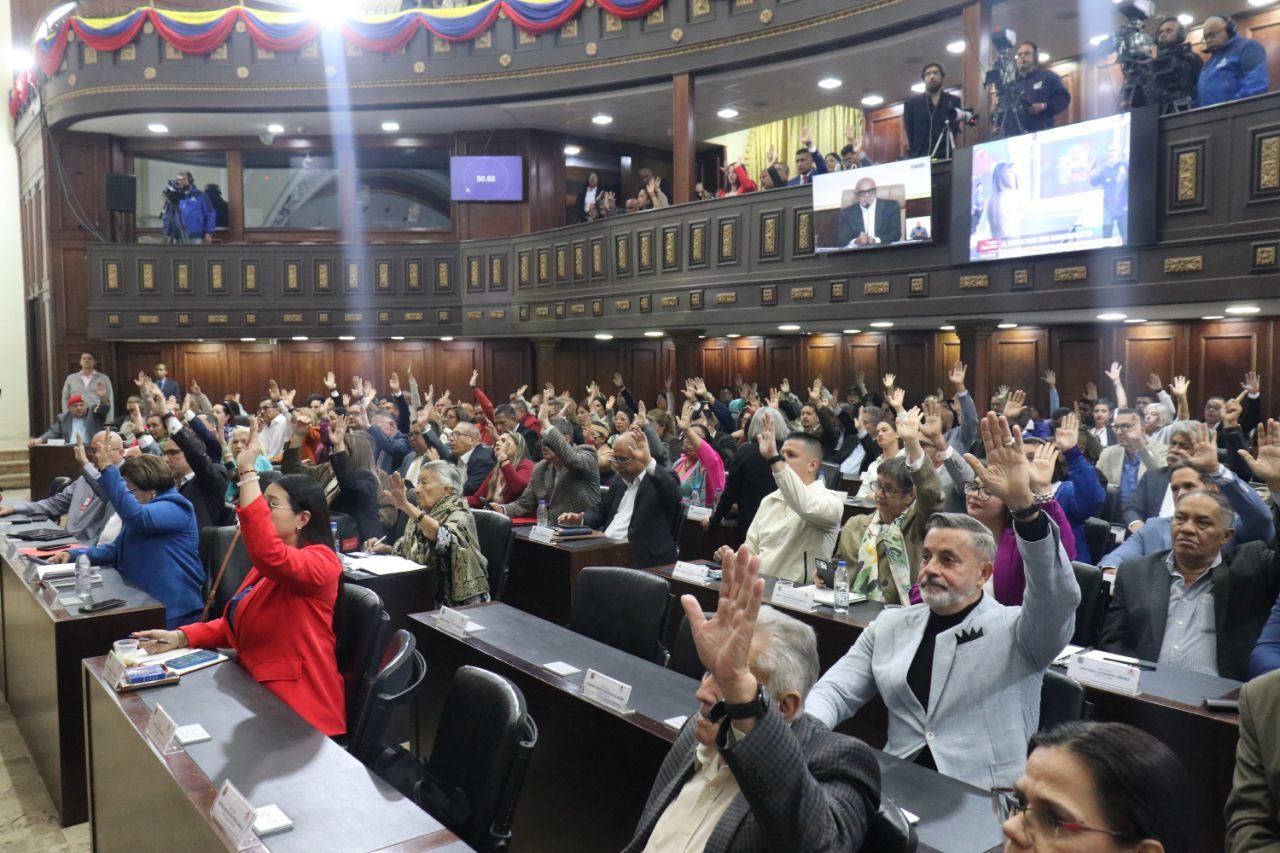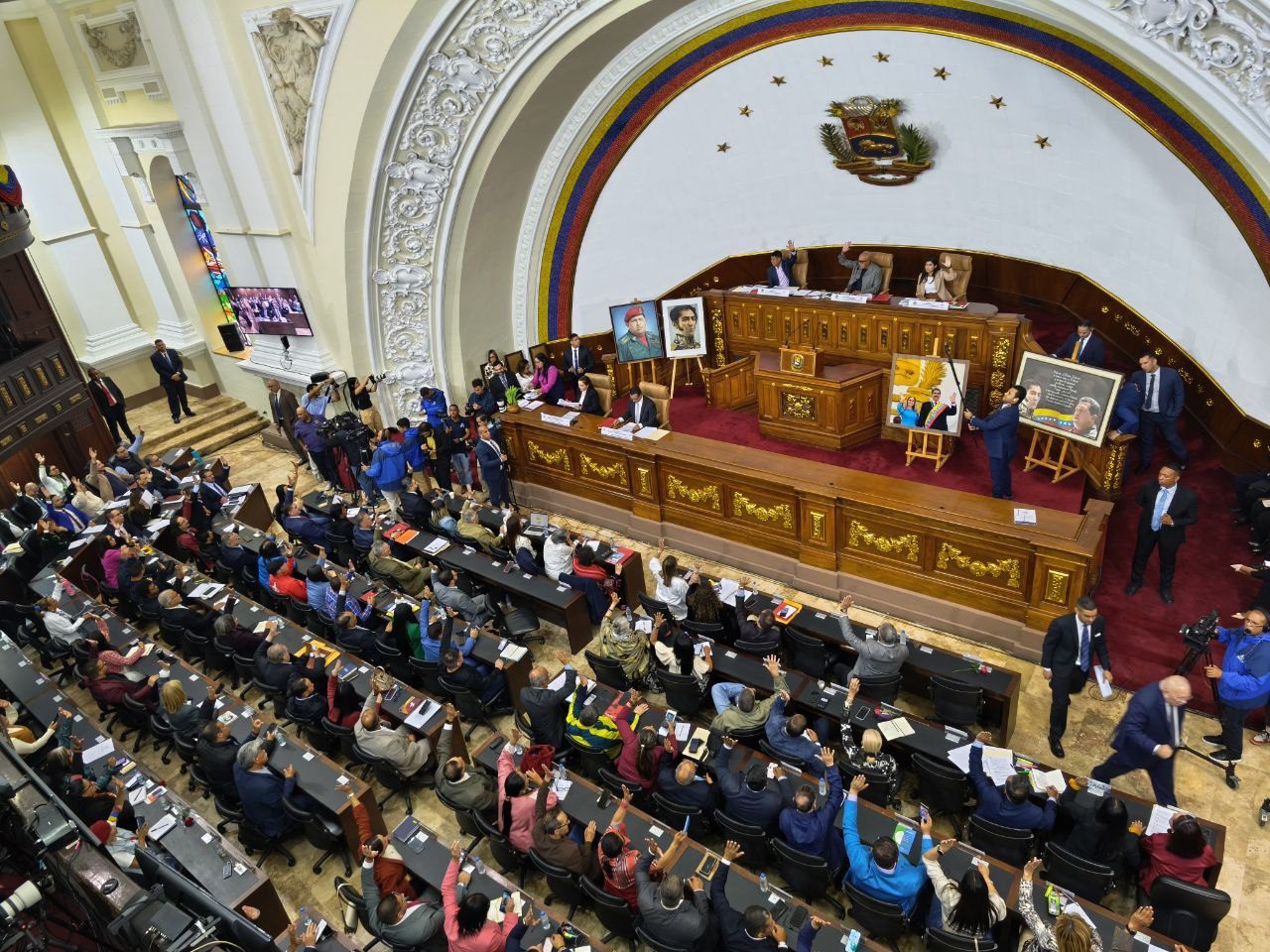
The Parliament placed at the center of its agenda the pillars of the economic restructuring promoted by Acting President Delcy Rodríguez. / Photo: @Asamblea_Ven.
Guacamaya, March 26, 2026. The National Assembly unanimously approved on Thursday the Organic Law on Speed and Optimization of Administrative Procedures, while it continued the second discussion of the Draft Organic Law on Mines, whose progress was postponed for a second time.
The debate focused on these two initiatives after an agreement “rejecting the attempts to privatize the Venezuelan oil industry” was removed from the final agenda.
Modernizing public administration
Final approval of the Organic Law on Speed and Optimization of Administrative Procedures comes after a process that included the unanimous passage of its first six articles in second discussion on March 5. At that time, the National Assembly endorsed a regulatory framework enabling the Public Administration to shorten response times, simplify processes, and eliminate bureaucratic burdens.
The legal instrument, now fully approved with 12 articles, establishes as its purpose “to swiftly and effectively implement the mechanisms necessary to ensure greater speed and optimization of administrative procedures and processes.” It aims to make procedures clear, simple, agile, rational, and easy for people to understand.
A central pillar of the law is technological modernization. Public Administration bodies must digitize procedures, eliminate duplications, and move toward system interoperability. The goal is to allow any person to complete administrative processes, with special emphasis on reducing paper use and creating digital one‑stop service platforms.
The text also provides for the creation of a National Commission for the Speed and Optimization of Administrative Procedures and Processes, a high‑level body tasked with opening channels for consultation and citizen participation. It also incorporates safeguards against the digital divide by requiring public agencies to maintain in‑person services, priority systems, and direct assistance mechanisms.
This legal framework is part of the package of economic and administrative reforms that Acting President Delcy Rodríguez presented to Parliament in her State of the Nation Address on January 15. At that time, she pushed for the acceleration of this law alongside the reform of the Organic Hydrocarbons Law — already approved — and the Draft Organic Law for the Protection of Socioeconomic Rights.
The Mining Law crosses the halfway mark in the legislative process
The second discussion of the Draft Organic Law on Mines advanced to the approval of Article 55, consolidating more than one‑third of the legal text and leaving for after Easter the debate on the most sensitive chapters of the mining regime. The session was chaired by First Vice President Pedro Infante, after Jorge Rodríguez delegated the role to attend a meeting with the Spanish ambassador.
During this session, the only modification to the original draft was a stylistic rewrite of Article 48; the rest of the articles were approved without changes. The first twelve articles establish the general framework, incorporate a technical glossary, enable arbitration mechanisms for disputes, and create the National Geoscientific‑Mining Data Bank.
Beginning with Article 13, the law creates the National Superintendency of Mining Activity (SUNAMIN), responsible for supervision, control, oversight, and revenue collection; formalizes the National Mining Guard as an auxiliary body; and defines the nature and functions of the National Institute of Geology and Mining (INGEOMIN), responsible for scientific research, reserve certification, and geological data management.
Articles 23 through 55 outline the structure of the National Mining Fund, its purpose, sources of income, and administrative mechanisms, along with the first rules on authorizations, operator obligations, and administrative procedures. With 55 articles approved and 71 still pending, the National Assembly must resume discussion of the chapters regulating concessions, licenses, environmental obligations, the mining tax regime, and sanctions.