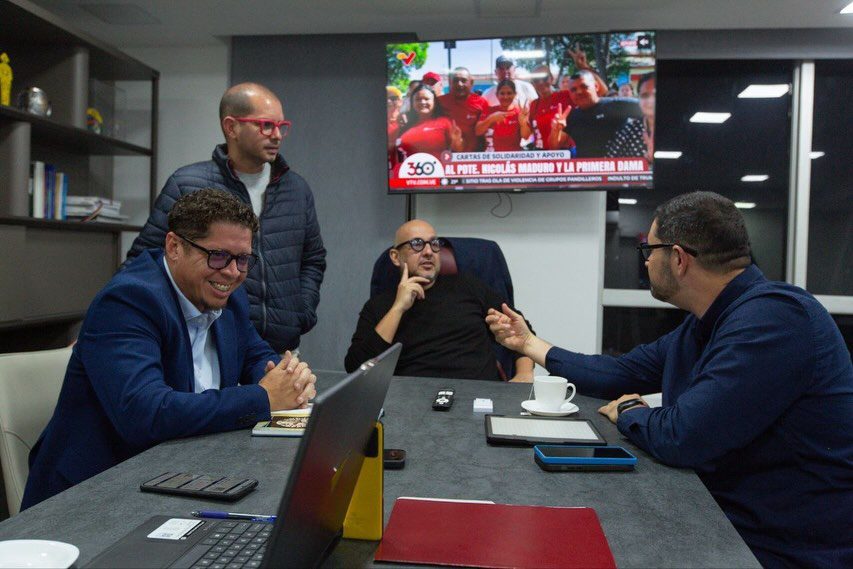
The new Minister of Communication and Information, Miguel Pérez Pirela, with his new vice ministers Johan Briceño, Gustavo Villapol, and Alberto Alvarado. Photo: Instagram / @mincomunicacion_ve.
Carlos Carrasco is a journalist and professor at UCV and UCAB. He has been a consultant for multilateral agencies such as UNDP, ILO, and ECLAC.
Guacamaya, February 5, 2026. Facing a new juncture in the country following the past January 3rd, one of the first observable changes in the “acting” Government concerns the Ministry of Popular Power for Communication and Information (Mippci). Since January 16th, a series of appointments have been made which, in line with a “Basic Legislative Plan” encompassing 29 draft laws, aim to generate a new management narrative for the citizenry.
Some appointments suggest a decentralization of communications, as well as a marked tendency towards digital communication and the logic of communications warfare. However, other appointments seem to privilege a harder line. This raises questions and generates contradictions.
To better understand what to expect, the following is a brief review of the new figures in the Ministry of Popular Power for Communication and Information under the management of acting president Delcy Rodríguez.
The New Minister, Miguel Pérez Pirela
The first appointment to mention is the designation of Miguel Pérez Pirela as the new Minister of Communication and Information. He is a recognized profile within Chavista circles for being the director and founder of the news and analysis portal La Iguana TV, as well as for hosting the program “Cayendo y Corriendo” on VTV. Similarly, more recently, Pirela has been hosting the program “Desde Donde Sea”.
Despite his activism, Pérez Pirela has also had moments of criticism towards Chavismo. For example, in 2015 during a broadcast of Cayendo y Corriendo on VTV, he stated that the “Bolivarian Revolution” had to assume the very serious communication errors and claimed that 2.0 communication did not exist or was sustained solely by positioning hashtags on Twitter and not by generating content on web portals (this comment was in reference to the opposition’s victory in the 2015 legislative elections). He even pointed out that there was not a single official portal among the top 100 in the world ranking. Precisely from this era, famous phrases can be found such as “Enough with the game of musical chairs. Ministers who move to other ministries, from there to governorships, then to mayoralties and later to deputy positions.”
In 2020, Pérez Pirela was also a figure who made critical comments about the “Anti-Blockade Law” or about the management of the governor of Zulia, Omar Prieto. Similarly, he questioned the objectives and lifespan of the National Constituent Assembly, as well as the need to refresh the personalities within the high government.
Pérez Pirela’s last major public act, before this new position, can be located in November 2025 during the Venezuela Book Fair, where he presented his book “Papeles de política”, a compilation of journalistic publications from 1999 to 2025, where he develops the idea of communications warfare.
A Young, but Old Acquaintance, Gustavo Adolfo Villapol Ríos
But it’s not just about Pérez Pirela. Official Gazette 43.299 lists a series of new appointments. For example, Gustavo Adolfo Villapol Ríos was appointed as Vice Minister of Communications Management. Villapol is the director of the weekly “Cuatro F”.
During 2025, Gustavo Villapol was re-elected as a deputy for the state of Miranda on the PSUV list. On the other hand, he has also had a facet as a disseminator, as in 2023, within the framework of the Venezuela International Book Fair (Filven 2023), he presented his book “Los amos del significado”, where he provides a historical analysis of the media in Venezuela and poses challenges for building a counter-culture in the digital space with its own technologies, platforms, and knowledge.
While not a figure with national visibility, Villapol is not a newcomer to the ministry or government communications. Previously, he had worked as Vice Minister of Social Networks of the Mippci; project coordinator at Alba Ciudad 96.3 FM; principal member of the Presidential Commission of Popular Power; and public policy coordinator at the Ministry of Popular Power for Culture.
Hernán Canorea, the New President of Venezolana de Televisión (VTV)
The previous communications minister, Freddy Ñáñez, also held the position of president of Venezolana de Televisión (VTV). However, Delcy Rodríguez’s appointments break with this concentration.
In this sense, journalist Hernán Canorea was designated as the new president of Venezolana de Televisión (VTV). Prior to this position, he served as head of the Communications Management Office of the Ministry of Interior, Justice and Peace under the administration of Diosdado Cabello.
Also, Hernán Canorea is the producer of the program “Con el Mazo Dando”, also hosted by Diosdado Cabello. Previously, he was press chief of the National Assembly (AN) when Cabello presided over the chamber between 2012 and 2016.
A notable aspect of his management at the Ministry of Interior was the Encuentro de Formación Comunicacional Revolucionario of the Bolivarian National Police Corps. These consisted of a cycle of workshops and discussions, which also featured speakers such as Ibesmar Jiménez, Miguel Pérez Pirela, and Michel Caballero.
Other Appointments and Their Backgrounds
An important designation was that of Alberto Rafael Alvarado Galiz as the new Vice Minister of Communications Planning and Strategy. Prior to this position, Alvarado Galiz had been elected principal deputy of the PSUV for the state of Falcón. He has also served as a professor at the International University of Communications (LAUICOM). Likewise, within the PSUV, he has held the position of agitation, propaganda, and communications at the state level of Falcón.
Another old acquaintance is journalist Isbemar Jiménez, who returns as an executive of the anonymous company Radio Nacional de Venezuela (RNV). Jiménez is one of the figures with the longest trajectory among these new appointments. Previously, she has been vice minister of Mippci; secretary of the VI Vertex of Communication and Culture of the Gran Misión Venezuela Mujer. She has also hosted the podcast “Aquí Entre Nos” on ANTV Venezuela.
In 2024, Isbemar Jiménez supported the reform of the Law of Popular Communication in the National Assembly. Publications can be found where she appears with the digital popular communication collective “Prende la Radio” from the Sucre municipality.
On the other hand, the appointment of Johan Harris Briceño Bermúdez as the new Vice Minister of Communication and Information of the Mippci can also be mentioned. Previously, Briceño worked as a journalist and vice president of the portal La Iguana TV.
Initial Readings and Expectations
As Delcy Rodríguez stated on January 14th, Venezuela is going through a new political moment. Similarly, Jorge Rodríguez, on January 5th during the installation of the new National Assembly period, said that if they had failed in the exercise of their functions, they apologized. However, the question is how this translates into practice within the context of communications.
In Pérez Pirela’s first statements regarding the appointments of the new vice ministers, he praised their talent, fresh vision, and commitment to communication. Furthermore, he described his team as “young intellectuals.” That is, one could infer an interest on the part of the Government in forming a technical team for communications.
However, the designation of figures like Isbemar Jiménez and Hernán Canorea suggests a shift towards more radical positions, far from the “fresh vision” or the establishment of a new political moment. Furthermore, based on the “Basic Legislative Plan” presented by the National Assembly, the management of an institution like the Mippci could be key for draft laws such as the Cybersecurity Law; the Intellectual Property Law; the Telecommunications Law; or the Digital Rights Law.
Additionally, there are pending appointments worth tracking, as the Mippci oversees decentralized entities such as the Ávila TV Foundation, Correo del Orinoco Foundation, National Journalism Prize Foundation (FPNP), Venezuelan Social Television Foundation (TVES), Venezuelan News Agency, Autonomous Service of the National Press and Official Gazette, Circuito Radial Mundial, La Radio del Sur, among others.
On the other hand, we must not forget that Delcy Rodríguez was also communications minister. The Mippci as an institution served as a platform to boost Rodríguez’s political trajectory at the beginning of Nicolás Maduro’s administration; so, without a doubt, she must understand its importance.
However, until now, no significant changes are evident. Although, we can mention the return to X (formerly Twitter) of government figures and the creation of the account Miraflores al Momento (@AlMomento_M), which bears a similarity to the White House account (@RapidResponse47) in terms of its objective. Similarly, in Gazette No. 43.288, the National Communications Training Program was created with specializations in Political Communication, Popular Communication, Digital Communication, and Communications Management. In practice, it is still unknown how this program will be executed and what its implications will be.
January has not yet ended and it is hasty to draw conclusions. But if the words of Jorge and Delcy Rodríguez are taken as true, more substantial changes would be expected.
A good gesture of substantial changes would be the release of all journalists and press workers, the inclusion of opposition voices in the programming of public media, the unblocking of informative websites, the repeal of laws contrary to freedom of expression or at least their review, especially the Constitutional Law against Hatred; and the Law against Fascism, Neo-Fascism and Similar Expressions; as well as the construction of a narrative that does not appeal to the detriment of political adversaries. There is an opportunity to offer something different, but there must be clear signs of real political will.