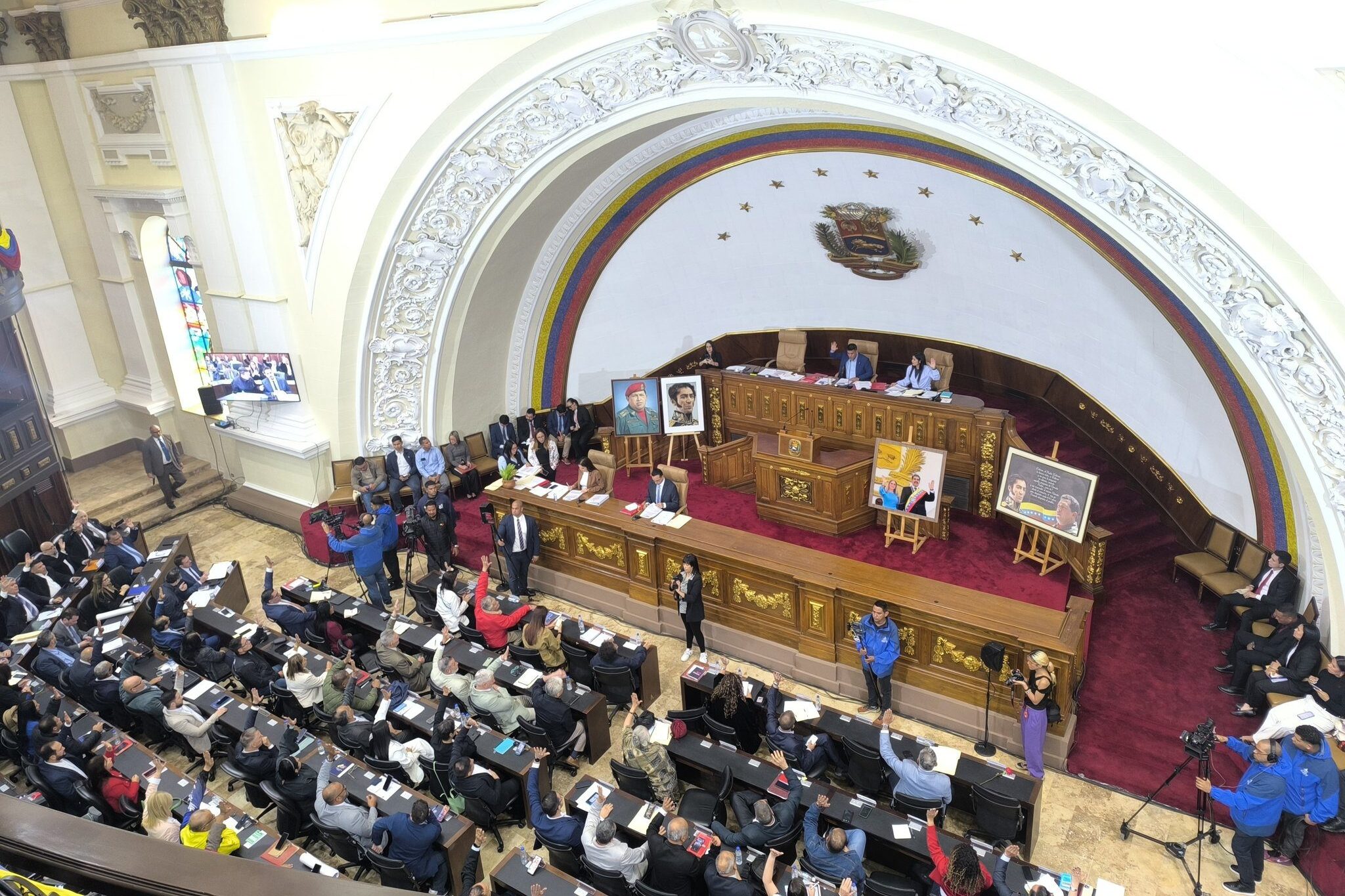
Its definitive sanction, which depends on approval in a second discussion, could redefine the role of the State and the private sector in the country’s oil exploitation. Photo: @Asamblea_Ven / X.
Guacamaya, 22 de enero de 2026. The National Assembly (AN), with an officialist majority, approved this Thursday in first discussion the Partial Reform Project of the Organic Hydrocarbons Law. The modification, which must undergo a second discussion, aims to modernize the oil sector and attract foreign investments, following an initiative driven by the interim President of the Republic, Delcy Rodríguez.
What was expected to be a minor adjustment ended up transforming into a far-reaching reform. This project marks a radical shift in Venezuelan energy policy by repealing pillars of the Law sanctioned in 2006, and distancing itself from the absolute state control scheme inherited from Hugo Chávez’s administration and his successor, Nicolás Maduro.
Reasons: Private operativity, fiscal flexibility, and legal guarantees
The reform’s statement of motives, whose content (like the project text) was known only 1-2 hours before the debate, responds to what is identified as a “global transformation of the oil industry.” This argument demands agile frameworks to capture investments in the world’s largest hydrocarbon reserves, held by Venezuela.
It thus addresses three main areas: incorporation of Production Sharing Contracts (CPP) and models from the Anti-Blockade Law, where privates manage at their own risk for volume participation; fiscal flexibility such as royalty reductions in greenfields; and legal guarantees with arbitration, maintaining state sovereignty.
In summary, the project, presented as a way to “dynamize investment” and “modernize the legal framework,” introduces major changes in operational management, commercialization, tax regime, and financial handling of oil resources. Thus, it seeks to grant commercial autonomy to private companies to sell quotas and manage currencies, optimizing operations ahead of contract expirations in 2026.
An energy shift between two models
The reform contemplates two key legal figures for hydrocarbon exploitation: mixed enterprises and contract operators. Both schemes include asset reversion to the State without compensation at contract end, along with mechanisms to balance investment economic viability.
In mixed enterprises, the State will retain majority shares, but the private partner can manage technical and commercial operations, the latter if achieving prices higher than state ones. Financial handling is also flexibilized, allowing management and opening of foreign currency accounts in international jurisdictions.
One of the most disruptive changes is allowing partner companies to export and sell their share of production directly, eliminating the state commercialization monopoly. On this, Guacamaya accessed assessments of this legal framework by an expert lawyer in oil legal advisory, who shared impressions anonymously.
“This is one of the big changes. Now private companies can operate individually without needing to form mixed enterprises, but only through operation contracts with PDVSA and its subsidiaries,” he noted. However, he adds that “the big doubt persists on how PDVSA, as majority partner, will provide funds for projects.”
Contract operator enterprises, meanwhile, are private firms domiciled in Venezuela that operate via contracts with state subsidiaries, assuming risks, costs, and commercializing part of production as payment. In this model, neither the State nor its subsidiaries assume financial commitments or debts from operations.
Another economic expert in hydrocarbons, who also chose anonymity, noted that while these changes open a regularization window, they leave a dilemma on the comparative attractiveness of the models.
“It’s good on one hand because it regularizes CPPs under the Anti-Blockade Law, but on the other, without such profound transformations in mixed enterprises in terms of profitability, investors expecting a CPP will see the opportunity cost of going for a mixed enterprise,” he states.
New era in contracts, royalties, and arbitration
Regarding contract duration, mixed enterprises can operate up to 25 years, extendable by 15 more upon state request. For contract operators, duration will be as established in the agreement, but yacimiento ownership remains with the Venezuelan State.
The reform also seeks competitiveness by reducing current minimum royalties of 30%. In mixed enterprises, both royalty and extraction tax can drop to 15%, while in contract operators, to 20%.
On this, the consulted authority in energy legal matters states: “The reduction is no longer tied to mature fields or extra-heavy oil as in the 2006 Law. Unfortunately, an opportunity is lost to foresee even greater reductions for complex projects like offshore or extra-heavies. This is a way to improve Government Take,” he said.
In the same vein, the economist consulted by Guacamaya notes that although greater flexibility in percentages is proposed, royalty fixation does not necessarily adjust to each project’s real conditions, potentially limiting investor appeal.
“The royalty still falls under National Executive discretion and not geological-technical criteria allowing to say royalty should be up to a certain level to make projects viable economically,” the financial expert pointed.
The economist highlights a critical aspect the reform does not address: the so-called “Shadow Tax,” in terms and conditions for mixed enterprise contracts. He notes guilds have always spoken of the need for legal harmonization of all hydrocarbon sector taxes to attract investment.
Another key change is dispute handling. While the current law requires national courts, the reform allows independent arbitration and mediation, potentially attracting international investors.
“Unfortunately, it doesn’t clarify if international arbitration is allowed but doesn’t prohibit it. Initial opinion is that arbitration clauses could be included since Venezuelan legislation permits it,” noted the legal expert, clarifying that in Venezuelan jurisdiction, independent arbitration is without an arbitration center.
On the other hand, in commercialization, the reform keeps significant discretion in Executive hands, notes the economist. “Institutional parameters are not clear to ensure sustainable commercial freedom participation,” he added.
Recognized advances and pending challenges
This first legislative step opens deep debate on the country’s energy model, amid recent oil agreements with the United States, against a backdrop of international sanctions, production decline, and need for private capital. The reform must still pass second discussion and could face changes, but already marks an inflection point in oil policy.
Both consulted experts agree on significant advances, though issues remain. “The project is a positive step in the right direction and at least partially resolves the main bottlenecks in the 2006 Organic Hydrocarbons Law,” concluded the energy sector legal expert.
The hydrocarbons financial expert states that “guilds celebrate the thorough Law review, and several elements do respond to long-requested guild demands, but details remain pending to deepen for full sustainability and legal security for private investment.”