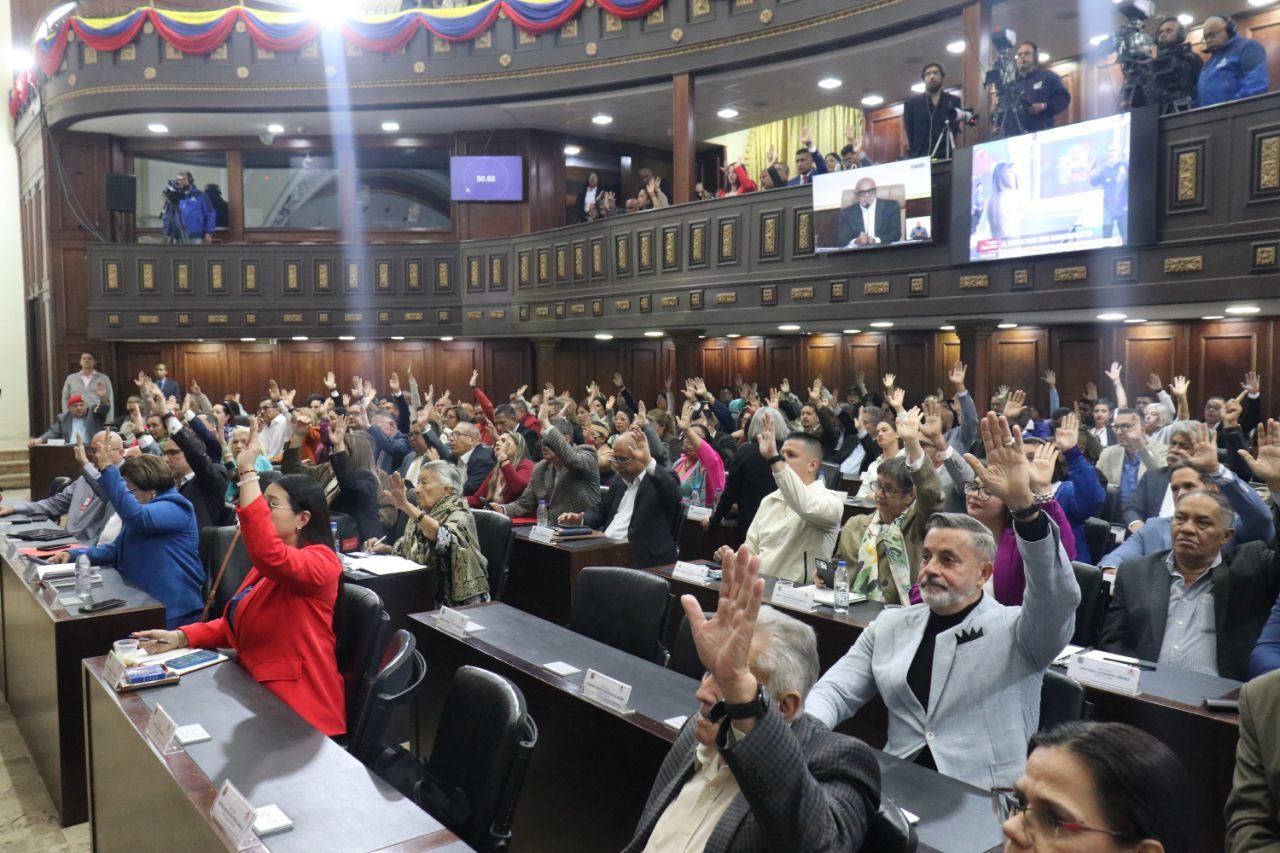
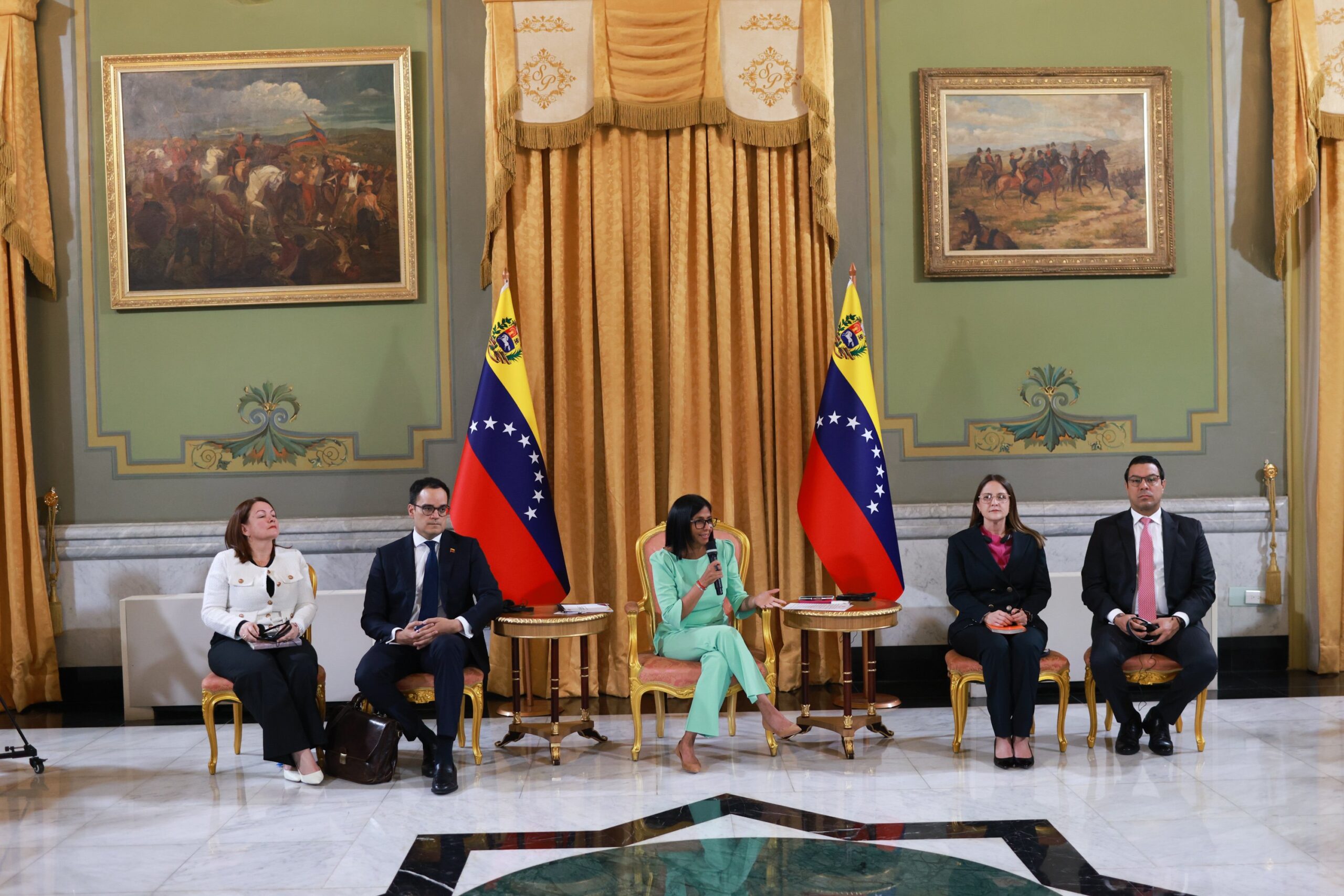
Flags of the United States and Venezuela. Photograph: Presidential Press Office
Guacamaya, January 7, 2026. Statements by U.S. Secretary of State Marco Rubio, together with recent military, financial, and regulatory moves, outline a gradual strategy by Washington toward Venezuela that combines control over oil, conflict management, and a political transition still full of unanswered questions.
The United States has begun to reveal its strategy toward Venezuela more clearly following remarks by Secretary of State Marco Rubio, who stated that “the only way Venezuela can transport oil is if it cooperates with us.” The comments came after the interception of two oil tankers—Bella I and Sophia—linked to the so-called “ghost fleet,” one located in the North Atlantic and the other in international waters near the Caribbean.
Rubio was emphatic in stating that Petróleos de Venezuela (PDVSA) “cannot move its oil without our authorization,” adding that Washington now has “more leverage to control all of that.” According to the head of U.S. diplomacy, recent actions are not improvised, but rather part of a pressure lever aimed at directly influencing the management of Venezuela’s national oil industry.
First phase: oil as an instrument of control
According to Rubio, the first scenario outlined by the United States for Venezuela’s so-called “reconstruction” involves the extraction and control of between 30 and 50 million barrels of oil, a figure publicly announced the previous night by President Donald Trump. According to U.S. officials, this operation would make it possible to finance the initial steps of the strategy and set the tone for future relations with Caracas.
Trump has said that the country’s eventual recovery would be financed with revenues from oil activity, while other members of his administration have stressed that an immediate priority would be the rehabilitation of the national power grid, considered essential for reviving the economy and, in particular, the oil sector itself.
Second phase: economy, companies, and political prisoners
The second stage, according to Rubio, would focus on Venezuela’s economic recovery under new terms. In this framework, the United States would seek to ensure that “U.S. companies have access to that oil,” while also working toward the release of all political prisoners.
This economic-financial approach coincides with signals coming from the markets. Bloomberg reported that the firm Teucrium filed an application with the U.S. Securities and Exchange Commission (SEC) to launch the Teucrium Venezuela Exposure ETF, an exchange-traded fund that would seek to track an index composed of companies based in Venezuela or with significant exposure to the country.
If approved, it would be the first ETF specifically designed to offer equity exposure linked to Venezuela, in a context marked by political volatility and the low liquidity of the local market. The mere expectation of political change triggered a sharp rally on the Caracas Stock Exchange, which rose more than 16% in a single session, and fueled a surge in Venezuelan defaulted bonds.
Third phase: the political transition
The final phase described by Rubio points directly to a transition of power in Venezuela. “We have to work on that, and we will continue doing so,” he said, without offering further details on mechanisms, actors involved, or timelines.
At the same time, market analysts and managers of emerging-market debt funds anticipate that a potential political shift could open the door to a restructuring of Venezuela’s debt, which has been in default for nearly eight years. Some estimate that such a process could take place over a horizon of 18 to 24 months, a prospect that has pushed up the value of Venezuelan securities on secondary markets.
From confrontation to conflict management
From a conflict-resolution perspective, the current moment suggests a shift toward a phase of conflict management. This approach seeks to prevent further escalation and stabilize the situation through mechanisms of control and pressure, without immediately addressing the structural causes of Venezuela’s conflict.
While the roadmap announced by the United States more clearly outlines its objectives—energy control, economic reordering, and political transition—many questions remain about the sustainability of the scheme, its impact on Venezuelan sovereignty, and the social and political consequences of a strategy that prioritizes managing the conflict over resolving it at its roots.
In terms of conflict resolution, what the United States appears to be proposing for Venezuela more closely resembles a model of conflict administration than a structural solution. History shows that such schemes can work in the short term, but tend to generate accumulated tensions if they do not incorporate inclusive agreements, social legitimacy, and effective sovereign control.