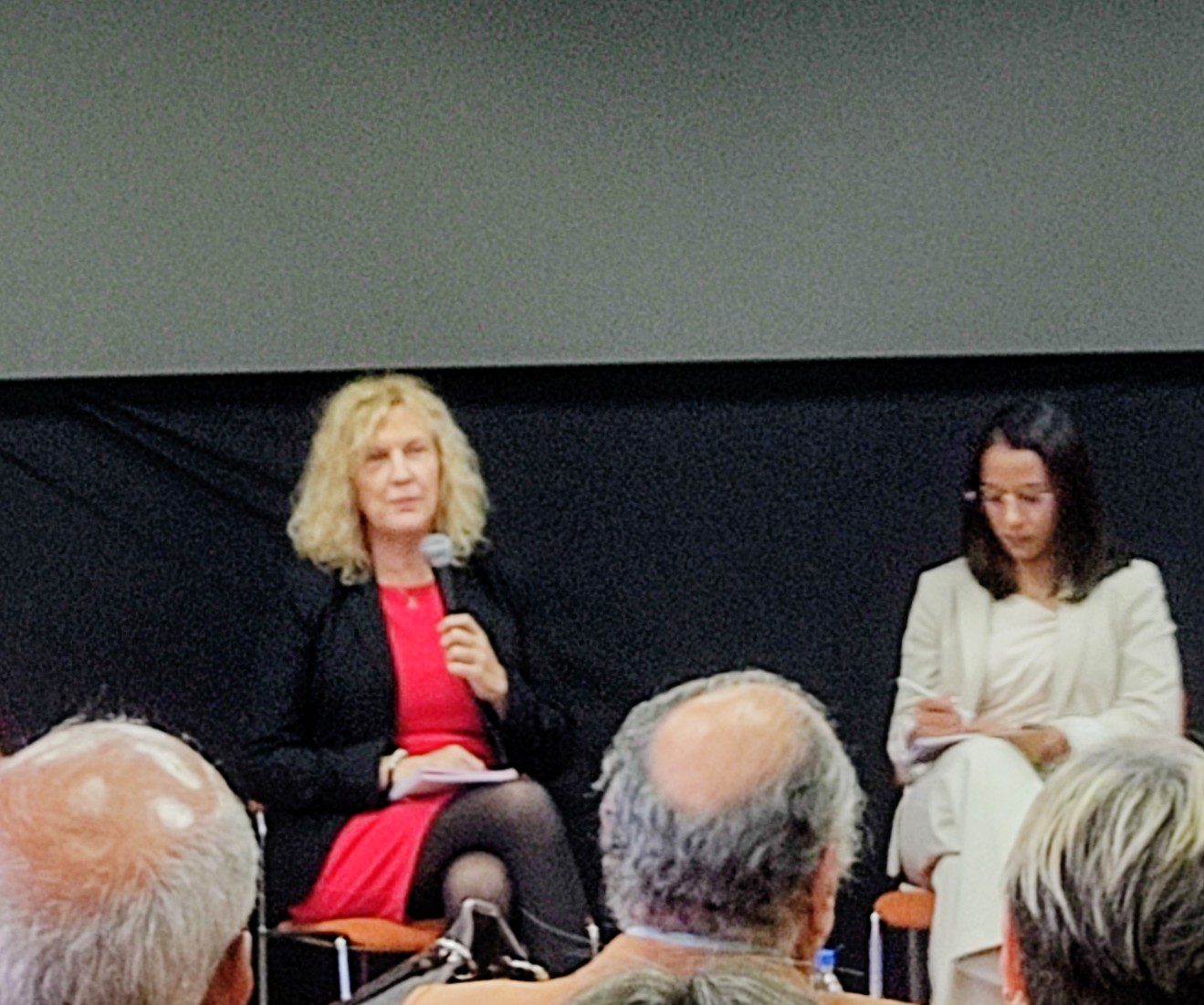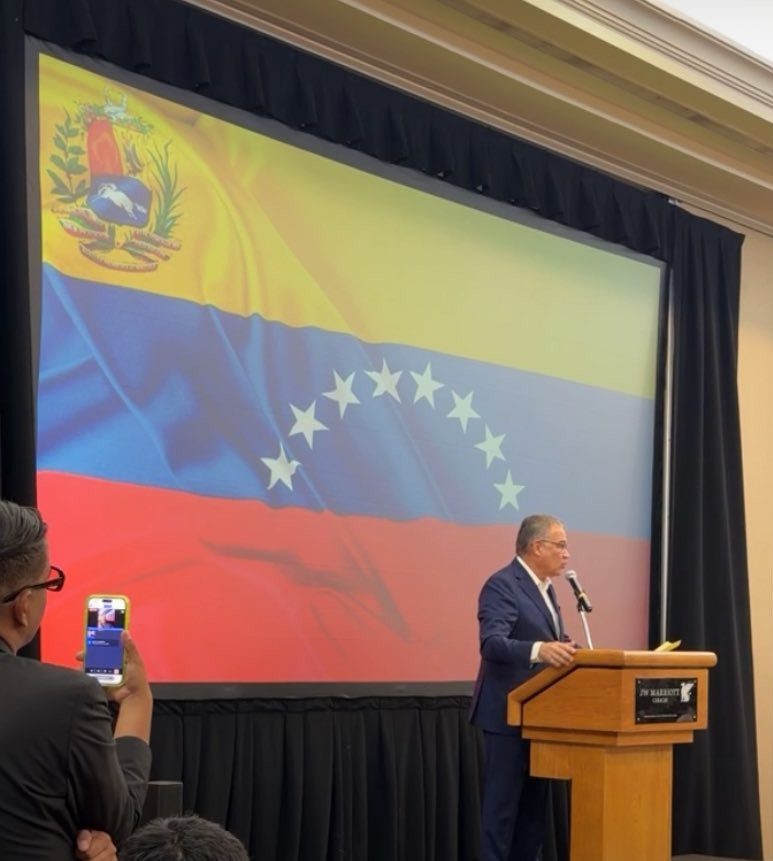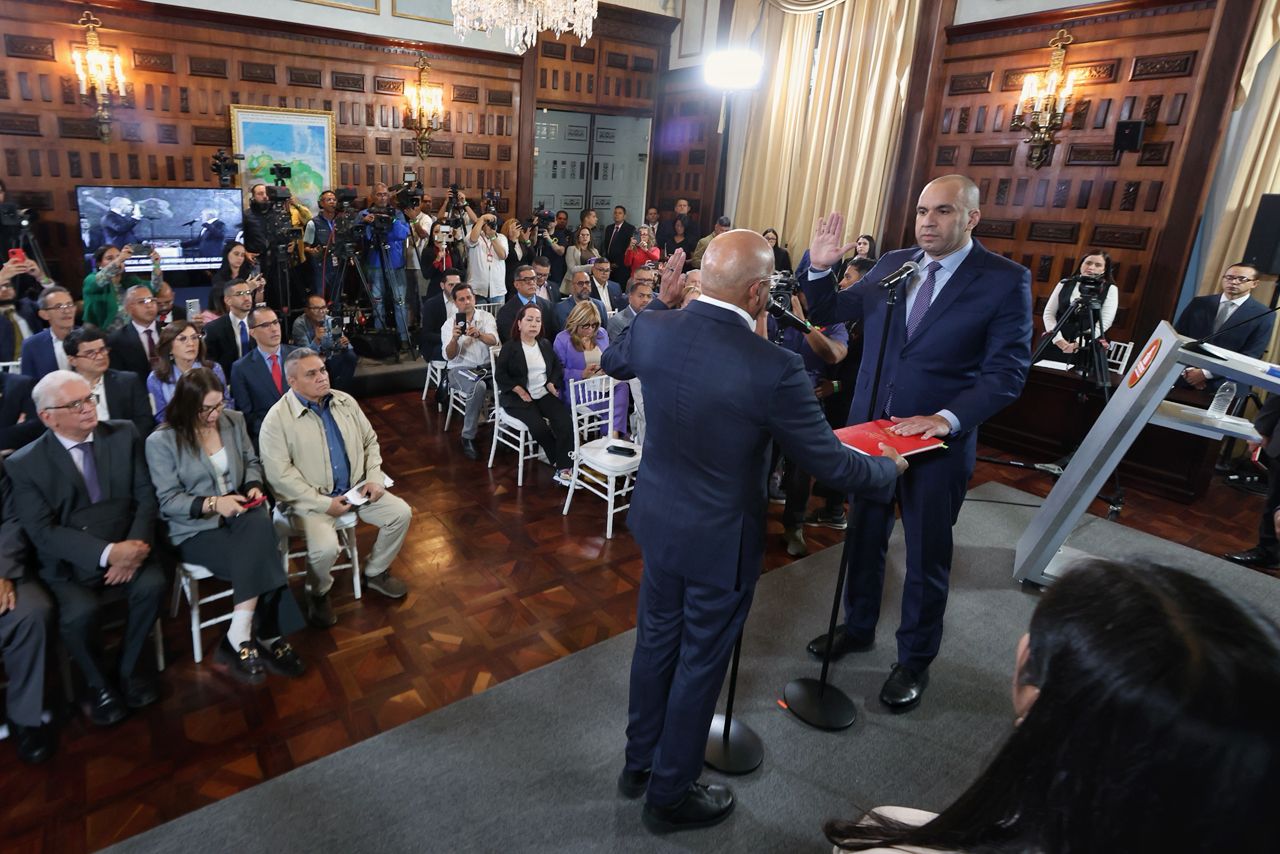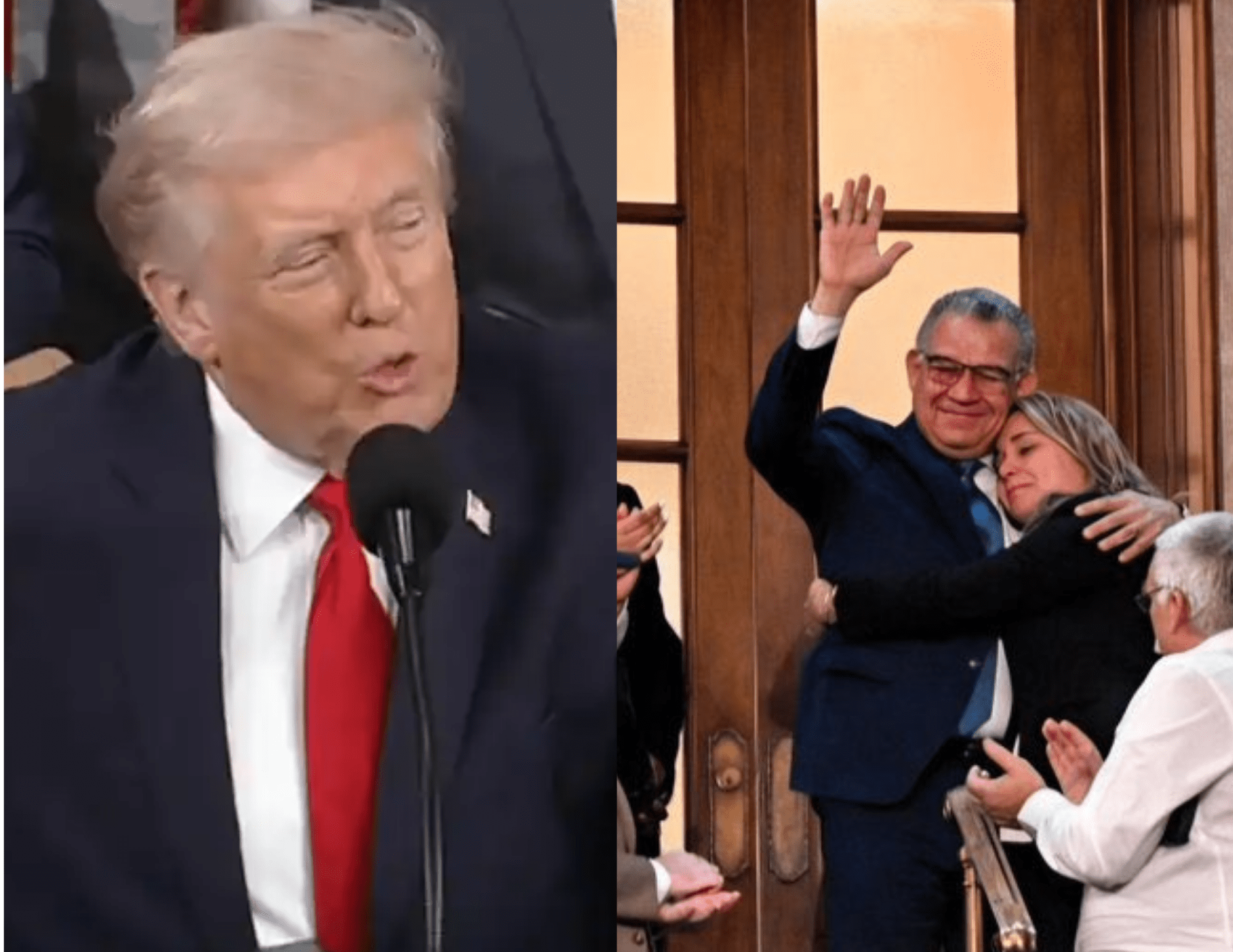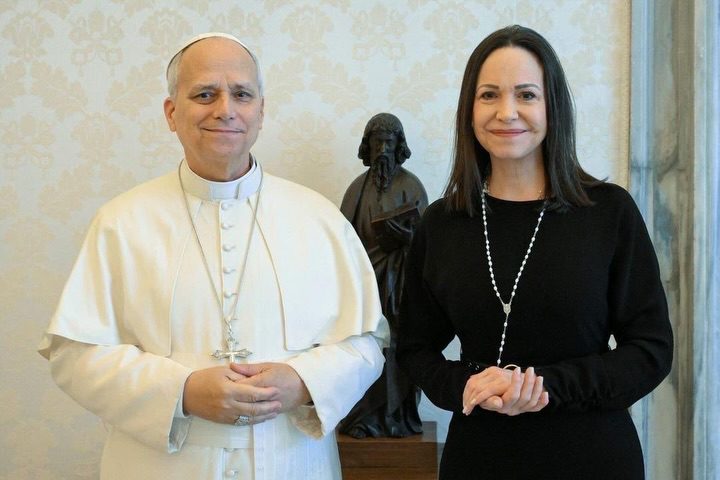
The Pope and María Corina Machado met on January 12, 2026, at the Vatican. Photo: Instagram / @VaticanMedia.
Guacamaya, January 12, 2026. Pope Leo XIV held a private audience this January 12 with Venezuelan opposition leader María Corina Machado, Nobel Peace Prize laureate, in a context marked by the fall of Nicolás Maduro, an ongoing political transition in Caracas.
At the end of a morning filled with audiences at the Apostolic Palace, Pope Leo XIV received María Corina Machado, one of the most prominent figures of the Venezuelan opposition. The meeting took place barely ten days after the capture of Nicolás Maduro and his wife, Cilia Flores, during the U.S. military operation known as Operation Absolute Resolution, carried out on January 3 in Caracas.
Maduro, accused by U.S. authorities of drug trafficking and narco-terrorism, remains detained at the Metropolitan Detention Center in Brooklyn, while Venezuela is undergoing an unprecedented phase under an interim government led by Delcy Rodríguez, with international backing and open negotiations aimed at a political transition.
The audience between the Pontiff and Machado goes beyond a merely protocolary gesture. The Venezuelan leader, head of the liberal movement Vente Venezuela, has for years been one of the most outspoken critics of Chavismo. Living in exile for several month ago , Machado received official notification in December, in Oslo, that she will be awarded the Nobel Peace Prize in October 2025.
María Corina Machado has also openly supported U.S. military action and has endorsed Washington’s policy of economic coercion against Caracas in recent years.
Machado is expected to travel this week to Washington, where she will meet with U.S. President Donald Trump, who publicly confirmed the encounter. The sequence —Vatican City, Washington, and Oslo— reflects the international dimension the Venezuelan crisis has acquired and the attempt to articulate political legitimacy, moral backing, and strategic support.
The Pope’s voice on Venezuela
Pope Leo XIV has closely followed developments in Venezuela. In the Angelus of January 4, one day after Maduro’s capture—an operation that left around 80 dead, including Venezuelan and Cuban military personnel and civilians—the Pontiff expressed his “great concern” over the escalation of violence.
“The good of the beloved Venezuelan people must prevail over any other consideration,” he said, urging all parties to “overcome violence, guarantee the country’s sovereignty, and embark on paths of justice and peace.” The Pope emphasized the need for full respect for human and civil rights, as well as for building a future of stability with special attention to the poorest sectors, severely affected by the economic crisis.
These appeals were reiterated on January 9 before the Diplomatic Corps accredited to the Holy See, when Leo XIV called for “respecting the will of the Venezuelan people” and for working toward a society founded on justice, truth, and fraternity.
The Vatican as a geopolitical actor
Beyond the Venezuelan case, the audience with Machado fits into a long tradition of Vatican diplomacy. The Holy See, one of the oldest diplomatic actors in the international system, has historically played a distinctive role as a mediator in highly sensitive political conflicts, thanks to its moral authority, its global diplomatic network, and its ability to engage with opposing actors.
Among the most notable precedents is the decisive mediation by Pope John Paul II and Cardinal Antonio Samoré in the dispute between Argentina and Chile over the Beagle Channel in the late 1970s, which helped avert open war. More recently, the Vatican facilitated the rapprochement between the United States and Cuba in 2014, leading to the restoration of diplomatic relations after more than five decades of rupture.
In Latin America, the Holy See has also accompanied peace processes in Colombia, participated in dialogue initiatives in Central America during the armed conflicts of the twentieth century, and—albeit with mixed results—sought to promote negotiation channels in Venezuela itself in recent years.
Between neutrality and influence
Vatican diplomacy operates along a delicate line between political neutrality and moral influence. By receiving María Corina Machado at this critical moment, Pope Leo XIV sends a signal that has not gone unnoticed: without explicitly endorsing a political actor, the Vatican acknowledges the centrality of the Venezuelan crisis and the need for an outcome that combines justice, sovereignty, and reconciliation.
In a scenario of still-fragile transition and strong involvement by major powers such as the United States, the Vatican’s role could once again be that of a quiet yet influential actor, capable of providing legitimacy and channels for dialogue where hard politics reaches its limits.