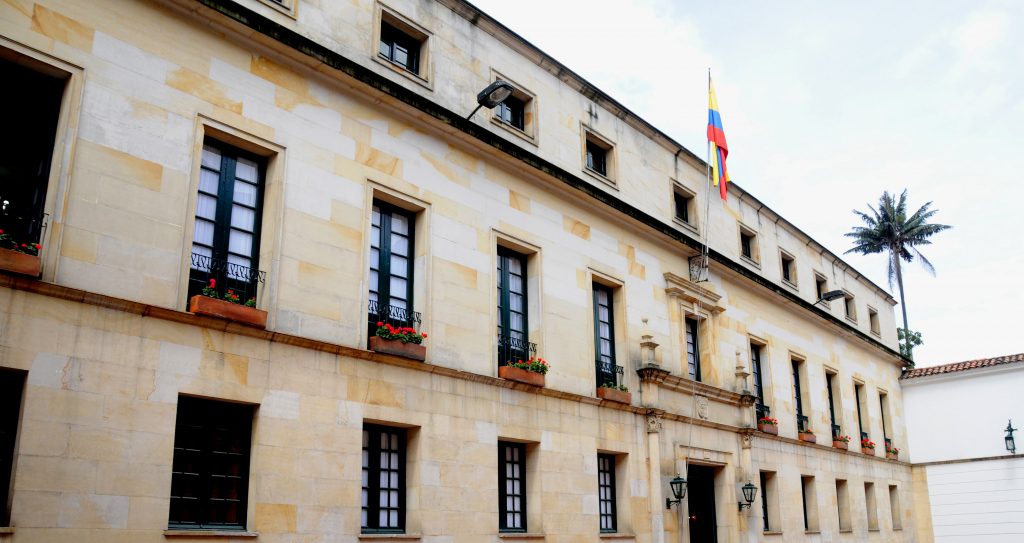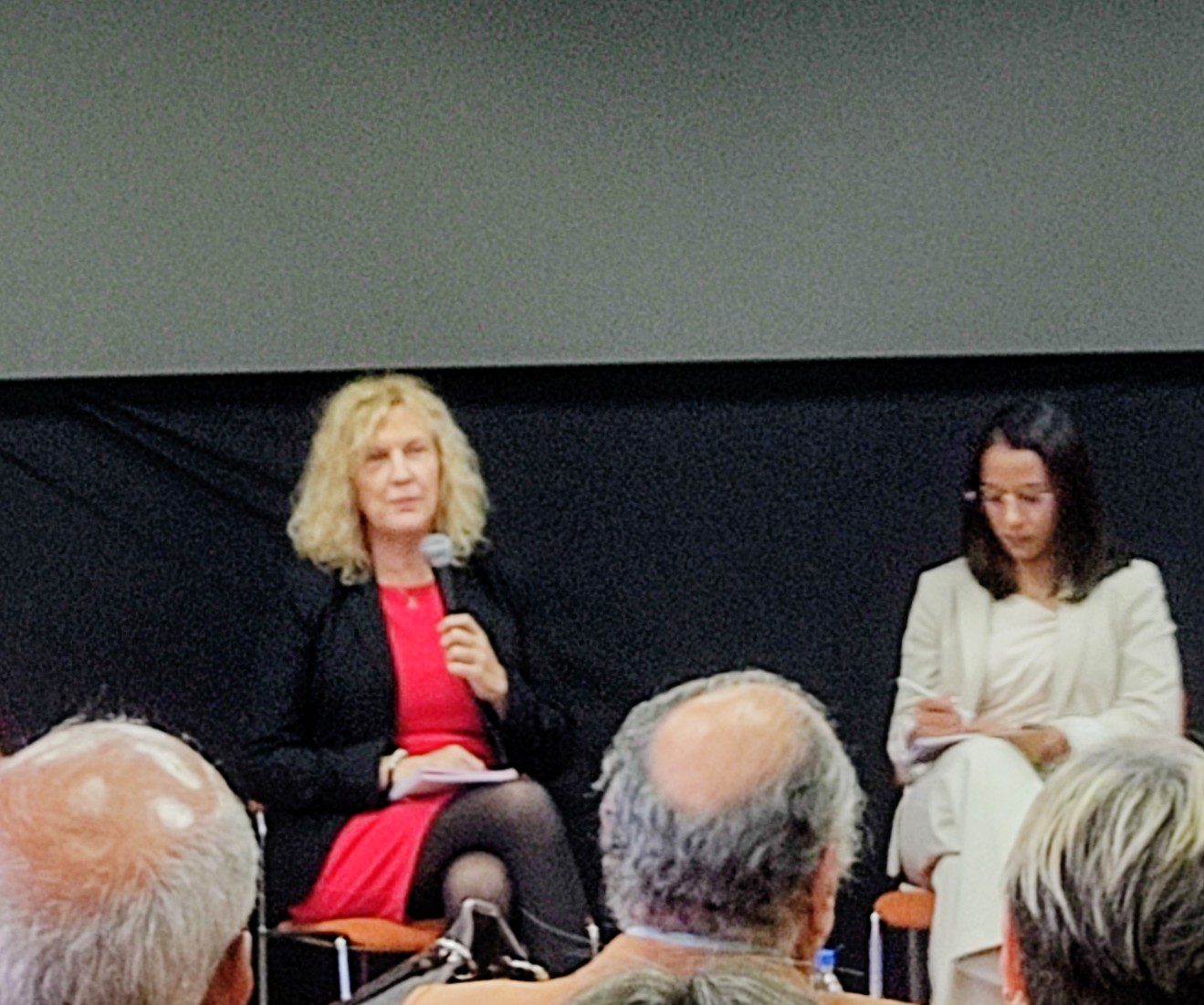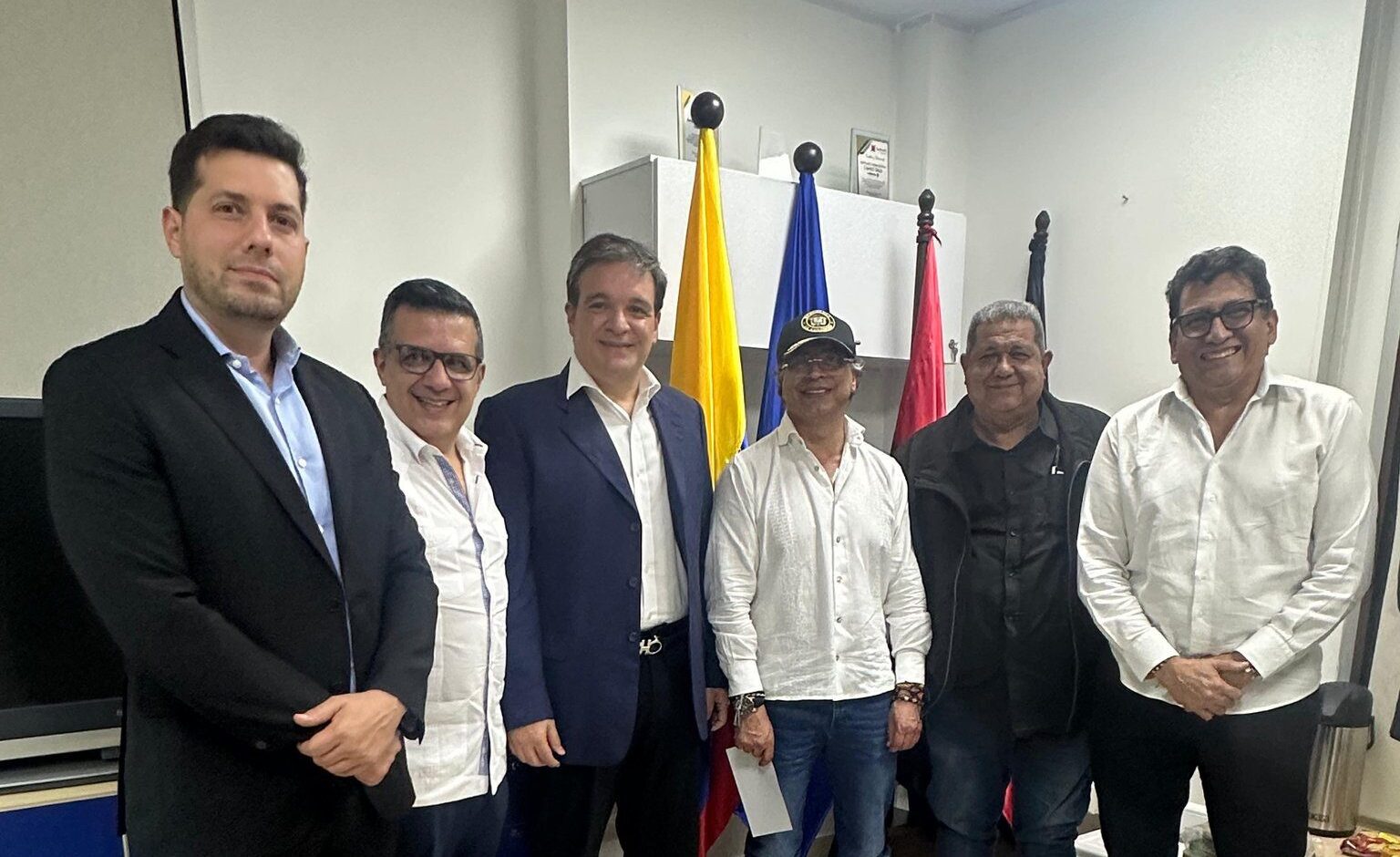
From left to right, Eric Ondarroa, leader of Lápiz; Jesús “Chuo” González, professor at the UCV; Ricardo Cusanno, former president of Fedecámaras; Gustavo Petro, president of Colombia; Pablo Zambrano, executive secretary of the union Fetresalud; and Milton Rengifo, Colombian ambassador in Caracas. Photo: X / @petrogustavo.
Guacamaya, December 4, 2025. A group of Venezuelan political and social representatives met in Cúcuta with Colombian president Gustavo Petro on December 3 to propose a peaceful, negotiated, and democratic solution route for their country and to reject any form of military interference.
The delegation, made up of members of the platform Una Venezuela Democrática, also insisted on the release of political prisoners, the creation of a broad dialogue table, and the construction of a “grand national agreement.”
The Venezuelan representatives were Pablo Zambrano, executive secretary of the Fetresalud union; Jesús “Chúo” González, professor at the Central University of Venezuela; Ricardo Cusanno, former president of Fedecámaras; and Eric Ondarroa, leader of the political party Alianza del Lápiz. The Colombian ambassador in Caracas, Milton Rengifo, also attended.
The meeting, which took place at Cúcuta’s Camilo Daza International Airport, lasted one hour, according to a source with first-hand information who spoke to Guacamaya. The planning of future meetings aimed at continuing to build this route of dialogue and understanding among the different actors involved is also being evaluated, the same source added.
During the meeting, the representatives of Una Venezuela Democrática presented two central proposals: the creation of an “inclusive national dialogue” for a Venezuelan-led solution to the crisis and the promotion of regional cooperation to consolidate the Caribbean as a zone of peace, according to an official press release. They outlined a dialogue process with all sectors of Venezuelan society, with international accompaniment, focused on “human dignity, the rights of the population, and the search for understanding above differences.”
The delegates emphasized that any path toward peace requires verifiable gestures, including a call for the release of all people detained for political reasons. In this context, they also expressed the need for a general amnesty to help move toward a resolution of the conflict. According to the statement, President Gustavo Petro received the proposals with interest and agreed on the need to address the Venezuelan situation through dialogue and regional cooperation. The platform also announced that it will bring this agenda to other international forums to promote a sovereign, peaceful solution arising from within Venezuela.
Who represented “Una Venezuela Democrática”?
“Una Venezuela Democrática” is a plural platform established on October 14, 2025, which seeks to promote national reunification, peace, and respect for human rights. Since its inception, it has been made up of political and union leaders, civil society representatives, journalists, and academics, among others. The attendees at the meeting represent diverse sectors of Venezuelan life.
Union leader Pablo Zambrano is currently the executive secretary of Fetrasalud. He was also a candidate for the National Assembly in May for Circuit 5 of Caracas with Fuerza Vecinal and is part of the Civic Forum.
Eric Ondarroa, opposition leader and executive secretary of Alianza Lápiz, was a candidate for the governorship of Miranda in the last regional elections in May.
Jesús González, professor at the Central University of Venezuela, PhD in Political Science, and also a member of the Civic Forum, attended as an academic and social representative.
Businessman Ricardo Cusanno was president of Fedecámaras and later of the Venezuelan Red Cross— the latter under a restructuring board appointed by the Supreme Court of Justice. He stood out for promoting more fluid dialogue between the business sector and the Venezuelan government during his tenure, and for encouraging the study of peace processes such as those of Colombia, Tunisia, and Northern Ireland. Cusanno was a member of the Civic Forum and was recently a candidate this year for the National Assembly with the support of Un Nuevo Tiempo (UNT) and Unión y Cambio (UNICA).
A dialogue proposal amid the U.S. military deployment
The meeting took place in the context of the U.S. military deployment in the Caribbean Sea, which the government of Nicolás Maduro considers a “threat.” In response to this situation, the Venezuelan leaders reiterated their rejection of any foreign military intervention and presented to Petro the need to promote a national democratic agreement that strengthens sovereignty and encourages bilateral cooperation.
The delegation also emphasized its call for the construction of a broad table that includes various political sectors of the country and works toward the search for a grand national agreement of a democratic nature.
The approach of this group contrasts with the strategy of the more maximalist sector of the Venezuelan opposition, led by Nobel Peace Prize winner María Corina Machado, who has openly supported the actions of former U.S. president Donald Trump in the Caribbean Sea. This military deployment has drawn criticism from several European countries and the United Nations.
The meeting in Cúcuta took place just days after Petro himself offered Colombia as a venue for a potential meeting between Nicolás Maduro and Donald Trump. “I believe Trump should accept that Venezuelans, in their different positions and in their own diversity, meet; it could be in Caracas, I offer Cartagena,” the president said.
The Colombian government has consistently reiterated the need for a negotiated solution to Venezuela’s political crisis. Petro, who did not officially recognize Maduro’s controversial victory in the 2024 presidential elections, has even raised the possibility of a repeat election and has defended the idea of a “shared transitional government” as a way to avoid an escalation of violence or foreign intervention.
On several occasions, the Colombian administration has also insisted on the release of political prisoners as an indispensable step toward fostering a climate of détente. The initiative presented in Cúcuta by Venezuelan social and business representatives aligns with the same logic: rejecting violence, promoting dialogue, and contributing to the construction of joint solutions to the economic and political challenges facing Venezuela.