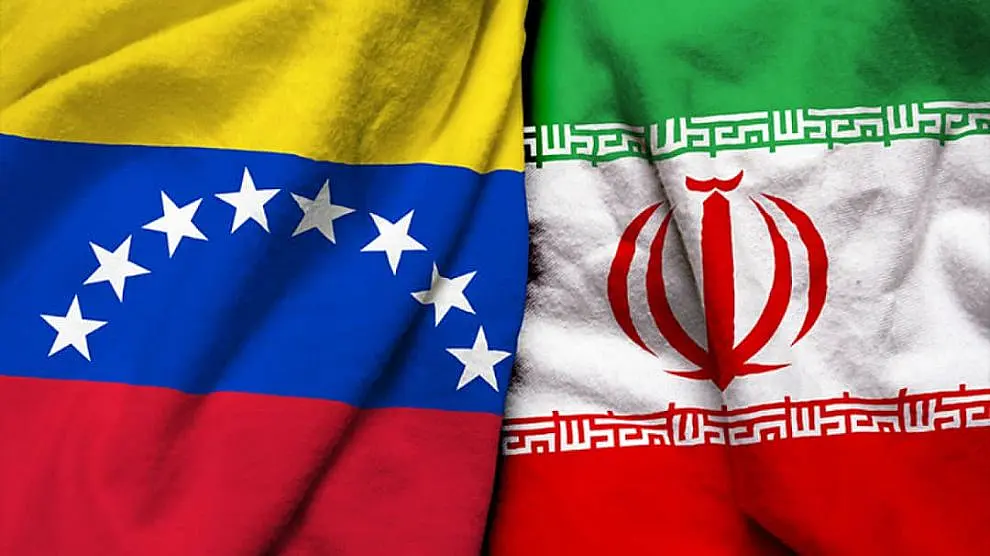
Flags of Venezuela and Iran. Photo: Website of the Ministry of Popular Power for Economy and Finance
Guacamaya, December 30, 2025. The Office of Foreign Assets Control (OFAC) of the U.S. Department of the Treasury announced the designation of ten individuals and entities based in Venezuela and Iran, whom it accuses of participating in the proliferation of unmanned aerial vehicles (UAVs), ballistic missile components, and other Iranian military capabilities. This action is part of the context of the reimposition of United Nations sanctions against Tehran in 2025.
The Office of Foreign Assets Control (OFAC), under the U.S. Department of the Treasury, announced a new round of sanctions targeting ten individuals and entities based in Venezuela and Iran, including a Venezuelan company accused of facilitating trade in Iranian-designed unmanned aerial vehicles (UAVs) to Venezuela.
According to the U.S. Treasury, these measures seek to hold both countries accountable for what it describes as an “aggressive and reckless” proliferation of lethal weapons. In the words of Treasury Under Secretary for Terrorism and Financial Intelligence, John K. Hurley, Washington will continue to act “swiftly to prevent those who facilitate the access of the Iranian military-industrial complex to the U.S. financial system” from operating unrestricted.
Framework of the sanctions
The decision falls within the continuity of non-proliferation designations issued by the Treasury Department in October and November, and is linked to the reimposition of UN sanctions and other restrictions against Iran, effective since September 27, 2025. According to the United States, Iranian UAV and missile programs represent a threat to U.S. personnel and its allies in the Middle East, in addition to contributing to instability in commercial navigation in the Red Sea, as per Washington’s assessment.
The Treasury further maintains that Iran’s continuous supply of conventional weapons to Caracas constitutes a threat to U.S. interests in the Western Hemisphere, including its own national territory, and states that it will use all tools at its disposal to hinder this type of exchange.
These actions are taken in compliance with Presidential Memorandum on National Security No. 2, which instructs the U.S. government to restrict the Iranian ballistic missile program, counter the development of other asymmetric and conventional weapons capabilities, prevent Iran from obtaining a nuclear weapon, and deny the Islamic Revolutionary Guard Corps (IRGC) access to assets and resources supporting its destabilizing activities. OFAC acts under the authority of Executive Order 13382, targeting proliferators of weapons of mass destruction and their facilitators, and Executive Order 13949, focused on persons and property linked to Iran’s conventional weapons activities.
Venezuelan company linked to iranian drones
Among the designations is Empresa Aeronáutica Nacional S.A. (EANSA), based in Venezuela, and its president, José Jesús Urdaneta González, a resident of that country. According to OFAC, since 2006, Iran and Venezuela have coordinated the supply of UAVs from the Mohajer series, produced by Qods Aviation Industries (QAI), which in Venezuela were renamed as ANSU series UAVs.
EANSA maintains and oversees the assembly of these systems on Venezuelan soil and has negotiated directly with QAI, contributing to the sale of Mohajer-6 UAVs valued at several million dollars. The Mohajer-6 is a combat UAV with intelligence, surveillance, and reconnaissance capabilities, manufactured by QAI. The Venezuelan company also participated in the assembly of aircraft sold by QAI to Venezuela.
According to the U.S. Treasury, EANSA maintains UAVs operated by the Venezuelan Armed Forces, including Iranian Mohajer-2 models, known locally as Arpia or ANSU-100. The latter is described as an upgraded and armed version of the Arpia-001, a direct derivative of the Mohajer-2, and considered the first UAV produced in Venezuela. The ANSU-100 is capable of launching guided Qaem air-to-ground bombs of Iranian design.
Urdaneta, on behalf of EANSA, allegedly coordinated with members and representatives of the Venezuelan and Iranian armed forces for the production of UAVs in Venezuela. For these reasons, EANSA was designated pursuant to Executive Order 13949 for having provided financial, material, or technological support to or for the benefit of QAI, while Urdaneta was designated for acting on behalf of the company.
It is worth recalling that in October 2023, OFAC had already designated Qods Aviation Industries, pursuant to Executive Order 13949, for being owned or controlled by Iran’s Ministry of Defense and Armed Forces Logistics (MODAFL), or for acting on its behalf. In turn, the State Department designated MODAFL in September 2020 for its involvement in activities contributing to the supply and transfer of weapons and related materiel.
Iranian network for missile component procurement
OFAC also announced the designation of three individuals based in Iran for their involvement in the procurement of chemicals used in ballistic missile programs, including sodium perchlorate, sebacic acid, and nitrocellulose, destined for Parchin Chemical Industries (PCI). This company is part of Iran’s Defense Industries Organization (DIO) and is responsible for the import and export of chemicals.
Sodium perchlorate is used to produce ammonium perchlorate, a substance controlled by the Missile Technology Control Regime (MTCR), used in solid propellant rocket engines, commonly found in ballistic missiles. Sebacic acid is used to produce resins and plasticizers, some of which are also controlled by the MTCR, while nitrocellulose is used to enhance the performance of solid propellant rocket engines.
PCI was designated by OFAC in July 2008 pursuant to Executive Order 13382, and DIO was designated by the State Department in March 2007 under the same authority. Both entities are also subject to asset freezes under UN Security Council Resolutions 1737 and 1747.
Among the designated individuals is Mostafa Rostami Sani, based in Iran, accused of acquiring dozens of metric tons of sodium perchlorate for PCI, in coordination with Marco Klinge, Majid Dolatkhah, and the company MVM Amici Trading LLC. Rostami Sani also allegedly facilitated the acquisition of sebacic acid and nitrocellulose, acting as a liaison between PCI and other intermediaries.
Klinge and Dolatkhah were designated by OFAC on November 12, 2025, pursuant to Executive Order 13382 for providing material and financial support to PCI, while MVM Amici Trading LLC was designated for being owned or controlled by Klinge.
Rostami Sani chairs the board of directors of Pardisan Rezvan Shargh International Private Joint Stock Company, based in Iran, of which he was the founding managing director. Reza Zarepour Taraghi, also based in Iran, is the company’s managing director and a member of its board. Rostami Sani was designated pursuant to Executive Order 13382 for supporting PCI, while Pardisan Rezvan Shargh and Zarepour Taraghi were designated for acting under his ownership or control.
High-Tech companies and links to the IRGC
OFAC also announced the designation of two entities and three individuals based in Iran for their links to Rayan Fan Kav Andish Co (RFKA), also known as Rayan Fan Group, a holding company designated by the United States that groups companies in the high-tech systems sector. RFKA owns Rayan Roshd Afzar Company (RRA), accused of producing components for the IRGC’s UAV program and software for its aerospace program.
RFKA is the majority shareholder of Fanavari Electro Moj Mobin Company, based in Iran, and is represented by Mohsen Parsajam as president and a member of its board of directors. Seyyed Reza Ghasemi and Farshad Hakemzadeh, also previously designated by the United States, are part of the board, along with Bahram Rezaei, managing director of Fanavari.
RFKA was designated in May 2024 pursuant to Executive Order 13382 for being under the control of Parsajam. RRA had already been designated in July 2017 for supporting the IRGC, and on that occasion, Parsajam, Ghasemi, and Hakemzadeh were also designated. Fanavari was now designated for acting under the ownership or control of RFKA, and Rezaei for acting on behalf of Fanavari.
Rezaei is also the majority shareholder and chairman of the board of Kavoshgaran Asman Moj Ghadir Company (KAMG), based in Iran. Erfan Qaysari is its managing director and Mehdi Ghaffari its vice president. KAMG was designated pursuant to Executive Order 13382 for being under the control of Rezaei, while Qaysari and Ghaffari were designated for acting on behalf of the company.
Legal effects of the designations
As a result of these measures, all property and interests in property of the designated individuals and entities that are in the United States or under the control of U.S. persons are blocked and must be reported to OFAC. Furthermore, any entity that is owned, directly or indirectly, 50 percent or more by one or more blocked persons, is also subject to blocking.
Unless authorized by a general or specific license or exemption, OFAC regulations generally prohibit all transactions by U.S. persons or within the United States that involve property or interests in property of blocked persons. Non-compliance can result in civil or criminal penalties, applicable to both U.S. and foreign persons, and OFAC can impose civil sanctions based on a strict liability regime.
Additionally, engaging in certain transactions with the designated persons can lead to the imposition of secondary sanctions on foreign financial institutions, including the prohibition or imposition of strict conditions for maintaining correspondent or payable-through accounts in the United States.
The UN sanctions regime reimposed on Iran in 2025
The reimposition of UN sanctions against Iran in 2025 falls within the mechanisms provided by the Security Council to respond to non-compliance related to missile programs, weapons proliferation, and activities sensitive from a non-proliferation standpoint. These sanctions restore multilateral restrictions including embargoes on conventional weapons, limitations on the transfer of missile and UAV technologies, freezing of assets of entities and individuals linked to Iran’s defense sector, and increased financial and commercial controls. Unlike unilateral sanctions, the UN regime is binding on all Member States, obliging them to adjust their national legislation and policies to prevent transfers, financing, or technical assistance that could contribute to Iran’s military and missile programs. In practice, this framework reinforces international cooperation in export controls, financial oversight, and enforcement of punitive measures, and serves as a basis for additional actions taken by countries like the United States in their own sanctioning regimes.
It is important to note that all this is happening while the United States is enforcing a naval blockade off the Venezuelan coast and tensions with Iran in the Middle East have increased significantly in this year 2025.