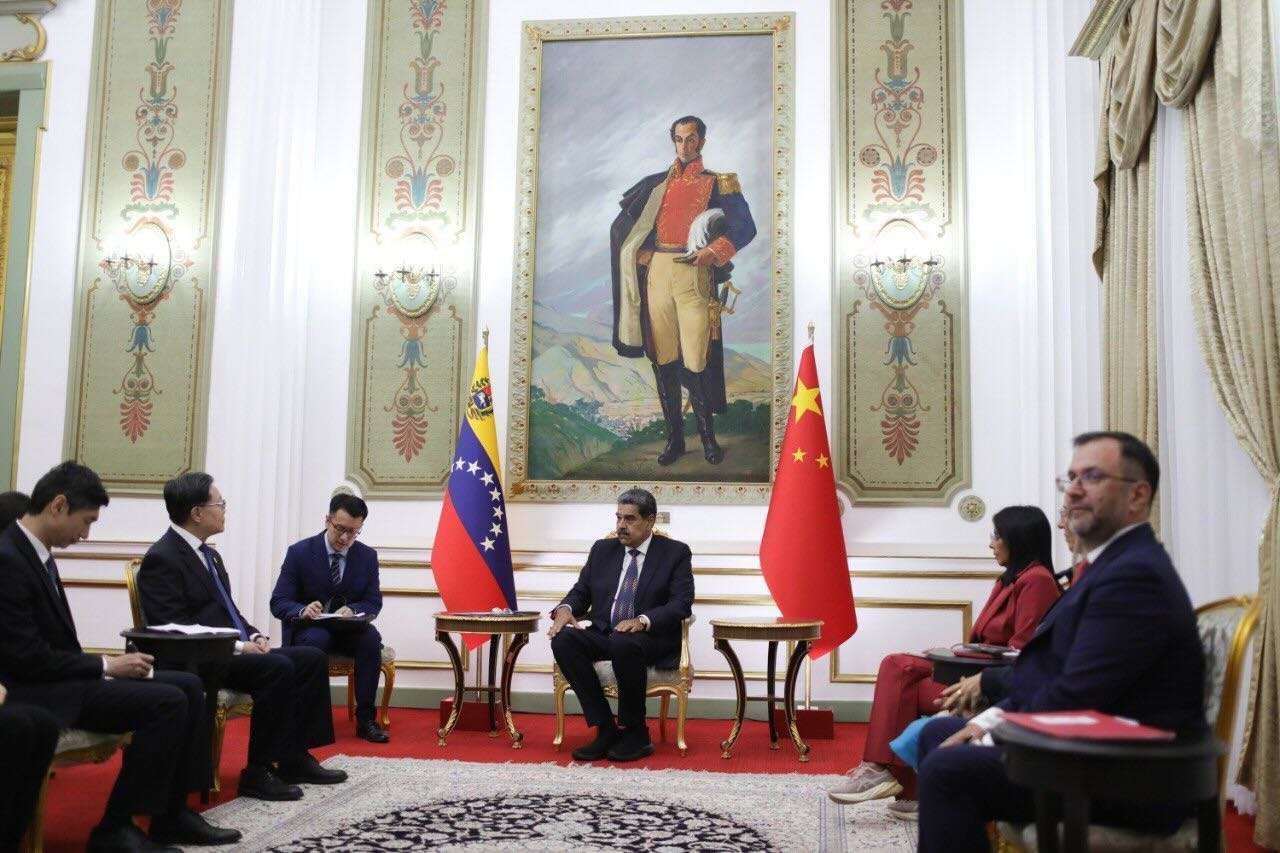
Delegation of the People’s Republic of China, headed by Qiu Xiaoqi, special envoy of Chinese President Xi Jinping, along with the team from the asian country’s embassy in Venezuela, meets with Nicolás Maduro. Photograph: Presidential Press
Guacamaya, January 2, 2026. Venezuelan President Nicolás Maduro received in Caracas Qiu Xiaoqi, special envoy of Chinese President Xi Jinping, in a visit marked by mounting military and economic pressure from the United States on Venezuela and by China’s growing role as the country’s main energy partner.
The meeting took place this Monday at the Miraflores Presidential Palace, where Maduro held talks with Qiu Xiaoqi in the presence of Executive Vice President Delcy Rodríguez and Foreign Minister Yván Gil. The Chinese delegation also included China’s ambassador to Venezuela, Lan Hu, according to state broadcaster Venezolana de Televisión (VTV).
According to the state network, the visit aimed to review the status of more than 600 cooperation agreements signed between the two countries, covering strategic sectors such as energy, infrastructure, technology, financing, and political cooperation.
China remains the main destination for Venezuelan oil: nearly 700,000 barrels per day of the approximately 1.2 million barrels currently produced by PDVSA are exported to the Asian country at discounted prices.
The presence of the Chinese special envoy comes amid growing confrontation between Caracas and Washington. Since August, the United States has maintained an air and naval deployment in the Caribbean which, according to U.S. authorities, seeks to combat drug trafficking, but which the Venezuelan government describes as a direct threat to its sovereignty. Beijing has openly criticized these operations, accusing the United States of violating international law, particularly following the seizure of vessels carrying Venezuelan crude.
On December 22, Chinese Foreign Ministry spokesperson Lin Jian reiterated his country’s opposition to unilateral sanctions against Venezuela, arguing that they lack legal basis and do not have the authorization of the United Nations Security Council.
“Venezuela has the right to independently develop mutually beneficial cooperation with other countries,” he said at the time.
Tensions escalated further after U.S. President Donald Trump announced an attack on a “large installation” linked, according to Washington, to a drug trafficking network allegedly led by Venezuela. Reports by The New York Times pointed to a drone strike on a Venezuelan port facility, a claim that Maduro neither confirmed nor denied, although he stated that the country’s defensive system has guaranteed its territorial integrity.
At the same time, frictions have emerged in the maritime and energy spheres. Russia formally requested that the United States cease its pursuit of an oil tanker heading toward Venezuela to load crude, an episode that adds to the recent sanctions imposed by Washington on companies linked to Venezuela’s oil sector.
Many of these tankers typically transport Venezuelan oil to several Chinese refineries, meaning that the U.S. blockade is disrupting China’s energy interests and its efforts to recover outstanding debt, at a time when Beijing is conducting military maneuvers near Taiwan.
The visit by Qiu Xiaoqi—a senior diplomat with extensive experience in Latin America and former ambassador to China in Brazil and Mexico—should be interpreted as a deliberate political signal at a moment of geopolitical realignment. He is one of China’s most experienced officials on Latin America, a region where Washington increasingly views China’s presence as a strategic threat.
Until now, China had largely limited itself to public statements, particularly at the United Nations. In that sense, the visit marks an important step in Beijing’s level of engagement in the Venezuelan conflict.
Moreover, the presence of the special envoy coincides with an apparent intention to move toward a higher level of coordination among China, Russia, and Iran, together with strategic allies such as Venezuela, Cuba, and Nicaragua, in response to U.S. pressure on energy and maritime routes. The implicit message Caracas seeks to project is that Venezuela is not isolated and that any escalation against it would have consequences beyond the bilateral sphere. For China, diplomatic support for Venezuela also reinforces its narrative of alternative leadership in the international order, while narrowing Washington’s room for maneuver in a region it has historically considered within its sphere of influence.
Meanwhile, Iran is also experiencing significant protests and heightened military tensions with the United States and Israel, developments that carry major energy implications for China. Added to this are rising tensions in the Red Sea following Israel’s recognition of Somaliland as an official state, a move that has escalated tensions along a critical commercial and energy corridor.
In this sense, the visit by the Special Envoy of the People’s Republic of China should be read within a global context that extends far beyond Venezuela alone.