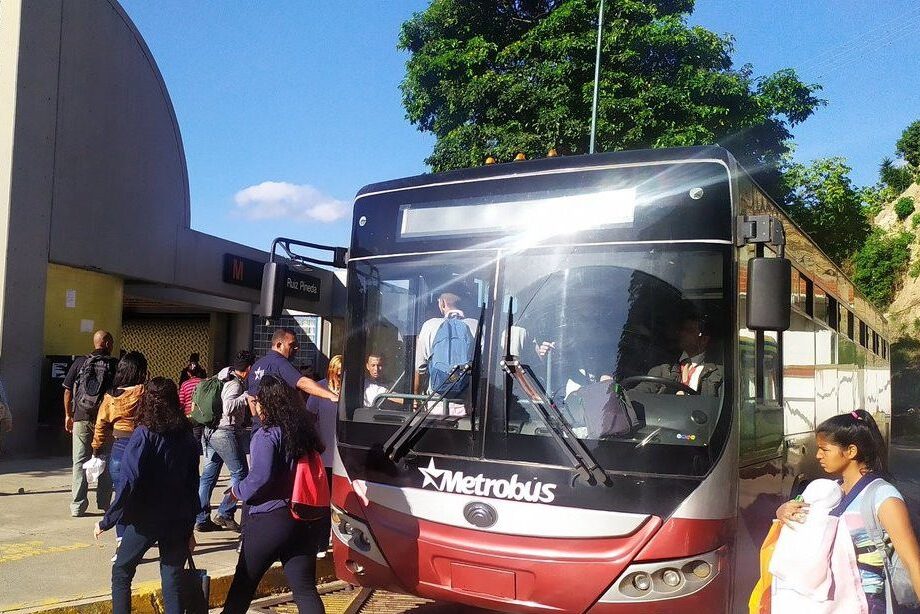
The Metrobús system deployed a special operation on Monday with more than 90 units to support mobility in the areas of highest demand in Caracas. Photo: Agencia Venezolana de Noticias.
Guacamaya, March 16, 2026. Caracas woke up on Monday partially paralyzed by a transportation strike that overwhelmed bus stops, collapsed the Metro, and once again exposed the divide between the Executive, drivers, and users. On one side, the government downplayed the call and labeled it an “attempt at sabotage,” while transport unions insisted the strike was the only way to pressure for fares that would make the service viable.
From early morning, users reported on social media that bus stops in areas such as Chacaíto, La Pastora, El Silencio, Caricuao, Antímano, Petare, and Guarenas-Guatire had no units available, while long lines of people stretched across major terminals and transfer points. The situation forced thousands to walk long distances or look for alternative ways to move around the city.
The absence of surface transport was felt sharply in the Caracas Metro, which became the only mass option to cross the city. Stations like Plaza Venezuela, Capitolio, Chacaíto, and La California saw overcrowded platforms, trains operating at maximum capacity, and waiting times longer than usual due to recurring system failures.
Pressure on the subway coincided with the recent fare increase from 60 to 80 bolívares, applied without prior notice to users. The measure added to the “silent” adjustment of surface transport, which many passengers found already at 100 bolívares on Monday, despite the union’s insistence that the Executive had originally promised to raise it to 120 bolívares.
The Sunday Call and the Demands
The strike was announced on Sunday, March 15, through videos and voice notes circulating on social media and messaging groups, in which leaders of Caracas transport lines called for suspending service from early Monday, March 16. The protest was based on the lack of an official response after an apparent commitment two weeks earlier to publish in the Official Gazette a minimum fare of 120 bolívares.
“We have pending agreements with the Ministry of Transport that have not been fulfilled,” said Nelson Vivas, president of the Asociación Civil Conductores La India, in a message shared on Sunday. The union spokesperson, from the line based in La Vega in southwest Caracas, also demanded the return of units that had been seized “for working with unauthorized fares.”
It is worth noting that since last year, the Inter-Union Transport Command has reiterated its demand to anchor the fare to 0.50 dollars. According to its own calculations, with the official exchange rate as of March 16, that anchor would place the urban fare at around 223 bolívares—well above the de facto increase to 100 bolívares ($0.22) that began to be charged on various routes without Official Gazette backing.
However, that adjustment—charged as of this week—is very close to the 130 bolívares that remain the current monthly minimum wage. To try to close that gap, unions have proposed a transportation bonus of between 25 and 30 dollars for all users. Their logic is that “there must be a balance between those who provide the service and the users who pay for it.”
Minister Aníbal Coronado’s Response
From the Executive, the visible face was Transport Minister Aníbal Coronado, who in a video posted on his social media accounts described the strike as “an attempt at sabotage and boycott” driven by “a few lines.” “Some tried to boycott and sabotage—just a few urban transport lines in the city—but this Government went into battle. Let me tell you, they failed,” he said.
Coronado highlighted the deployment of Metrobús units, the state-owned Sitssa fleet, official jeeps, and even vehicles from the National Bolivarian Police to mitigate the impact of the stoppage. However, despite the triumphant tone, the minister also expressed openness to dialogue and confirmed meetings with the Superior Transport Authority to review cost structures and the sector’s demands.
Capriles: Macroeconomics Disconnected From People’s Income
From the opposition, Unión y Cambio leader and lawmaker Henrique Capriles interpreted the strike as a symptom of a deeper problem. “The transportation strike we’re seeing today—at least in Greater Caracas—once again shows a reality the country lives every day: macroeconomics is completely disconnected from people’s income,” he wrote on social media.
Capriles highlighted the contradiction of discussing a 120-bolívar fare when the minimum wage and pension remain at 130 bolívares per month: “One fare is practically equivalent to an entire minimum wage or pension.” In his view, the issue is not about pitting drivers against users, but about recognizing that both sides have legitimate reasons to protest.
Users Report Abuse and Deterioration
Public frustration resurfaced on social media. Many users reported that even before the strike was announced, a significant number of drivers had already raised fares above the amounts agreed with the Executive, taking advantage of people’s urgency to reach their destinations and the lack of oversight.
Complaints about arbitrary increases were accompanied by reports of deteriorated units—buses with broken seats or obvious mechanical failures—as well as mistreatment of traditionally protected groups such as students and older adults. Users said they had been insulted, forced to pay unofficial increases, or left at stops amid disputes over the fare.
The Gap Exposed by the Strike
Monday’s strike not only left images of people walking along avenues or crowded lines at Caracas terminals—a situation that extended to La Guaira and parts of Miranda. It also made clear that the public transport system—operated by private drivers—resists disappearing, but does so in a context of official indifference and an economy that places drivers and users on opposing sidewalks.
Caught in the middle is a city that depends on a fragmented mobility system—costly for users and inefficient overall—in which any partial stoppage triggers a domino effect across other services. The debate, beyond fares, raises questions about the economic model and the State’s capacity to guarantee basic rights.