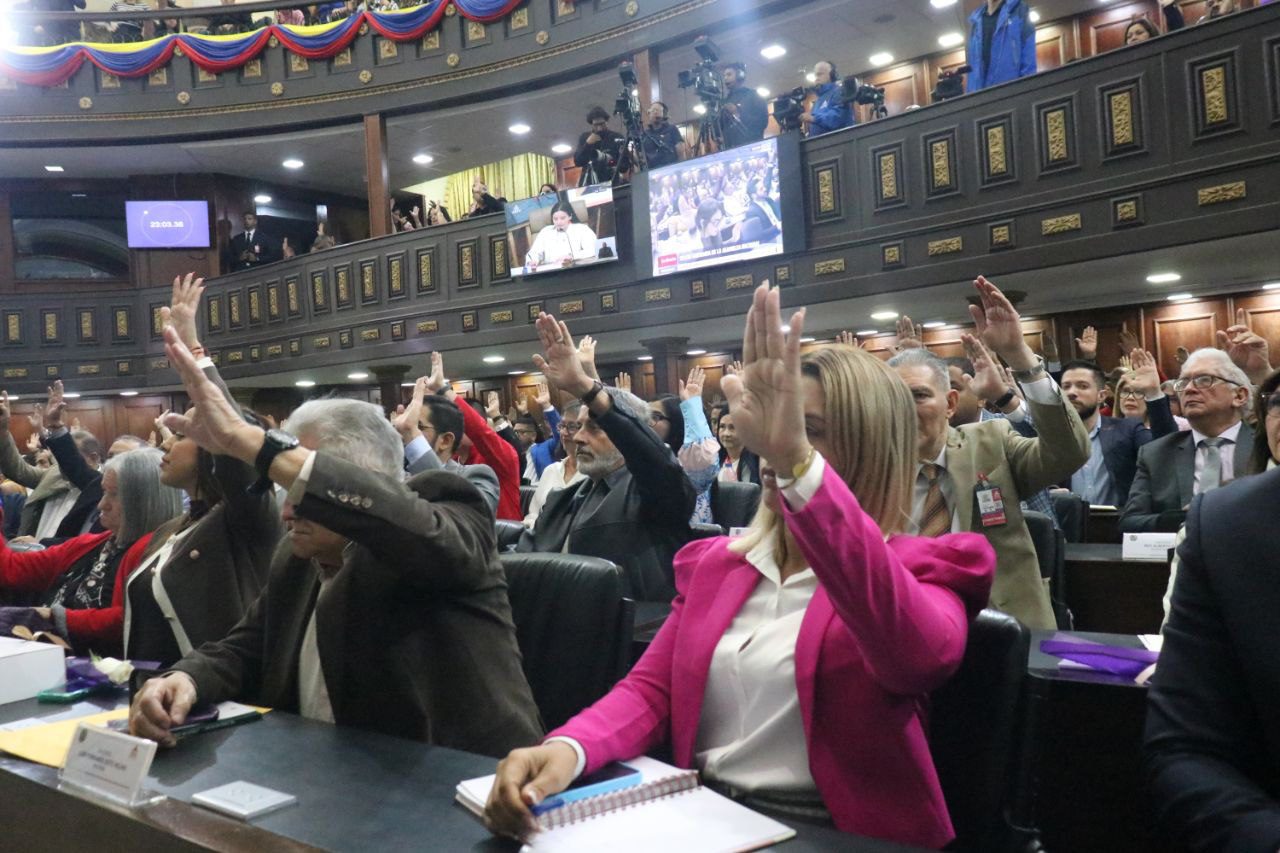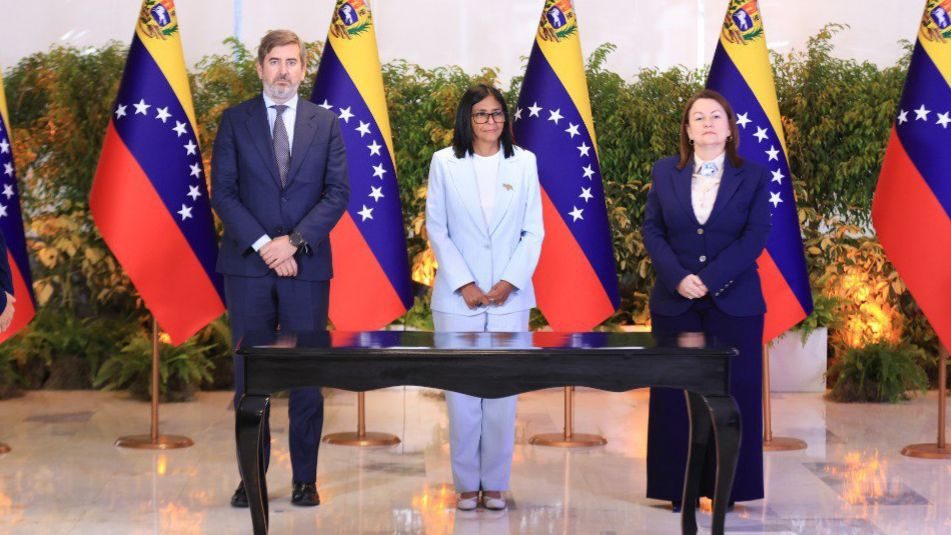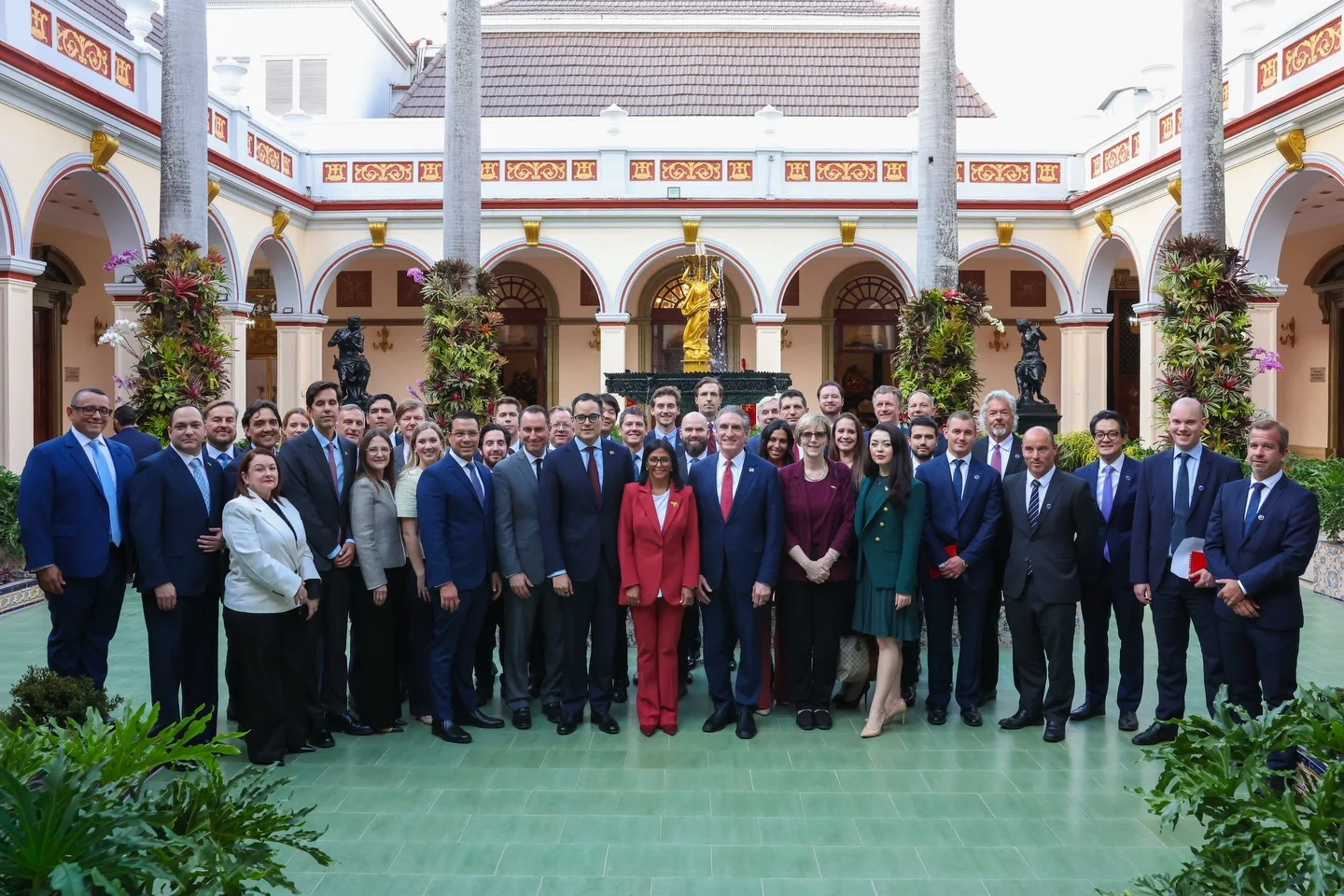
Venezuela is at a political turning point, sparking great interest and curiosity among investors around the world. In the image, Venezuela’s acting president, Delcy Rodríguez, and U.S. Secretary of the Interior, Doug Burgum, along with other senior officials and executives from mining and energy companies. Photo: Instagram / @delcyrodriguezv.
Guacamaya, March 23, 2026. The opening of strategic sectors and Venezuela’s repositioning on the global map after January 3 have caught the attention of international investors seeking high returns, difficult to find in other markets.
Although hydrocarbons concentrate most of the attention, this interest has diversified towards other sectors such as mining, infrastructure, tourism, financial services, and the real estate market.
While structural challenges and doubts about the institutional framework persist, various international and regional actors are observing with caution — and growing interest — the possibility of participating in the country’s productive reconstruction, or of taking advantage of it. In this balance between risk and opportunity, Venezuela is once again shaping up as a space where capital, politics, and strategy converge.
Opening After January 3
After January 3, and in the context of Delcy Rodríguez’s inauguration as acting president, a significant shift in the country’s economic orientation begins to take shape. This shift, still incipient but clearly identifiable, points towards greater openness, driven both by internal needs and changes in the international environment.
One of the key factors has been the partial relaxation of the sanctions regime by the administration of Donald Trump, particularly in strategic sectors such as oil and mining. Although these measures do not imply a total lifting of sanctions — and maintain significant restrictions in financial, technological, and operational matters — they do open up limited but important spaces for productive reactivation and the progressive reintegration of Venezuela into certain global economic circuits.
This new context has begun to capture the attention of international investors, especially those with a high tolerance for risk. These are, in many cases, actors already operating in other emerging or “frontier” markets, accustomed to complex regulatory environments and political volatility. For these investors, Venezuela represents an asymmetric opportunity: high risks, but also potentially extraordinary returns in undervalued sectors or those with capacity for accelerated recovery.
However, it is essential to distinguish between interest and commitment. So far, what predominates is an exploratory phase characterized by technical missions, preliminary contacts, country risk assessments, and sectoral analyses. The materialization of concrete investment flows — in the form of fresh capital, joint ventures, or structured financing — requires additional conditions: greater regulatory clarity, legal guarantees, macroeconomic stability, and, above all, sustained signs of continuity in the easing of sanctions.
In this sense, the current moment can be interpreted as a “pre-investment” stage, where expectations are built, opportunities are identified, and risks are calibrated. The transition to a phase of effective investment will depend on the country’s ability to consolidate trust, both internally and in its relationship with international actors.
Thus, rather than an endpoint, the post-January 3 situation should be understood as the beginning of a gradual process, full of nuances, where economic opening is not a one-time event, but a trajectory under construction.
Why Venezuela?
Beyond the recent economic opening and political changes, Venezuela is beginning to shape up as an atypical case within the universe of emerging markets. A high-risk environment, but with opportunities difficult to replicate in other geographies.
Firstly, the country offers an uncommon combination of underutilized assets and low effective competition. Unlike other markets where capital has already captured much of the value, in Venezuela, broad sectors — especially energy, mining, and infrastructure — remain lagging after years of disinvestment. This creates a scenario where the first entrants can access particularly favorable conditions, both in valuation and contract negotiation.
Added to this is a key distortion: the almost total absence of internal credit. The national financial system, severely limited, does not provide significant financing for either consumption or business expansion. In practice, this means that a large part of the economy depends on external capital or alternative financing schemes. For international investors, this lack translates into a structural advantage, as they see less local competition and greater capacity to influence projects and entire sectors.
Another central element is the magnitude and diversity of natural resources. Venezuela not only possesses some of the world’s largest oil reserves but also significant deposits of gas, gold, and strategic minerals. In a global context marked by geopolitical tensions and supply chain reconfiguration, these resources acquire additional geostrategic value. The country’s location — with access to the Caribbean and proximity to the U.S. market — reinforces its potential as an energy and logistics hub in the hemisphere.
In parallel, other sectors show equally attractive opportunities from a valuation standpoint. The real estate market, for example, presents significantly depressed prices compared to other economies in the region. Homes, commercial assets, and agricultural land are, in many cases, well below their replacement value, which opens up space for long-term investment strategies based on recovery and appreciation.
However, these opportunities are inseparably linked to considerable risks. Political uncertainty remains high, and the regulatory framework continues to evolve. Although steps have been taken towards openness — such as legal reforms to attract investment in hydrocarbons and a projected increase in oil investment — questions persist about the stability of the rules of the game, legal security, and the sustainability of changes over time.
Consequently, Venezuela is not — at least for now — a destination for traditional or conservative capital. It is, rather, a frontier market in transition, one where the risk-return differential can be extraordinary, but where only certain investor profiles are willing to enter.
First is Oil
A new business ecosystem is taking shape around Venezuela’s most attractive — and strategic — asset: hydrocarbons.
The large corporations that already had a foot in the country are now in a position of advantage. Companies like Chevron, Repsol, and Shell have not only resumed operations but have already announced plans to increase investment and production in the short and medium term, driven by the easing of the sanctions regime.
In this context, not only are existing operations being reactivated, but new companies and financial vehicles are also beginning to be constituted, specifically designed to capture value in the process of reopening the energy sector. These are more flexible structures, often with hybrid capital and an opportunistic approach, aimed at participating in new schemes like production sharing.
These new participants are not seeking to replicate the traditional model of the major oil companies. On the contrary, they show interest in more dynamic schemes, mainly focused on the recovery of mature fields, where the initial investment required is much lower and returns can be achieved in a short period.
Overall, what is emerging is a reconfiguration of the Venezuelan energy map: a space where large majors coexist with new, more agile actors, all operating under evolving rules. However, as in the rest of the economy, this process remains in an early phase. The signing of agreements, the financial closing of projects, and the execution of large-scale investments will depend on regulatory stability, legal security, and the continuity of sanctions relief.
Rather than an immediate boom, what is being observed is the assembly of the architecture that could support a new oil cycle in Venezuela.
The Gold Rush and Strategic Minerals
The visit of U.S. Secretary Doug Burgum to Caracas in early March brought with it two dozen mining executives, reinforcing the new political-economic framework emerging after January 3. Among the companies represented were Gold Reserve, Lundin, Trafigura, Glencore, and Peabody.
In his remarks, the U.S. official emphasized the need to articulate capital, technology, and talent to “create the appropriate economic conditions” that allow for the reactivation of oil production and the development of Venezuela’s mining potential.
These types of meetings do not occur in a vacuum. They are part of a broader strategy aimed at redefining global supply chains, particularly in the context of geoeconomic competition between the U.S. and China, and the search for alternative sources of critical minerals. In this framework, Venezuela appears not only as a traditional energy supplier from the past but as a relevant player in the supply of strategic resources such as gold, bauxite, copper, and coltan, essential for technology and defense industries.
The simultaneous presence of high-level corporate actors — including global commodity traders and energy companies with experience in complex markets — reinforces the reading that this is not an incipient interest, but an advanced exploratory phase towards a possible reconfiguration of Venezuela’s role in the international energy and mining market.
In this sense, the meeting in Caracas not only confirmed the interest of global investors but also evidenced a turning point: the transition from a logic of isolation and sanctions towards a scenario of negotiation, where investment flows begin to redraw the coordinates of the Venezuelan economy. For the international actors in that room, Venezuela ceases to be solely a geopolitical risk and becomes, once again, a space of strategic opportunity.
Brazil and Colombia: Neighbors Set Their Sights on Venezuela
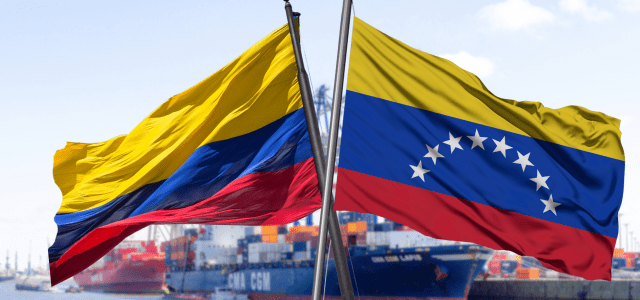
In this context, Guacamaya has learned of multiple visits and approaches from investors from Brazil. Similarly, Colombian businessmen have shown interest not only in the oil sector but also in the growth of the purchasing power of their largest neighbor.
One of the most emblematic cases is that of Jaime Gilinski and his family, who have two fronts. On one hand, they seek the expansion of Grupo Nutresa in the neighboring country, through the sale of products like chocolates, cookies, ice cream, and coffee, leveraging prior knowledge of the Venezuelan market and the historical affinity of the brand with consumers in the country.
Instead of developing production plants immediately, the strategy focuses on increasing productive capacity in Colombia and channeling exports to Venezuela via land routes. The bet is based on an increase in purchasing power rather than industrial capacity. In the words of Gilinski himself to Bloomberg, “growth in Venezuela could occur at an accelerated pace, without the need to wait for long periods of investment in productive infrastructure.”
On the other hand, the Gilinski family has bought 20% of the energy company GeoPark, becoming its largest shareholder. This company already has hydrocarbon assets in Colombia and Argentina, although the ultimate intention is clear: to invest in oil production in Venezuela.
In parallel, a process of strengthening connectivity between Colombia and Venezuela is observed, with the incorporation of new frequencies by airlines such as Wingo and the projected expansion of other international companies like LATAM. These dynamics point towards greater regional integration, where both countries are beginning to position themselves as a joint corridor to global markets.
Added to this is the possible inauguration of the Doha–Bogotá–Caracas air route, planned between late April and May, reflecting a new boost in Venezuela’s international connectivity and its insertion into broader geoeconomic dynamics. According to information from ProColombia, this project — in development for about a year — involves the authorities of Colombia, Venezuela, and Qatar, and seeks to consolidate a strategic air corridor connecting Latin America with the Persian Gulf.
The Tourism Sector in the Sights of an Egyptian Magnate
In February, the landing of a private flight carrying Naguib Sawiris on Venezuelan territory not only marked the arrival of a high-profile visitor but also another indication of the growing attention the country is attracting among high-net-worth global investors.
Sawiris is one of the most influential businessmen in the Arab world; his conglomerate includes interests in telecommunications, infrastructure, media, tourism, and energy. The Egyptian magnate has been president and central figure of Orascom Telecom, a company that became one of the most important players in the sector in Africa and the Middle East before its multibillion-dollar sale to the Russian firm VimpelCom in 2011.
According to sources consulted by Guacamaya, Sawiris has shown interest in Venezuela for his luxury tourism companies. He has led exclusive projects such as the El Gouna resort on the Red Sea and the development of premium destinations in Greece and the Caribbean island of Grenada.
His profile is not that of a conventional investor, but rather a strategic actor capable of influencing markets and regional trends. Sawiris has also ventured into sectors such as media — including his stake in Euronews — and global investments through holdings spanning Africa, Europe, and the Middle East.
Venezuela Seeks Investments in Gulf Countries
The relevance of this new air route transcends the merely logistical, to the extent that Qatar has consolidated itself as a key actor in the process of political and economic reconfiguration that Venezuela is undergoing after January 3. Its role is not limited to connectivity or commercial exchange but has also been fundamental in mediation and international articulation dynamics, positioning itself as a bridge between Caracas and other centers of global power.
In this context, the foreign policy promoted by Delcy Rodríguez has prioritized strengthening ties with Gulf countries, recognizing their growing influence in global energy, financial, and investment markets. This strategy has translated into an active agenda of diplomatic approaches, which has included meetings with delegations from Qatar, the United Arab Emirates, and Jordan, aimed at exploring cooperation opportunities in strategic sectors such as energy, trade, tourism, and investment.
Complementarily, the sectoral vice president of Economy, Calixto Ortega, has played a key role in this opening strategy, leading a recent visit to Dubai.
These efforts seek to insert the country into the Gulf’s investment circuits, characterized by high liquidity. Financial centers like Dubai also facilitate the trade of commodities such as oil and gold away from the oversight of U.S. and European regulatory bodies.
Electricity: Can We Say the P-word?
The Venezuelan National Electric System (SEN) has become one of the central points of discussion for the entire country, and even for high-ranking officials of the Trump administration. Resolving its structural failures is as important for the well-being of the population and the country’s stability as it is for the recovery of oil production and other industries.
Several investors who have visited Caracas have inquired about the SEN, either to study their possible participation in the sector, or to evaluate the viability of investments in other industries while a stable energy supply does not exist. Curiosity has also been sparked regarding the interconnection of the Venezuelan and Brazilian electrical systems, which could flow in both directions.
According to sources consulted by Guacamaya, the governments of Venezuela and the U.S. have discussed the possibility of privatizing and decentralizing the SEN, which would reverse 20 years of monopoly by the state-owned CORPOELEC.
Since late 2025, the recently replaced Minister of Electric Energy, Jorge Márquez, had been promoting a series of consultations with businessmen, aimed at evaluating mechanisms to incorporate private participation in solving the system’s structural failures. Among the options under evaluation are resources from private funds, as well as support from multilateral organizations such as the CAF – Development Bank of Latin America.
New Financial Instruments for Investment from Abroad
One of the initiatives in the financial sector has been the announcement by IFG Capital and Privatam that they have decided to structure a financial certificate based on Venezuelan assets. The instrument will incorporate a diversified portfolio that includes shares listed on the Caracas Stock Exchange and assets linked to strategic sectors such as energy and natural resources.
The initiative focuses not only on the composition of the portfolio but also on the regulatory architecture that supports it. In this regard, IFG Capital and Privatam emphasized that the certificate will be structured and administered under a scheme of strict compliance with all applicable regulations and policies regarding international sanctions. This expressly includes observance of the provisions issued by the Office of Foreign Assets Control (OFAC) of the U.S. Department of the Treasury, as well as other relevant sanctions regimes internationally.
From an economic perspective, the creation of these instruments also contributes to the appreciation of Venezuelan assets. By integrating them into a professionally structured and managed portfolio, an investment narrative is generated that can influence the country’s risk perception, at least in specific niches. This can translate into greater visibility for key sectors and, potentially, the establishment of clearer price references, something particularly relevant in markets with low liquidity or high uncertainty.
The creation of financial instruments like the one described is not an isolated event; it has profound significance for Venezuela in economic terms, but above all in geopolitical terms. In essence, these certificates represent a sophisticated way to “reconnect” the country with the Western financial system without completely dismantling the sanctions regime or waiting for the process of political or diplomatic normalization between Washington and Caracas to materialize.
The Current Landscape of Venezuelan Assets
The current situation of Venezuelan assets and the State’s growing intention to transfer part of them to the private sector goes beyond electricity, mining, or oil and must be understood as a structural transformation of the country’s economic model, marked by the need to attract investment, recover productive capacity, and adapt to an international environment of crisis and volatility.
For over two decades, Venezuela followed a model of strong state control, especially since the government of Hugo Chávez, based on the nationalization of strategic sectors. Key industries such as oil, electricity, steel, agribusiness, and telecommunications passed into state hands. This process involved the expropriation of private companies and the consolidation of a broad state productive apparatus, but over time it also generated significant problems: falling production, deteriorating infrastructure, lack of investment, and loss of efficiency.
An illustrative example is Agropatria, which originally was the private company Agroisleña. After its expropriation in 2010, it passed into state hands, but years later it was again transferred to private actors, evidencing a tendency towards partial reversal of the statist model.
In the current context, the Venezuelan government has begun to promote a progressive opening to the private sector. This process is not limited to specific cases but responds to a broader logic: reactivating underutilized or deteriorated assets through private capital, technology, and management.
One of the most important changes has occurred in the oil sector, historically controlled by the State through PDVSA. The reform of the Organic Hydrocarbons Law in 2026 marks a turning point, as it allows the direct participation of private companies in exploration, production, and commercialization activities. In this case, the state-owned company is not sold, but loses its monopoly.
However, the opportunities for privatization or opening to the private sector are not limited to oil. There are clear indications that the process extends to other strategic sectors. In the case of the basic industries of Guayana — such as steel, aluminum, and mining — possible privatization schemes or private participation are already being discussed, driven by the need for investment and modernization. An existing example is the “strategic alliance” between India’s Jindal Steel & Power and the state-owned Ferrominera del Orinoco.
This set of factors configures what could be called a process of “functional privatization” or “pragmatic opening.” It is not necessarily a total sale of assets, but rather hybrid schemes where the State maintains some ownership or formal control but delegates operation, financing, or management to the private sector.
From an economic perspective, this implies a renewed interest in Venezuelan assets. Companies that for years were deteriorated or off the international radar are beginning to be seen as investment opportunities, especially in a context where the country remains one of the most undervalued markets in Latin America.
However, the process faces significant challenges. Investor confidence remains conditioned by a history of expropriations, unresolved legal disputes, the political context where stability is key, and perceptions of legal insecurity. Furthermore, the opening is partial and controlled, meaning that not all sectors nor all actors have access under equal conditions.
Venezuelan assets are ceasing to be merely deteriorated state assets to become, once again, instruments of strategic interest for international investors, albeit within a complex, conditional, and deeply geopolitical environment.
Elías Ferrer collaborated with the writing of this article.