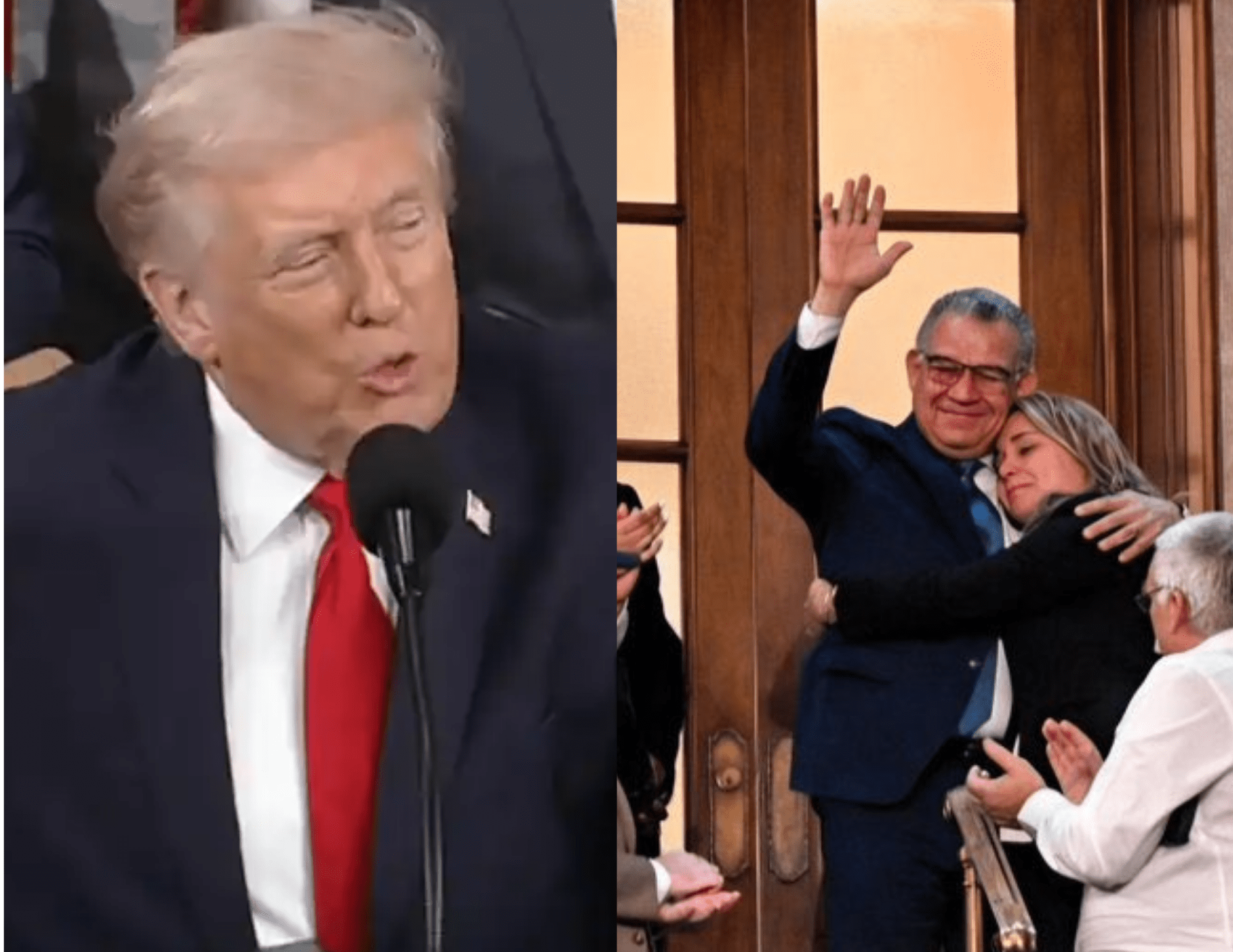
He stressed that Washington is working “very closely” with interim president Delcy Rodríguez to unlock “extraordinary economic benefits for both countries” and to bring “new hope to those who have suffered so terribly.” Central to that renewed relationship, Trump underscored, is energy cooperation. He announced that more than 80 million barrels of Venezuelan crude had recently entered the U.S. market. One of the most unexpected moments of the address came when Enrique Márquez—former presidential candidate and leader of the Centrados party—was introduced in the chamber. Márquez had spent a year imprisoned at El Helicoide, headquarters of Venezuela’s intelligence service. Trump invited him to stand and celebrate his freedom, as cameras captured an emotional embrace with his niece.
Guacamaya, February 25, 2026. In his first State of the Union since returning to the White House, Donald Trump placed Venezuela at the center of his foreign policy agenda: he celebrated the military operation that led to the capture of Nicolás Maduro, announced close cooperation with interim president Delcy Rodríguez, highlighted the large-scale flow of Venezuelan oil to the United States, and surprised lawmakers by presenting recently released opposition leader Enrique Márquez as a guest of honor.**
President Donald Trump devoted one of the most extensive and emphatic sections of his State of the Union address to Venezuela, describing it as “our new friend and partner” following the U.S. military operation in January that culminated in Maduro’s capture and forced removal. Trump characterized the mission as “impressive,” calling it “a colossal victory for the security of the United States” and “a brilliant new beginning for the Venezuelan people.”
He stressed that Washington is working “very closely” with interim president Delcy Rodríguez to unlock “extraordinary economic benefits for both countries” and to bring “new hope to those who have suffered so terribly.” Central to that renewed relationship, Trump underscored, is energy cooperation. He announced that more than 80 million barrels of Venezuelan crude had recently entered the U.S. market.
“American oil production has increased by more than 600,000 barrels per day, and we have just received, from our new friend and partner Venezuela, more than 80 million barrels of oil,” Trump declared.
The president also paid tribute to a helicopter pilot wounded during the operation against Maduro who, according to Trump, completed the mission despite his injuries. In one of the most ceremonial moments of the evening, Trump paused to award him the Congressional Medal of Honor.
Beyond celebrating the oil partnership, Trump asserted that hundreds of Venezuelan political prisoners have been released since Maduro’s detention—an outcome he framed as a direct achievement of his administration.
The political gesture: Enrique Márquez at the Capitol
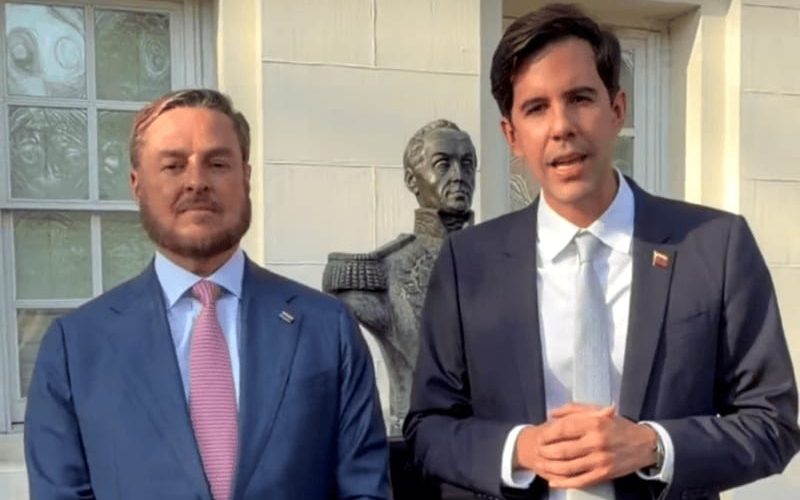
One of the most unexpected moments of the address came when Enrique Márquez—former presidential candidate and leader of the Centrados party—was introduced in the chamber. Márquez had spent a year imprisoned at El Helicoide, headquarters of Venezuela’s intelligence service. Trump invited him to stand and celebrate his freedom, as cameras captured an emotional embrace with his niece.
“We brought him here tonight to celebrate his freedom. Enrique, please enjoy yourself. I’m glad you’re back,” Trump said.
Observers interpreted Márquez’s presence as a powerful symbolic gesture underscoring Washington’s decisive role in Venezuela’s new political phase and in the release of political detainees—particularly amid ongoing criticism from human rights groups regarding the implementation of the Amnesty Law passed by the National Assembly.
An electrical engineer from Maracaibo and former rector of the National Electoral Council (CNE) from 2020 to 2023, Márquez ran in the July 2024 presidential election. During that process, he denounced inconsistencies in the official results and demanded publication of the tally sheets supporting Maduro’s proclaimed victory. He appealed to the Supreme Tribunal of Justice but obtained no favorable ruling.
His candidacy emerged as an alternative amid government efforts to block opposition leader María Corina Machado from participating. After Machado’s disqualification and the subsequent nomination of academic Corina Yoris as a substitute, Márquez became a contingency option in the event of further exclusions, including that of unity candidate Edmundo González Urrutia.
He was detained amid a broader wave of repression preceding Maduro’s third-term inauguration in January 2025. Colombian president Gustavo Petro publicly criticized the arrest at the time, arguing that injustice cannot be confronted through further injustice exercised from power.
Márquez was among the first political prisoners released after Maduro’s fall. His appearance in the House chamber was widely seen as reinforcing Washington’s new influence over Caracas.
Who Is Enrique Márquez? : political trajectory and ideological profile
Emerging from a strand of Venezuelan leftism that did not align with Chavismo, Márquez began his activism in student movements before joining the labor-oriented party La Causa R. He later served as a deputy for Zulia state from 2000 to 2005, advocating parliamentary autonomy during the consolidation of executive power under Hugo Chávez.
His professional background includes academic studies in the United Kingdom through a scholarship program and work at Lagoven, one of Venezuela’s major oil companies in the late twentieth century.
In 2006 he joined Manuel Rosales’ presidential campaign against Chávez and subsequently became affiliated with the social democratic party Un Nuevo Tiempo in 2007. He promoted the “No” vote in the 2007 constitutional referendum and later secured a seat in the National Assembly after Rosales’ political disqualification. Though later nominated for mayor of Maracaibo, he withdrew following opposition primaries to support Eveling Trejo de Rosales.
In 2016 he served as First Vice President of the opposition-controlled National Assembly. His decision to participate in the contested 2018 presidential election—boycotted by most opposition parties—led to his expulsion from Un Nuevo Tiempo but strengthened his image as a figure willing to engage institutionally.
As a CNE rector until 2023, Márquez defended a strategy aimed at gradually rebuilding electoral credibility. This stance drew criticism from hardline opposition sectors aligned with María Corina Machado, as well as figures such as Leopoldo López and Julio Borges, who viewed engagement with state institutions as legitimizing the regime. At the same time, it positioned him as a potential bridge between polarized political camps.
A defining moment in his career was his rejection of the April 11, 2002 coup attempt against Chávez. Despite his strong criticism of Chavista governance, Márquez opposed unconstitutional removals from power, reinforcing his commitment to legal and institutional channels.
Over time, he also distanced himself from strategies centered on foreign intervention or sweeping U.S. sanctions, arguing that such measures imposed severe collateral costs on Venezuelan civilians and could entrench nationalist rhetoric within the government.
Following the disputed 2024 election, he formally challenged the results through judicial mechanisms. His enforced disappearance in January 2025 was denounced by civil society organizations.
Ideologically, Márquez advocates national reconciliation, decentralization, democratic institutionalism, and negotiated political solutions. His profile embodies a minority yet persistent current within the opposition—one that rejects both authoritarianism and maximalist confrontation.
In a deeply polarized system, this position has left him marginalized by the government and questioned by sectors of the opposition alike. Yet it also makes him a potentially relevant actor in scenarios of negotiation, reconciliation, and peacebuilding.
According to a source consulted by Guacamaya, Márquez is expected to return to Venezuela after concluding his agenda in Washington.
Absences
Although María Corina Machado had previously presented her Nobel Prize to Trump, she did not attend the address. Reports indicated she had been invited by Florida Republican Senator Rick Scott, though the reasons for her absence remain unclear.
Geopolitical context
Trump also reviewed other foreign policy fronts, including mediation efforts toward a Gaza ceasefire, pressure on NATO allies to increase defense spending, and renewed tensions with Iran. He warned Tehran while considering further military measures, despite Iranian Foreign Minister Abbas Araghchi reiterating that Iran would not develop nuclear weapons.
U.S. envoys Steve Witkoff and Jared Kushner are expected to continue talks with Iranian officials, though disputes persist over ballistic missiles and support for regional armed groups such as Hamas and Hezbollah.
Trump only briefly referenced the war between Russia and Ukraine, despite earlier campaign promises to end it swiftly. He stated that he is working to halt “the killing and carnage,” while indirect negotiations continue under U.S. mediation. Ukrainian President Volodymyr Zelenskyy maintains that Washington is aiming for a deal before midyear.
U.S. Public Opinion
The address came amid growing domestic skepticism. Recent polling shows that a majority of Americans disapprove of Trump’s handling of foreign policy and believe he has gone too far in deploying U.S. military force abroad.
Nevertheless, Trump framed Maduro’s capture and Venezuela’s transformation into a strategic energy partner as among the defining achievements of his administration—signaling a dramatic shift in hemispheric relations and positioning the South American nation as central to his narrative of security, economic strength, and global leadership.
Márquez visits the White House
A day after the address, Enrique Márquez attended the White House following an invitation from the U.S. government. Speaking to Venezuelan television network Venevisión, he referred to national reconciliation, expressed hope regarding the political transition unfolding in Venezuela, and highlighted the desire of the Venezuelan diaspora to return home and help rebuild the country.