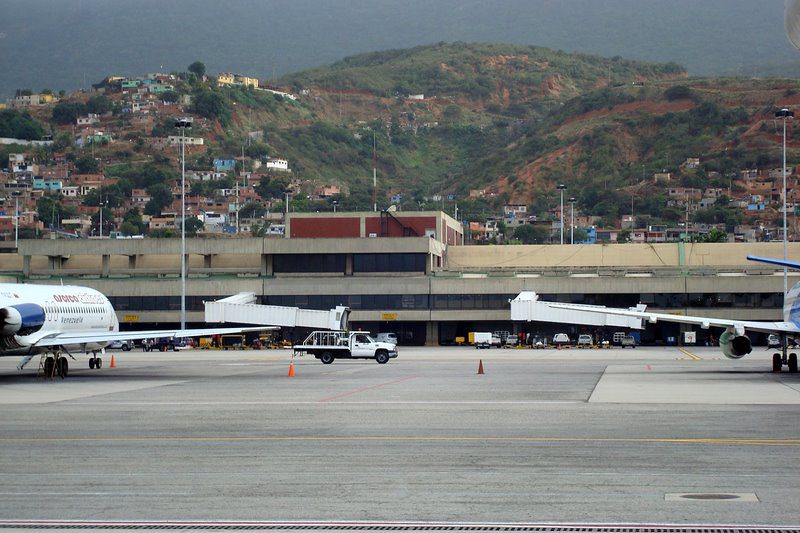
The Maiquetía International Airport is widely recognized for its “Ambientación de Color Aditivo” (1974) artwork by Carlos Cruz-Diez. Photo: David Hernández Aponte.
Patricio Alejandro is a journalist, aviation expert, and editor of @dgaviacion_.
Guacamaya, February 6, 2026. Venezuela’s air connectivity is experiencing an unprecedented recovery following the lifting of restrictions and alerts regarding its national airspace, which were imposed during the weeks of heightened military tension with the United States.
Various international airlines have announced the restart of their operations to and from Caracas, significantly expanding travel options for passengers and strengthening the country’s integration with the Americas and Europe.
Among these airlines are Colombia’s Avianca, Chile’s LATAM Airlines, Brazil’s GOL Linhas Aéreas, Venezuela’s Laser Airlines, and Turkish Airlines.
Other companies, such as American Airlines, have also issued statements about returning to the South American country, but have not yet defined the start date for their available flight frequencies.
Avianca Resumes Daily Operations Between Bogotá and Caracas
The Colombian airline Avianca will restart its Bogotá-Caracas route starting February 12, with daily frequency.
Operation schedules:
- Bogotá → Caracas: 07:10 – 10:10
- Caracas → Bogotá: 12:15 – 13:15
Flights will be operated using Airbus A320 aircraft, enabling immediate connections from Bogotá to destinations in South America, Mexico, the United States, and Europe.
LATAM Airlines Returns to Venezuela with Four Weekly Flights
Starting February 23, LATAM Airlines Colombia will resume its flights between Bogotá and Caracas, with four weekly frequencies.
Operation schedules:
- Bogotá → Caracas: 10:45 – 13:40
- Caracas → Bogotá: 15:00 – 16:00
Flights will be operated with 174-seat Airbus A320 aircraft, offering connections to Chile, Peru, Brazil, and the United States via the Bogotá hub.
Connectivity Record Between Caracas and Bogotá
With the return of Avianca and LATAM, the Caracas-Bogotá route will reach over 35 weekly flights, distributed among:
- Avianca: Daily.
- Avior: 6 times per week.
- Laser: Daily flight.
- LATAM: Monday, Wednesday, Friday, and Sunday.
- Rutaca: Monday, Wednesday, and Friday.
- Wingo: Daily flight.
Additionally, flights to Medellín are being reactivated, operated by Avior (Tuesday and Thursday) and Wingo (Tuesday, Friday, and Sunday).
Laser Airlines Reestablishes Direct Route Between Venezuela and Spain
The Venezuelan airline Laser Airlines announced the restart of its direct Caracas-Madrid flights, operated with Airbus A330 aircraft from the Portuguese company HiFly.
Operation schedules:
- Madrid → Caracas: 12:40 – 17:15.
- Caracas → Madrid: 20:05 – 09:50 (+1).
Frequencies:
- Caracas–Madrid: Monday, Wednesday, and Friday.
- Madrid–Caracas: Tuesday, Thursday, and Saturday.
The announcement of the return of Air Europa, Iberia, and Plus Ultra is expected in the coming days, further expanding the offer between Spain and Venezuela.
Turkish Airlines Reestablishes Its Istanbul-Caracas Route
Turkish Airlines will resume its operations to Venezuela starting March 3, with three weekly flights.
Operation schedules:
- Istanbul → Caracas: 15:30 – 21:50
- Caracas → Istanbul: 23:50 – 18:30 (+1)
Flights will be operated with Boeing 787-9 aircraft, enabling connections to over 200 destinations in Europe, Asia, and Africa via the Istanbul hub.
GOL Linhas Aéreas Reconnects São Paulo with Caracas
The Brazilian airline GOL will restart its flights to Venezuela with four weekly frequencies from São Paulo (GRU): Tuesday, Thursday, Saturday, and Sunday.
Operation schedules:
- São Paulo → Caracas: 17:05 – 22:50
- Caracas → São Paulo: 22:50 – 07:00
Flights will be operated with Boeing 737 MAX 8 aircraft, facilitating connections throughout Brazil and to cities like Buenos Aires, Córdoba, Rosario, Asunción, Montevideo, and Santa Cruz.
The Strategic Impact of Increased Connectivity
The return of these airlines represents an important step for Venezuelan aviation, reconnecting with key destinations like São Paulo, Madrid, and Istanbul, and adding more flights to Bogotá.
Primarily, they contribute to strengthening the air connectivity of the Maiquetía International Airport in Caracas, although new international frequencies to other cities in the country, such as Maracaibo, Barcelona, and Valencia, are expected.
Increased competition helps reduce fares by generating competitive pressure, which benefits passengers. It will also contribute to boosting tourism and investments.
We can also see a direct benefit for the Venezuelan diaspora, as millions of compatriots are in Spain, Colombia, Brazil, Chile, and Peru, who will have more options with fewer layovers to visit their home country.