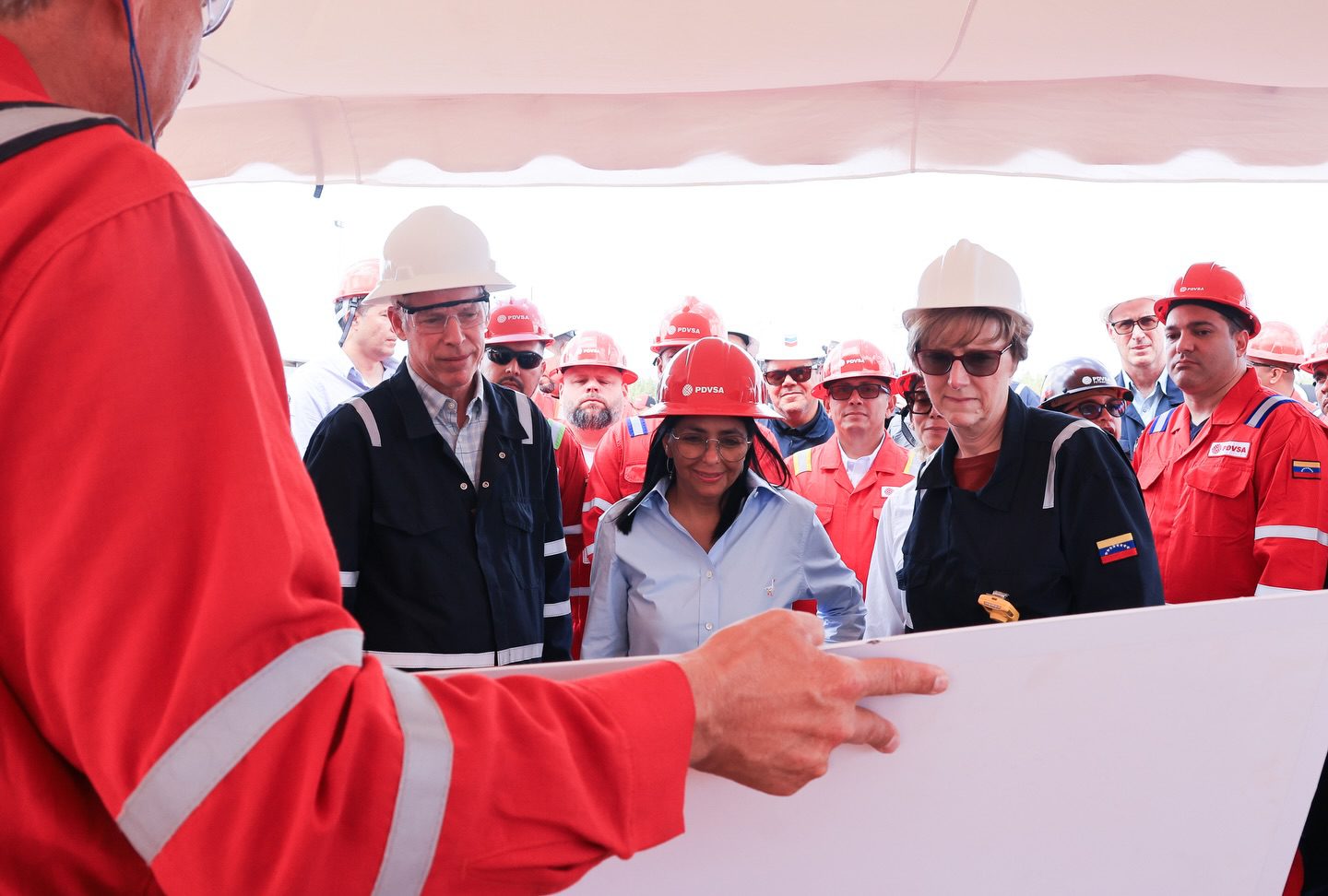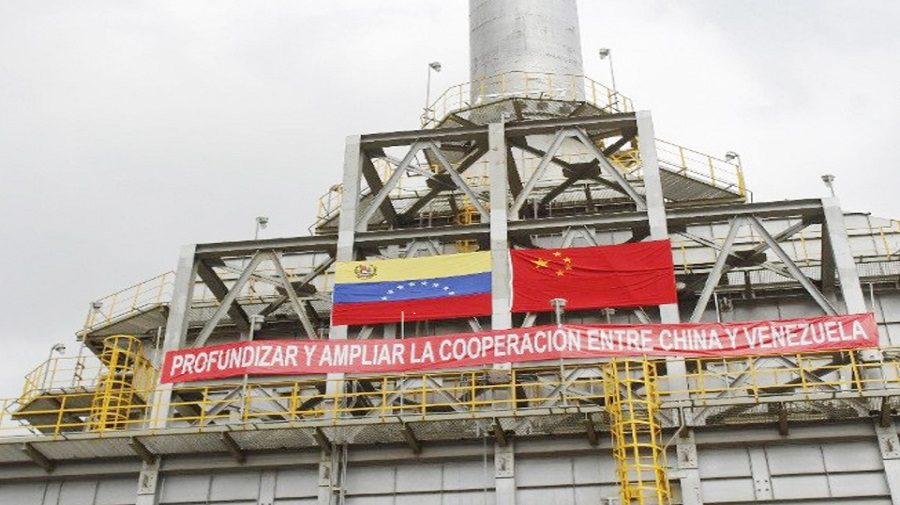
PDVSA facility operated in partnership with a Chinese company. Photo: PDVSA
Guacamaya, January 27, 2026. Washington’s decision to take control of Venezuela’s oil exports is already reshaping global crude flows. PetroChina has ordered a halt to all trading of Venezuelan oil, while Indian refineries are receiving only marginal volumes, as most supplies are being diverted to the United States and offered discounts are not competitive with other heavy crudes.
PetroChina has instructed its operators not to buy or trade Venezuelan crude following the United States’ move to take control of oil exports from the OPEC member country in early January, two trading executives told Reuters.
The Chinese oil company—listed subsidiary of state giant CNPC—was the largest single buyer of Venezuelan oil until early 2019, when it suspended imports after sanctions imposed by the administration of then U.S. President Donald Trump. Its current decision to stay on the sidelines while it assesses the new framework reinforces expectations that crude flows to China will remain limited, pushing Chinese buyers toward alternative suppliers such as Canada, Iran and Russia.
Although China has publicly condemned Washington’s decision to redirect Venezuelan exports, the practical impact is moderate: Venezuelan crude accounted for only about 4% of China’s total imports and was purchased mainly by small independent refineries.
A key factor behind China’s caution is the assessment of the impact on the “oil-for-debt” program, under which Venezuela has repaid billions of dollars in Chinese loans with crude shipments. The redirection of cargoes to the United States could affect these long-term financial arrangements.
Meanwhile, global trading houses Trafigura and Vitol began marketing Venezuelan oil this month after an agreement between Caracas and Washington under which the United States controls about 50 million barrels. However, industry executives said the prices on offer are not competitive with other heavy crudes, such as Canadian grades. Discounts for Venezuela’s Merey crude have narrowed by about $10 per barrel since December, discouraging new purchases.
India: slow return and marginal volumes
The new framework is also affecting the return of Venezuelan crude to India, the world’s third-largest oil importer. Four Indian refinery executives told Reuters that they are currently receiving only small volumes of Venezuelan oil, as most supply is being diverted to the United States.
Indian refineries have reiterated that the discounts offered are not wide enough to justify significant purchases, especially in a market with abundant alternative crude supplies. In this context, sales of Venezuelan oil have been concentrated in U.S. and European refineries, including Valero, Phillips 66, Repsol, and Vitol’s Saras refinery in Italy.
An executive at Bharat Petroleum Corp (BPCL) said the company plans to partner with another firm to buy Venezuelan oil, as its requirement is small—around 200,000 barrels—and does not justify standalone operations on a large scale.
A new map for Venezuelan crude
The combination of less attractive pricing, U.S. control over exports, and the redirection of volumes to the North American market is limiting the return of Venezuelan oil to Asia. In both China and India, Venezuelan crude is losing ground to more competitive suppliers, while the new U.S.-driven framework is redefining Venezuela’s role in the global energy market.
Separately, BP’s chief executive in Trinidad and Tobago, David Campbell, said the British oil and gas company remains interested in pursuing cross-border energy projects with Venezuela, despite the cautious investment climate surrounding the country.
BP
According to Reuters, BP and Shell have obtained U.S. licenses to develop natural gas projects along the maritime border with Venezuela, where large gas reserves have been identified.
Campbell said there is a clear industrial rationale for pursuing these joint developments, as the resources lie just across the border in an area where some investors may be more cautious, yet are adjacent to underutilized energy infrastructure in Trinidad, such as Atlantic LNG and the Point Lisas industrial complex.
In that regard, the executive highlighted the potential of the Cocuina-Manakin gas field—a project BP would develop alongside Venezuela’s state oil company PDVSA—describing it as an obvious and natural initiative from a strategic and operational standpoint.
Petrobras sees Venezuela as a potential option in its search for natural gas
Petrobras is considering the possibility of expanding its operations into Venezuela as part of its strategy to secure new sources of natural gas, while acknowledging that the country’s context still requires greater clarity.
Angelica Laureano, the Brazilian state oil company’s head of energy transition and sustainability, said that entering the Venezuelan market has not been ruled out. “It could be an alternative,” she said when asked on the sidelines of an event in Rio de Janeiro.
The executive stressed that the market is still assessing recent developments in Venezuela and that any decision will depend on how the situation evolves. She also noted that Petrobras is already involved in a natural gas project in Colombia.