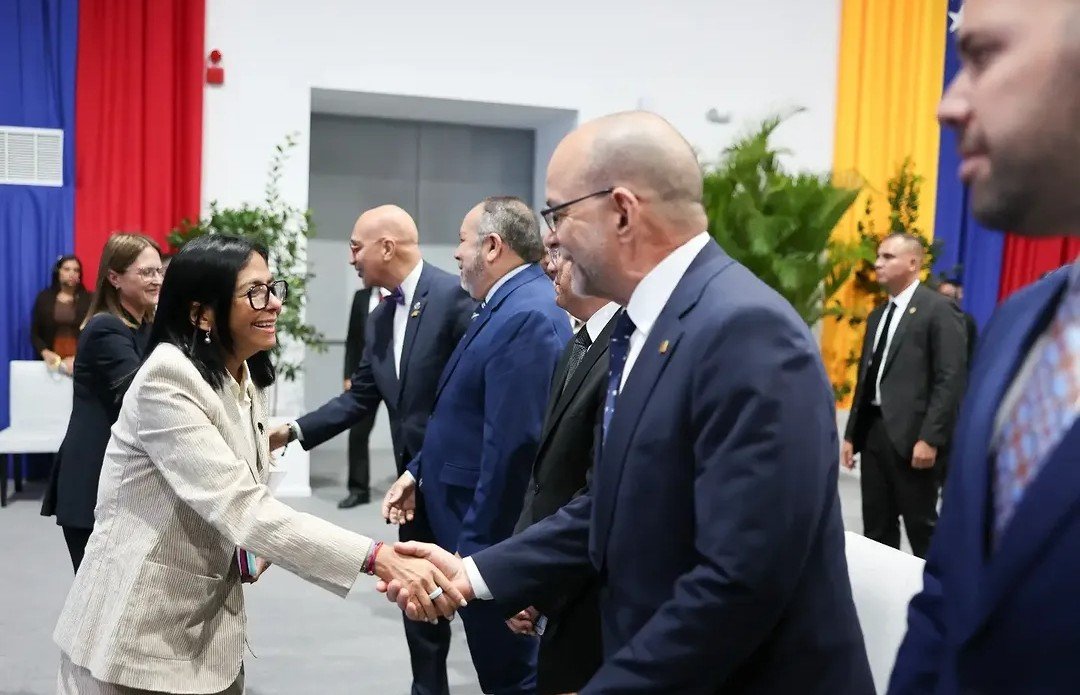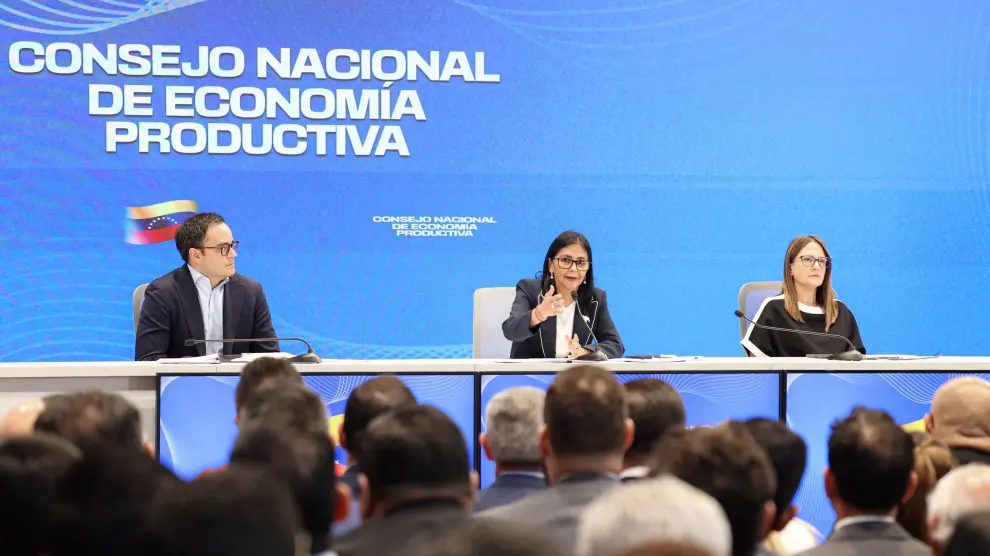
Delcy Rodríguez leads the National Council of the Productive Economy, accompanied at her right hand by Calixto Ortega, one of the most recent appointments to her cabinet. Photograph: Presidential Press
Guacamaya, January 16, 2026. The acting president led the 2026 National Council of the Productive Economy, where she reaffirmed the economic program launched in 2018, announced the channeling of oil revenues into the foreign-exchange market through private banks, and formalized the creation of two sovereign funds aimed at social protection and infrastructure, amid sustained economic growth and an international financial realignment.
The acting president of the Republic, Delcy Rodríguez, chaired the National Council of the Productive Economy this Friday, a forum that brings together public and private sectors. From this platform, she reiterated that revenues derived from oil rents will be allocated exclusively to two sovereign funds—one for social protection and another for infrastructure and services—and called on the business sector to maintain productive momentum with an emphasis on import substitution and economic sovereignty.
“No one should lose their head here, because the processes arising from oil revenues and oil rents will go to the two sovereign funds we announced to the country yesterday,” Rodríguez stressed, while reaffirming full executive support for national production and the expansion of the anti-blockade model to dismantle restrictions and create incentives for economic activity.
During her remarks, the acting president highlighted that Venezuela has accumulated 19 consecutive quarters of GDP growth, recorded a 66% increase in non-oil exports, and reached record levels of domestic supply (99%) and local production (98%), positioning itself as the fastest-growing economy in the Americas since 2021.
Rodríguez also reaffirmed the continuity of the economic recovery program presented in 2018 by President Nicolás Maduro. “It has allowed the Venezuelan economy to become a growth leader throughout Latin America,” she said, underscoring that the central challenge is ensuring that macroeconomic growth translates immediately into social well-being.
Sovereign funds and social protection
In this context, mechanisms for implementing the Social Protection Fund were discussed. This fund is aimed at restoring workers’ real incomes and strengthening critical areas such as the public health system, school infrastructure, food programs, and the Great Housing Mission Venezuela (GMVV). At the same time, the Infrastructure and Services Fund was formalized, designed to finance projects related to drinking water supply, the national electricity system, and road network recovery.
“The commitment is to turn national wealth into direct protection for our people,” Rodríguez emphasized, recalling the guidelines presented in her State of the Nation address before the National Assembly, where she defended the model of self-sufficiency in the face of external pressures.
Foreign exchange, private banking, and Qatar
One of the central announcements was the channeling of oil revenues into the national financial system through the Central Bank of Venezuela (BCV) and private banks, as part of the foreign-exchange market mechanism. According to the acting president, these resources are intended to strengthen exchange-rate stability and boost economic activity.
According to financial information reported this week by the U.S. press, $500 million from oil sales were deposited into trust funds in Qatar, under international supervision, as a mechanism to avoid the risk of asset seizures in other jurisdictions. Of that amount, $300 million will be allocated to the country’s four largest private banks—Banesco, Mercantil, BBVA Provincial, and Banco Nacional de Crédito (BNC)—with $75 million each. These banks are required to auction the foreign currency to local companies at market prices, prioritizing imports of food, medicines, and inputs for small and medium-sized enterprises.
The scheme seeks, on the one hand, to inject foreign currency in a controlled manner to curb the depreciation of the bolívar, and on the other, to allow the BCV to collect bolívares to cover essential public expenditures under a framework of fiscal discipline. Participating companies must meet financial traceability requirements, such as having SWIFT codes.
Consumption, investment, and confidence
During the meeting, the sectoral vice president for Economy and Finance, Calixto Ortega, reported that household consumption grew by more than 37% in 2025 compared to 2024, reflecting improved consumer confidence. He noted that the largest increase occurred in non-essential spending, which, in his view, points to positive economic expectations. “Consumption reflects the present, but investment defines future capacity,” he stressed.
Mixed commission and international outreach
At the institutional level, the creation of a mixed commission to engage with foreign and multilateral economic bodies was announced. A source from the business community present at the event, consulted by Guacamaya, confirmed that Venezuelan business leaders will actively participate in this commission, which—according to Delcy Rodríguez—will travel and represent the country in various international forums to “defend Venezuela’s interests.”
With these announcements, the Executive seeks to consolidate a new balance between economic growth, exchange-rate stability, and social redistribution, in a context marked by international financial realignment and the partial reactivation of Venezuelan oil revenue flows.
Delcy Rodríguez also announced this Friday a series of changes to the ministerial lineup: she appointed Vice Admiral Aníbal Coronado as the new Minister of People’s Power for Transportation, replacing Ramón Velásquez Araguayán and thanking him for his service at the helm of the ministry; named Miguel Pérez Pirela as Minister of People’s Power for Communication and Information, seeking to strengthen the State’s communications strategy; and reassigned Freddy Ñañez as Minister of People’s Power for Ecosocialism, a post from which, she said, he will promote public policies for environmental protection and the preservation of the nation’s ecosystems.
She announced the merger of two strategic ministries for the country’s economic development: the Ministry of People’s Power for Industries and National Production and the Ministry of People’s Power for National Commerce. The new unified ministry will be headed by Minister Luis Antonio Villegas, who will assume responsibility for coordinating the country’s industrial, commercial, and production policies within a single body, with the goal of optimizing management and promoting economic recovery.
Additionally, Rodríguez publicly thanked Álex Saab for his service to the nation, highlighting that he will take on new responsibilities within the government. The acting president emphasized that these changes aim to boost prosperity and the well-being of the Venezuelan people, consolidating the coordination between production, commerce, and industrial policy as a key axis of economic recovery.