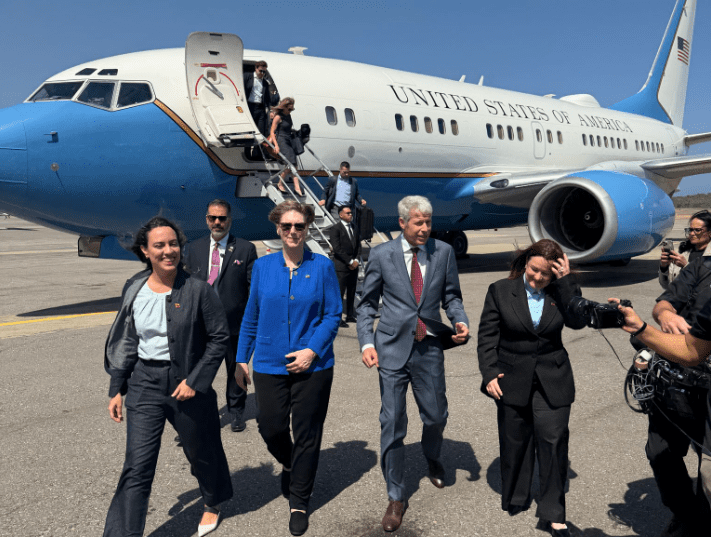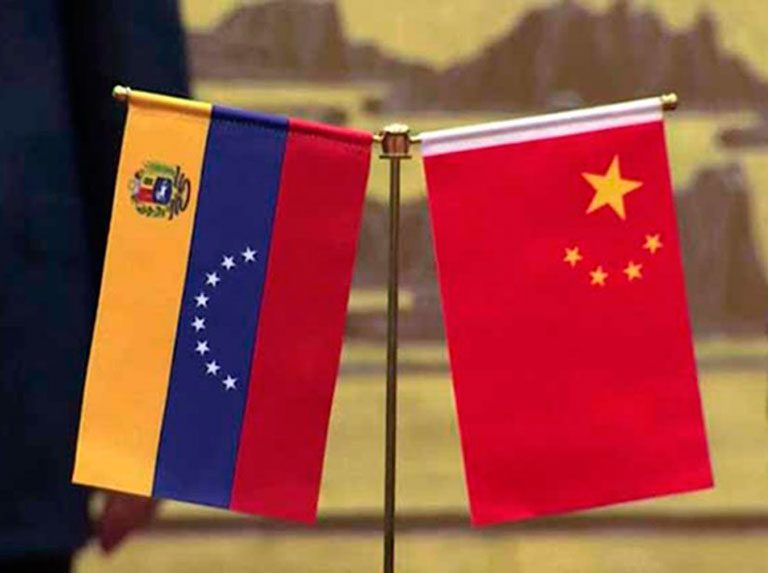
Flags of China and Venezuela. Photo: Presidential Press Office
Guacamaya, January 15, 2026. Chinese government officials and representatives of the country’s main state-owned banks have initiated contacts with both Venezuelan authorities and U.S. officials to secure repayment of billions of dollars in loans granted to Caracas, in a context marked by the capture of Nicolás Maduro by U.S. forces and the political reordering underway in Venezuela, according to Bloomberg.
China has begun a discreet but intense diplomatic offensive to protect its financial interests in Venezuela, one of the countries that for more than a decade ranked among the main destinations of its international lending. According to people familiar with the matter cited by Bloomberg, Beijing is seeking guarantees on the repayment of Venezuelan debt while also demanding a seat at the table in any future debt restructuring process.
This move follows Maduro’s removal from Caracas and the shift by the Donald Trump administration, which is attempting to bring Venezuela back into the political and economic orbit of the United States. For China, this change in circumstances opens a period of uncertainty regarding agreements signed under the governments of Hugo Chávez and Maduro, particularly those backed by oil shipments.
The exact amount of outstanding debt remains a matter of debate. Since the 2017 default, Caracas has stopped publishing detailed debt figures, and current estimates place outstanding obligations to Chinese entities between US$10 billion and US$20 billion. Beijing considers it essential to ensure that these commitments are recognized by any new Venezuelan authority.
A spokesperson for the Chinese embassy in the United States, Liu Pengyu, reaffirmed that cooperation between China and Venezuela is governed by international law and stressed that his country “will take all necessary measures” to protect its legitimate rights and interests. At the same time, he reiterated China’s official position that U.S. intervention constituted a violation of Venezuela’s sovereignty.
China’s economic footprint in Venezuela is largely a legacy of the “loans-for-oil” model launched in 2007, which made Beijing the country’s largest bilateral creditor. Through state-owned banks, China disbursed more than US$60 billion, securing repayment through crude oil shipments at fixed prices, even as new lending largely dried up.
In the energy sector, China’s exposure remains significant but limited. Companies such as CNPC and Sinopec maintain stakes in oil and gas projects, although production has been uneven due to the deterioration of Venezuela’s energy industry. For Beijing, securing Venezuelan oil supplies is no longer the primary concern: although China absorbed nearly 80% of Venezuela’s crude exports in 2025, those volumes accounted for only about 4% of China’s total oil imports.
Beyond energy, China’s presence in Venezuela has focused on areas such as surveillance technology, energy cooperation, and space-related projects, with a more limited operational impact than is often portrayed in geopolitical debates.
In this new scenario, China appears to be betting less on a deep strategic alliance and more on a clear priority: ensuring that the financial commitments assumed by Caracas are not diluted amid political change and the reconfiguration of power in a Venezuela strongly overseen by the United States.
According to Reuters, China’s imports of oil from Venezuela are expected to decline starting in February, due to a sharp drop in the number of tankers that have managed to depart for Caracas’ main crude buyer. Traders and analysts say the decline is directly linked to measures adopted by the United States after it assumed control of the South American country.
The flow of tankers bound for China fell abruptly after U.S. President Donald Trump imposed a blockade in December on sanctioned vessels carrying Venezuelan oil. The move was part of Washington’s pressure campaign against Nicolás Maduro, which culminated weeks later in a U.S. military operation that led to his capture.
Following that episode, Trump declared that the United States was in control of the OPEC founding member and urged U.S. companies to begin investing in Venezuela’s oil sector. However, the blockade was accompanied by concrete actions: Washington seized five vessels linked to Venezuela, prompting several shipowners to turn their tankers around or return them to Venezuelan waters even after loading crude, in order to avoid the risk of confiscation. These steps effectively imposed tighter control over the country’s oil flows.
Amid the U.S. raid on January 3, around a dozen tankers departed Venezuela with their location transponders switched off. Most of them later returned after Caracas’ interim government negotiated a 50 million-barrel oil supply agreement with Washington. Only three of those vessels continued their voyage to Asia and are expected to arrive in China by late February, according to a source involved in the shipments.
Those tankers are carrying about 3 million barrels of fuel oil and 2 million barrels of heavy Merey crude, the source said, requesting anonymity due to the sensitivity of the matter. Data from analytics firm Kpler show that since the blockade began in December, roughly 2.9 million barrels of Venezuelan crude have headed to Asia aboard three vessels carrying Merey and other Venezuelan grades. The firm also estimates that another 2.6 million barrels of fuel oil managed to bypass the restrictions.
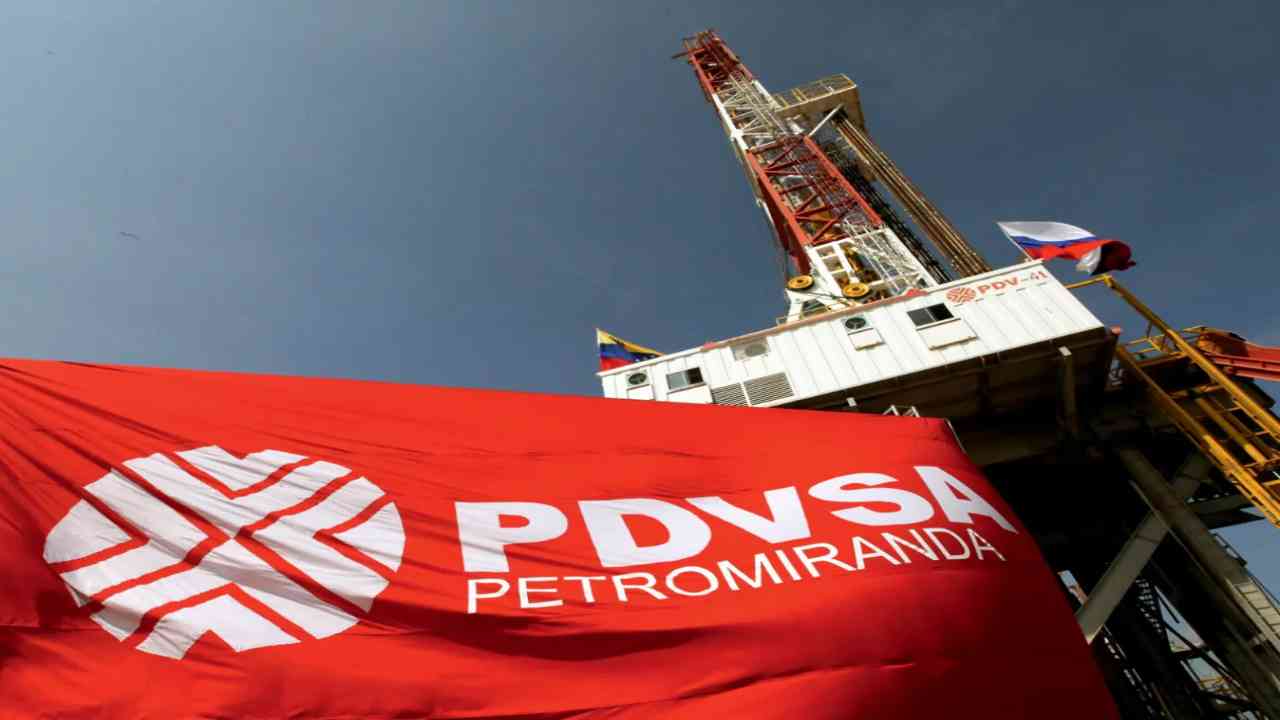
In total, the nearly 5 million barrels of crude and fuel oil expected to reach China amount to around 166,000 barrels per day. This represents a significant decline from the average of 642,000 bpd that Venezuela exported to China in 2025, which accounted for 75% of its total average exports of 847,000 bpd last year, according to internal PDVSA documents.
Even so, Chinese refiners are not rushing to secure alternative supplies. Late last year, China ramped up purchases of Venezuelan oil while millions of barrels were still in transit, helping to cushion—at least for now—the immediate impact of the drop in shipments.