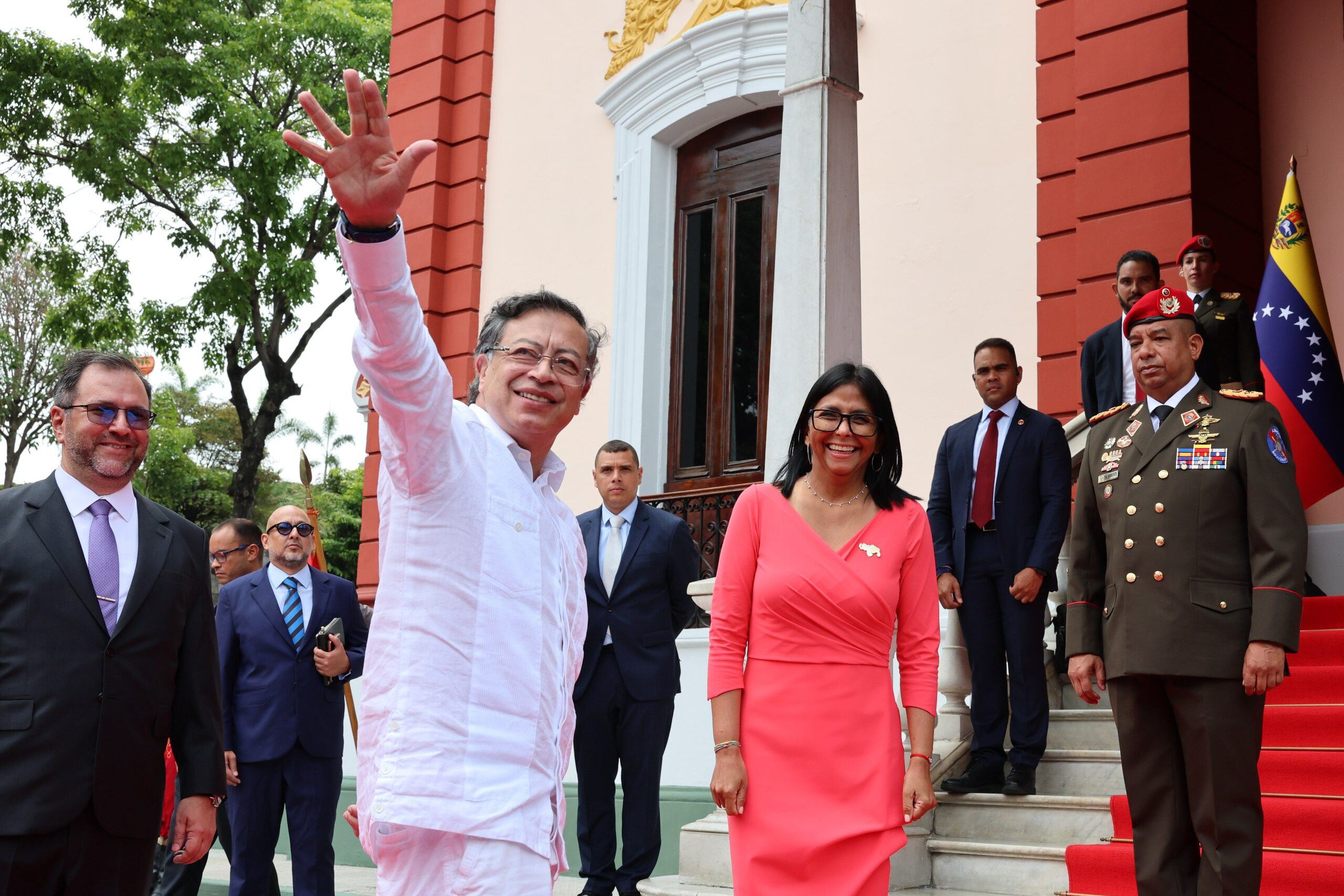
Following a private meeting, both leaders gave joint statements before later leading an expanded session with their respective delegations, where various strategic issues for the bilateral relationship were discussed. | Photos: Presidential Press
Guacamaya, April 24, 2026. The visit of Colombian President Gustavo Petro to Caracas this Friday once again brought to the forefront the relationship between Venezuela and Colombia, one of the most sensitive and strategic in the region. After being received in Maiquetía by Foreign Minister Yván Gil, he held a meeting with acting President Delcy Rodríguez at the Miraflores Palace, with topics such as trade, energy, and border security as the main priority.
The meeting also carried unprecedented political weight, as it was Rodríguez’s first meeting with a head of state since she assumed power following the capture of Nicolás Maduro. The meeting, which had previously been attempted in the border city of Cúcuta, was canceled a day earlier for security reasons argued by Venezuela, according to the Colombian Foreign Ministry.
For the Colombian president, however, the arrival marked his sixth visit to Venezuela since taking office, although the first since April 2024, before Venezuela’s controversial electoral process that year which led to international questioning of Nicolás Maduro’s legitimacy. Petro and Rodríguez gave joint statements outside the Presidential Palace.
A meeting with political weight
Rodríguez opened her remarks with a welcoming gesture aimed at framing the meeting within regional integration. “I want to welcome, in the name of the Venezuelan people and government, President Gustavo Petro and his distinguished delegation, who have been participating over the past two days in the third meeting of the Colombian-Venezuelan Neighborhood Commission,” she stated.
The acting president insisted that the meeting occurs at a moment of historical rapprochement between both countries. “This visit takes place at a time of profound need for unity and integration of our peoples,” she affirmed, while also highlighting the role of the border reopening, promoted by Petro in 2022, as a turning point in the bilateral relationship.
Border, trade, and local production
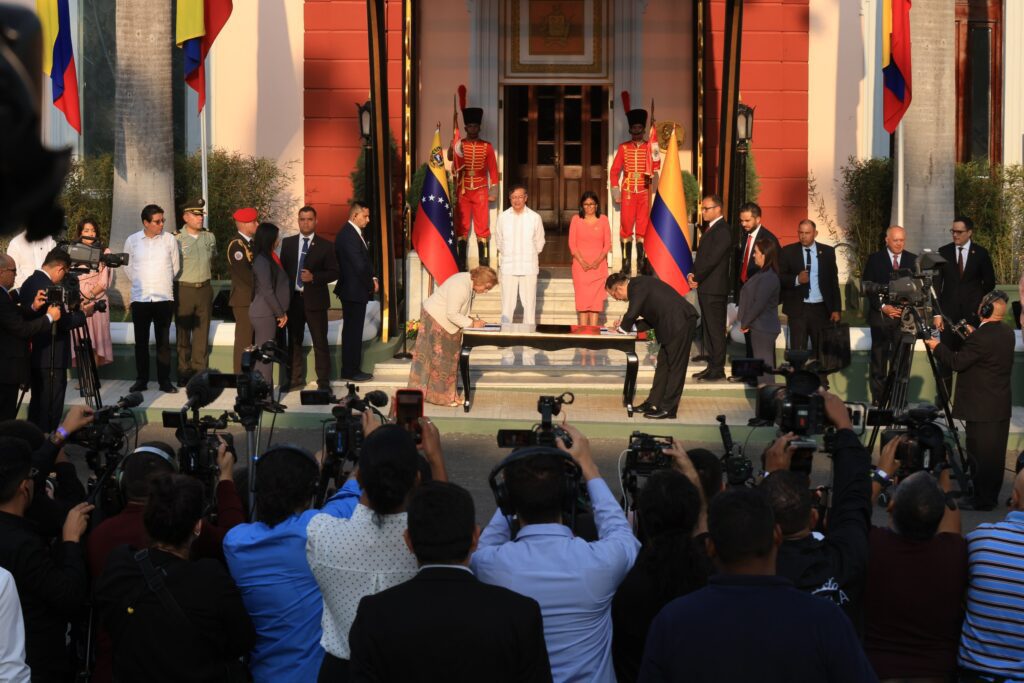
Building on that border reopening milestone, Rodríguez emphasized the normalization of commercial exchange as a central issue after correcting a historical situation she described as anomalous. “We achieved the opening of the border. It was an unnatural act to keep our border closed in populations accustomed to commercial exchange,” she noted.
The head of state also defended a vision of shared economic sovereignty. “It makes no sense for Colombia or Venezuela to look toward other latitudes and hemispheres for what we can obtain within our own territories,” she said, alluding to the need to strengthen local production and replace imports. Along the same lines, she called for thinking of the bilateral relationship as a historical and social unity.
Border security and transnational crime
Border security naturally also occupied a priority place on the agenda. Rodríguez warned about the illegal economies operating in the border area. “Let the drug trafficking groups, the groups involved in fuel smuggling and other types of smuggling, know that we are taking firm steps to combat these crimes,” she stated.
Petro, for his part, insisted that the border must cease to be a space captured by armed actors and illegal structures. “The border should only belong to the people, the Colombian people and the Venezuelan people. The border cannot belong to anyone other than the people,” he affirmed, advocating for a joint strategy of territorial control and intelligence cooperation.
Geopolitics, energy, and brotherhood
The Colombian leader went beyond the immediate border situation and spoke about the geopolitical dimension of the relationship. “We are the heart of the world. To the extent that we divide ourselves, we break the heart of the world; to the extent that we unite, we restore the heart of the world,” he stated, connecting with his vision of Latin America as the axis of a new international architecture.
On energy matters, Petro also projected cooperation toward global changes, insisting that the energy transition can become an instrument for peace and shared development. “New forms of energy can bring peace, can bring the construction of a global democracy, of a brotherly humanity,” he noted.
The reactivation of the Venezuela-Colombia binational gas pipeline appears as one of the technical backdrop issues of the meeting. The project mainly revolves around the recovery of the Antonio Ricaurte gas pipeline, which connects both countries and has been out of operation since 2019. The plan is to repair a damaged 5-kilometer stretch to bring it back into service.
Expanded meeting in the Simón Bolívar Hall
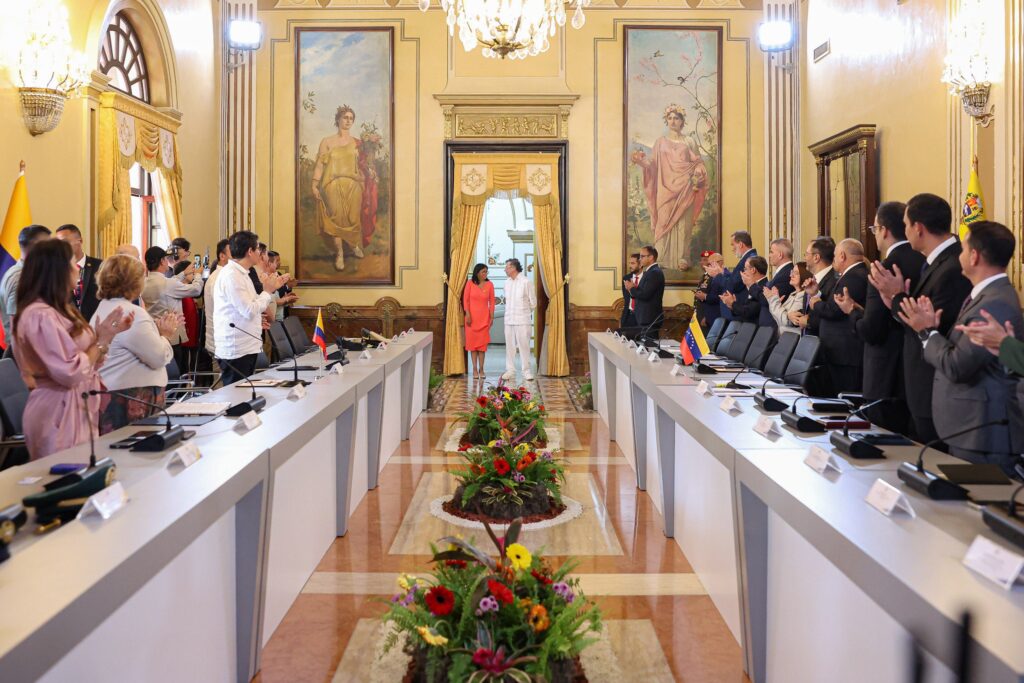
After the statements, both leaders moved to an expanded meeting with delegations from both countries in the Simón Bolívar Hall of the Miraflores Palace, where specific cooperation topics were discussed in depth. The agenda includes trade, energy, border security, the fight against drug trafficking, smuggling, and institutional integration mechanisms.
The Caracas meeting consolidates the diplomatic shift initiated in 2022 with the border reopening and reinforces both governments’ commitment to rebuilding a relationship that for years was marked by the deterioration of binational exchange. In this new moment, Petro and Rodríguez aim to project a narrative of neighborliness, sovereignty, and cooperation that aspires to move toward tangible results.