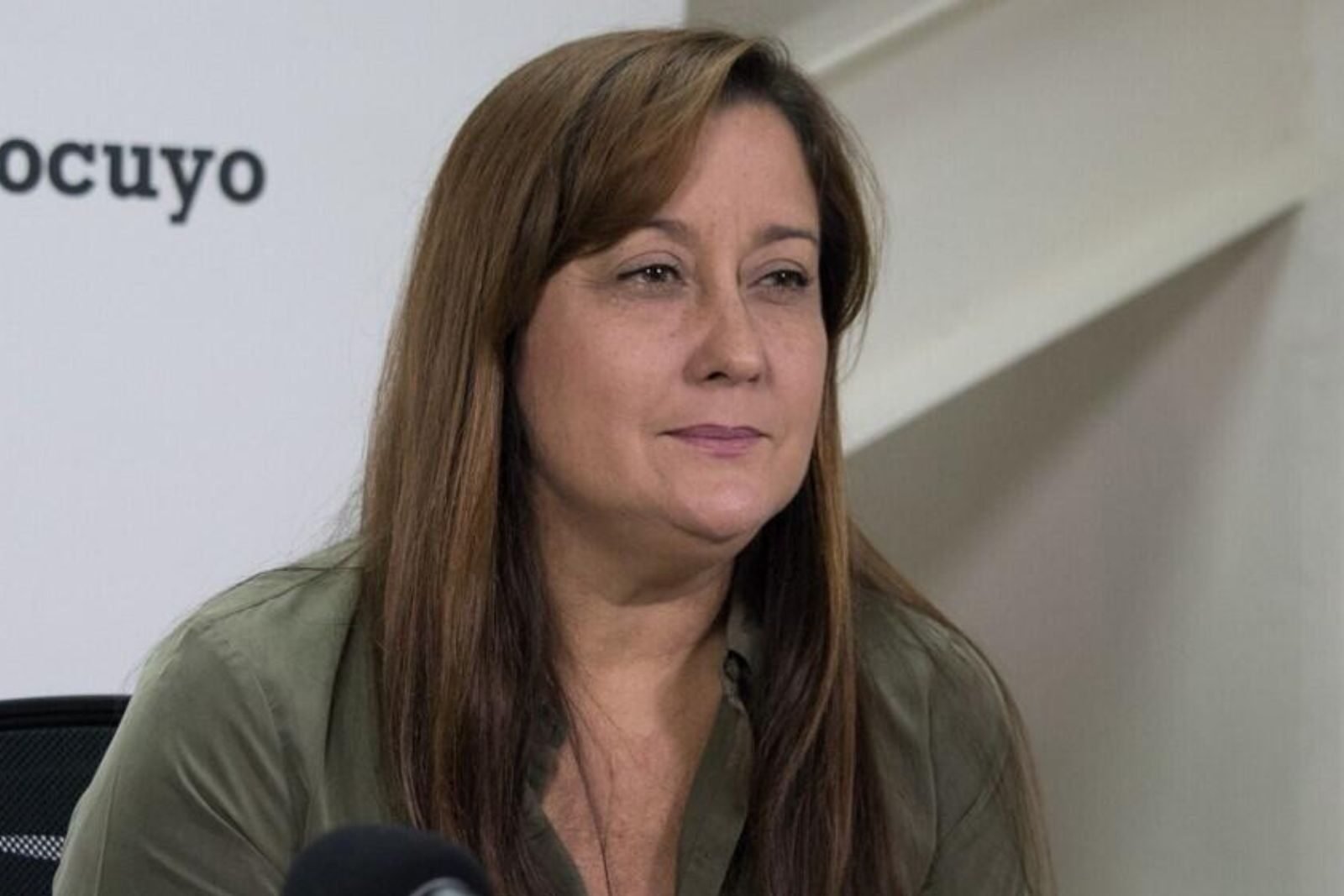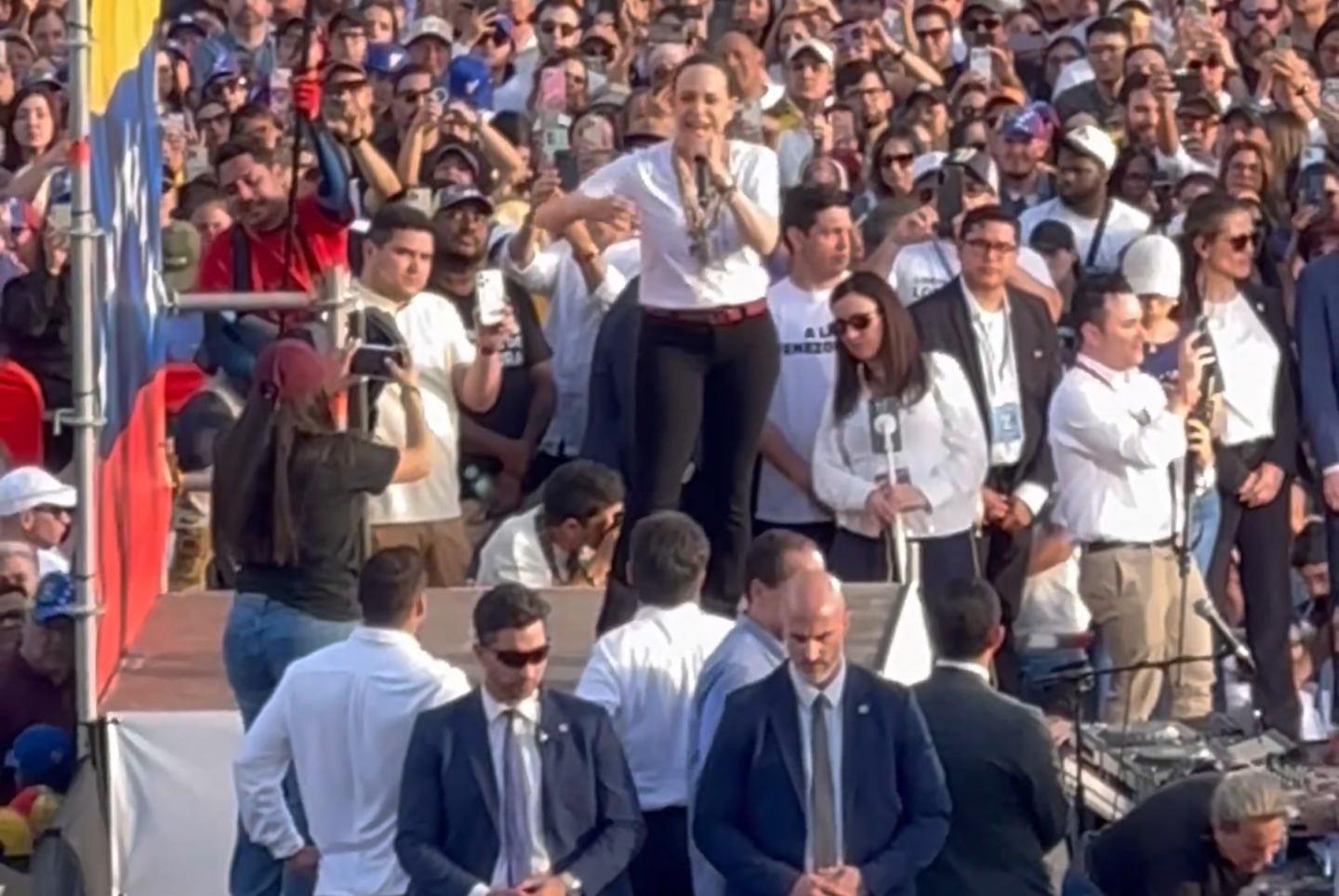
The trip received follow-up and had an impact on both sides of the Atlantic, with developments in the perspectives of both the Venezuelan and Spanish political landscapes. / Photo: @MariaCorinaYA.
Guacamaya, April 21, 2026. The recent visit of María Corina Machado to Spain became a high-intensity political tour, at least in the public eye. Initiated by a controversy over racist chants against Delcy Rodríguez, Machado’s tour continued with meetings with opposition parties, avoiding a meeting with President Pedro Sánchez, and signs of political recalibration regarding the Venezuelan scenario.
The opposition leader arrived in Madrid with an agenda that combined support for the Venezuelan community, media visibility, and explicit gestures towards the Spanish right. Leveraging her status as a Nobel Peace Prize nominee, she ended up displaying her willingness to act as an international influencer, although this ultimately left behind new controversies and a trail of clashes with the Spanish government.
Carlos Baute’s racist controversy
From the start, Machado’s trip to Spain was marked by a controversy that overshadowed the rest of her agenda. This involved the chant “fuera la mona” (get the monkey out), repeated and promoted by Venezuelan singer Carlos Baute during a gathering at Puerta del Sol in Madrid last Saturday, referring to Venezuela’s acting president, Delcy Rodríguez.
Machado tried to distance herself from this incident: “You will never hear from my mouth a word or expression that disqualifies a person because of their religion, gender, or race,” she stated in an interview with EFE this Sunday. Baute apologized for his manner. “I got carried away by emotion,” he said via his social media, in a message that attempted to separate political indignation from personal insult.
However, the episode left a shadow difficult to erase, especially because Machado’s party, Vente Venezuela, initially spread the video showing Baute repeating the chant, a post that was later deleted. In reaction, the Venezuelan Embassy responded with a statement expressing “sincere apologies” to the Spanish people and condemning the “hate speech.”
Even so, Machado’s presence in Madrid had a strong emotional and political component for the Venezuelan migrant community, in a city that has become one of the main meeting points for the opposition exile. In her agenda, she sought to connect the Venezuelan crisis with political, business, and media networks, using the symbolic capital of the diaspora as a platform for international pressure.
The disagreement with Pedro Sánchez
Another of the most commented points of Machado’s visit was the decision not to meet with the President of Spain, Pedro Sánchez, despite the Spanish government claiming to have extended the invitation. Sánchez stated that “we offered her the possibility of meeting with me, and unfortunately we did not have the opportunity to have that meeting, because she considered it was not appropriate.”
The Spanish Head of Government made it clear that the presidential seat has always been presented as an available institutional space, recalling previous meetings with Edmundo González Urrutia and Leopoldo López. “The doors of La Moncloa are open to meet with all opposition leaders,” he emphasized upon leaving a binational meeting with Brazil, held on Friday in Barcelona.
Machado explained that she did not consider the meeting appropriate at that time, in the midst of the summit that Sánchez was leading with progressive leaders from around the world, called “In Defense of Democracy.” “The meeting he had in Barcelona with other world leaders shows why it is not convenient,” she said, indicating that the coincidence was not intentional “but providential.”
This decision was interpreted by the Spanish Executive as a snub, while the opposition in that country valued it as a coherent position to avoid an uncomfortable photo with a president whom sectors of the Venezuelan opposition associate with ambiguities towards Chavismo. Machado thus chose to speak to the Spanish right and not to the center-left in power, something different from what happened in other countries.
In response to this, José Manuel Albares, Minister of Foreign Affairs, was one of the members of the Spanish government who reacted most harshly. In the minister’s opinion, Machado disrespected Spanish institutions by refusing the meeting with Sánchez and instead privileging her contacts with leaders of the PP and Vox.
Albares accused Machado of coming to Spain “as an ideological leader” and of meeting only with the political spectrum she shares affinities with, in his reading, the Spanish far-right. “You cannot ask for help and then come and disparage Spanish institutions,” the official stated, recalling that Machado requested refuge from him and Spain always offered her the possibility.
PP, Vox, and the message of “impeccable elections” for Spain
Machado, on the other hand, did maintain a fluid relationship with leaders of the PP and Vox, two forces that received her with affinity and without reservations. In that scene, the Venezuelan leader found a comfortable space to project a narrative of “freedom, democracy, and national reconstruction,” framed by discourses that connect with the European right and its language of order, sovereignty, and anti-Chavismo.
The Venezuelan leader took the opportunity to thank the reception from the Popular Party. Machado referred to the mayor of Madrid, José Luis Martínez-Almeida, who gave her the Keys to the City; the regional president, Isabel Díaz Ayuso; and also to “all the authorities of the Congress, the Senate, the parties, and the city’s chroniclers” who, she noted, have expressed support for her cause.
Santiago Abascal of Vox also met with María Corina Machado in Madrid at the headquarters of the Disenso Foundation, where they held a private meeting. The choice of location was deliberate: Vox’s think tank is responsible for promoting the Madrid Charter, a manifesto “in defense of freedom and democracy,” supported by political figures aligned with the party, including Machado.
Machado also participated this Monday in an informational breakfast of the Nueva Economía Fórum, where she presented her vision on the future of Venezuela and the country’s economic reconstruction. In that space, she met with businessmen, leaders, and spokespersons of the Venezuelan opposition in exile, including Leopoldo López and Antonio Ledezma, figures not without controversy.
After this meeting, Machado released one of her most forceful phrases of the entire tour: “I hope Spain can have very soon some impeccable elections,” an idea that neatly condenses this logic of selective affinity. “My affections and preferences, I believe, are very clear to everyone in this room and in this country,” she added, although paradoxically she stated that she does not want to get involved in Spanish politics.
Although formally the statement can be read as a democratic wish, in practice it operated as a symbolic intervention in the Spanish political debate, precisely at a time of strong polarization. The question it leaves open is whether Machado was speaking as a Venezuelan leader in exile or already as a figure trying to influence another country’s politics based on partisan alliance criteria.
The discursive shift regarding Delcy Rodríguez
Beyond the controversy in Madrid, another of the most striking elements of the trip was Machado’s change in tone towards Delcy Rodríguez and regarding the transition. Previously she had stated that Rodríguez was “a core part of a criminal structure,” but now she speaks of her “carrying out a dismantling” of said structure, in statements given to media outlets.
Furthermore, in an interview with Spain’s ABC, the leader showed a possible willingness to share a coalition government “if that would allow advancing free elections.” In recent interventions, Machado even spoke of a nine-month period to prepare for presidential elections, something that contrasts with the urgent message that had dominated her narrative in earlier stages.
She also changed the timeline for her return to the country. Where before she spoke of a return in weeks or months, she now places the possibility of a political exit towards the end of the year. This adjustment can be interpreted as political realism, but also as a sign of fatigue or the need to adapt the narrative to a longer negotiation.
Machado’s trip to Spain left a clear conclusion: she no longer acts only as a Venezuelan activist, but as a figure who intervenes in Spanish political conversation with very defined allies and antagonists. With the clashes, controversies, and narrative shifts, on one hand, she was able to show political muscle, but regarding institutional breadth, her image is arguably much more debatable.