Fabián Campos is a Business Economist who graduated from the Universidad Metropolitana and Coordinator of Scenarios and the Datanálisis Multisectorial Business Survey.
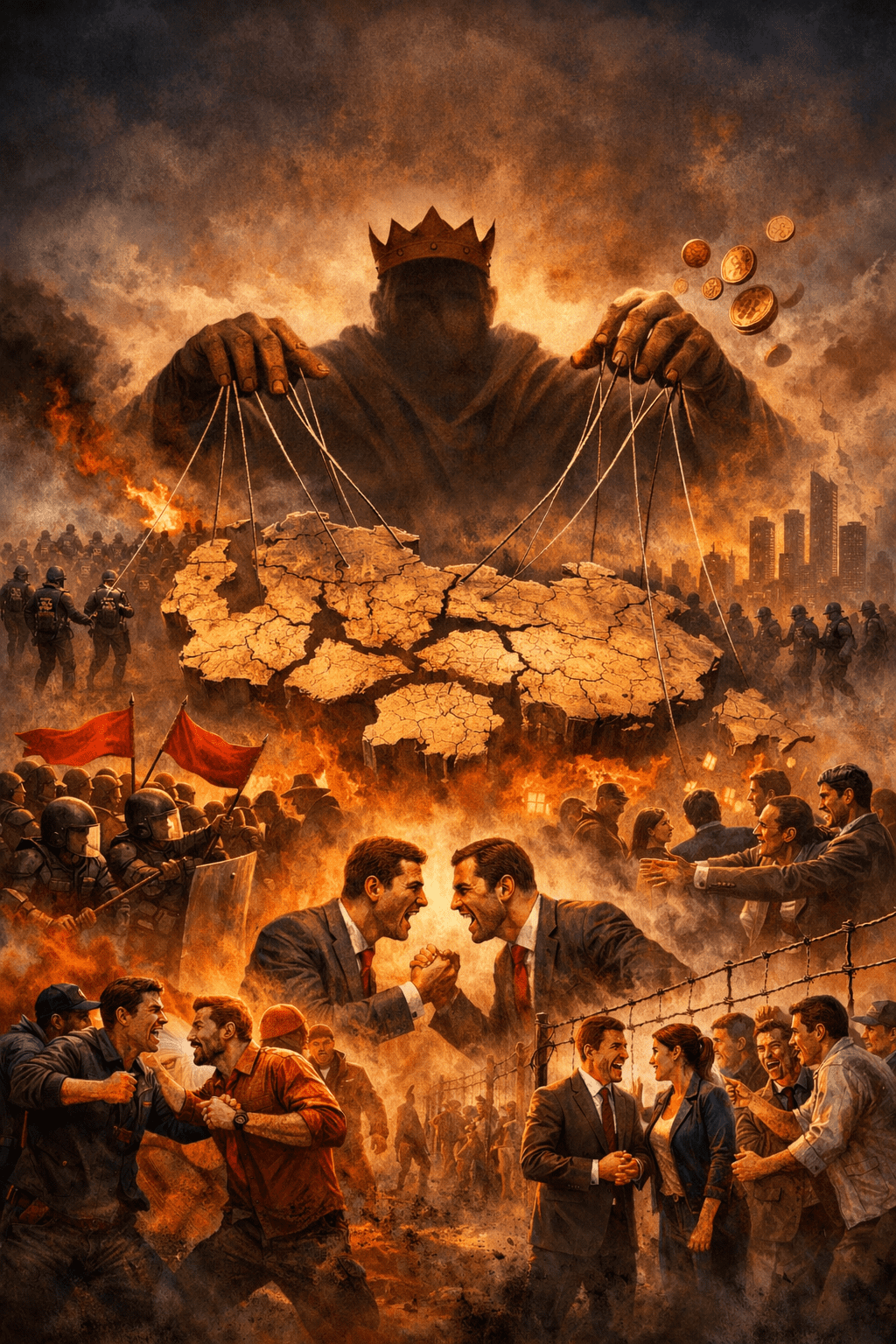
Guacamaya, January 11, 2026. Divide et Impera (“Divide and Conquer”) refers to a strategy of military origin, but one that can be extrapolated to politics, psychology, and other social sciences. Its core principle can be summarized as follows:
It is easier to defeat or control a group if it is fragmented into smaller factions that fight amongst themselves, rather than allowing it to remain united with a common purpose.
It is ironic that the implementation of such an effective strategy owes its origin and success to three basic actions:
- Foster discord: Create or deepen rivalries between groups.
- Prevent alliances: Ensure that small groups do not unite to form a solid front.
- Offer selective benefits: Grant privileges to a specific group so that it feels superior or allied with the dominant group, generating “resentment” in the other groups.
Although this aligns with one of the tenets of modern politics, its origin dates back to the 4th century BC, when Philip II of Macedonia consolidated it as one of the most significant military strategies in all of history. A move so “significant” that even his son, Alexander the Great, made it one of his most important strategic and military pillars.
If we analyze our recent history and reflect on the implications of Divide et Impera, we would realize that we have been allowing the oldest trick in the book to be applied to us. From this, we can understand much about the “how” we have turned out as a society and what has brought us to this point. And the facts seem to suggest that, for a long time, we have succumbed to the “temptation” of each of those three actions.
In principle, we began to accentuate differences and minimize similarities. We became Rich or Poor; Business Owners or Employees; “Right-wing” or “Left-wing”; “Adecos” or “Copeyanos”; “Reds” or “Blues”; and the list goes on. We turned everything black or white and forgot that in life there can be infinite shades of “gray,” each with its nuances, its pros and cons, and not “mutually exclusive” of each other.
Then we forgot that “in unity there is strength.” We put alliances in the background and began to pursue our own “agendas.” We focused on acquiring and growing, but neglected contributing. At times we brushed against excellence and managed to be a society that added, but we failed to notice that we were moving further and further away from being able to multiply. In the case of companies, it is notable that the most successful ones have more permanent agreements with the links in their production chain, so they depend more on the competitiveness of those chains than on themselves. Distrust took root in our psyche, transferred to our behavior, and we began to count more enemies than friends. We started to “play alone” and let natural selection bring out the worst in us.
And the cherry on top was accepting a modus operandi and a set of rules that directly pitted us against each other. By prioritizing weaving vertical threads “with whoever governs” (and not horizontal ones, among peers), like any tribal society. We accepted that know-who was more important than know-how, we took things for granted, and we felt entitled to everything “because now it’s my turn.”
So, if we were to undertake this exercise of self-awareness, rather than finding arguments, we would probably ask ourselves: when did we allow ourselves to be “divided and conquered”?
There will be time later for gurus, for the know-it-alls, for projecting and deciding, for reuniting, for speculating, for cunning tricks, for pushing ahead, for entrusting ourselves. There will be time to think and reflect on what was done right and, above all, to delve into what was done wrong. There will be time for self-blame and for seeking culprits. There will be time to demand and to be demanded of. There will be time to do what we have known how to do best for so long: polarize everything.
But now, it seems the nation demands a different path from all of us. To align in what we think, feel, and do. To be and know how to be Team Venezuela. A call to accept and tolerate those who have not thought, do not think, or will not think like us. To understand that there is beauty in the grays and that this ship belongs to everyone.
To remain divided would be to repeat the same mistakes and would be a nod to a culture that has turned us into our own detractors. Because today Venezuela cannot afford to keep subtracting, and because it demands the best from us. Because it seems it is time to propose a different strategy: Unite et vincite (“Unite and Conquer”).