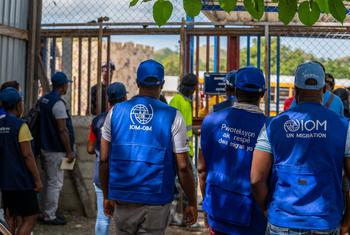
OIM staff prepare to help deported Haitians re-enter their country of origin. Photograph: OIM/Antoine Lemonnier.
Guacamaya, December 19, 2025. A new regional report reveals that Venezuelan migrants are not only integrating into the labor market and consumer base but are also contributing billions of dollars in taxes, investment, and economic dynamism in their host countries, debunking myths about their fiscal impact.
For years, Venezuelan migration has been portrayed as a humanitarian and social challenge for Latin America and the Caribbean. However, a recent regional study supported by the International Organization for Migration (IOM) demonstrates that, beyond the initial emergencies, the Venezuelan diaspora has become a key economic actor for the societies that receive it.
The report, prepared by the consultancy Equilibrium Business, Data & Communities, systematizes research conducted between 2021 and 2025 in eight countries in the region—Aruba, Chile, Colombia, Costa Rica, Ecuador, Panama, Peru, and the Dominican Republic—and offers a comparative overview of the fiscal and economic contribution of over 5.7 million Venezuelan migrants.
A contribution translating into consumption, employment, and taxes
One of the most relevant findings of the study is the direct impact of migrant consumption on local economies. It is estimated that the Venezuelan population generates over $10.6 billion annually in consumption, primarily concentrated in housing, services, and food. This everyday spending stimulates key economic sectors and translates into significant indirect tax revenue.
In countries like Colombia and Peru, the volume of migrant consumption reaches magnitudes comparable to major state budget items or the revenues of large corporate conglomerates. Far from being a burden, Venezuelan migration supports millions of daily transactions that strengthen internal markets.
Positive fiscal impact and growth potential
The report also documents a positive fiscal impact. In Colombia alone, the tax contribution of Venezuelan migrants amounts to $529 million, while in Panama it reaches $203 million, representing over 4% of the country’s fiscal revenue. Furthermore, the study emphasizes that these contributions could increase significantly if regularization processes, degree recognition, and labor formalization are expanded.
According to projections, more inclusive integration policies could generate hundreds of millions of dollars in additional tax revenues in countries like Chile, Colombia, Peru, and Panama, cementing migration as a medium- and long-term economic asset.
Young, of working age, and highly educated
From a demographic perspective, Venezuelan migration represents an injection of human capital. The majority of migrants are of working age, with an average age lower than that of local populations, and with technical and university education levels that, in several countries, exceed the national average.
This profile is especially relevant in a region marked by population aging and a shortage of skilled labor in strategic sectors. However, the study warns that the lack of recognition of degrees and skills continues to cause underemployment and underutilization of available talent.
Entrepreneurship, remittances, and transnational networks
Faced with barriers to formal employment, entrepreneurship has become a central pathway for economic integration. Businesses driven by Venezuelan migrants generate employment, promote innovation, and strengthen the local productive fabric, while also connecting economies and cultures through so-called “ethnic entrepreneurship.”
Simultaneously, remittances sent by migrants—although representing a smaller percentage of total income—play a fundamental role in reducing poverty in recipient households. The report highlights that, despite the regular sending of remittances, the majority of the migrant population’s income remains and circulates within the local economies.
Integration, not containment
The study concludes that the greatest challenges lie not in the presence of migration, but in the barriers limiting its full integration: labor informality, discrimination, xenophobia, and difficulties accessing financial services. In response, it recommends strengthening coordinated regional policies, reducing migration bureaucracy, and promoting evidence-based public narratives.
“Venezuelan migration is a driver of development,” summarizes the report. The empirical evidence shows that when structural barriers are removed, the integration of migrants not only improves their living conditions but also drives economic growth and social cohesion throughout the region.