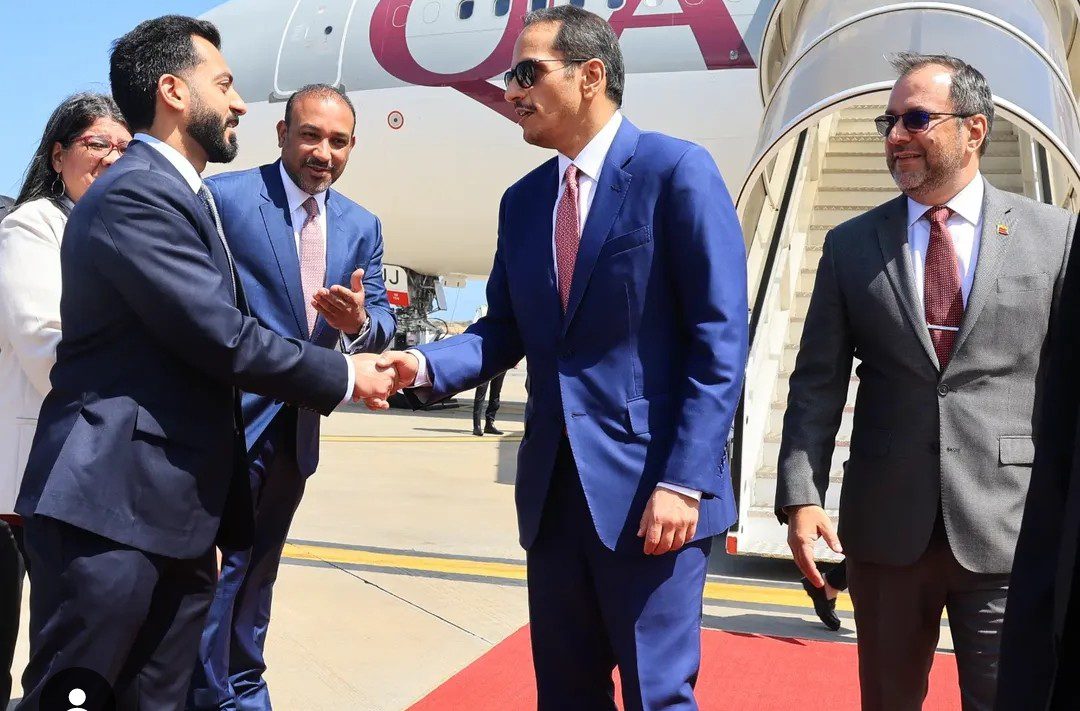
The Prime Minister of Qatar, Sheikh Mohammed bin Abdulrahman al-Thani, arrived in Venezuela on Tuesday and was received by Foreign Minister Yvan Gil, according to images broadcast on state television. Photograph: Presidential Press Office
Guacamaya, February 18, 2026. The visit of the Qatari head of government comes at a time of political and economic reconfiguration in Venezuela, with Doha consolidating its role as an intermediary between Caracas and Washington while expanding its global profile as a conflict mediator.
The Prime Minister of Qatar, Sheikh Mohammed bin Abdulrahman al-Thani, arrived in Venezuela on Tuesday and was received by Foreign Minister Yvan Gil, according to images broadcast on state television. Neither government has released an official agenda, although Doha has for years played a key role as an indirect channel between Caracas and United States.
This small Gulf state, which in the past prioritized its own defense, has evolved into a global diplomatic actor. Far from being an improvised process, this transformation reflects a long-term strategy linked to its National Vision 2030, aimed at turning Doha into an international hub for diplomacy, finance, and energy.
The experience of the blockade imposed by Saudi Arabia and other neighboring countries led Qatar to rethink its international role. Rather than isolating itself, it chose to become a reliable interlocutor. From negotiations in Afghanistan to humanitarian initiatives related to Gaza, as well as mediations in Sudan and Chad, the emirate has shown that diplomatic patience and a willingness to invest can translate into political influence.
After the upheavals of the Arab Spring, Qatari foreign policy shifted from a more interventionist regional stance toward pragmatic mediation. Academic Ali Abo Rezeg argues in Qatari Foreign Policy in a Precarious Decade that this new phase rests on three pillars: active mediation in complex conflicts, maintaining open channels with all parties, and expanding soft power through investments, humanitarian aid, and major global events such as the FIFA World Cup 2022.
This projection has now reached Latin America. Since Caracas was subjected to sanctions and faced a weakened economy, Qatar has offered more than energy or financial cooperation, emerging as a discreet bridge to Washington capable of facilitating sensitive talks without public exposure. Through Doha, Venezuela has been able to address humanitarian issues, explore sanctions relief, and maintain a presence on the international agenda.
For the emirate, the relationship also carries strategic value. Acting as a mediator in the Americas strengthens its reputation as a global actor capable of operating beyond the Middle East and expands its geopolitical influence.
Qatar’s involvement in Venezuela is part of a broader network of international mediations. In 2020, Doha facilitated contacts between Washington and the Taliban; it has participated in humanitarian negotiations between Israel and Hamas and has promoted dialogues in several African conflicts. In 2008, its mediation helped resolve a severe political crisis in Lebanon through an agreement signed in its capital. Across these efforts, Qatar has cultivated an image as a neutral host offering safe space and resources for negotiations.
The rapprochement between Doha and Caracas also reflects broader shifts in global power balances. Latin America is no longer an exclusive sphere of U.S. influence, while Venezuela seeks to diversify its alliances. Moreover, as a major producer of gas and oil, Qatar has a direct interest in energy market stability. It is known that the country advocated with the U.S. administration for Venezuelan crude to return to formal markets, while also supporting diplomatic efforts related to sanctioned Russian oil.
Bilateral relations between the two countries date back more than half a century. On May 24, they will mark 53 years of diplomatic ties.
Qatar possesses one of the world’s largest natural gas reserves—approximately 380 trillion cubic feet—placing it among the leading energy powers and explaining its high per-capita income and elevated human development indicators in the Arab world. Venezuela, for its part, holds the world’s largest proven oil reserves, estimated at about 303 billion barrels, roughly 17% of global totals. The country also ranks ninth worldwide in gas reserves and first in Latin America.
Venezuela’s internal political landscape changed dramatically following the capture of Nicolás Maduro in an operation on January 3. Since then, Vice President Delcy Rodríguez has served as interim president. The new government has signaled cooperation with Washington, especially in the energy sector, approving legislation to attract foreign investment. Subsequently, the United States eased some sanctions to encourage that investment.
Qatar expressed concern over Maduro’s removal and offered to help achieve a peaceful solution. During the first months of the new situation, a Doha-controlled account received Venezuelan oil revenues, although this arrangement was later modified. According to Rodríguez, Qatar’s efforts were crucial in securing a form of lifeline from Washington during the most tense moments.
U.S. Energy Secretary Chris Wright told NBC that the funds are now channeled through the Treasury Department. He stated that Venezuelan oil sales have generated about $1 billion since the previous government’s fall.
The mechanism drew criticism in Congress. Lawmaker Gregory Meeks sent a letter to Secretary of State Marco Rubio warning that an offshore account could enable corruption.
Qatar, designated a major non-NATO ally of the United States, continues to position itself as an international mediator. Together with Egypt and Washington, it participated in negotiations for a Gaza ceasefire last October.
Before the recent political changes, Doha maintained cordial relations with Caracas. Rodríguez was received last April by Emir Tamim bin Hamad Al Thani and by the Qatari prime minister. Maduro’s last visit to the Gulf state took place in 2022.
Despite diplomatic engagement, economic exchanges remain limited. In 2023, Venezuela exported only $303,000 in goods to Qatar, mostly dried legumes. No more recent trade data are available.
In aviation, Qatar Airways announced in January 2025 the launch of a route to Caracas, although the connection has yet to materialize.
The visit of the Qatari head of government is thus seen as part of a broader strategy to consolidate Qatar as a global mediator while offering Venezuela an additional channel of international engagement at a decisive moment for its political and economic future.
An additional element highlighting the global scope of Qatari diplomacy is its participation in peace efforts in Colombia. Doha has hosted negotiation rounds between the Colombian government and the Gaitanista Self-Defense Forces of Colombia (Clan del Golfo), facilitating preliminary agreements and commitments toward demobilization with the support of other international mediators.
This is particularly significant for Venezuela, which has also been affected by the dynamics of the Colombian conflict. The country must contend with the presence of armed groups such as the ELN and dissident factions of the FARC, a situation that could seriously undermine the stabilization phase envisioned by Washington in the ongoing process. In this context, interim authorities and their U.S. partners may view Qatar as a key ally for addressing these challenges and ensuring stability for investment and oil business operations.
Qatar’s involvement reinforces its image as a trustworthy actor in Latin American conflicts and has direct implications for Venezuela, as Colombian stability reduces migration pressures, border tensions, and illicit economies affecting both countries, while establishing Doha as a credible interlocutor for complex regional issues.
The prime minister’s visit illustrates how a small Gulf state has become a central player in contemporary diplomacy and how Venezuela seeks to leverage that mediation capacity to reposition itself in an increasingly fragmented international environment.
The article will be updated as meetings and the agenda of the Qatari representatives in Venezuela become known.