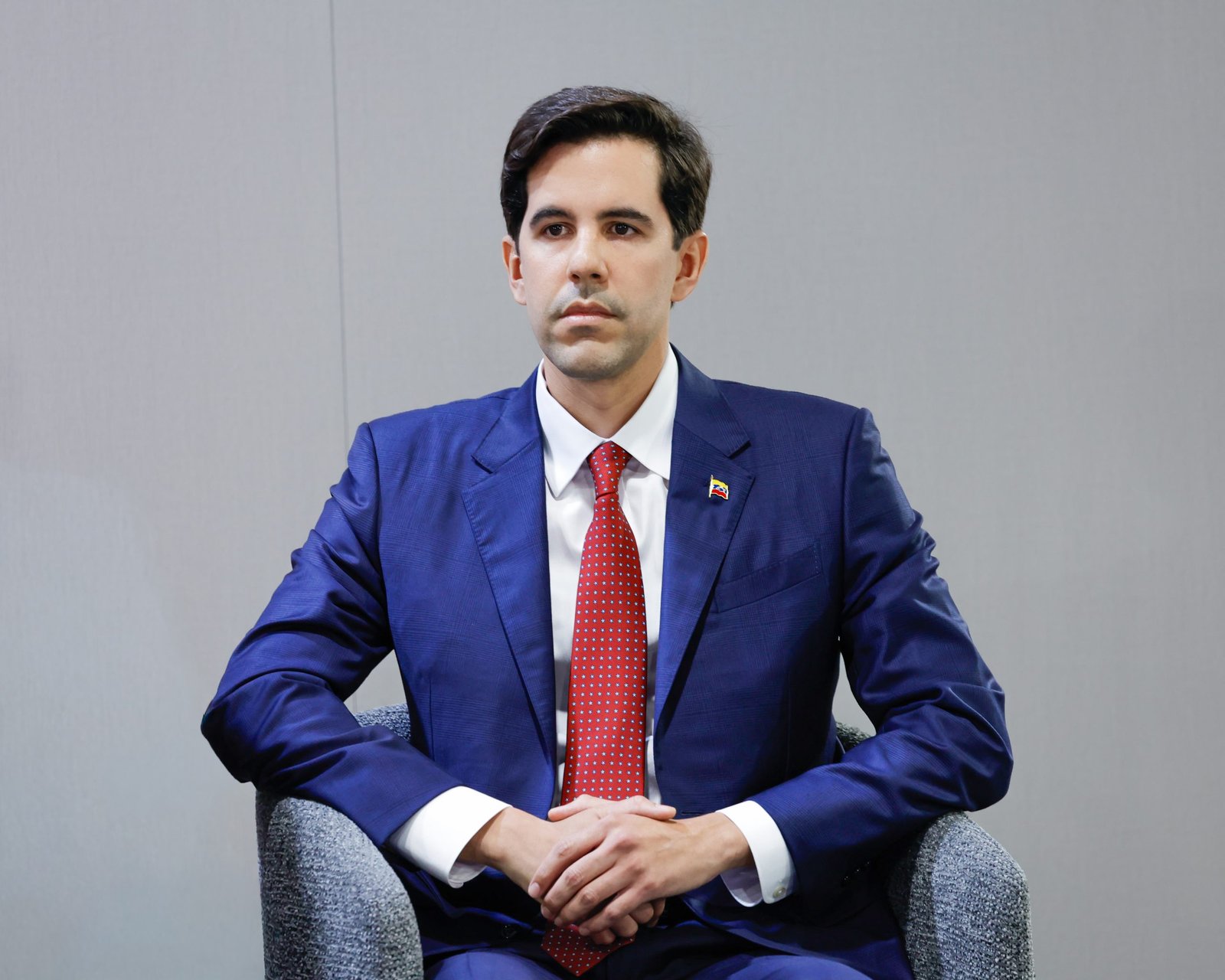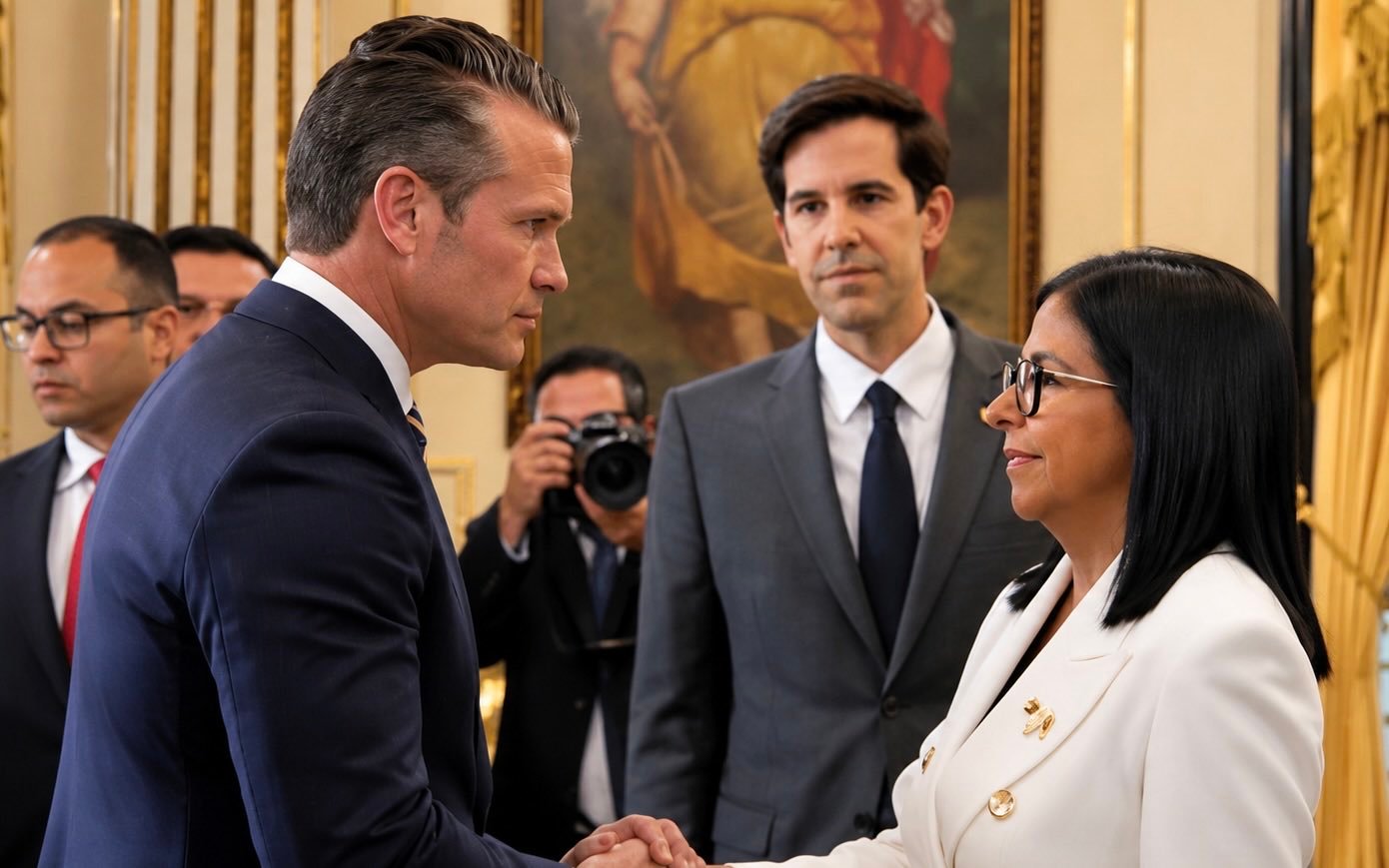
U.S. Secretary of War Pete Hegseth greets Venezuela’s acting president, Delcy Rodríguez, alongside Venezuelan Foreign Minister Oliver Blanco. Photo: VTV broadcast.
Guacamaya, November 20, 2026. The surprise visit by U.S. Secretary of War Pete Hegseth to Caracas and the signing of an agreement to resume military cooperation between the two countries mark a new chapter in bilateral relations, which had been interrupted in 2005 by then-President Hugo Chávez. The rapprochement comes amid a transformation of Venezuela’s security policy, including joint operations against criminal organizations and Colombian armed groups, as well as greater coordination with Washington. Beyond its military dimension, the understanding reflects converging interests around hemispheric security, energy resources, critical minerals, and the reshaping of the international order.
Hegseth’s arrival in Venezuela on the night of Tuesday, November 17, had not been announced beforehand. The U.S. official landed at Maiquetía International Airport aboard a U.S. Air Force aircraft and was received with honors by Venezuelan authorities.
He subsequently traveled to Miraflores Palace, where he met with Delcy Rodríguez, Defense Minister Gustavo González López, and Foreign Minister Oliver Blanco. Businessman Alejandro Betancourt was also present, while the U.S. delegation included War Department officials, among them the deputy secretary and several advisers. The visit represents the highest-level trip by a Trump administration official to Venezuela since the U.S. military operation of January 3, 2026, which culminated in the capture of Nicolás Maduro.
During his remarks, Hegseth announced the resumption of the military partnership between the two countries after more than two decades of interruption. He explained that the aim of the understanding was to develop cooperation mechanisms to address shared threats, particularly drug-trafficking organizations, criminal networks, and armed actors operating in the region. He also expressed Washington’s interest in leveraging the experience of its Armed Forces and the capabilities of the Department of War to contribute to the rebuilding and modernization of Venezuela’s military institution. Delcy Rodríguez, for her part, expressed her administration’s willingness to expand training, equipment, and access to new technologies for the Bolivarian National Armed Forces (FANB), which during the Chavista era had historically relied on Chinese, Russian, and Iranian suppliers.
The interruption of this cooperation under Hugo Chávez resulted from a process of political and strategic distancing that deepened after 2002 and culminated in 2005 with the breakdown of military and counternarcotics cooperation mechanisms between the two countries. Tensions escalated following the April 2002 coup, differences over foreign policy, and Washington’s allegations regarding Venezuela’s cooperation with actors considered hostile to its regional interests.
In August 2005, Chávez announced the suspension of cooperation programs with the U.S. Drug Enforcement Administration (DEA), while bilateral military relations also deteriorated progressively. This distancing coincided with a reorientation of Venezuela’s defense policy toward Russia, China, and Iran, which came to play a central role in supplying weapons, technology, and technical assistance. Over the following two decades, military relations between Caracas and Washington were virtually frozen, alongside a Venezuelan foreign policy aimed at reducing U.S. influence and expanding ties with partners beyond the region. The agreement announced by Pete Hegseth therefore represents not simply the restoration of previous cooperation mechanisms, but a shift in the strategic orientation that shaped Venezuelan defense policy for much of the 21st century.
Historical background
One of the most significant elements of Hegseth’s speech was his reference to the Monroe Doctrine, formulated in 1823 by U.S. President James Monroe. The doctrine established Washington’s opposition to new European colonial interventions in the Americas, although it was later reinterpreted as the basis for a policy of U.S. predominance in the hemisphere. In 1904, President Theodore Roosevelt expanded this concept through the so-called Roosevelt Corollary, which justified U.S. intervention in Latin American countries on grounds of stability and security. Hegseth’s revival of these historical references reflects the Trump administration’s intention to assert a vision of hemispheric security in which the United States seeks to strengthen its influence and limit the presence of extra-regional powers.
The secretary also recalled cooperation between Venezuela and the United States during World War II. At the time, Venezuelan oil was a critical resource for supplying the Allied countries, particularly given the production capacity of western Venezuela’s oil fields and their connection to the Caribbean. In February 1942, German submarines attacked oil vessels carrying crude from Lake Maracaibo to Aruba and Curaçao, highlighting the vulnerability of regional energy routes. Protecting these facilities and maritime corridors made Venezuela a strategic partner for Washington. By invoking this episode, Hegseth drew a parallel between that cooperation and the energy and security interests that are once again bringing the two countries closer together.
These historical precedents help clarify the Trump administration’s strategic view of the relationship between energy, territory, and national security. Pete Hegseth’s reference to oil and military cooperation between Venezuela and the United States during World War II was more than a historical reminiscence.
It also points to a conceptual continuity: protecting energy resources and the infrastructure that makes them usable is part of a great power’s core security interests. In today’s international environment, this concept has a much broader scope, in which oil fields, refineries, ports, power systems, and logistics corridors can serve strategic functions comparable to those of certain military installations.
The idea that oil fields will become the military bases of the future should be understood as a transformation in the traditional concept of security. For much of the 20th century, state power was measured primarily by military capabilities, territorial control, and the availability of weapons. Today, geopolitical competition also incorporates factors such as reliable access to energy, control of critical minerals, supply-chain protection, and the ability to ensure essential infrastructure keeps operating. In this context, an oil facility is not merely a source of revenue or production; it is also a strategic asset whose disruption can affect a country’s economic, industrial, and military capacity.
This view is connected to the evolution of U.S. energy-security doctrine. The experience of the 1973 and 1979 oil crises, as well as subsequent interventions and military operations in the Middle East, reinforced in Washington the perception that energy-market stability and the protection of supply routes have direct consequences for national security.
The importance of this approach also lies in the private sector’s growing role in the U.S. security architecture. Companies controlling energy infrastructure, technology, communications, transportation, and mineral processing can become key actors in ensuring the country’s economic and military resilience. As a result, the boundaries between public security, national defense, and business interests are becoming increasingly porous. Protecting an oil facility, for example, may involve satellite surveillance, intelligence, cybersecurity, autonomous systems, and cooperation between government agencies and private operators.
The geopolitical dimension is also tied to competition with China and other extra-regional powers. Their influence in sectors such as energy, mining, telecommunications, and infrastructure has made Latin America a relevant arena for strategic competition. U.S. interest in Venezuela is therefore not limited to restoring trade relations or securing oil supplies; it may also form part of a broader strategy to reshape the hemisphere’s economic and security relationships. Access to natural resources, critical-infrastructure protection, and the reduction of technological dependencies thus become interconnected objectives.
Ultimately, the new military cooperation between Washington and Caracas can be understood within a concept of security in which energy and mineral resources are fundamental elements of national power. Future oil infrastructure will not necessarily have to function as a conventional military base to acquire defensive significance; it will be enough for its production, protection, and availability to be considered essential to a state’s economic, industrial, and strategic stability. Under this logic, Venezuela represents not only an opportunity for oil recovery, but also a territory of importance in shaping a new hemispheric security architecture.
Venezuela: from threat to new partner after the war ends
From the U.S. Embassy in Caracas, Hegseth further elaborated on the political significance of the understanding and the transformation of bilateral relations. He said Venezuela had gone from being regarded by Washington as “the most aggressive regional threat” to becoming a “cooperative security partner.” He also described the events of January 3 as a day of liberation for Venezuela and said the country would be better positioned in the future thanks to cooperation between the two governments. In a message to criminal organizations, he warned that the United States would continue pursuing and dismantling their structures, while telling the Venezuelan people that the bilateral confrontation was over and a period of jointly building peace was beginning.
The operational dimension of this rapprochement had already begun to emerge before the visit. One of the most significant precedents was the joint operation against Héctor Rusthenford Guerrero Flores, known as Niño Guerrero, identified as the top leader of the Tren de Aragua. In June 2026, U.S. and Venezuelan forces took part in an operation in Bolívar state that, according to statements by Donald Trump and Pete Hegseth, resulted in the criminal leader’s death. Investigations by The Washington Post pointed to the involvement of the U.S. Joint Special Operations Command (JSOC) and the CIA, which reportedly provided intelligence and operational support to Venezuelan authorities. Hegseth’s public acknowledgment of cooperation between the two countries is evidence that military and intelligence coordination mechanisms predated the agreement announced at Miraflores.
The ELN in the crosshairs
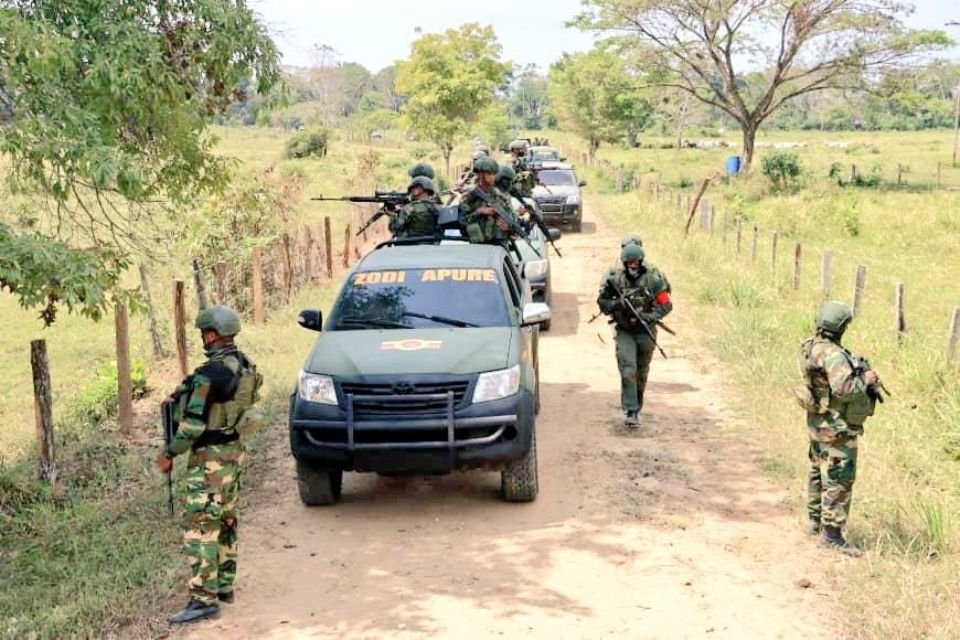
Another episode illustrating this transformation is the operation against structures of the National Liberation Army (ELN) in Apure state, along the Venezuelan-Colombian border. On October 30, an attack was carried out against a camp belonging to the organization in the Buena Vista del Meta area. According to reports published by The New York Times and EL PAÍS, U.S. officials acknowledged that Washington provided intelligence and drone support to facilitate the operation. Venezuelan authorities deployed military capabilities in a region where ELN structures linked to territorial control, extortion, and illicit economies have been documented for years. The episode marks a shift in Caracas’s willingness to coordinate operations against Colombian armed groups operating on its territory and demonstrates the growing U.S. involvement in border-security dynamics.
This process coincides with increased coordination between Caracas and Bogotá in addressing threats along their shared border. The two countries have maintained contacts to develop cooperation mechanisms against armed organizations and criminal networks, amid kidnappings, displacement, and territorial disputes. The ELN’s presence in Colombian border departments and Venezuelan states such as Apure, Táchira, and Zulia represents a shared challenge for both administrations. The possibility of incorporating U.S. intelligence, aerial-surveillance, and drone capabilities adds a regional dimension to this emerging security architecture, in which cooperation among the three countries could become more significant.
Hegseth’s visit should also be understood in the context of the economic and energy interests reshaping relations between Washington and Caracas. Businessman Alejandro Betancourt’s presence at the Miraflores meeting is significant in this regard. This week, NABEP, a company linked to the businessman, announced that it would take control of Petrocedeño, increasing its involvement in Venezuela’s oil sector. This move adds to other business and operational agreements aimed at restoring hydrocarbon production and facilitating the entry of private capital. The overlap between the military agenda and the participation of business actors reflects how the protection of strategic infrastructure, the recovery of energy assets, and investment security are becoming part of the same bilateral discussion.
The energy dimension is especially important at a time when major powers are reorganizing their priorities around supply security and access to strategic resources. Venezuela has significant hydrocarbon reserves and mineral resources such as gold, iron, and bauxite, as well as a privileged geographic position in the Caribbean. These factors matter amid international competition for critical minerals needed to manufacture batteries, semiconductors, defense systems, and technologies related to the energy transition. Restoring Venezuela’s productive capacity and bringing in foreign capital are therefore connected to interests that go beyond the traditional oil market.
The new understanding is also part of a broader transformation of the international order. Competition among powers is no longer confined to conventional military balance; it now encompasses hybrid warfare, artificial intelligence, cybersecurity, control of digital infrastructure, and technological dependence. The ability to protect power grids, oil facilities, telecommunications systems, and logistics corridors has become a priority for states. In this context, military cooperation between Washington and Caracas could extend beyond combating drug trafficking and armed groups, gradually incorporating technological security, critical-infrastructure protection, and territorial surveillance.
The Caracas leg is part of Hegseth’s regional tour, which includes visits to Colombia and Ecuador, as well as a possible stop in Honduras. In Colombia, the U.S. official is expected to take part in activities related to military cooperation and the delivery of C-130 Hercules transport aircraft. His trip through South America is also taking place amid political controversy in Washington over the war in Iran and U.S. operations against vessels suspected of carrying drugs in the Caribbean and Pacific, which have resulted in more than 200 deaths, according to figures released about those operations.
Ultimately, the resumption of military cooperation between Venezuela and the United States represents a substantial shift in the parameters that defined bilateral relations over the past twenty years. For Washington, it means bringing Venezuela into a regional security framework aimed at confronting criminal organizations, strengthening territorial control, and protecting strategic interests. For Caracas, it offers the possibility of rebuilding military capabilities, gaining access to new technologies, and restoring channels of engagement with the United States. The evolution of this understanding will depend on its implementation and on both administrations’ ability to reconcile their interests. Nevertheless, the political message of the visit is unmistakable: relations between the two countries are entering a phase in which security, energy, investment, and geopolitical competition are once again deeply interconnected.