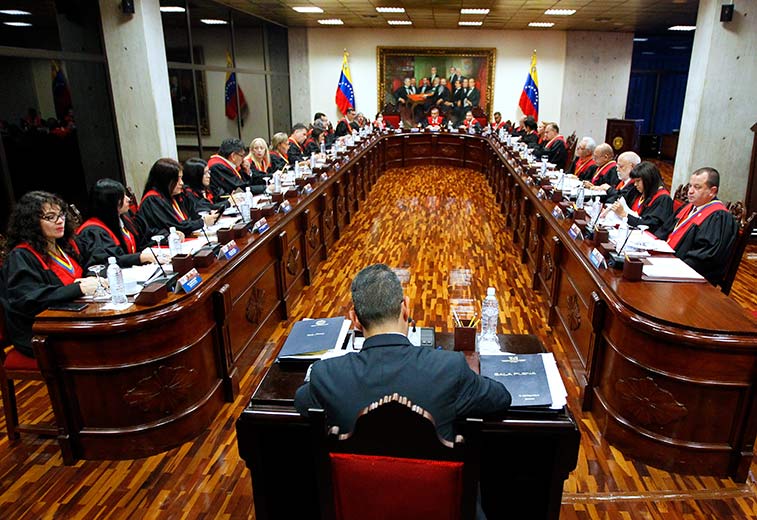
The departures driven by the new post-Maduro political context leave chambers such as Constitutional, Criminal, Civil, and Social with majorities of substitute judges / Photograph: Reference | Supreme Court of Justice.
Guacamaya, April 29, 2026. The Supreme Court of Justice is on the verge of a deep restructuring — or at least that appears to be the goal following recent moves marked by the new political moment. According to judicial sources, the Plenary Session approved this Monday, April 27, the retirement of eight of its 20 sitting magistrates, which, added to four previous vacancies due to permanent absences, creates 12 available seats in the Judicial Branch.
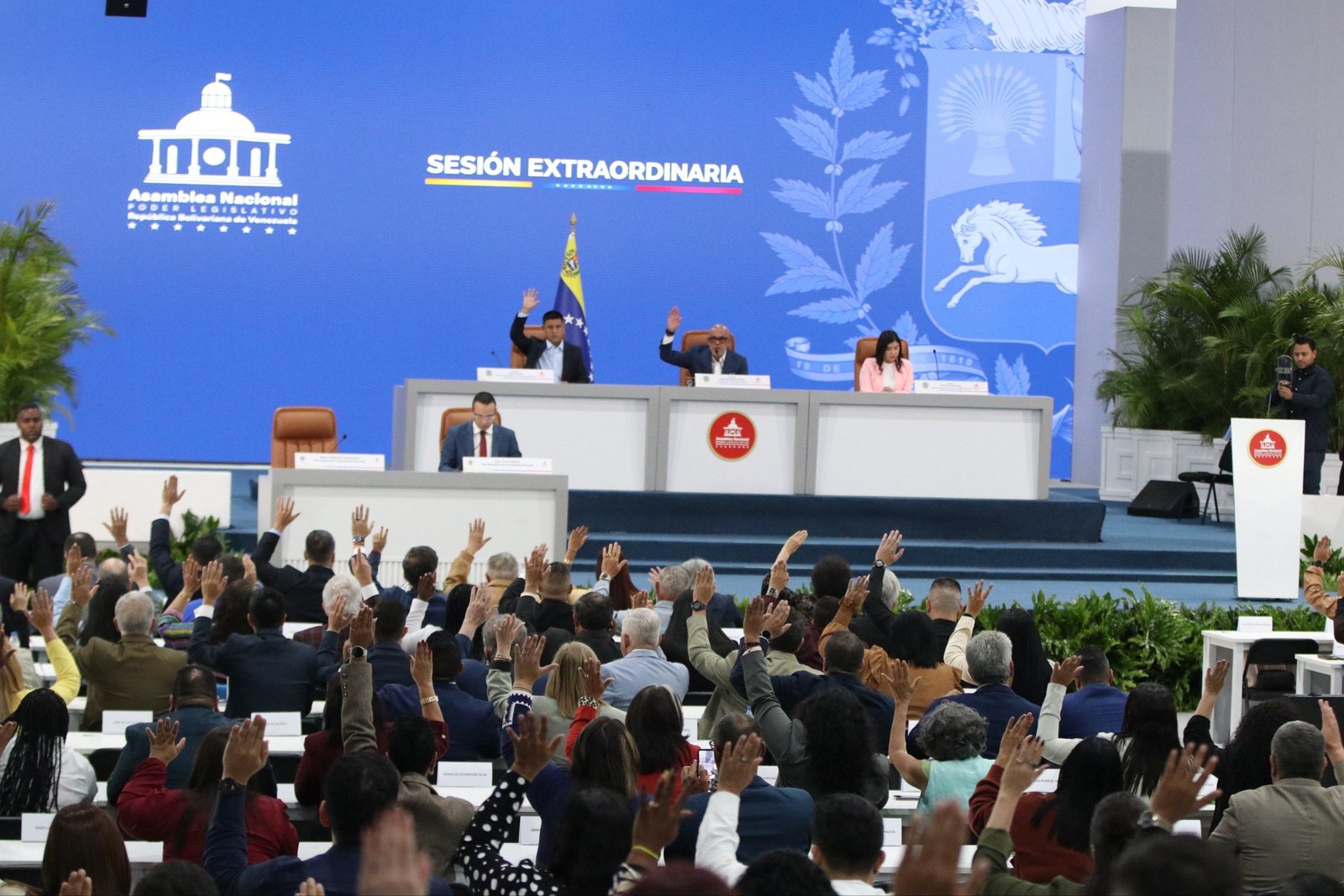
This massive change, which leaves more than half of the highest court in the hands of temporary substitutes, responds to the new political context with the implicit aim of purging figures linked to the Maduro-Flores couple and attempting to restore credibility in the justice system. The National Assembly (AN) had already activated a replacement process amid an atmosphere of anticipation and skepticism.
Therefore, this scenario does not arise out of nowhere, as it aligns with recent announcements such as the appointment by the AN of the preliminary commission to form the Judicial Nominations Committee. Additionally, the installation by Delcy Rodríguez of the Commission for the Great National Consultation on the Reform of Criminal Justice stands out, seeking to eradicate “vices and deviations of power” accumulated over the years.
The magnitude of the departures shows a selective purge of magistrates associated with the detained presidential couple, to open the door to a renewed Judicial Branch that could influence pending cases of corruption, human rights, and political disputes, at least according to the government narrative. The move that has shaken the judicial system configures a restructuring process with few precedents.
Confirmed Retirements: Profiles of an Era That Ends
The Plenary Session ratified the retirements of eight key magistrates, each with a history illustrating the government’s influence on the TSJ, especially during the most recent years. These retirements, driven by the “new political moment,” leave chambers such as Criminal, Civil, Political-Administrative, and Social operating provisionally with substitutes until definitive appointments are made.
One of the retired magistrates is Maikel Moreno, former president of the TSJ (2017-2022) and member of the Criminal Chamber, sanctioned by the United States and the European Union for being identified as contributing to the undermining of democracy and the rule of law in Venezuela. Additionally, Washington offers a $5 million reward for his alleged role in organized crime, bribery, and money laundering.
Another retiree is Elsa Gómez, president of the Criminal Chamber and aunt of the wife of Walter Gavidia Flores, son of Cilia Flores. Gómez has been accused of pushing judicial persecutions, leaving a legacy of criticism for procedural abuses. In 2013, when she was a judge of the Caracas Court of Appeals, she benefited an Army general convicted of corruption, a fact questioned by the TSJ itself.
Edgar Gavidia, president of the Social Chamber and brother of Cilia Flores’s first husband, had secured a 20-year stay in the Judicial Branch after being ratified in 2022, but was retired four years later. Luis Fernando Damiani Bustillos, of the Constitutional Chamber, who authorized ruling 343 of March 25 prohibiting criminal evictions, would also cease his functions.
Likewise, Henry Timaure, president of the Civil Chamber and general of the FANB (from the same graduating class as Diosdado Cabello), represents the fusion of military and judicial power in that instance. Alongside him, also in the Civil Chamber, Carmen Alves was retired, having been elected in 2022 and having managed, through that process, to remain a magistrate for at least 19 years after joining the institution in 2015.
In the Political-Administrative Chamber, its president Malaquías Gil Rodríguez also says goodbye to his functions. He had been a magistrate since 2010 and was sanctioned in 2018 by Canada for alleged corruption and human rights violations. From the same Chamber, Juan Carlos Hidalgo Pandares, a military officer from the same graduating class as Vladimir Padrino López, was also removed from his functions.
Notably, the Electoral Chamber remains intact, preserving its original composition amid the wave of retirements. The decision, taken in a morning session with witnesses present, reportedly submitted a formal report to the National Assembly to expedite the replacement process. While new sitting magistrates are appointed, the chambers will operate with substitutes.
Additional Vacancies: The Absences That Preceded the Shake-Up
Beyond the eight fresh retirements, Transparencia Venezuela documents four vacancies due to “permanent absence” since 2024. In the Constitutional Chamber, Gladys Gutiérrez retired after being appointed ambassador to Spain, and Calixto Ortega did not return after leaving his role as Venezuela’s representative to the International Criminal Court in The Hague, despite having obtained a “leave” to assume the position.
The Political-Administrative Chamber lost Bárbara César Siero in total opacity, following the detention of her military brothers for alleged conspiracies; it is unknown whether her departure was under the figure of retirement or resignation. In the Social Chamber, Carlos Alexis Castillo assumed as Minister of Labor on March 18 under Delcy Rodríguez, with a temporary substitute who does not fill the main seat.
This accumulation of absences, prolonged by prior inaction, reveals a slowdown in judicial reform now forced into a comprehensive reconfiguration, with the TSJ sending the official report to the AN for immediate action. Organizations such as Transparencia Venezuela highlight that this “renewal” comes only four years after previous changes, underscoring the political instability of the court.
Options for Substitutes: Rumors and Expectations
Judicial sources and social media circulate names for the vacancies left by retirements, but certain profiles are far from less polarized. These candidates, not yet confirmed, spark debate over whether they are independent actors or mere functional replacements. Given this, the Nominations Committee process will be key to validating their suitability.
For the Criminal Chamber, Katherine Harrington is a strong rumored candidate. Harrington, current wife of Defense Minister Gustavo González López, was recently retired as president of the Criminal Judicial Circuit of the Caracas Metropolitan Area and is remembered for attempting to enter the Public Prosecutor’s Office in a car trunk in 2017, following a questionable appointment as deputy prosecutor by the TSJ.
The other vacancy in the Criminal Chamber would be filled by Heriberto Peña, who currently serves as a judge on the Court of Appeals of the Criminal Judicial Circuit of the Caracas Metropolitan Area. For the Social Chamber, Edelio González is mentioned, coming from being president of the Labor Judicial Circuit of the Caracas Metropolitan Area.
Jaime Báez and Juan Cuenca would be the successors in the Civil Chamber, both currently serving as substitute magistrates, as would Emilio Ramos, who would occupy one of the available seats in the Political-Administrative Chamber. In this latter chamber, the other vacancy would be filled by Luis Emilio Rondón, former rector of the CNE and son of the current opposition deputy of the same name from the Fracción Libertad.
The Legal Framework: Composition of the TSJ and the Appointment Process
The Constitution (Article 264) and the Organic Law of the TSJ (LOTSJ, reformed in 2022) establish that the TSJ is composed of 20 sitting magistrates in the Plenary Session, distributed across five chambers: Constitutional (5 members), Criminal (3), Civil (3), Political-Administrative (3), Social (3), and Electoral (3), each presided over by a sitting magistrate and complemented by substitutes or accidentals appointed by the Plenary Session.
For vacancies, the AN forms a preliminary commission (the 11 deputies already named) that summons civil society for the remaining 10 members of the Judicial Nominations Committee, thus totaling 21 members. This Committee evaluates applicants, conducts interviews, and draws up shortlists for final vote in plenary. The current call for applications is open until May 1st, at the Bolivarian Museum.
The Law sets rigorous standards to be a magistrate: Venezuelan by birth with no other nationality; recognized honorability, ethics, and legal competence; full mental capacity; no final criminal convictions; and resignation from political party militancy. Professional alternatives include 15 years of legal practice with a postgraduate law degree, full university teaching position in law, or having been a superior judge in the corresponding specialty.
The Nominations Committee verifies moral solvency and experience as a mechanism for independence. Magistrates serve 12 years without immediate reelection, chosen by the AN with a 2/3 vote of the list submitted by the Committee, previously verified by the Citizen Power. This purge could revitalize the TSJ, although its success will depend on the plurality of the Committee and the national consultation.