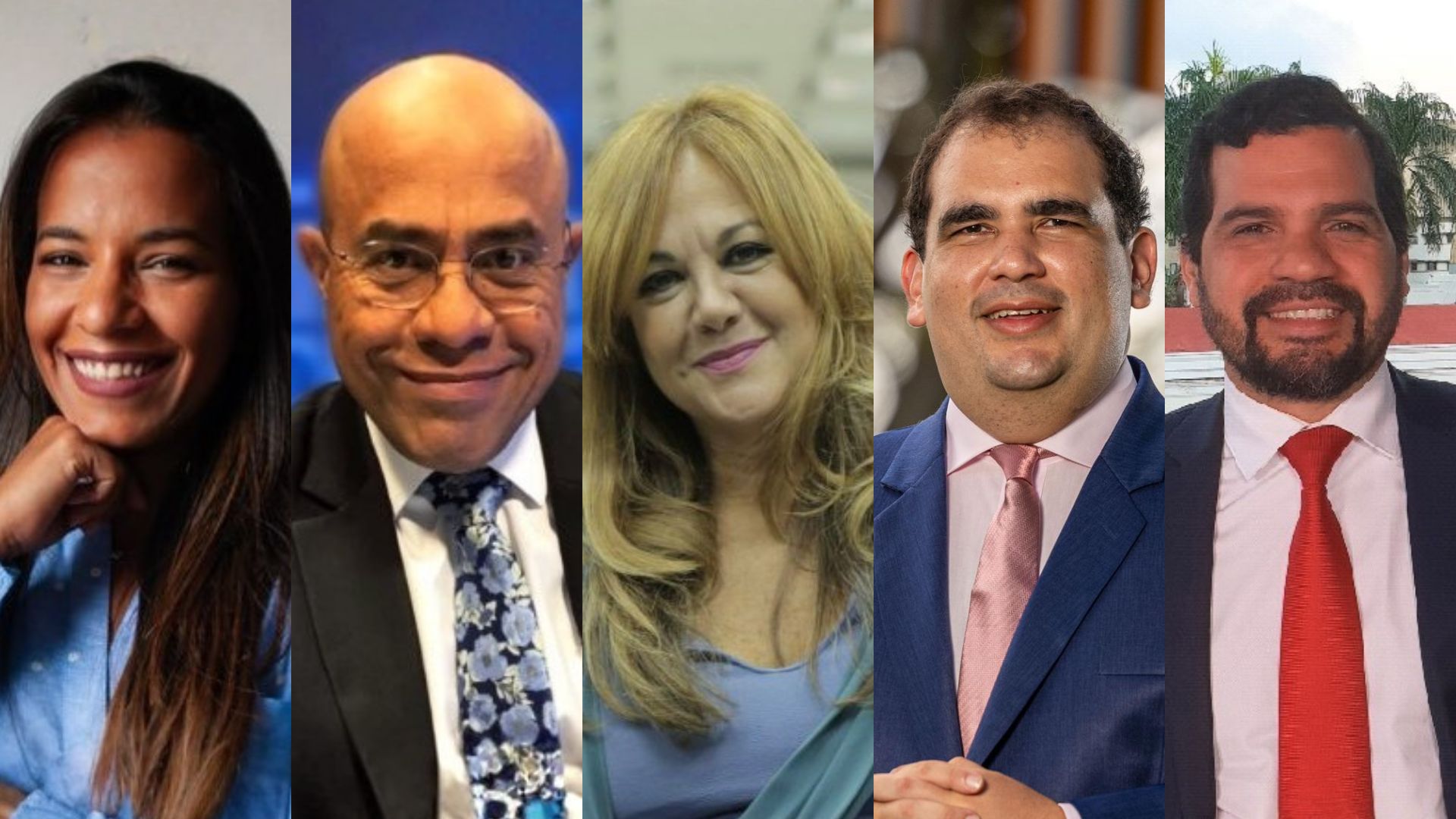
The Committee for the Evaluation of Nominations continues to navigate negotiations around the profile of one of the key bodies of the Citizen Power. Photos: Social Media / Guacamaya composition.
Guacamaya, March 26, 2026.— Parliamentary sources confirmed to Guacamaya that the list of candidates for Ombudsperson—after the 48‑hour extension granted to the Citizen Power Nominations Evaluation Committee for receiving and screening names—now includes new, well‑known figures from the political, academic, and media spheres. Among them are Marialbert Barrios, Eglée González Lobato, Vladimir Villegas, Luis Daniel Álvarez, and Edgardo Toro.
It is a heterogeneous roster that mixes figures with an opposition parliamentary past, critical analysts, academics, and intellectuals linked to the ruling party. Although it is known that the committee has already held interviews with some of these nominees, no official details have been released regarding who has gone through the evaluation round, keeping the internal dynamics of the process under a veil of political discretion.
Marialbert Barrios, former opposition lawmaker and human rights activist
Among the names associated with the opposition camp, Marialbert Barrios stands out. She is a former deputy of the National Assembly elected in 2015 for Caracas’ Circuit 1, representing the Democratic Unity Roundtable (MUD). At the time, she was presented as the youngest female lawmaker in the chamber, a generational symbol of the opposition platform in contrast to chavismo.
Her trajectory is rooted in Primero Justicia within the MUD and marked by a critical stance toward central power, with emphasis on youth issues, civil rights, and political oversight. In recent years, Barrios has focused much of her public work on defending women’s rights and women’s economic autonomy through the organization Wommu.
Eglée González Lobato, a technical profile
Eglée González Lobato is primarily noted for her technical background: she is a lawyer, holds a PhD in Sciences with a mention in Law, and is a specialist in Administrative Law and electoral processes. She is also a university professor with more than two decades of experience in public law, democratic governance, and institutional strengthening.
She has worked as an electoral and citizen participation consultant, including in international cooperation, and has dedicated herself to researching and explaining the functioning of the electoral system and public administration. Although she occasionally appears in media spaces offering critical readings of the political landscape, her résumé presents her mainly as an expert in institutions.
Vladimir Villegas, journalist and former constituent
Another name entering the race is journalist Vladimir Villegas, a well‑known figure in Venezuelan public opinion. With a long career in print, radio, and television, Villegas was a member of the 1999 Constituent Assembly and has hosted various interview and analysis programs featuring both pro‑government and opposition voices.
His family and political background link him to the Venezuelan left: he is the brother of former Minister of Culture and former Ombudsperson candidate Ernesto Villegas, as well as journalist Mario Villegas, the latter a government critic. In recent years, Vladimir Villegas has distanced himself from the government, though without fully severing ties with sectors of power.
Luis Daniel Álvarez, academic and international affairs specialist
The list also includes Luis Daniel Álvarez, who publicly identifies as a PhD in Social Sciences, journalist, and international affairs specialist. His recent trajectory highlights his work as a university professor and analyst of international politics, with frequent appearances in media and academic spaces. His work addresses issues of international relations and political dynamics.
Although there are no public records formally linking him to a specific political party, nor open data about his exact age, the tone of his analyses and his professional environment place him closer to the democratic opposition than to ruling‑party structures. His presence on the list adds a technical and academic component to the race for the Ombudsperson’s Office.
Edgardo Toro, a lawyer who reinforces the official narrative
According to available information, Edgardo Toro is a lawyer and international affairs specialist linked to the legal‑political field that supports the government, with expertise in critical monitoring of the multilateral human rights system. He is a member of the Venezuelan Association of Jurists (AVJ), from which he has taught courses and lectures on various international protection mechanisms.
Documents from the United Nations system list him as Second Secretary of the Permanent Mission of the Bolivarian Republic of Venezuela and later as Second Secretary of the Venezuelan mission in Geneva. Within the PSUV and allied media, he is presented as one of the technical cadres tasked with countering UNHCR reports and other agency assessments on migration.
The National Assembly between the mining law and the reconfiguration of Citizen Power
While the Citizen Power Nominations Evaluation Committee advances with interviews and credential reviews, the National Assembly maintains an intense legislative agenda. At the center of today’s debate was the Organic Mining Law Bill, already approved in first discussion and now continuing its second discussion phase, article by article.
During today’s session, Parliament also approved the Organic Law for the Acceleration and Optimization of Administrative Procedures of the Public Administration, aimed—according to the official narrative—at “unblocking” bureaucracy and simplifying citizens’ interactions with state institutions.
The combination of names emerging for the Ombudsperson’s Office shows that the dispute goes beyond government vs. opposition, touching on different approaches to managing institutional frameworks. In the coming days, it will become clearer whether the ruling party opts for a profile clearly aligned with its project, a figure of “controlled consensus,” or a candidate who blends technical expertise, experience, and the ability to engage across sectors.