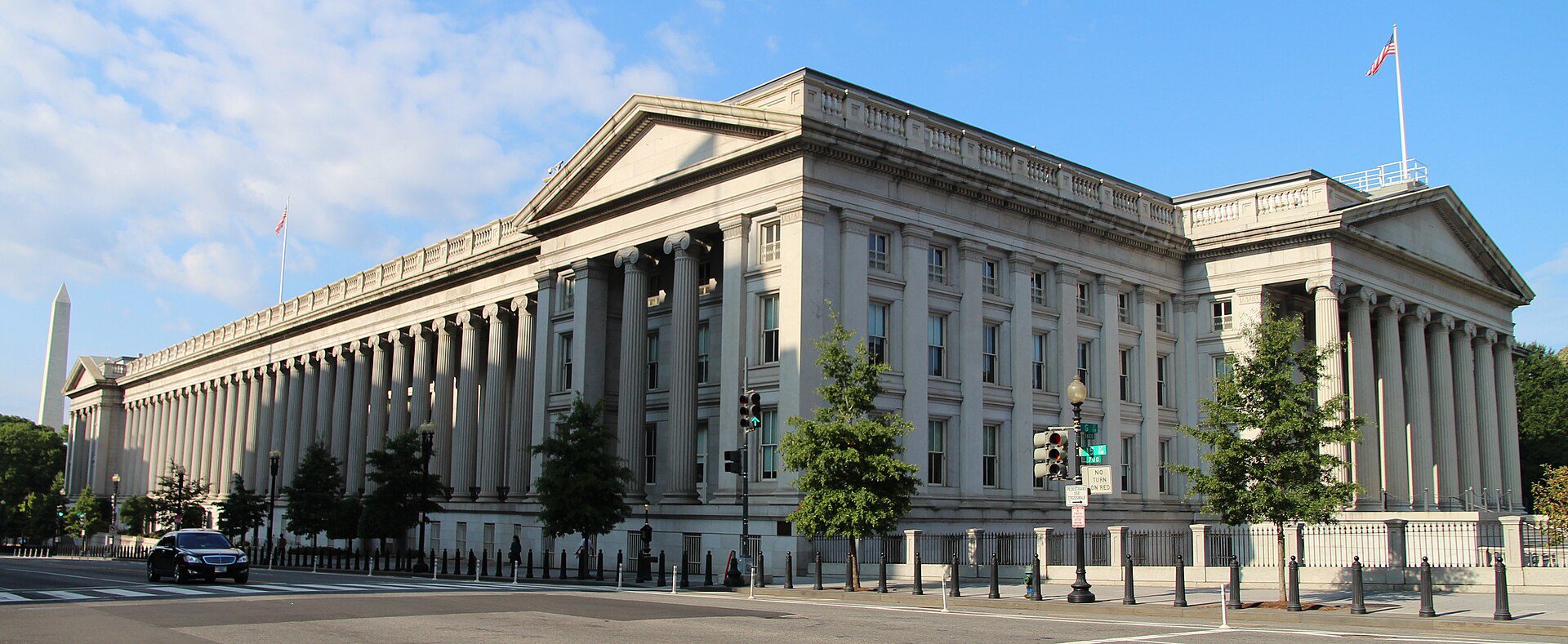
The latest license is part of the Trump administration’s plan for Venezuela’s economic recovery, while maintaining Washington’s control. In the image, the United States Department of the Treasury. Photo: National Register of Historic Places.
Guacamaya, May 5, 2026. The U.S. Treasury Department’s Office of Foreign Assets Control (OFAC) issued General License 58 on Tuesday, opening a pathway for the restructuring of Venezuela’s sovereign debt.
The latest sanctions authorization permits transactions with the Government of Venezuela and PDVSA that are necessary to provide legal, financial advisory, and consulting services related to a potential resolution of defaulted liabilities.
This exception to the sanctions is introduced as an amendment to a 2017 measure, when the first Trump administration prohibited new debt issuance by the Venezuelan state and its national oil company, cutting off a vital source of financing for any country and blocking the possibility of a restructuring.
This step is essential to begin conversations on restructuring Venezuela’s sovereign debt. The work of experts is necessary to determine the total size of the debt and locate its holders, as well as to estimate the country’s present and future capacity to repay creditors, taking into account that the Venezuelan economy today is one-third of what it was in 2012.
The news has been well received by the market, as various investors prepare for one of the largest debt restructurings in emerging markets history, following Argentina in 2001 and Russia in 1998.
The main concentration of sovereign debt is in the Republic and PDVSA bonds issued in dollars in New York, which have been in default since 2017. Between the Government and the state oil company, they ow a combined debt of $66 billion, to which default interest must be added, which could bring the total to between $120 billion and $160 billion, according to different estimates.
The latter figure would be greater than Venezuela’s current Gross Domestic Product, which stands at around $100 billion. However, the country is not expected to pay the entire debt; rather, an agreement is expected to be reached between creditors and the government.
Both sides would negotiate a discount or “haircut,” which could even reduce the debt by more than half in more extreme scenarios. In exchange, creditors could obtain mechanisms to gain more if Venezuela performs well, such as a “Value Recovery Instrument” (VRI), which could be tied to economic growth or oil royalties.
The bonds have been trading on the international market, although they have faced temporary restrictions. Between 2017 and 2023, OFAC maintained a prohibition on their purchase by U.S. citizens on the secondary market, which pushed prices down. For this reason, quotes have reached lows below 10 cents on the dollar at the height of sanctions and economic crisis, whereas today they may trade between 40 and 60 cents on the dollar.
Some risk funds may have quadrupled the value of their bet on Venezuelan debt, even without having reached a restructuring.
This license does not yet permit the resolution of this debt — that is, the restructuring itself. It is exclusively for hiring advisors. As with other recent authorizations, transactions with other sanctioned entities, or those located in Russia, Iran, North Korea, Cuba, and China, are prohibited.
Venezuela also faces other external debts, including $23 billion in arbitration awards, mainly due to Hugo Chávez’s nationalizations, loans from multilateral institutions, and bilateral debts with Russia, China, and Brazil.
The state, as well as PDVSA, also have outstanding trade accounts, for example with oil companies ranging from Chevron and Repsol to the China National Petroleum Corporation (CNPC).
OFAC’s measure is part of the United States’ strategy to gradually reverse sanctions imposed during the first Trump administration and to support an economic recovery aligned with Washington, D.C.
Since the capture of Nicolás Maduro on January 3, we have already seen licenses allowing oil production and marketing activities, entry into the mining sector, and transactions with the Central Bank of Venezuela and other state banks.