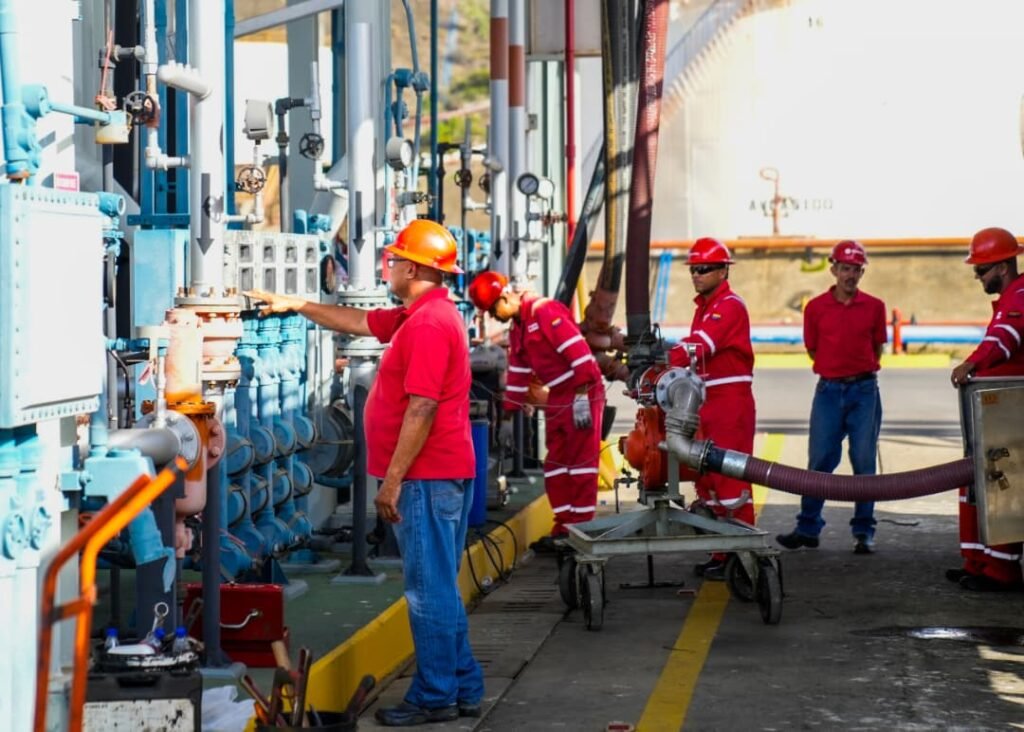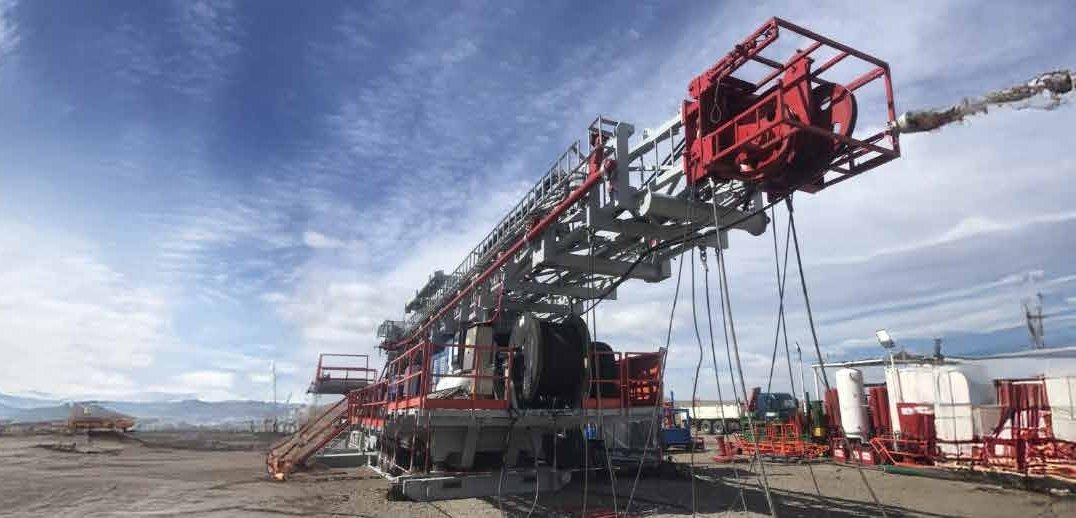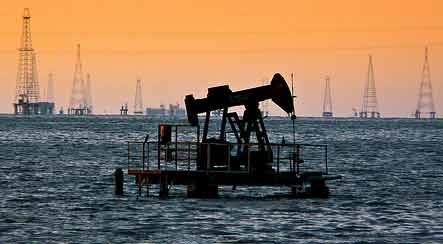
Oil operations in Lake Maracaibo, Venezuela. Photograph: PDVSA website
Guacamaya, April 10, 2026. Venezuela’s hydrocarbon sector is undergoing a phase of reactivation marked by a sustained increase in exports to the United States, the gradual return of interest from major international oil companies, and an intense diplomatic agenda aimed at unlocking energy projects. However, this renewed dynamism coexists with regulatory delays, unresolved disputes, and a still fragile financial environment that conditions the real pace of investment.
The cautious return of major U.S. oil companies
According to Reuters, renewed international interest is reflected in the movements of major energy companies. ConocoPhillips has sent a team to Venezuela to evaluate the possibility of resuming operations.
According to company spokesperson Dennis Nuss, the objective is to better understand the country’s potential and compare it with other global opportunities.
However, its CEO, Ryan Lance, has reiterated that the priority is to recover approximately $12 billion following the nationalization of assets in 2007.
In parallel, ExxonMobil has also sent a team to assess opportunities. Its president of exploration and production, Dan Ammann, warned that restoring production to 3 million barrels per day would require “hundreds of millions of dollars” in long-term investment.
Both companies agree that multiple conditions still need to be met to enable large-scale investments.
Local expectations: early-stage exploration and long timelines
In the state of Trujillo, foreign investors are conducting soil studies and well evaluations in the Tomoporo field, in La Ceiba municipality.
The president of Fedecámaras in the region, Rodrigo Vásquez, highlighted that these initiatives could place the state on the national and international oil map.
However, he warned that results will not be immediate: projects could materialize within a one- to three-year horizon, reflecting the long-term nature of these investments.
Energy diplomacy and relations with Trinidad and Tobago
A key development that has gone somewhat under the radar is that Trinidad and Tobago has recognized Delcy Rodríguez as Venezuela’s interim president and is preparing to send a high-level delegation to Caracas in the coming days.
Foreign Minister Sean Sobers stated that relations are improving, although political tensions persist, including the designation of Prime Minister Kamla Persad-Bissessar as persona non grata in Venezuela.
The main objective of the visit will be to advance negotiations on shared hydrocarbon resources, particularly in projects such as Dragon and Loran-Manatee.
These fields are critical for energy security and the development of liquefied natural gas in Trinidad and Tobago.
Shell’s role and the push for gas
In this context, Reuters reports that Shell plans to begin gas production in 2027 at the Loran-Manatee field.
According to Gerald Ramdeen, president of the National Gas Company (NGC), the company is working to secure first gas and has increased the pipeline capacity to 1 billion cubic feet per day, up from the originally planned 700 million.
The project’s reserves are significant:
Loran: approximately 7.3 trillion cubic feet
Manatee: approximately 2.7 trillion cubic feet
Additionally, global geopolitical uncertainty—particularly in the Middle East—has pushed Trinidad and Tobago to consider reactivating infrastructure such as Atlantic LNG.
Europe enters the picture
Vice Foreign Minister Oliver Blanco held meetings in the United Kingdom with Harriet Thompson and Peter Costello of Shell’s global upstream division, discussing hydrocarbon projects such as those mentioned above.
In Italy, Undersecretary of Foreign Affairs Maria Tripodi agreed to relaunch bilateral cooperation with Venezuela, including investments in mining and industry.
Meanwhile, Giuseppe Mauriello of the Venezuelan-Italian Chamber of Commerce highlighted growing interest from Italian companies in sectors such as agribusiness, metals, and machinery.
The main bottleneck: contractual uncertainty
Reuters has reported that companies interested in investing are waiting for Venezuela’s Ministry of Petroleum to publish new contract models.
Although the Hydrocarbons Law reform granted greater autonomy to PDVSA’s partners, contractual and fiscal frameworks have yet to be defined.
This has delayed investment decisions in key projects, as companies require clarity on operational, tax, and legal conditions.
Additionally, there are institutional limitations, as many officials lack the authority to negotiate specific terms, complicating discussions with investors.
Moreover, agreements must be compatible with U.S. licenses, adding another layer of complexity.
Rising exports and repositioning in the U.S. market
According to the U.S. Energy Information Administration (EIA), Venezuelan oil exports to the United States have grown significantly in early April 2026. In the seven days ending April 3, shipments reached 321,000 barrels per day (bpd), a 65% increase compared to the previous period.
This volume places Venezuela as the third-largest crude supplier to U.S. refineries, behind Canada (4.271 million bpd) and Saudi Arabia (589,000 bpd).
Medium-term indicators reinforce this trend. The four-week moving average stood at 372,000 bpd, the highest level of the year and the highest since February 2019. Compared to the same period in 2025, this represents a 48% increase, showing a sustained recovery in oil flows.
However, the average for the first 13 weeks of 2026—218,800 bpd—remains 12% below the same period in 2025, indicating that while recovery is clear, it has not yet reached previous levels.
This rebound is directly linked to the new political and economic framework following the events of January 3, including sanctions easing and the Hydrocarbons Law reform.
India: the new Asian driver of Venezuelan crude
Alongside the rebound toward the United States, India has emerged as a key player in the reconfiguration of Venezuela’s oil market.
Exports to India rose to 342,000 barrels per day (bpd) in March, up from just 35,000 bpd in February, showing exponential growth within weeks.
Reuters reports that Reliance Industries has played a central role, purchasing crude directly from PDVSA. A supertanker, the Helios, chartered by its subsidiary RIL USA, loaded 2 million barrels of Merey crude at the José terminal in Anzoátegui state, bound for the port of Sikka.
These shipments have helped streamline operations at the country’s main oil terminal and reduce accumulated inventories.
Trade with India resumed in late February after a 10-month pause, initially through intermediaries such as Chevron and later via direct purchases.
Shipping data also indicate that Indian refineries have significantly increased demand, positioning India as one of the main destinations for Venezuelan crude, at times even displacing China.
It is worth noting that revenues from these sales remain under U.S. supervision, channeled through accounts managed by the Treasury Department.
All of this suggests that an agreement between India and the Trump administration to reduce tariffs by replacing sanctioned Russian and Iranian oil with licensed Venezuelan crude is gradually advancing.
A sector in transition: between potential and uncertainty
Venezuela’s hydrocarbon sector shows clear signs of reactivation: rising exports, renewed international interest, new gas projects, and active energy diplomacy.
However, the pace of investment remains constrained by structural factors: legal uncertainty, institutional weakness, and financial risks.
In this context, Venezuela is in a transitional phase where its potential is evident, but its realization will depend on the country’s ability to provide clear rules and long-term stability.