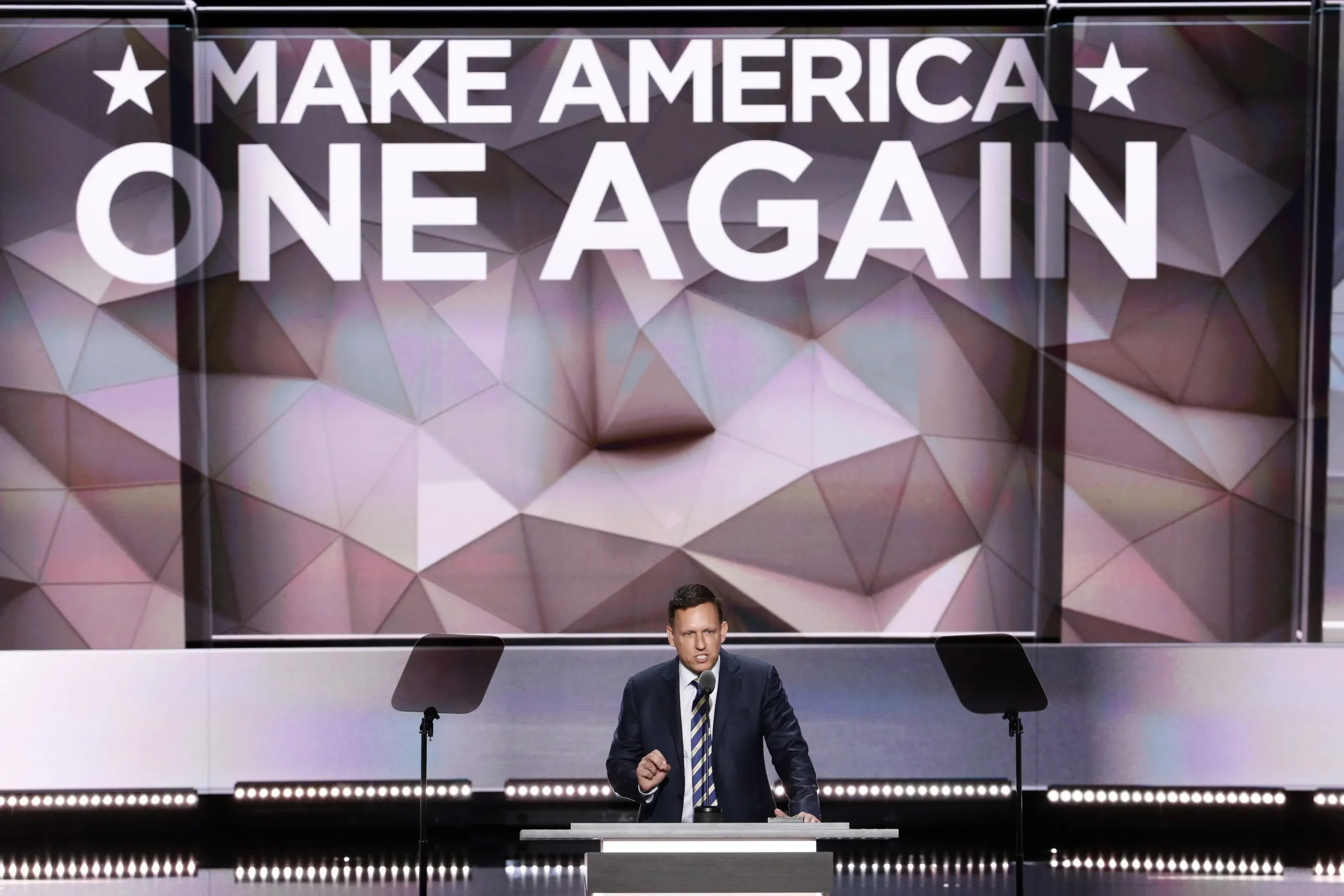
Peter Thiel, a German-American venture capitalist, was a co-founder of PayPal, Palantir, and the Founders Fund. He is also one of the main financiers of the new Republican ecosystem. Photo: Gage Skidmore.
Jorge Barragán is an international analyst. He graduated from the Central University of Venezuela (UCV).
Guacamaya, May 20, 2026. The possible correspondent banking agreement between the Bank of Venezuela and Erebor Bank should not be read solely as a financial operation. Above all, it is a political signal: Venezuela’s main public bank could find a gateway into the North American financial system through Erebor Bank, backed by the tech entrepreneur with the greatest influence within Washington’s Republican ecosystem.
Although it operates with a neobank logic and fintech focus, Erebor Bank is formally a U.S. national bank. This status gives the potential correspondent agreement with the Bank of Venezuela greater regulatory weight.
According to Reuters, Erebor received a national banking charter in February 2026 and counts among its investors figures such as Palmer Luckey, Joe Lonsdale and, according to reports, Peter Thiel. These names reflect the new Republican power of Silicon Valley: tech capital, defense, artificial intelligence, economic nationalism, and closeness to the Trump–Vance universe.
Bloomberg reported that Erebor has offered to establish correspondent lines with Venezuelan banks and sub-accounts for their clients, which would make it easier for local companies to open accounts in the United States and move funds from Venezuela more smoothly.
The figure of Peter Thiel is key to understanding the political dimension of the move. Co-founder of PayPal and Palantir, Thiel has become one of the major financiers of the new Republican ecosystem. In the 2022 midterm elections, he contributed around $35 million to sixteen candidates, twelve of whom were elected. Among them was JD Vance, the current Vice President of the United States, who before his political career worked at an investment firm associated with Thiel himself.
Peter Thiel’s interest in Venezuela is not just banking; it’s about critical minerals.
Thiel’s interest in Venezuela is not limited to banking: it also connects to the race for critical minerals. Thiel, co-founder of Palantir, is part of the new U.S. military-technological complex, where artificial intelligence, defense, data, and national security converge as a single industry. In May 2025, the Department of Defense increased Palantir’s contract for the Maven Smart System by $795 million, evidence of the growing weight of these platforms in 21st-century algorithmic warfare.
And that war needs minerals: drones, sensors, satellites, missiles, semiconductors, command systems, and artificial intelligence depend on secure supply chains of bauxite, nickel, coltan, tantalum, niobium, rare earths, and other strategic inputs. That is why Venezuela, as I have written before, can be read not only as an energy powerhouse, but as a potential piece in the industrial defense and technology architecture of the United States.
For Venezuela, the implication is evident: a correspondent relationship with a U.S. bank would once again connect the Bank of Venezuela with channels of the North American financial system. It would not be a complete lifting of financial isolation, but it would be a relevant operational step for companies, suppliers, importers, exporters, and economic actors who need accounts, payments, dollars, traceability, and less banking friction.
But the most important dimension is the political one. A bank linked to Republican tech capital wanting to be the financial operator for Venezuelan banking is not just seeing a banking opportunity; it is reading a geopolitical window.
The potential winners are clear. On one hand, the Venezuelan government could showcase a sign of financial reintegration. On the other hand, Venezuelan companies would have a more formal way to operate with dollars and international counterparts. But above all, the winners are the American businessmen with political weight in Washington: those capable of entering a complex market early.