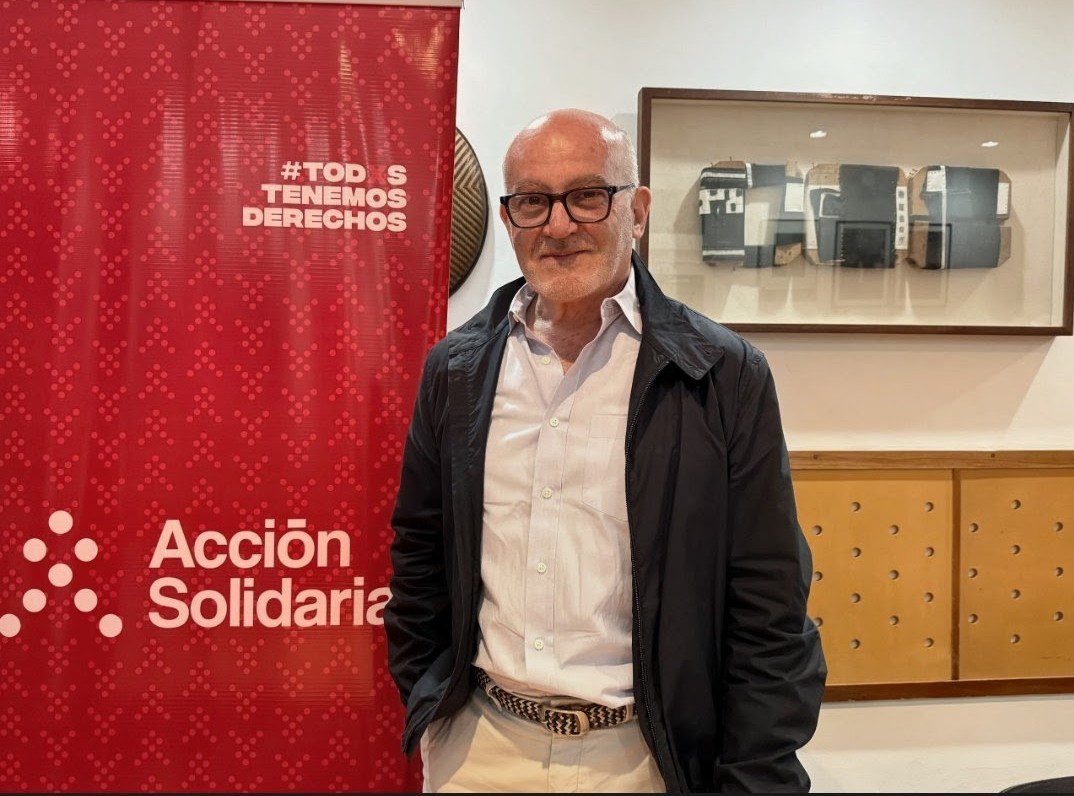
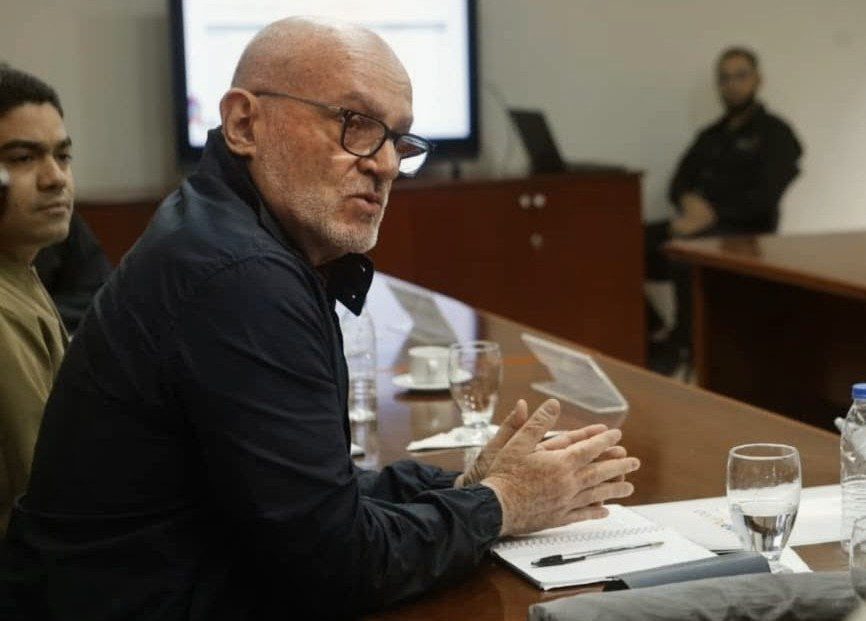
Guacamaya, May 10, 2026. Feliciano Reyna is a Venezuelan architect and renowned human rights defender, founder and president of the organization Acción Solidaria. His career is deeply marked by his activism in the public health arena, particularly in the response to HIV/AIDS in Venezuela, where he has promoted an approach focused on education, prevention, and access to treatments.
He founded Acción Solidaria, which created the country’s first telephone helpline for people affected by HIV and developed national awareness campaigns through audiovisual media. Subsequently, he participated in the creation of CODEVIDA, a coalition of organizations dedicated to defending the right to health and life in Venezuela.
His work has been widely recognized internationally. In 2002, he was selected as an Ashoka Fellow, and in 2006, he was a finalist for the Red Ribbon Award at the International AIDS Conference in Toronto. In 2017, his work was distinguished by Amnesty International Venezuela with the “Llama de la Esperanza” (Flame of Hope) award, one of the organization’s highest recognitions for sustained commitment to human rights.
Internationally, Reyna has maintained active dialogue with United Nations mechanisms and global human rights organizations. His work has been key in documenting the humanitarian emergency in Venezuela and in articulating international responses to the crisis.
In 2023, he was awarded the prestigious Martin Ennals Award, sometimes called the “Nobel Prize for human rights,” considered one of the most important recognitions for human rights defenders in the world, granted by a coalition of international organizations that includes Amnesty International and Human Rights Watch.
Currently, in addition to his role at Acción Solidaria, he is part of the Civic Forum (Foro Cívico), a space for articulating diverse voices of Venezuelan civil society, from which he promotes dialogue, international advocacy, and consensus-building amidst the country’s complex political situation. He has recently announced his incorporation into the Program for Peace and Democratic Coexistence in Venezuela.
Q: How does Acción Solidaria evaluate the implementation of the Hospital Optimization Plan announced by the government, and what concrete guarantees should be established — in terms of transparency, accountability, and independent monitoring — to ensure that this effort truly improves equitable access to health and the conditions of health personnel in the country, in line with the recent recommendations of the Office of the UN High Commissioner for Human Rights?
A: Well, Luis Alejandro, a very important issue that I think underlies everything that led to what at one point we called a complex humanitarian emergency — perhaps it’s no longer an emergency because the situation of humanitarian need has been entrenched for years; it would be a crisis by now — but that issue is corruption.
Because until 2019, there were still some mechanisms in the health sector that worked. We ourselves, a group of organizations, created a network called CODEVIDA, which was the coalition of organizations for the rights to health and life, with organizations beyond HIV: women with or surviving breast cancer, transplant recipients, people with hemophilia.
And we managed to do some lobbying with the Ministry of Health, the Venezuelan Institute of Social Security, the Ombudsman’s Office, the Pan American Health Organization. At one point, we actually made the only protest ever made against the Pan American Health Organization in all of the Americas, telling them that they also had a responsibility for health in the country.
But the truth is that in 2019, a supposed national hospital renovation began, I think around 52 at the same time, and seven years later, there was no progress in that renovation, only partial things here and there. It was a very dramatic issue and was part of some of the expressions of corruption incurred, of course, by people in public office.
So a sustained deterioration began there, because I remember that at some point, a little later, talking with a Vice Minister of Health, she told us: “Well, but you have to understand that since there are no resources, health cannot be universal.”
And I said, “But look, Doctor, we had this situation with the hospital restoration and all that.” So, well, that’s how it stopped, and unfortunately, yes, it degenerated into damage to the very hospital structure at different levels, of large hospitals, and care in other areas.
Let’s also remember that Barrio Adentro was going to be created. There’s a statement by then-President Chávez where he says he claims that of the modules that had been planned, only half had been built, and only half of those were operating. He himself makes a very important call to attention there, but well, those were resources that were being put into a system parallel to the public health and social security system.
So that continued. We entered the very complicated moment of what we began to define as a complex humanitarian emergency, which was 2015 and 2016. We arrive today with that sustained deterioration of many years, of disinvestment, of, unfortunately, the loss of trained personnel.
In an analysis we conducted with a very important platform of organizations that has done field studies with household surveys, it showed that approximately 70% of specialized medical personnel and nursing staff had left the public health system, either through migration, leaving the country, or going to other sectors because, well, salaries were not enough.
And then capacity was also lost with all kinds of equipment. People who have to go to a laboratory even for a blood test, even the most sophisticated ones. And part of the drama this brings is that when someone goes to public health hoping for some care, they are told: “Okay, but bring this, this, this, and this from outside,” and the issue of so-called out-of-pocket expenses comes in, meaning you don’t have it, so you can’t get treated at that public hospital until we bring the supplies.
So it has been an immense challenge. I suppose there are those who do have research in terms of the investment needed to recover all that has been lost, and I hope that it is indeed possible, imagining some influx of significant resources for the country that can be directed towards the health and education systems. These are two very important areas, along with, of course, public services.
Q: What is the importance of the on-the-ground presence of the Office of the UN High Commissioner for Human Rights in Venezuela, why do some sectors seem to boycott it, and what should be the axes of cooperation at this time?
A: Indeed, I have been among those who advocate for the staff of the High Commissioner’s office to be in the country, and not only that, but I hope it is possible to formally establish an office, not just to allow staff entry, but to have a UN High Commissioner for Human Rights office in Venezuela.
I think one of the most important things is that it would give stability to the situation. It shouldn’t be that, at a given moment, a government can say, “Leave Venezuela effective immediately,” giving only a few hours to leave the country. A formal office would grant a different status and greater permanence.
But also, whoever truly wants to solve a problem must be willing to listen to those raising alarm bells. From the High Commissioner’s office, even from Michelle Bachelet’s time — as well as from the Inter-American Human Rights System and the Universal System, with its rapporteurships and other special procedures — the starting point is a rigorous analysis of what is happening on the ground: food, children and adolescents, freedom of expression, among many other issues.
Based on that analysis, they can sound alerts and point out areas requiring immediate attention. Also, as has been seen, when there is progress, it is recognized; that’s what acting responsibly is about. In that sense, these mechanisms end up guiding actions both in Venezuela — hopefully so — and in other countries.
Of course, they generate discomfort because no government finds it easy to have findings derived from international scrutiny appear in a report, as they receive attention, and this has happened here in the country, especially with issues like detained persons, arbitrary detentions, torture, and cruel treatment. There are, for example, the reports of the Fact-Finding Mission, as well as Volker Türk’s reports on the human rights situation in Venezuela.
But, in the end, the ones to pay attention to are these mechanisms that, devoid of particular or political interests — although they act within legitimate frameworks — start from a rigorous analysis of what human dignity means and the conditions necessary for people to fully exercise their rights. And, in that sense, they point out what is not working.
Now, I truly hope — and it’s part of what I have maintained, as you well said — that these mechanisms can be in the country, that they are allowed a full presence.
There was an agreement signed with the Office of the High Commissioner that was never made public, but of which we know some elements, both from direct conversations and from subsequent documents, for example, in the Universal Periodic Review. In that agreement, among other things, the possibility of accessing detention centers anywhere in the country was guaranteed, something that remains highly relevant.
It is also essential that they can go to remote areas, see what is happening with indigenous populations, analyze environmental issues, and many other aspects that, as you mentioned, directly concern civil society.
I like to speak precisely of civil society organizations, because they are expressions of collectives that organize around common interests and problems. And these organizations play a key role in pointing out what affects society from different areas.
That voice arising from civil society, along with all the documentation produced by these international mechanisms, ends up being a kind of beacon for those in power. If alerts are being raised from different sectors — including organized communities — about problems like garbage, access to water, or even abuses within community spaces, it would be logical for those voices to be heard and guide public action.
So, returning to the initial point, I firmly believe it is very important for these mechanisms to be present in the country. Hopefully, we will also advance in the implementation of recommendations made in the Universal Periodic Review and facilitate visits by the UN’s special procedures.
And, on the other hand, as has also been proposed, it would be desirable for Venezuela to be able to fully rejoin the Inter-American Human Rights System, from which it withdrew some years ago.
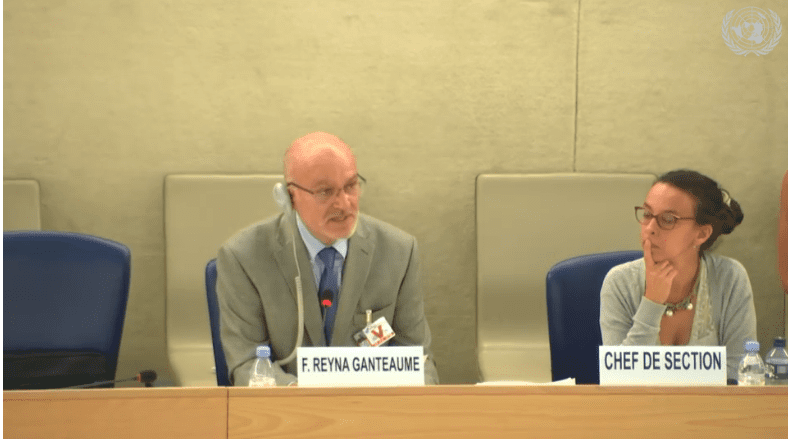
Q: Allow me to make a digression to close the UN topic. You mentioned Michelle Bachelet, now a candidate for Secretary-General. The UN is in an internal election process to choose its highest authority, and there are three Latin Americans among the options. In this regard, I would like to know your expectations regarding that.
A: Regarding the election process for the new UN Secretary-General — which, furthermore, has a significant presence of Latin American candidates — yes, I have expectations, especially because it is an opportunity that directly touches our region.
I find particularly interesting what has been seen these days listening to the proposals of figures like Rebeca Grynspan and also Michelle Bachelet. I think they bring very solid track records and visions that can be relevant at this time.
In general, we are facing an important election: three of the main candidates come from Latin America, along with Rafael Grossi, which reflects both the weight of the region and the expectation of geographic rotation in the leadership of the United Nations.
Personally, I have found the stance expressed by some of these candidates interesting, due to their experience and the way they approach multilateralism. I believe that for Venezuela and the region, it could be an important opportunity, even to rebuild or reduce certain distrusts that have accumulated towards the multilateral system.
It is true that there have been tensions — for example, following reports or international positions at specific times — but one would hope that this does not lead to ruptures, but rather to the possibility of opening spaces for conversation, expressing deep differences when they exist, but without closing doors.
Because, in the end, multilateralism at this moment — and particularly for a country like Venezuela — remains key. Not only as a space for pressure or scrutiny, but also as a channel for dialogue, accompaniment, and eventually, solutions.
“The Civic Forum is sometimes pointed to as if it assumes total representation of society, which is absurd.”
Q: There is an argument that has generated noise in the current public debate in our country, which is the idea that in Venezuela there is a conflict between two extremely polarized and deeply antagonistic sides. What does this argument mean in the context of Venezuela in 2026?
A: One of the great virtues of the Civic Forum, what even led me to become part of this space that has been growing over time since I saw it in 2021, has been that diversity of represented voices. Also, always with the focus on this idea that the Civic Forum is one more expression of civil society.
Sometimes it is pointed to as if it assumes total representation of society, and that is as absurd as what we discussed before. If civil society is this entire set of expressions of diverse interests, of people organizing to bring them into the public sphere, none of them can assume to be the sole voice of that multiplicity of spaces, encounters, and discussions.
No union can assume the voice of the entire labor movement; each has its own specific programs. So, that disqualification is also absurd.
But, let’s say, what has been very important within that space — which has functioned almost like a great “university” of dialogue — has been walking together and creating spaces, including significant disagreements on how we see the country’s situation. In the end, it’s a very pedagogical way of saying that, despite everything, we are capable of being there, coming from different areas, even geographically, ages, men and women, and from different areas of life.
It has been possible to converse, dialogue, and reflect in these meetings, in the convergence tables that have taken place recently. It is true that sometimes a word appears that is uncomfortable, and attention immediately focuses on that word, losing the richness of the debate, because it may happen that someone doesn’t like the use of a term, but it is also part of the analysis effort being made.
For example, the issue of polarization. If there are very extreme, very intransigent discourses that see the country’s situation from antagonistic positions, in the middle there exists a world that is not necessarily represented by those extremes. That world is looking for ways to solve the problems of its daily life, which are many, especially the issue of income, of how it’s not enough.
We, by the way, with this platform I mentioned, had seen that in 2025, income had reached around 237 dollars, but at that time, around June or August of last year, the food basket was at 550 dollars.
Let’s say, of course, these situations affect a large number of families and individuals. In this recent process of releases from prison, for example, or in the fact of not having good public services, one wonders how to make these things that make life so unstructured, that generate so much effort, improve.
I say it is a much larger universe that also requires political changes, of course, but the ways to achieve those political changes seem quite distant from the extremes that often propose an “all or nothing” logic.
And that, in the end, at this moment, is what we think cannot and should not happen, especially for the country to find a path at a time when I also believe many opportunities are opening up.
“If there are very extreme, very intransigent discourses that see the country’s situation from antagonistic positions, in the middle there exists a world that is not necessarily represented by those extremes.”
Q: The Civic Forum has been an actor with significant international dialogue with the European Union, Switzerland, and several Latin American countries. However, it has received accusations from some sectors — who also identify as part of civil society — and political actors, who accuse it of trying to soften international stances towards Nicolás Maduro and now towards Delcy Rodríguez. What has the Civic Forum proposed on its international advocacy tours, and what is its message at this moment for the international community?
A: I myself lived through those circumstances, and I would say regarding the Civic Forum and the people who are part of it — I could say something that implies a mea culpa — is that in an interview at the end of 2024, in which, by the way, I stated that despite the July results, I thought it was very important to make an effort to participate in the 2025 elections.
I considered it necessary to promote that participation because, despite all the obstacles, it was possible to open spaces in mayors’ offices, governorships, and the National Assembly.
I also recall that this was not a consensus within the Civic Forum itself. So, when I answer you now — and I’ll return to the topic of international activity, Luis Alejandro — I insist that some of us have different views.
Returning to these situations, today there are those who say: “But how is it possible that it was proposed not to go to elections if in 2025 the opposite was said?” However, the discussion was based on the possibility of achieving a more plural and diverse representation in the country’s institutional spaces, like the National Assembly and governorships.
Also, topics like the amnesty law and other relevant elements for all sectors of the country, not just those in exile, have been discussed there.
Evidently, all that can also dilute, in a way, representativeness if seen from a single perspective. A single option for social representation could have had — I don’t know — governorships and a National Assembly with a more plural composition, which would also allow it to measure itself against the majorities resulting from the 2024 election.
So, when options are proposed within the complexity of the moment that are not reduced to an “all or nothing” scheme, there are sectors that listen.
That is, it’s not only about what one proposes, but also that there are interlocutors who call you. We have heard those positions, they seem like possibilist proposals to us, and there spaces for participation and accompaniment from the international community open up there.
What can we do with our presence? How can we also contribute to favoring some of these situations? They tell us, “The initiatives you propose seem realistic and reasonable to us. Who else is on the ground?”
That is one of the things we have said most: there are not only two poles here with which to have dialogue. There is much more happening in the middle in this country, which, again, is not just one representation or one actor. A lot is happening in different sectors and also in other areas of the country. That’s why we insist on something fundamental: listen to those voices. That is an important part of what we have proposed.
Fortunately, there is a dialogue structure that allows for that approach. It can be here and now in Caracas, in conversations like the ones we have had or based on various recent news items, or the various interlocutors who have been working in these spaces.
In parallel, there are also concrete projects. For example, at one point there was support from the European Union to develop what the Civic Forum has called the “Social and Rights Agenda.” These are two elements happening simultaneously: on one hand, the internal articulation of civil society, and on the other, international accompaniment.
“Conflict should not be feared. On the contrary, in such a complex situation as this, the important thing is to incorporate multiple reflections and voices into the public agenda.”
Q: How important is the role of these international actors? Because they have also been questioned and attacked as part of the process.
A: I think their virtue is precisely that they are not actors directly involved in the daily dynamics of the conflict. That allows them to open spaces to listen to other voices and broaden the perspective on what is happening.
Conflict should not be feared. On the contrary, in such a complex situation as this, the important thing is to incorporate multiple reflections and voices into the public agenda.
For international actors, it is also very valuable to be able to add complexity to the understanding of the country: to understand what is happening, where it is happening, and in which sectors. Even to understand how conversations evolve in different areas.
And what we have also seen is that, for example, in the labor world, there have been interesting dynamics of rapprochement, after times when there was practically no possibility of dialogue. In the end, issues like income and labor demands are part of a common agenda that forces one to sit down to converse and present proposals, for example, to the Executive or the Ministry of Labor. There has been, in that sense, an important articulation effort within the work of the Civic Forum.
And it’s also interesting, Luis Alejandro, because many have criticized these dynamics and have still ended up coinciding on trips, invitations, or participation in activities in Brussels, Geneva, Bern, Washington, or in countries in the region like Brazil or Chile.
There are multiple civil society spaces that are entering these areas as part of international advocacy programs. For some time, initiatives like CIVICUS have promoted what is now called citizen diplomacy.
Since my first participation in its global forum in Glasgow, in 2005 or 2006, the right and value of organized citizens to bring their voice to international spaces was already being discussed. That has been, in short, another important dimension of this work.
And, once again, that also means a great effort to seek consensus so that a few, representing this space — which again is very plural — can propose some ways of looking at what is happening in the country, and again, probably not always in a single consensus that brings everyone together.
Q: A few weeks ago, your incorporation as a member of the Program for Peace and Democratic Coexistence, promoted by Delcy Rodríguez, was announced. For this, you have been the target of attacks from some sectors of the Venezuelan opposition.
What motivates you to join now, after the program has already been running for a couple of months? What role do you expect this space to play at such a complex time for the country, and how has the work dynamic been that you have found?
A: The truth is that one cannot stop thinking that a space like this, the Program for Peace and Democratic Coexistence, results from a very traumatic event in many ways, which was that of January 3rd, and it also came from a series of very serious situations that occurred during the second part of 2025: from the mistreatment of the Venezuelan population in the United States, very serious due to the stigma of being all [labeled], the suspension of the Temporary Protected Status (TPS), family reunifications, and then the bombings that took place in the Caribbean.
The issue of CECOT was terrible for the people who were there. There are testimonies collected, for example, by the New York Times and Human Rights Watch that account for how terrible it was and what happened.
All that also leads to a kind of impossibility of finding ways to overcome conflicts. The country, of course, was also severely affected by the naval and oil transport blockade. It was a truly very serious moment for the population.
The January 3rd events happen, and there possibilities, opportunities begin to open up to see what can be learned from this and how to navigate the path forward.
So this program was created. There are some people I knew before, with whom I have had dealings and communication, precisely in this way of seeing how we imagine the country and its possibilities within its complexities, like Michael Penfold, Ricardo Cusanno, and Ana María Sanjuan.
There are others I didn’t know. I had dealt with, of course; it was very interesting working with Larry Devoe, because Larry was in the program and is now Attorney General. But we were always on opposite sides of the table: he represented the State, and I was in hearings, for example, of the Inter-American Commission, or in sessions of the UN Human Rights Committee.
We were in different spaces, but I have also dealt with Indira Urbaneja, who in 2022 supported a proposal I was making publicly for the entry of the World Food Programme into Venezuela to be allowed, which at that time was not authorized.
In short, I have seen it as an opportunity to have a space that would need to be balanced more, and it has always been even an internal concern, since a majority of its members come from the, let’s call it officialist, world — to use a term — and fewer from an independent space like the one I represent.
The dialogue space has turned out to be truly very, very fruitful. Something important was woven together due to the type of meetings that were planned when I wasn’t there yet; I was in Spain. I returned on March 14th and had said I was interested in joining, but in person, precisely because I didn’t know most of the people in the program. And well, I did that upon arrival: I’ve been here for four weeks.
But I would imagine that one of the most important initiatives was having received relatives of people deprived of liberty, following the enactment of the amnesty law. And the truth is there are very serious situations. The courage of the families — mothers, wives, grandmothers — demanding the freedom of their relatives. Truly, we know we come from a terrain of enormous grievances.
Look, there they collected — and the data has been very important — more than 353 records that were made, not only of individuals, because more came than that, but the group organized itself to collect those testimonies and document them well. Even the entire group that did the work process was voluntary, on a voluntary basis.
Upon collecting this, the possibility of putting them online was created. In the end, more than 1,120 testimonies were collected. And this is being followed up on, and there is interest — which I think is very important, and I hope we can achieve it soon — to also have a meeting with organizations that do such important monitoring work as “Justicia, Encuentro y Perdón,” Foro Penal, Provea, which has also received so many cases, and Cecodap, which handles the issue of detained adolescents urgently and has done extremely important work.
Many of them also work with detained persons who have no one to speak for them, let’s say, the unknown cases. There are, of course, very recognized cases of imprisonment for political reasons, but there are a series of other events that are also being made visible.
And in that sense, returning to the program, it was like: “perhaps this is a space where it’s worth it and it’s important, they will listen to us, what can we start bringing?”
In total, it has been — when I wasn’t there — one of the most important calls: to collect, to listen first, to convene, to have dialogue, and to gather recommendations from different sectors.
From women’s rights, the world of work, for example in condominiums and neighborhood associations. There is incredible work being done by one of the members I only met once, but who does extraordinary work, Lankin González. And Lankin also comes from all that magnificent work that Elías Santana had done with “Mi Condominio.”
So, I give a lot of value to this. There are three areas that are important to me and on which I am promoting possible responses, knowing that everything comes from an accumulated debt.
The other day, in a very large meeting of young people, we talked about the humanitarian space, and I hope we soon receive the country’s humanitarian team. There are some very important reliefs that can occur for the population from the humanitarian response, which also has more than 120 organizations deployed throughout the country, along with the system agencies.
Then there is the regulatory issue. We know that laws like the oversight law imply obstacles for organizations — even us at Acción Solidaria — to be able to work with full fluidity and autonomy. Because if not, you finish meeting some requirements and a funnel pops up at SAREN. Also, the form of civil association that we use is used by many organizations, it’s the one used by, for example, condominiums. So that work was greatly backlogged.
Thirdly, there is the thicker human rights issue, such as arbitrarily detained persons. I find the number of people against whom charges have already been filed very important. Jorge Arreaza published it as part of the Follow-up Commission for the Amnesty Law: more than 8 thousand cases.
Q: The Amnesty Law has been described by some sectors as insufficient and exclusionary. On the other hand, it has also allowed the release of hundreds of people and the liberation of several political prisoners; however, many people remain detained, and in several cases, amnesty has been denied. There are also significant demands regarding guarantees for the free exercise of freedom of expression. How are you addressing this issue within the Program for Peace and Democratic Coexistence?
A: I think there is an underlying idea that I have always maintained: when you find a door closed or not opening as it should, you have to persist through possible avenues. I hope the law remains in effect. I understand that what might have changed is the functioning of the Follow-up Commission, but the law itself remains.
In any case, there are important claims that should find a response in the Prosecutor’s Office, and there is also an intention — from what has been heard recently — to make progress in that direction.
At the Ombudsman’s Office, there have been meetings with Eglée González Lobato, whom we have known for some time, with the commitment that the institution will once again become an institution that generates trust in the population.
I don’t remember who the person holding that position was, the Ombudsperson in some other Latin American country, but it was someone who walked down the street, and people would greet them to take a photo. But that’s not the point: these positions must be based on real trust, not superficial gestures. I hope that is possible.
And again, these cases that continue to be denounced are very important in a space of public deliberation that has been opening up recently, after a period of greater closure until the end of last year.
Seeing that, even if not everything is achieved, organizations can go to the National Assembly to express differences about the amnesty law, or that the labor world makes claims like wages, is very relevant.
In this more open context, with institutions like the Prosecutor’s Office acquiring a different profile, and the Ombudsman’s Office, where there are appeal mechanisms when one is not satisfied with a decision.
And one thing I think is very important too, Luis Alejandro, is that many times it is argued that the idea is to normalize all this and that the cases that have occurred don’t matter. It is key that one forgets that these situations have occurred, but also the process of moving towards justice, memory, and reparations is something that cannot be stopped.
There is no way to stop it when there are also, again, families and victims who say: “we want this to happen.”
It is part of a path full of enormous challenges, but it does not in any way exclude this type of demand that, of course, a part of the population is demanding.
Q: The Program for Peace and Democratic Coexistence, promoted in Venezuela by Delcy Rodríguez, is part of a context in which there are various historical antecedents of similar initiatives in the world — at least on a declarative level — aimed at reconciliation, institutional reform, or the management of social crises. In some speeches, Delcy Rodríguez has referred to experiences such as the Promotion of National Unity and Reconciliation Act in South Africa, linked to the Truth and Reconciliation Commission (TRC) in 1995, as well as the 1977 Amnesty Law in Spain.
However, some experts have pointed out that these comparisons would not be fully equivalent or directly transferable to the Venezuelan case. In that sense, I would like to ask you: what is your vision of the Program for Peace and Democratic Coexistence within the context of the current political process in Venezuela, and what elements or learnings do you consider pertinent — if any — from other international reference frameworks like those mentioned?
A: At the installation of the commission that will follow up on the reform of the criminal justice system, it was stated — and it is recorded in the document — that it has been a system that truly has not responded to the population at all. That is documented, and it also points out how it has been discriminatory, in the sense that the poorest have far fewer possibilities of accessing justice, as things have been in the country.
A profound reform is required, as has been proposed, and hopefully, that path can be taken.
The other day, Dr. Arteaga, in a very good interview, said that we have never had a system that really works as it should. And he started from the idea that one of the most important elements is the honorability of those who hold positions in these areas of the justice system.
I think that is a really very important point and I hope that change can happen soon.
Regarding experiences in other countries, I also think it’s important to look at them and see what could be learned from them. For purely fortuitous reasons, but being part of CIVICUS, I had the chance to share on several occasions, and once we spent a week on a large farm in South Africa, owned by Jay Naidoo.
Jay Naidoo was from a young age part of COSATU, the Congress of South African Trade Unions, and led very important struggles against apartheid. He told me: “Imagine growing up in a context where from half the street onwards some could live in fear and from the other half onwards others could not.” It was a very harsh experience.
But he was part of the subsequent process, the transition, and was linked to the reconciliation commission. Evidently, the process is not the same, because the damage was gigantic.
One of the things Jay told me is that when Mandela was released from prison — and he was among the people who accompanied him in that process; his wife is Canadian writer Lucie Basset — very tense moments were lived. There was a period of great violence because there were sectors that wanted to divert the peace and reconciliation building process.
But Mandela very clearly maintained the idea that they had to reach power and, from there, drive transformations without falling into the temptation of violence. And he insisted on something fundamental: we could not give reason to those who said we were violent.
He told us that the path was the institutional and democratic reconstruction of the country.
There are different ways to resolve complex situations. I believe we are in a learning process, of understanding what has happened.
You yourself just made an important publication, Luis Alejandro, about one of these processes, about how to also use the word, isn’t that right? How to start with the change precisely in the way what is happening is narrated, to then reach those possible changes. I believe we are in a moment of opportunity for that.
“It has been a system that truly has not responded to the population at all. That is documented, and it also points out how it has been discriminatory, in the sense that the poorest have far fewer possibilities of accessing justice, as things have been in the country.”
Q: You have stated on several occasions that during the negotiation process in Mexico City, you experienced profound frustration because the social agreement aimed at addressing the humanitarian emergency did not achieve substantial progress. In your opinion, this was due, on one hand, to the government’s lack of will to maintain fully democratic behavior, and on the other, to the resistance of some opposition spokespeople, who opposed the approval of those funds, considering they could help stabilize Chavismo in an electoral context.
What reflection does that missed opportunity regarding the Social Fund that could have been created in the Mexico negotiation leave you with today, in the current context? Do you consider that this “scorched earth” logic is still present in some political actors, and what message would you send to those who still insist on that way of approaching the Venezuelan conflict?
A: Unfortunately, an opportunity was lost. We were talking about some 3 billion dollars in funds from the Venezuelan state that were also being used — according to what was argued — by the structure that was still in power, in the context of the so-called interim government of Juan Guaidó.
So, that was again very frustrating, because the request for resources for the country’s Humanitarian Response Plan has been annually between 600-something and 700-something million dollars.
When we were talking about that social fund, and that eventually an amount close to 3 billion dollars could be allocated — even if only a part of that, a third — it would have been able to completely cover what was required for the humanitarian response plan.
That plan, which has been developed every year since 2019, has managed to achieve between 35% and, in the highest year, 2023, around 55% funding.
With those resources, although limited, more than 3.5 million people have been assisted. We are talking about a figure equivalent to the total population of a country like Uruguay.
Three million people is a very large number, within the framework of some 5.5 million people in extreme need.
So, of course, one wonders how it couldn’t generate frustration that, being national resources, they couldn’t be put into action. I understand there were breaches between the parties, but in this particular case, there were very large obstacles, especially from those who had access to administration in the United States who made it enormously difficult to move those resources.
There had even been progress with the idea that this fund would be administered by the Office of the UN Secretary-General. That was a moment of great frustration.
Because this didn’t materialize, we arrived at last year, which was also a terrible year in terms of international cooperation, both humanitarian, development, and migration.
The humanitarian response program in Venezuela, which had achieved around 35% funding at its best, barely reached 20%, although Europe contributed additional funds towards the end of the year.
We’ll see how it goes this year. It has already been recovering. I hope that this different relationship with the United States, which is again mobilizing resources for cooperation, development, and humanitarian aid, along with Europe and various European countries — not just the European Union, which has been an important pillar, but also different countries — will once again strengthen the response.
But there have been moments when the opportunity to act is lost, and the bet of some has been to close spaces, when in the end that does not affect governments, but the population, especially the most vulnerable.
And one wonders if it wouldn’t be better, if it is possible to build social strength — as was evidenced in 2024 — to eventually reach a moment of democratic change in the country with better conditions.
Isn’t it better if you reach the government already having a series of capacities built, rebuilt, so that then, if you reach the government, you at least have an institutional and operational base that works?
Q: The analysis of the unilateral sanctions imposed on Venezuela is usually approached mainly from a political and economic perspective; however, the humanitarian dimension is often relegated to the background, and its documented effects are even denied by a large part of the political class. The UN High Commissioner for Human Rights has pointed out this problem in various reports. In this context, the Senior Analyst for International Crisis Group, Delaney Simon, in his research titled “Over-compliance with U.S. sanctions undermines peace efforts,” proposes the need to establish expanded exemptions within sanctions regimes so as not to hinder peace processes and humanitarian action.
As a humanitarian actor who has written on this topic in a book chapter and has worked for years in a context of humanitarian emergency and high political conflict, what consequences have sanctions — mainly those imposed by the United States — had on humanitarian efforts in Venezuela? Could you offer some concrete examples?
Likewise, in light of Delaney Simon’s reflections and the debate on over-compliance with sanctions, what lessons could be drawn for the Venezuelan case in this new political stage after January 3rd, especially regarding the design of exemptions that do not hinder dialogue, stabilization, and peace-building efforts, even in scenarios where sanctions are maintained or partially lifted?
A: As is known, I have spoken out publicly against sanctions. I always think it’s important to remember — and many colleagues also say this — that the situation was deteriorating before, that is true.
In fact, when we presented reports in 2016 for the Universal Periodic Review, a situation of collapse in the state’s capacity to protect the population, health, education, and transport was already appearing. It was so serious and structural that it led us to seek other definitions for what was happening.
Quite fortuitously, in a dictionary on humanitarian action prepared by a group in Navarra, we found the term “complex humanitarian emergency,” which precisely described how this collapse was a product of political conflict, and also included corruption as one of the important factors.
As the State’s capacities to manage conflicts with the population were lost, repression also begins to appear: “better to silence voices, not listen.” And that plunges the country into a situation of enormous difficulty.
The damage started before. Not for nothing the fall in GDP and everything that has already been analyzed. But when individual sanctions arrive in 2017, which affect people and officials more directly, and then more seriously, sectoral and general sanctions, we saw it and lived it directly.
In August 2019, President Trump, in his first administration, issued an order establishing that no type of transaction can be carried out with the Venezuelan Government, understanding Government as the State and its institutions.
At that time, we were going to make an investment for the humanitarian space in a maternal and child hospital. That implied recovering an intensive care unit. We spent more than three months trying to make that investment, because the purchase of equipment was from an international supplier that did not dare to finalize it due to the issue of over-compliance.
Even when it came to humanitarian activities, medicines, or food, the problem was the same: even if licenses existed, many actors did not dare to operate.
And one of the most serious things about these sanctions is that when they become laws, their reversal becomes much more complex, because it no longer depends only on an executive decision, but on Congress.
That means lifting them could take a long time. Meanwhile, very serious collateral damage is generated.
For example, even to support organizations, you couldn’t transfer small amounts of money for basic humanitarian projects. An environment of very strong restrictions was created.
It is true that they did not create the collapse situation by themselves, but they did exacerbate, deepen, and maintain many of those social damages. There is no way to deny that.
“We have to understand that our great task is to create a meeting space under the umbrella of democracy, respect, and recognition of the dignity of the other person.”
Q: According to the UNDP survey “What unites us: The voice of Venezuelans on dialogue and coexistence,” the main limit to cohesion appears in public debate. Only 18.6% frequently converse with people who think differently on political or social issues, while 54.7% believe there is not enough respect to debate without aggression. Furthermore, a “general state of suspicion” seems to have taken hold in public opinion towards anyone who has any kind of dialogue with sectors linked to Chavismo.
What does this imply for the need for coexistence and the current political moment that Venezuela is going through?
A: It’s a tremendous challenge. I wish I had more of an answer, but in some of these spaces that have opened for peace and democratic coexistence…
Recently, we were with indigenous and Afro-Venezuelan communities, and it came up following the unfortunate event we saw in Madrid with racist chants.
So, there you see in these communities a vindication of their identity, which, moreover, has been recognized since the beginning of Hugo Chávez’s government, where a series of rights were recognized, and that identity is there and cannot be erased.
And the temptation is always to generalize, and that should not happen on either side. Not every person who was in Madrid was part of that in any way. There, moreover, with full freedom and democratic legitimacy, they can be and support the option represented by María Corina Machado, without any doubt.
Neither is it true that the groups that had such important vindications remain there for any reason other than economic or self-interest. They felt they were recognized, and there were also a number of key organization and participation spaces.
Being able to understand that our great task is to create a meeting space under the umbrella of democracy, respect, and recognition of the dignity of the other person.
That can lead us, in this period that will have many challenges, to eventual elections where there may be winners and losers, with all the guarantees to continue doing political life.
We have time to strengthen and grow that space for meeting and recognition within those differences.
There are words from the book “The Anatomy of a Moment,” written by Javier Cercas, where he says that Adolfo Suárez — who came from Francoist representation — and Santiago Carrillo, president of the Spanish Communist Party, the pact they made was not one of forgetting, but of remembering, but they were capable, out of political responsibility, to park and temporarily set aside grievances, because they understood that first they had to build conditions for the path towards the future that would prevent the repetition of the horrors of the Civil War and Francoism, which had created so many wounds.
We have a situation that involves us all in terms of responsibility. We cannot lose sight of the fact that in the middle there are so many people who demand that solutions be well constructed.