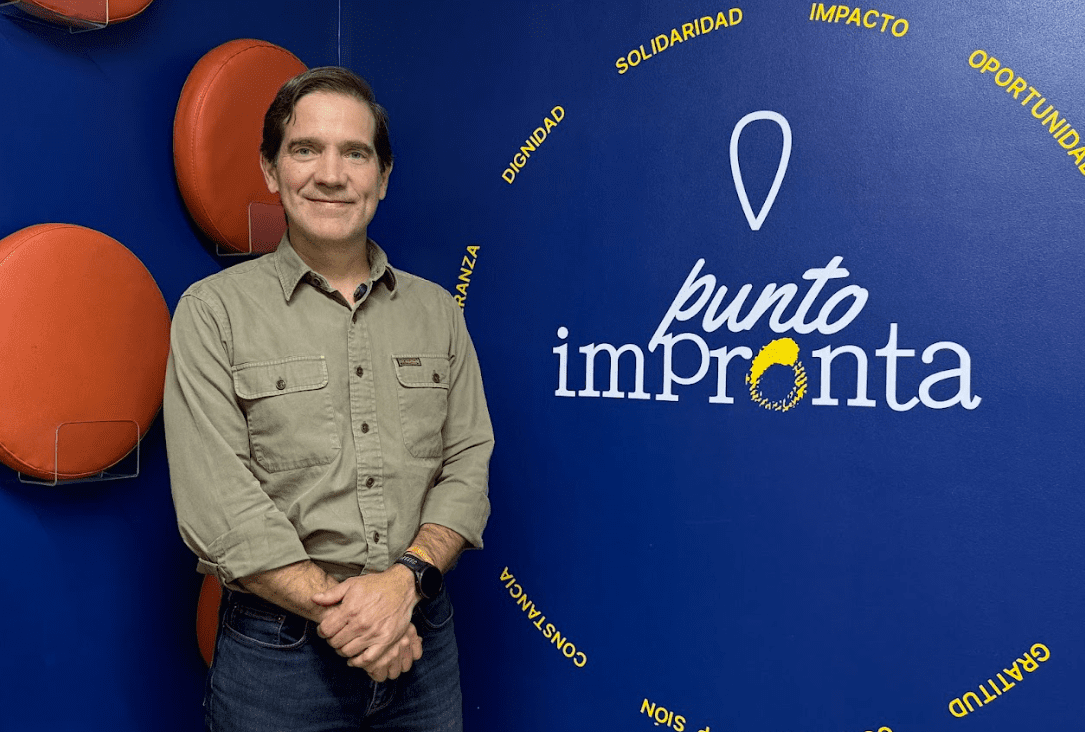
With various programs focused on education, sports, and the arts, the organization reaches more than 4,000 people annually, primarily children, who receive new opportunities up close. Photo: Shailee Rondón / Guacamaya.
Guacamaya, April 13, 2026. Ascending to one of the highest points of Caucagüita, a hillside community nestled in the far east of Caracas, is to enter the world of Bernardo Guinand Ayala. President and co-founder of Fundación Impronta, holding a degree in Business Administration from UCAB and a postgraduate degree in fundraising from Indiana University, this social leader has accumulated more than 25 years as an architect of hope in Venezuela.
Guinand Ayala was recently a finalist for Social Leader of the Year at EY Venezuela’s 2026 LEI (Innovative Business Leaders) Awards, but he never boasts of this achievement or his career. Instead, he insists that the best voices regarding his work are those of his community allies, whom he considers an inseparable team.
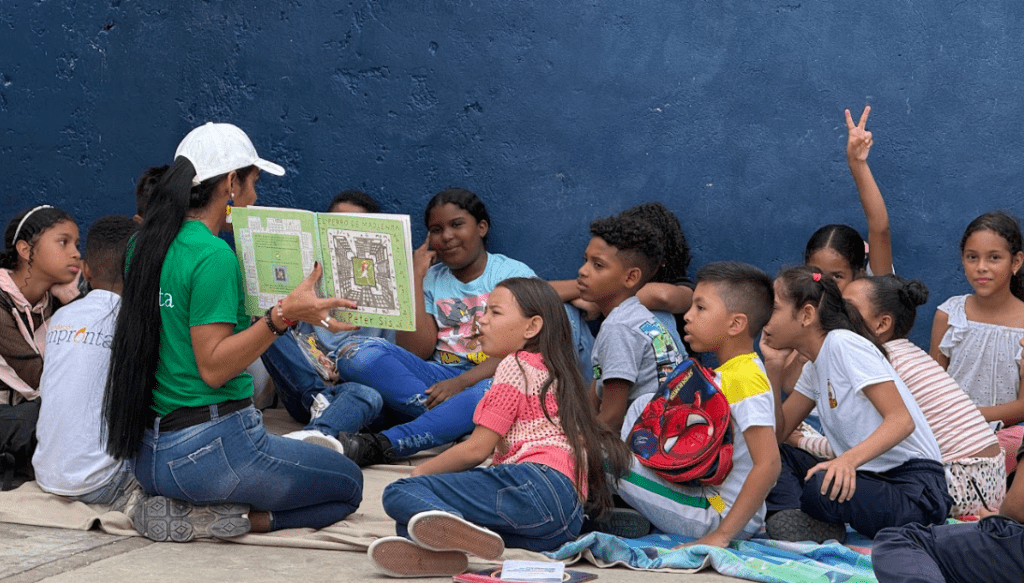
On the way to the Impronta Hub, the landscape offered steep streets and the usual housing and blocks of popular Caracas sectors, a faithful reflection of stories of resilience. The first stop was the Don Bosco School in Brisas de Turumo, where the Reading on Wheels program—promoted by Impronta in alliance with Fundación Letras en Acción—illuminates the minds of 160 children.
Yuleima Delgado, coordinator of this program aimed at improving reading and writing skills through playful and dynamic activities, summarizes it with passion: “Reading on Wheels is an after-school program for free time use. It’s a way of seeing reading on another level; it’s a spectacle so that they can appreciate how beautiful reading is.”
About Bernardo, Yuleima highlights the key facilitation he embodies for the project. “Bernardo Guinand represents a pillar. He’s the foundation, the alliance with other companies that makes this a reality. Without his support, without his collaboration, this program wouldn’t have the impact it has, which benefits all the children. He basically makes this a reality,” she emphasizes.
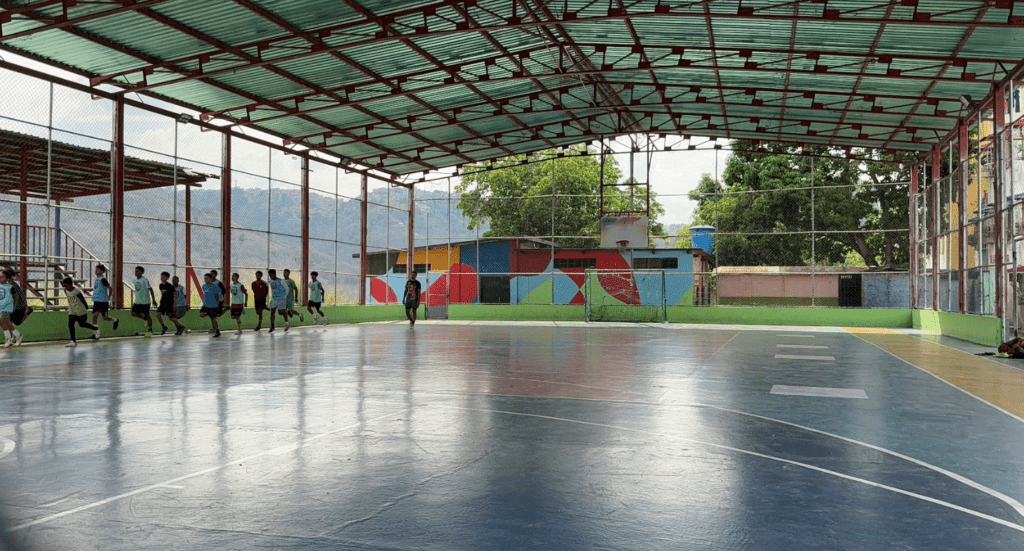
Further along the tour, on a community court recovered and repainted multiple times by the residents themselves—whom Impronta taught the techniques—Alexander trains a group of children in soccer. “This is ours,” he says proudly. Finally, upon arriving at the Impronta Hub, a collaborator named Lilieth hugs Bernardo: “Thanks to you, thanks to this, I bought my motorcycle.”
These testimonies show that the Foundation not only transforms the vulnerable lives of the youngest, who, Bernardo points out, represent 88% of its beneficiaries, but also generates jobs with competitive incomes that change realities. Thus, with dignity, solidarity, and impact as his compass, Bernardo Guinand transcends and explains, from Caucagüita, how he makes it possible.
He welcomes the Guacamaya team warmly: “Delighted that you’re here, and to welcome you to the community we serve.” From the entire interaction, what stands out most is how he summarizes the social focus of his Foundation. “Impronta offers the youth of Caucagüita exactly the same things that you and I want for our children,” he points out.
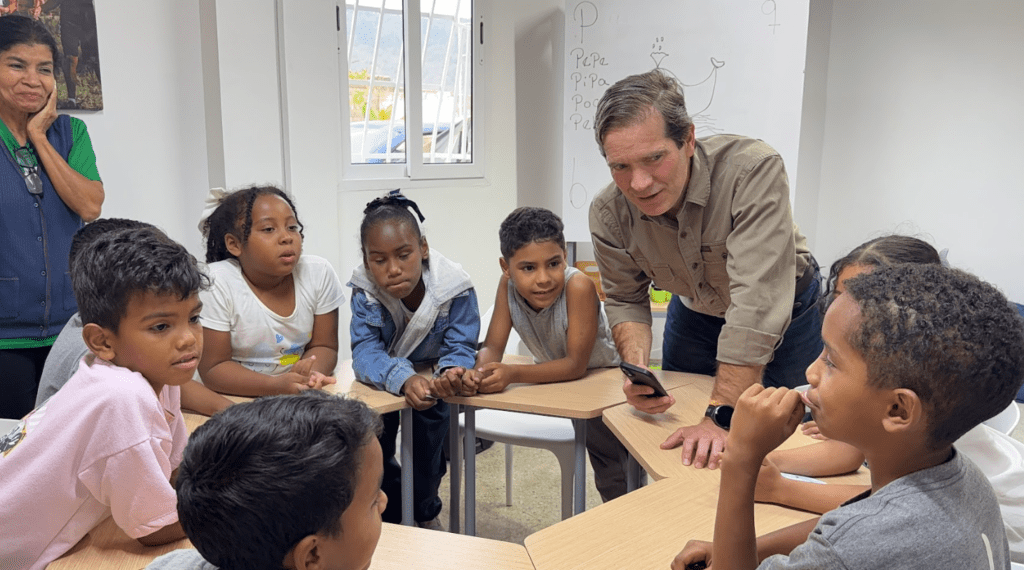
Question: Tell us a bit about Fundación Impronta. What is it about?
Answer: Indeed, part of Fundación Impronta’s focus has been to be consistently in the same place. We don’t intend to solve all the country’s problems, but we know that by making a sustained effort in one location, we can see long-term results. Our mission at Impronta is to generate opportunities that transform lives. We don’t intend to solve anyone’s life, but to place opportunities as close as possible, particularly for children and youth, so they can reach their maximum potential.
This is achieved through the ability to establish alliances, to bring closer, especially to people in vulnerable situations, the possibility that, through well-being and education, they can chart their lives. We aspire to the development of autonomous citizens. Concisely, Impronta offers the kids of Caucagüita exactly the same thing that you and I want for our children: a school that works, a school where they learn, a school where they feel safe.
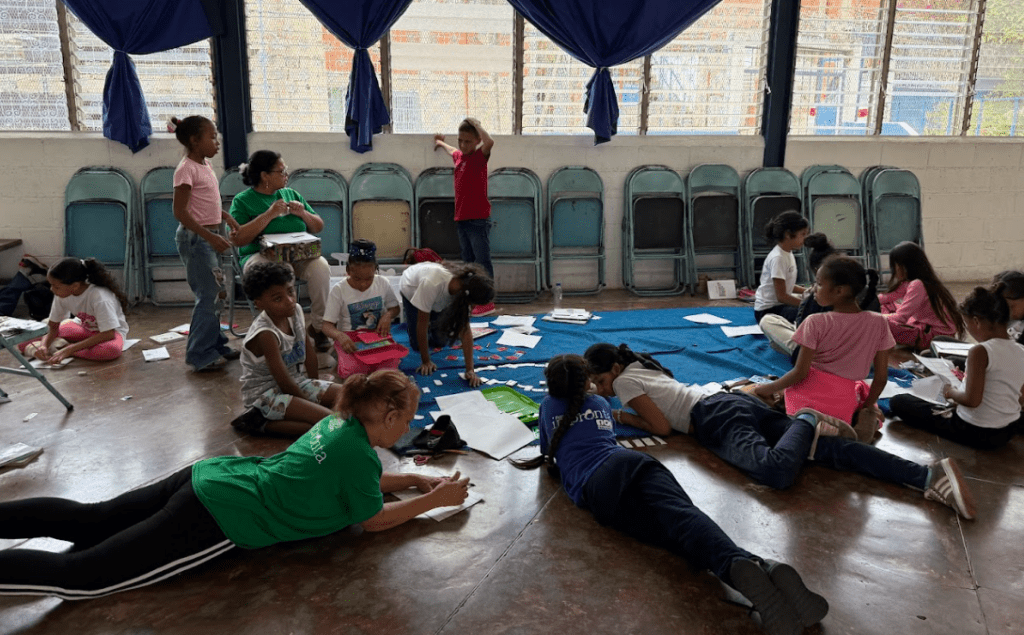
We are basically supported by the network of schools that already exist in Caucagüita and, on the other hand, by the development of a series of additional extracurricular programs that allow people to discover their talents, their likes, and develop skills through the arts, sports, and reading.
Q: But Fundación Impronta wasn’t your starting point. Since 1999, you have been dedicated to what is known as the third sector. How do you describe those beginnings in this type of initiative? What early experiences in the country or abroad drove you to dedicate yourself to this?
A: I owe a great deal of what I do today to a couple of Jesuit priests, Father (Luis) Ugalde and Father Luis Azagra (+). I studied Business Administration at the Universidad Católica Andrés Bello and worked at the University. This allowed, particularly Father Azagra, when the Catholic University was going to stage its most ambitious social project, the Padre Manuel Aguirre Social Park, to see in me a person who could fit well into the program they wanted to create, both for the entire complex and very particularly for a health center, the Santa Inés Health Center that operates there.
I owe much of what I do as an administrator. An administrator is dedicated to management. You can manage a multinational, an oil company, or a non-profit organization. These people identified that I could dedicate myself to this. Obviously, there is a sensitivity for the country, talents for wanting to build things that help others.
I have been a very privileged person throughout my life. I’ve been able to educate myself, I’ve had support from my family, I’ve had support to move forward, and I believe these are fundamental pieces to be able to turn that privilege into an opportunity for others. All that development began there at the Catholic University’s Social Park, and truly, as a result of that calling, I said, “This is what I’m meant to do.”
Q: Precisely, in these last 25 years or more, we know about the various political and economic situations Venezuela has gone through. Did this influence you in any way to dedicate yourself to this?
A: The truth is, although I believe that in recent years, even young people have somehow felt motivated by the country’s situation, in my particular case, I think it was more of a personal initiative.
There is a very interesting issue, which is that in the 90s, the Catholic University developed the entire project called “Proyecto Pobreza” (Poverty Project). There was already an issue being addressed within the University where private companies, and the State as a whole, had to address poverty as a deeply felt issue that affects us throughout Latin America. So that project somehow channels a sensitivity at the Catholic University that consolidates into this Social Park program, and I entered at that moment as a trigger. But note that this comes from 1998 (Bernardo’s graduation year), which was already in that gestation period.
Q: Impronta, through its various spokespersons and channels, celebrates the figure of Bernardo Guinand Ayala as “pure inspiration.” How did you discover that satisfaction of “being useful” that your team mentions as a life conviction?
A: I believe there is always a two-way path. I am very grateful and I feel that nowadays it is very fashionable to seek one’s purpose. Saying, “Well, what are you good at? What do you want to dedicate yourself to? What is the reason that inspires you to get up every morning and feel that somehow you can be a sower of hope or encourage others, serve as an impulse?” That, obviously, is feedback that I really like.
But for me, there is another key element: this is not a one-way bridge, but one also receives a lot from others. I am deeply grateful, for example, to my work team. If I wanted to give up today, I couldn’t, because I have a lot of people doing incredible work. Like, for example, the board of directors that accompanies me, the collaborators, allies, donors that Fundación Impronta has.
Q: How many people are we talking about?
A: Impronta is growing. In the core team, there are 10 of us on a daily basis, but today we contract about 28 people who are teachers in the Caucagüita community, and we also mobilize more than 200 volunteers each year. So, something that sometimes you might see as what you have in an office, a correlation dynamic that some might say, “There’s a small organization,” I myself am amazed by the impact it generates. And what I mean is that inspiration is returned. Today, rather, I feel inspired.
Right now, you come from a tour seeing what we’ve done with the “Reading on Wheels” programs, right here at the Impronta Hub, with what we’re doing. And that is pure inspiration. I come, and that’s why I insisted that the interview be here, because it’s like a plug that connects you and you say, “Well, you leave energized, you leave wanting that.”
So, this issue of inspiring is an issue that I believe is like a welcome where everyone has the chance to do it, to impact the happy faces, for example, of these young people. And that is a joint effort. That is not the work of a lone Quixote. It’s a collaborative effort, and I am deeply grateful for it.
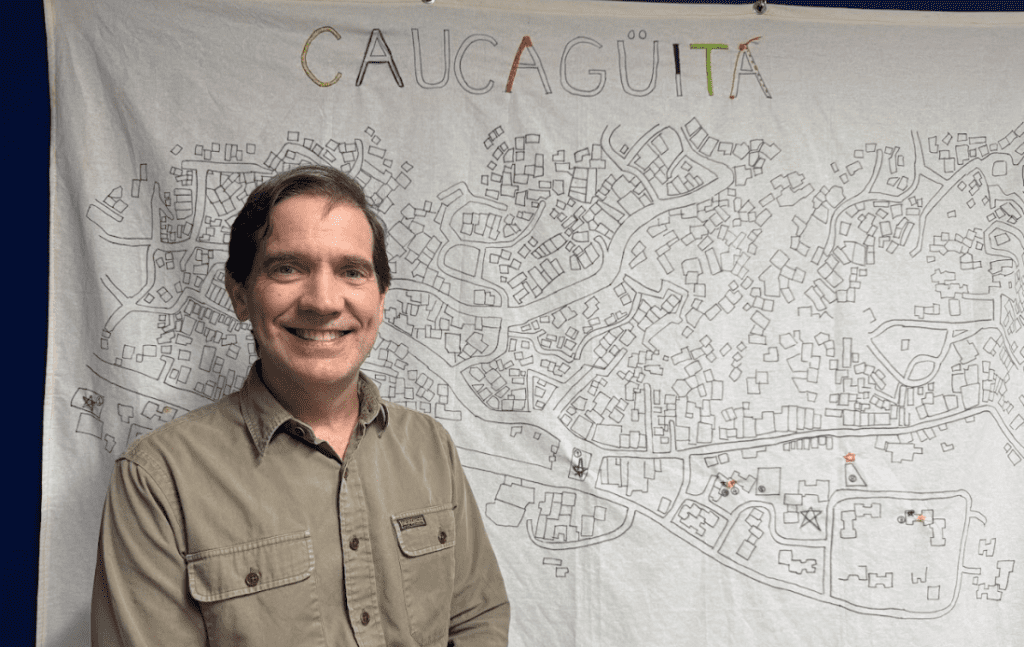
Q: You talk about having been privileged since childhood. You were at UCAB, from UCAB to Indiana, and from Indiana to Caucagüita. Why Caucagüita? Why is Caucagüita today the scenario or your space for action?
A: Look, I believe that, if you see it from faith, God placed us here in Caucagüita. I had been working on the far west side of the city and, effectively, when we founded Impronta, there wasn’t a specific place for what we wanted to do. You start in a phase where you have an idea, you shape it, and you seek allies you’ve built over the years.
There was some idea of doing something in Antímano, then there was a project that seemed very clear to consolidate in the lower part of Petare, but due to circumstances it didn’t happen, and while some doors seemed to close, we received an invitation here to Caucagüita. A community leader, Henry Vivas, invited us to see what he was doing. It was an idea from someone who wants to share what they are doing in their community: a soup kitchen, support for sports. And the truth is, while we kept insisting on other places, we started proposing some things here. And it was so easy. It was as if, in Caucagüita, and very particularly with Henry Vivas, the word “no” wasn’t in the dictionary.
There was a moment in 2018 when we said, “We don’t need to go anywhere else. We are welcome here.” That’s how we titled the editorial of our latest annual report: “You are welcome,” because now we have the pleasure of receiving people here, but it was truly the people of Caucagüita who have welcomed us in every corner of what we are doing.
Q: You talk about those alliances that allowed Impronta to consolidate here in Caucagüita. Impronta emerged in 2017, a rather particular, politically turbulent year. What have been the biggest obstacles, but also the achievements that Impronta has had in this process of institutionalizing and consolidating itself in this location?
A: How would I define this a bit? You have to let yourself be surprised. Community work is very complicated work because, no matter how good your intentions, there is always a counterpart. If you aren’t welcome, if there isn’t someone who puts you in touch, if there isn’t someone who believes in you and starts paving the way, it’s simply impossible. I always tell my team, “We’re always on a tightrope; we have to take care of the details.”
We have also been full of difficulties, but always amidst the difficulties we listen to those who tell us, “Hey, you have a place here.” There are, for example, teachers or school principals who at some point have told us, “How wonderful the obstacle you had there, because now you don’t focus on one place, but you have focused on a large number of schools.”
Q: Here we see (in the art of the Impronta Hub identification) a number of values that encompass the Foundation. Values that, we understand, build that identity. How was the definition of these values formed, and how is this reflected in a real case of transformation, since we see that it is one of the pillars?
A: Obviously, the specific values of Impronta are not as many as these present here, because yes, they would be more concise. There are five values. Here we extended them for a very particular reason. The five are: Dignity, Solidarity, Impact, Passion, and Transcendence. There are several more here because we wanted to honor the people who helped us financially to create our headquarters, and each of them chose one of our values to feel represented. That also reminds us to be grateful to those who make it possible for us to have our headquarters. And in turn, obviously, these are values that we transmit.
I’ll even tell you an impressive anecdote: recently we did a workshop as a team, and for me, the value of transcendence was a bit more complicated to explain, let’s say it’s less grounded, but my group of teachers knew how to say in their daily lives what transcendence meant. To transcend is to do the things you have to do each day well, and you transcend not because you made a wonderful play one day, but because every day you put what you have to do in its rightful place. That is transcending, and somehow all these values also represent part of that.
Q: Some of that has been transformed into important achievements for you. For example, you were just a finalist for “Innovative Business Leaders” 2026 from EY Venezuela alongside other great figures of social leadership. What does this recognition mean to you, alongside these people who have also shone in this area, and what does it mean, especially, in the Venezuelan landscape?
A: While I feel very honored from a personal standpoint, I also do it on behalf of an organization. We are in a world very marked by personal brands and all that that means and the world of social media. I love building institutions. Obviously, I can be the visible face, but I do take advantage of that recognition to insist that this is a team effort, and I dared to apply because I feel that there are people who deserve recognition, who are doing painstaking work, particularly in the area of education in this country.
Of course, being among very valuable people, and organizations with many years of history, and people who are in the interior of the country is also rubbing shoulders. That Innovative Business Leaders program, I believe, is a hopeful message for the country that there are people building things in different sectors, and that’s what everyone hopes for, that Venezuela prospers as a result of some of that.
Q: This also stems from the fact that one of the values we mentioned earlier is passion. That passion, as an organizational leader, how do you go about transforming it into actions?
A: I believe there are certain things that are innate and that you transmit, and the truth is that I am passionate about my work. When we established passion as one of our values, it was because, effectively, while we want professional people, we want the people who work at Impronta to be people who also choose Impronta, choose Impronta as a space. Not just “I need a job,” which is valid and we do want to be a very good workplace, but also for people to say, “I want to work here.”
Right now, as we make this recording, there’s Feryení helping us with cleaning, picking things up. She’s been the last formal addition to the team, but because Feryení has also been behind us, meaning she has wanted to work at Impronta. So, passion becomes something that is shared and, furthermore, something that is renewed day by day when you see that what you propose is fulfilled, is done.
It’s not just that the children are occupied; the children are learning, the children are growing up healthy, and I have a team that transmits that passion and professionalism to the children for that to happen. So, it is indisputably the engine, it is something that makes your work not only good but shines above other things.
Q: This passion, already transformed into actions, evidently has an impact on society. Given the current public policies in Venezuela regarding social inclusion and economic development, how do you see the role that these social organizations play in favor of that social development?
A: I believe indisputably that social organizations do not substitute the role of the State. Nor do I agree with those who say, “If the State did everything perfectly, social organizations shouldn’t exist.” No, because third-sector organizations are born from that very strong human desire to want to make a difference. Obviously, the issue is how we all align for the same purpose. And I think that is the great challenge we have as a country: private companies, government, the State as a whole, communities, and civil society organizations, all pointing in the same direction.
When you achieve leadership where everyone believes in the same thing and you agree, the changes are wonderful. Here in Caucagüita we are achieving it, and I think it’s somewhat that alignment of interests that occurs there and also knowing very well, on the other hand, what role one has to play. We accompany, we do things with others. We propose different things in such areas. And we also communicate that, transmit it, socialize it, discuss it with the different actors. As I told you before, communities are quite complex; here we are talking about people, people are complex, and you have to agree so that things actually happen.
Q: As a leader of a social organization, could you propose some ideas to the National Government regarding public policies to enhance the role of these organizations?
A: We can work in schools thanks to the assent of the Ministry of Education, and we have been able to sit down and say, “This is our proposal, what we are doing.” And also in that role of saying, “I’m not going to solve everything, but in this I can help.” So, that work is effectively being done, it needs to be followed up as such, and obviously also as an organization, like any of us as individuals, the idea is to propose what we see as a society.
I am a firm believer in the work of civil society organizations, because I believe they bring out the best in human beings. They also bring out, from their very birth, the desire to solve some particular thing. So, they are nothing more than open-door organizations for everyone to be able to build things that are tangible and aim at improving people’s lives.
Q: Precisely from that point of sustainability, how do you make an NGO sustainable in Venezuela in current times, from your management point of view?
A: That is one of the biggest challenges. There are different types of organizations and that depends a lot on the type of organization. In a community-based case like this, it’s about seeking solidarity from many. And there each organization invents its model. We have focused a lot on diversifying resources, but even as a space that is an invitation to people through small individual donors, through our Reto Impronta race.
That is, even our financing model is part of what we are as Fundación Impronta. It is also a welcome for people to say, “I am part of this transformation.” For example, one way we finance ourselves is through our volunteer program, that is, people who put in work hours, and more than half of our volunteers are people from the community itself. That is, the commitment is also within the community.
There are many greater challenges to face. For example, many of our programs depend on external funding, and increasingly we want to see how we integrate the community we serve, which has possibilities or to some extent to achieve some of that funding. So, it ends up being an issue of co-responsibility among different actors so that this proposal, if it proves useful, can have that financing possibility.
Q: You talk about usefulness. All financing must also respond to objectives. Impronta, how many people is it currently serving, and over these years, how many beneficiaries have you totaled?
A: We are currently presenting our management report, and we have been growing for several years, even though our focus is not on large numbers. We prefer to talk about impact, and for example, programs like the ones we have here where children come on a permanent basis are what generate the most change. However, I am amazed that year after year, in the schools we work with plus the permanent programs, we already serve more than 4,000 beneficiaries. We’ve had two years with that figure of over 4,000, and even with a significant increase because the educational team has been growing.
That is, the team has grown, especially the people from the community, to respond so that it’s not just a lukewarm patch that leaves people with little, but that it is truly educational opportunities. Perhaps the most notable thing is that of those 4,000-plus, 88% are elementary school-aged children, primary school age, where we have focused from first to sixth grade, very particularly first and second grade, where the greatest incidence of Fundación Impronta is in programs related to reading.
Q: How many programs does Impronta have?
A: Wow, look, just in reading we have “I Read, I Play, and I Learn,” “Reading on Wheels,” “Reading Explorers.” There’s “Aula 360,” there’s the support we give to schools. We have the sports program (Reto Impronta) and we have a number of after-school programs that help young people develop talents: The Integrated Arts Laboratory, Little Singers of Caucagüita, there’s our Impronta Scholarship Fund, for older youth who are accessing university. I don’t know which one I’m missing now, but basically the vast majority are educational programs and, of course, also recreation, our Summer Plan, and the sports area in which we accompany and are part of this community.
Q: Since you touch on the sports topic, you also define yourself as a fan of running and mountaineering. How do these personal passions feed this social commitment or help you face these daily challenges?
A: When we propose the topic of well-being, it’s because we also apply it. That is, having a healthy life, eating well, playing sports is fundamental for me. And obviously, I played baseball when I was a kid, many other sports, but I love the mountains and I love running. The wonderful thing was that the pandemic gave us a wonderful opportunity to propose a race when no one was doing anything, when all the streets were closed. We created the Reto Impronta, and it was about connecting my personal passion with something that has become the main fundraising and visibility campaign for Fundación Impronta.
Today, with great satisfaction, we have also brought that to Caucagüita. That is, the Reto Impronta is also experienced in this community. Look, for example, since January I start seeing teachers from Caucagüita now training for the 5K they will do in November, our scholarship youth who are also seeing sports as a space for emotional support. That is to say, how wonderful that, without consciously intending it, in the organization I have promoted, part of these personal tastes have been grounded as a shared program where we are seeing the benefit that playing sports and having a healthy life brings.
Q: What role does your family or your personal network play in this trajectory, and how do you balance this leadership, such an important responsibility, with that everyday life role?
A: Family is the fundamental support. In my case, moreover, as I told you before, I have been privileged to have a father, mother, brother, that is, support. My parents are alive, my father turns 90 this year and is still present, and in fact, they are founding members and members of the assembly of Fundación Impronta. And they continue to be a space of support, sharing, encouraging everything we are doing here. And my immediate family, my wife and my two children, well, also, as I said, I want for the youth of Caucagüita the same things I have in my home.
I manage to achieve a balance where I even involve my family in my work, where my passions are also part of them. It’s not that everyone goes their own way, and where I am also with that challenge of encouraging my children, now university students, to also find their own path. So, well, it’s that space, that home that one hopes for, and that effectively allows you, even the very decision to found Impronta. So, family is a safe, necessary, and extremely important space for one to keep moving forward.
Q: To close, you are undoubtedly an inspiring person for many; you also have more than 25 years of experience in this work. If you could leave a message for those new generations who perhaps see in social leadership an opportunity to contribute to Venezuela, what would you say to them?
A: In Venezuela, there is so much to do, as the maestro Cruz Diez said, “How wonderful, because all the things that one can do are here.” There are so many spaces where one can find their talent and develop and make a difference. We are at an extraordinary moment as a country to continue getting to know ourselves. Today we are in a world where people are searching a lot for their life’s purpose, but that knowing yourself in what you are useful for, put at the service of others.
So, social work has that element of putting oneself at the service of others. There’s nothing more rewarding in the world than being able to serve another. May those who can find it and strengthen it, not only because they have a big heart but because they can professionally materialize it into tangible results, into advancing communities, into a couple of children learning, not miss that bus, because that will give them joy and a greater purpose to also chart their lives. So, ¡Échenle pichón! (Go for it!)