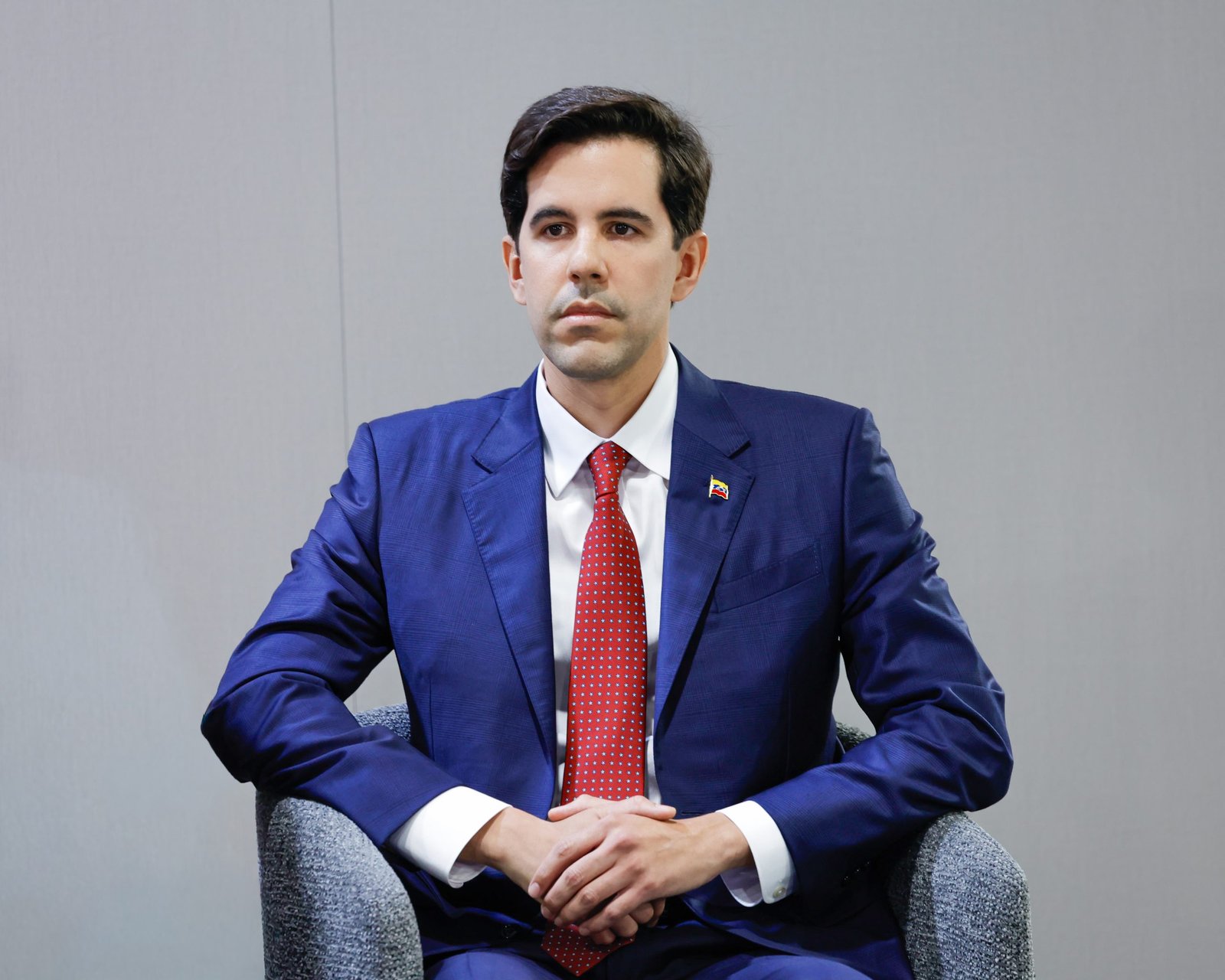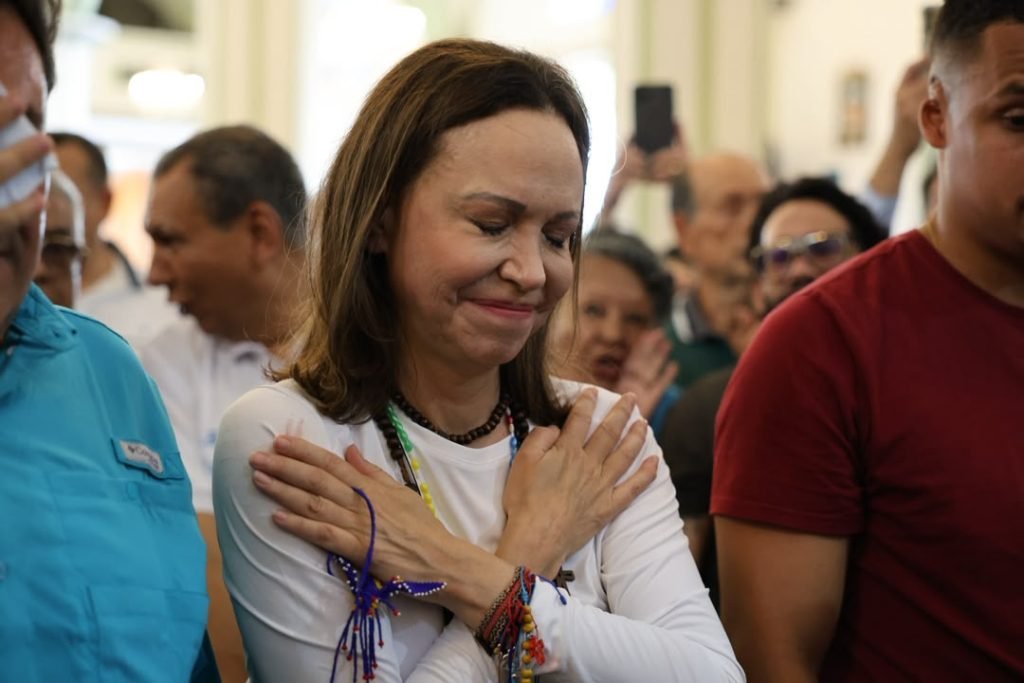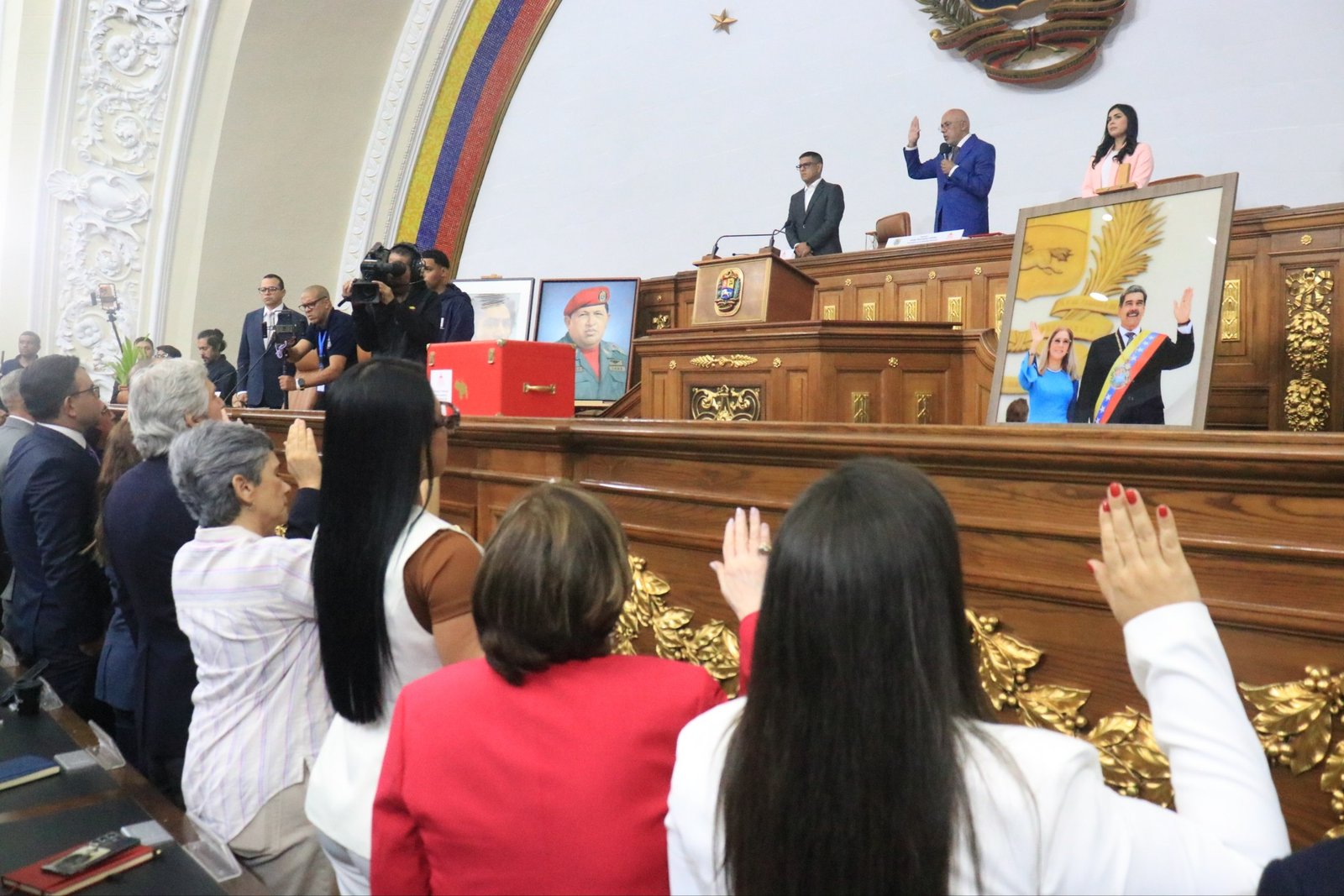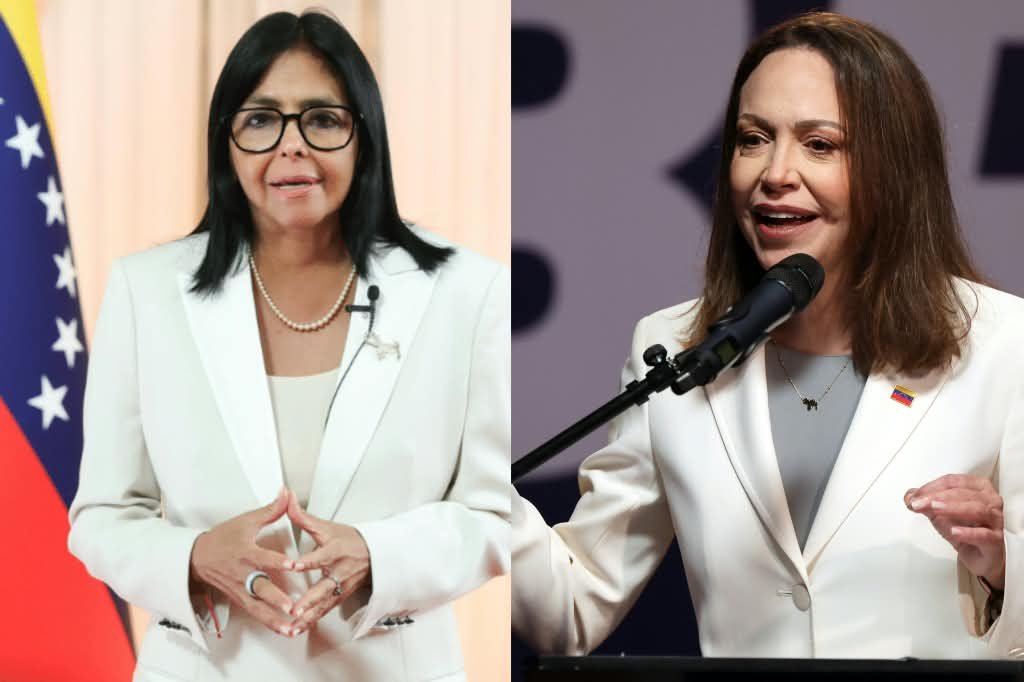
While the acting head of state highlights the advances of her administration in matters of amnesty, the economy and energy agreements, the opposition leader seeks to mobilize society and demands the dismantling of the “repressive system.” | Photograph: Presidential Press / Vente Venezuela.
Guacamaya, October 26, 2026. This Thursday, October 29, offered two adversarial narratives attempting to steer Venezuela’s political destiny. Both Delcy Rodríguez, speaking for the Executive, and María Corina Machado, in her first in-person meeting with the media after returning to the country, staged a duel for control of the public agenda.
Delcy Rodríguez burst in with a recorded message to the nation, strategically broadcast minutes before the time stipulated for María Corina Machado’s press conference. The move sought to get ahead in the day’s news agenda and set the conceptual framework for what the ruling party calls a “path of orderly transformations.”
María Corina Machado reappeared from a setting of strong symbolic weight: the auditorium of the Andrés Bello Catholic University (UCAB), the same place where years earlier she received her university degree from Father Luis Ugalde. Her format was a live press conference, surrounded by national and international media.
The staging by the acting head of state offered the static rigor of formal institutional power, that of a rigidly controlled environment with no room for journalistic questioning. However, Machado’s event was not without friction on that front, as she received severe criticism from the press guild for limiting access to local media.
The contrast in the forms of production and dissemination immediately evidenced the political calculations on both sides. Although both coincided in a not-insignificant aesthetic detail—dressing in white, a color traditionally associated with peace, institutionality and renewal—their discourses differed drastically on how to achieve those goals.
Economy and Workers: The Salary Promise Postponed to 2027
In her address, Delcy Rodríguez acknowledged the severe failures in basic services—especially electricity service interruptions—and families’ anguish over wages. Nevertheless, when addressing the labor sector’s demands, the government proposal announced that direct increases to workers’ income are postponed until 2027.
As she detailed, these adjustments will be structured in four stages conditioned on each quarter’s economic growth. “In 2027, increases to the income of the country’s workers are planned at four moments, and in no case may they be lower than the economic growth of each preceding quarter,” promised the acting president.
Faced with this deferral, Machado appealed to the unsustainability of the current economic model. The leader stated that “as long as this regime is in power, none of the essential problems will be resolved.” Machado reiterated her proposal to open markets and carry out a restructuring of public debt under a formal agreement with the International Monetary Fund (IMF).
Oil Transparency and the NABEP Case
The energy sphere reflected two opposing visions of managing the State’s resources. Delcy Rodríguez presented as an achievement the signing of 61 oil contracts with national and international investors under the reform to the Hydrocarbons Law, as well as the negotiation of 44 additional agreements, with the United States as the main commercial partner.
In this regard, Machado was asked about the controversial agreement with the company NABEP and the involvement of figures such as Alejandro Betancourt. Without hesitation, Machado questioned the lack of institutionality of such contracts. “I don’t know the contract. And if anything suits Venezuela, it is a system of absolute transparency,” she stated. She also promised open tenders and arbitration.
Justice, Amnesty and Institutionality
On one hand, Rodríguez defended institutional management by highlighting the implementation of the Amnesty Law—which according to her figures has benefited nearly 9,000 people and freed more than 1,000 detainees—along with the recent reform to the Hate Law to eliminate criminal penalties. The official grounded the legitimacy of the government process in operational experience.
“Those outside power can call for these reforms, but signing a reform, moving an institution, seating at the same table those who for years neither sat nor spoke together—that can only be done by someone who knows the State in depth,” Rodríguez asserted.
Machado’s response dismantled the officialist rhetoric. She pointed out that the “repressive apparatus” remains intact and that the release must cover without exception all political prisoners, civilians and military personnel. She likewise dismissed participating in the dialogue table with the 2015 National Assembly and proposed instead the “Punto de Acuerdo” project, a citizen assemblies initiative.
Machado’s Solvency and Key Evasions
During the question round, María Corina Machado was eloquent and firm in addressing topics such as her return to the country through the autonomy of her teams, the relationship of mutual respect with international allies and the validity of the commitments assumed in the Panama Agreement. However, there were evasive answers or omitted topics before the journalists’ most pointed questions.
Journalist Almudena Ariza, of Radio Televisión Española (TVE), asked her directly how she assessed recent statements by U.S. President Donald Trump suggesting his desire for Venezuela to become the American “51st state” administered by a designated governor. In her turn to respond, Machado completely omitted the topic.
When asked by Yakary Prado (Alianza Rebelde Investiga) whether the opposition would accept a Nicaragua-style scheme—ceding political control but keeping Chavismo within the military structure—Machado preferred to appeal to the need to rebuild the security forces and the feeling of internal change within the FANB, sidestepping any definition of whether she would negotiate the continuity of the military leadership.
Delcy Rodríguez’s New Appointments
After Machado’s press conference, Delcy Rodríguez designated Oliver Blanco at a public event as the new minister for Foreign Affairs and International Trade, replacing Félix Plasencia. Blanco, an internationalist graduated from the Central University of Venezuela, has prior experience in opposition sectors (including membership in Acción Democrática).
The new foreign minister had been serving since February 2026 as deputy minister for Europe and North America, and first deputy minister of the Foreign Ministry. His promotion to head the Foreign Ministry is framed within the policy of foreign relations and diplomatic restructuring. In other adjustments, Marynna Saatdjian assumes the Deputy Ministry for Europe and North America, and Saúl Ameliach takes charge of the Deputy Ministry of International Trade.
Plasencia, for his part, moves to the Directorate of International Affairs of the Presidency of the Republic with the priority mission of establishing himself in the United Kingdom to manage the recovery of Venezuelan gold reserves (valued at some 2 billion dollars) held at the Bank of England.
By executing these important diplomatic announcements on the same October 29—in parallel with her recorded message to the nation and María Corina Machado’s press conference—the ruling party managed to dominate media coverage with high-impact government decisions, counterbalancing the public attention directed toward the opposition leader’s reappearance.
The Balance of the Contrast
October 29 clearly exposed two roadmaps for the country. While Delcy Rodríguez seeks to channel popular discontent within a gradual reform administered by the power elite—where substantial economic improvements are deferred until 2027—María Corina Machado bets on civic mobilization, the demand for immediate elections with a renewed CNE.
The terrain of the dispute is laid out, and the coming months will determine whether Venezuela’s future is decided in the offices of the State or in the push of organized civil society.