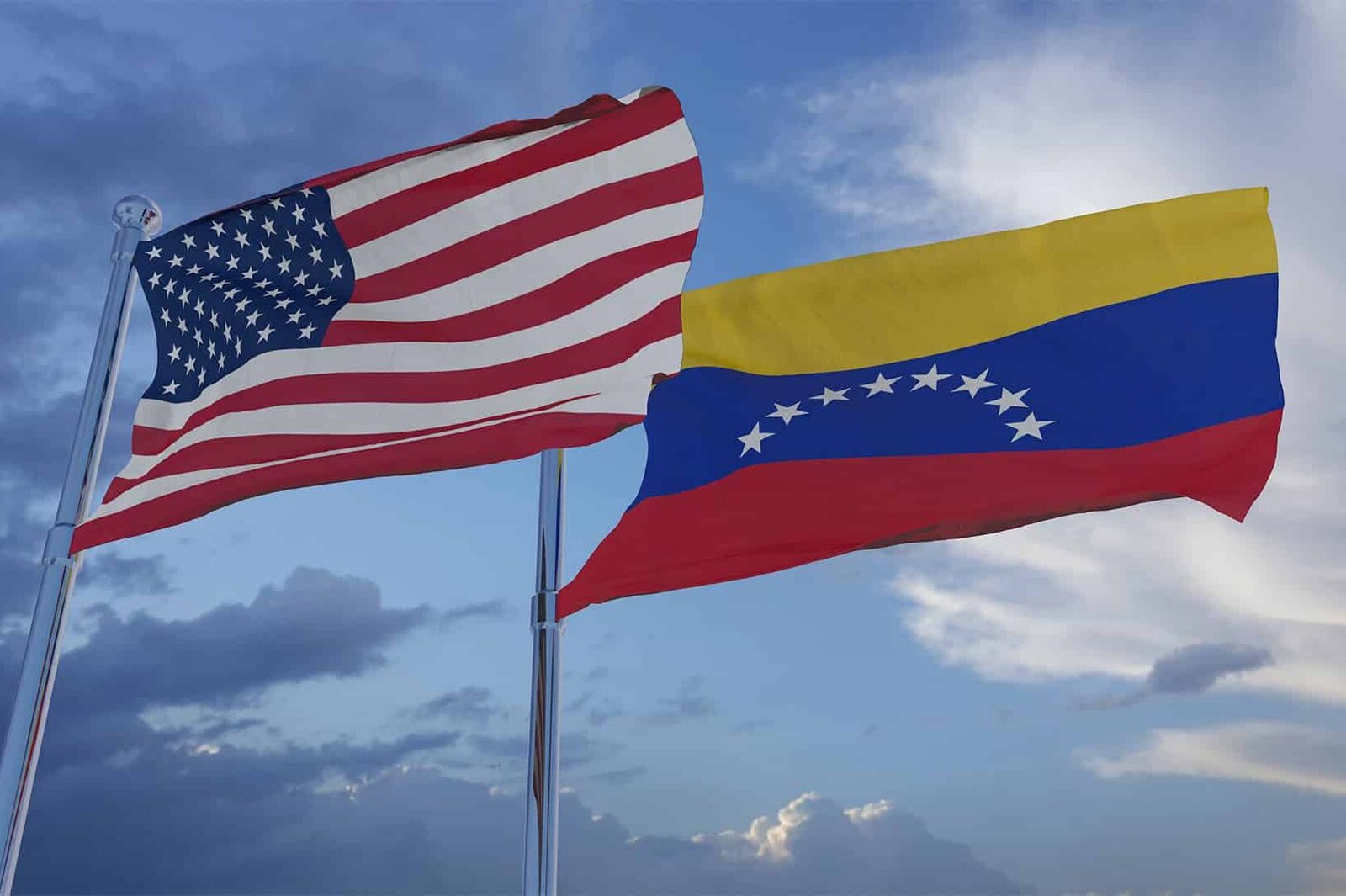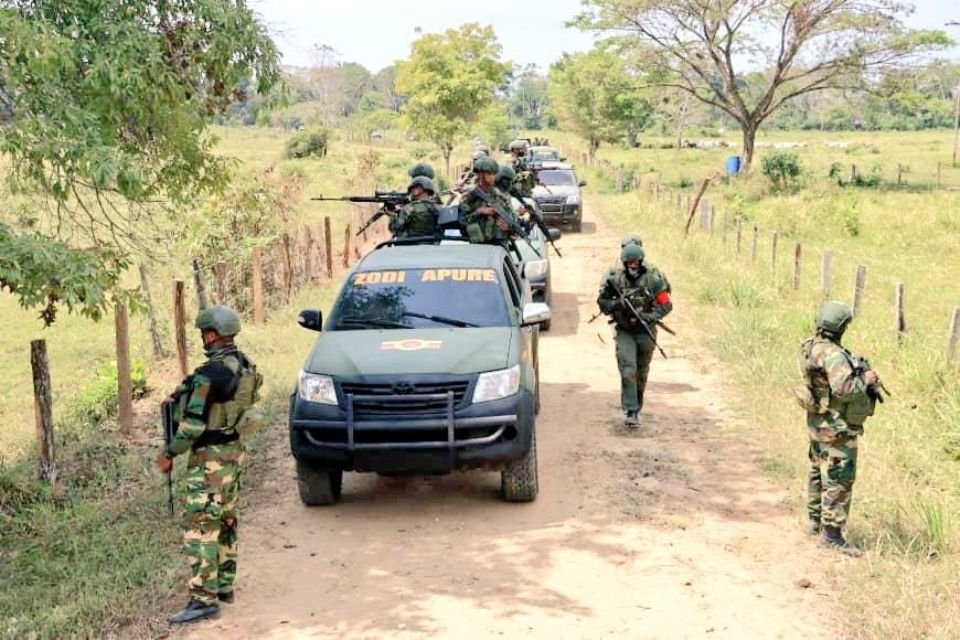
Recent events highlight the ongoing security problems faced by border localities between the two South American nations, amid growing pressure from Washington to change that reality. | Photograph: Zodi Apure.
Guacamaya, November 2, 2026. The security map along the border strip between Colombia and Venezuela is going through geopolitical and military tensions following major events in recent days. What from Caracas was kept for decades under a dynamic of coexistence and tacit complicity with Colombian guerrilla organizations has now taken a turn.
The most recent turning point occurred in the early hours of Friday, October 30, when the Venezuelan Army carried out an airstrike against a strategic camp of the National Liberation Army (ELN) in Apure. This military operation, marked by a thick official silence in Caracas, is intertwined with a violent paramilitary offensive in Cúcuta that forced its militarization.
Drones, Helicopters, and Fire Against the ELN in Apure
The Venezuelan military operation took place in the Buena Vista del Meta sector (frequently identified in local reports as Guafillas de El Meta), within the Pedro Camejo municipality of Apure state, a wooded and strategic strip adjacent to the Colombian department of Vichada.
Local sources and human rights defenders confirmed that the incursion was directed against a guerrilla installation that served as a collection center for narcotic substances, a storage site for aviation fuel, and an operations base for clandestine drug-trafficking runways.
Unlike past deployments, the armed action stood out for the incorporation of precision technology and attack drones, combined with fire from armed helicopters. The destructive barrage neutralized ELN aircraft camouflaged among the vegetation and razed the camp’s structures.
Despite the scale of the deployment in the Arauca pocket and the transfer of Cessna 208 Grand Caravan aircraft to the orders of the Bolivarian National Intelligence Service (Sebin), the interim administration headed by Delcy Rodríguez has not issued any formal statement or war report clarifying the specific objectives or the institutional scope of the mission.
Casualties, Nationalities, and the Finding at the Morgue
The death toll in Buena Vista del Meta rises to at least 19 people, although military reports from the area suggest the final count could exceed twenty.
The first assessments by the NGO FundaRedes documented the arrival of nine bodies at the morgue of the Luis Herrera hospital and the Pablo Acosta Ortiz care center in San Fernando de Apure during Friday, October 30. A day later, ten additional bodies were recovered and admitted to the same facility, in addition to later transfers and burials in Camaguán, Guárico.
Among the fatal victims, various nationalities stand out that expose the organized crime network in the region. Most of the fallen combatants were young men of Venezuelan nationality, with identity cards, driver’s licenses, and “carnets de la patria” found among their belongings.
The identification of at least two citizens of the Dominican Republic was also confirmed, who carried driver’s licenses and Venezuelan identification documents that were falsified or irregularly processed. Meanwhile, reports from Alianza Rebelde Investiga (ARI) indicate the presence of Colombian and Mexican citizens among the casualties collected.
Among the remains, the body of a woman preliminarily identified as Olinda Moraima Camacho de Solórzano, allegedly the partner of a military or civilian pilot of the structure, was also located. The victim carried multiple Venezuelan identity cards, Colombian papers, and American credentials.
Washington’s Fingerprint and the Geopolitical Reconfiguration
Although it may not seem so, the bombing in Apure is not an isolated event. The event appears to respond directly to pressure and close operational collaboration between Caracas and Washington following the events of January 3, 2026, when the capture of Nicolás Maduro opened the way for the caretaker government of Delcy Rodríguez.
A military source allegedly linked directly to the Apure operation revealed to AFP that the incursion had decisive support from U.S. agencies. “We were helped by people from the CIA and the FBI. This was an order from the United States,” the source declared, although neither the White House nor the Miraflores Palace have officially ratified these statements.
Nevertheless, the intelligence movement had already been brewing. Weeks earlier, U.S. Secretary of State Marco Rubio explicitly warned the authorities in charge about the urgency of dismantling ELN sanctuaries on Venezuelan soil. This also coincided with FlightRadar24 tracking of U.S. military aircraft, model C-146A Wolfhound, flying over the limits between Táchira and Amazonas.
The dynamic aligns with what was previously analyzed in Guacamaya in the report on security cooperation between the United States and Venezuela. Since the reestablishment of channels with CIA Director John Ratcliffe and the September meeting between Donald Trump and Delcy Rodríguez, the Executive in Caracas has accelerated atypical procedures.
Among them stands out the extraction of businessman Álvaro Pulido Vargas at the hands of the DEA at El Rodeo I prison, as well as the previous and lethal combined operation in Las Claritas where the top leader of the Tren de Aragua, Héctor Rusthenford Guerrero Flores, alias “Niño Guerrero,” fell.
The bombing against the ELN in Apure thus ratifies a change in military doctrine imposed from Washington to eradicate the guerrilla from strategic corridors.
The Wave of Violence on the Colombian Border
In parallel with the recent events, the border city of Cúcuta, in Colombia, experienced a week of shock following two consecutive attacks perpetrated in less than 24 hours.
One of them was the murder of candidate Miguel Castellanos, on October 26. The leader was a former Government Secretary of Cúcuta, a retired major of the National Police, and the figure with the greatest prospects of winning the Mayoralty in the 2027 elections. He was ambushed by hitmen near a service station on the Western Ring Road.
Castellanos, brother of former Senator Jairo Castellanos and former footballer Leandro Castellanos, was traveling without his protection detail from the National Protection Unit alongside his youngest son when he was shot. The attack was initially attributed to the ELN, although there has been no official confirmation so far.
The following day, October 27, there was a bomb attack against the Directorate of National Taxes and Customs (DIAN) in the El Escobal neighborhood, meters from the Francisco de Paula Santander international bridge that connects to Ureña. A suitcase bomb was activated behind the institutional headquarters, causing damage to homes and vehicles and injuring four police officers and four civilians.
Investigations by the Colombian Police point to a member of the ELN identified as alias “David” as responsible, who allegedly disguised himself as a homeless person to place the charge before fleeing to Venezuelan territory.
Faced with the wave of violence imposed by nine criminal and guerrilla gangs, the conservative president of Colombia, Abelardo de la Espriella, ordered the immediate and temporary militarization of Cúcuta on October 29. The deployment covers more than 500 soldiers from Urban Special Forces, supported by the activation of the “Esparta” campaign and the Operational Urban Security Block (BOSUR), turning Cúcuta into the second city militarized under his mandate after Santa Marta.
Pending Issues to Be Resolved in the New Scenario
While Apure and Cúcuta concentrate the direct actions of the Public Force, in southern Venezuela the security crisis continues to affect the civilian population. In the mining municipality of Cedeño, Bolívar state, alleged members of the Second Marquetalia of the FARC took over the facilities of a Fe y Alegría school in the indigenous communities of La Batea and Punta Brava, near the Los Pijiguaos mining enclave.
The complaint filed by Carlos Trapani, general coordinator of Cecodap, confirmed that teachers and entire families had to abandon the area due to the armed siege, leaving children without a safe educational space. This incursion is a reflection of the fierce territorial bloodletting between FARC dissidents and the ELN over control of gold mines (such as the El Burro mine), coltan, and bauxite.
Last August, this same FARC faction kidnapped and murdered indigenous leader Julio Rodríguez using drones and explosives, which weeks later prompted Venezuelan military overflights that paralyzed operations of the state company CVG Bauxilum.
On one hand, the attack in Apure, added to the massive deployment in the department of Norte de Santander, draws an enveloping maneuver. For the first time in decades, the ELN and FARC dissidents face a border “pincer” coordinated by Washington’s strategic pressure and executed on both sides of the border line between Colombia and Venezuela.
However, the institutional silence in Caracas and the lack of constitutional guarantees in these military operations leave indigenous and rural communities in complete vulnerability, trapped in the crossfire of a dispute that continues to be rewritten.