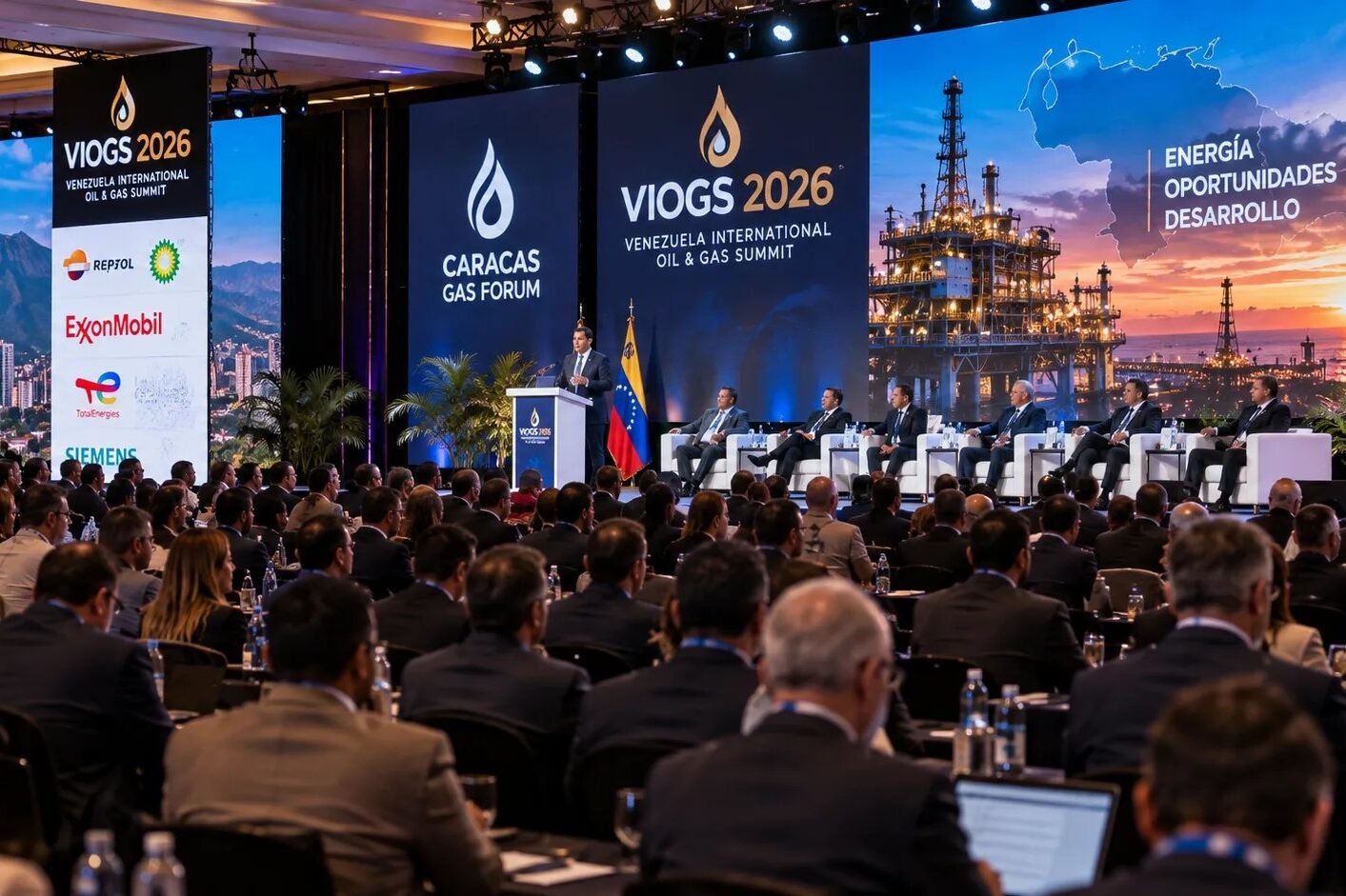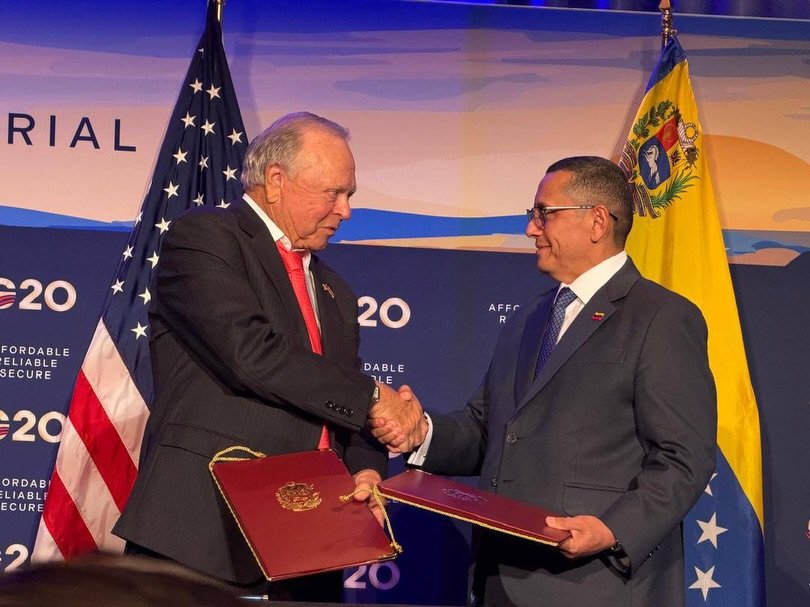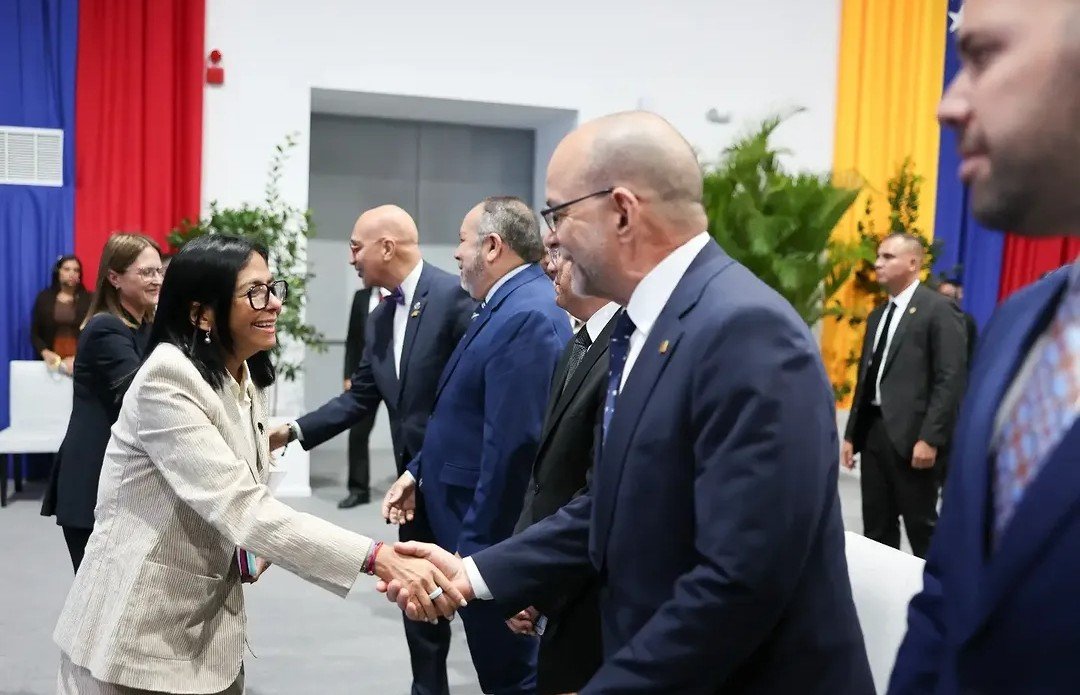
President Delcy Rodríguez led the opening of Friday’s meeting with the IDB Group, held as part of the National Economic Council, which brings together representatives of the Government, the private sector, and the national banking sector. Photo: Instagram / @presidencialve.
Guacamaya, October 2, 2026. A delegation from the private-sector arm of the Inter-American Development Bank, led by its General Manager, James Scriven, participated in the National Economic Council alongside the government of Delcy Rodríguez. It is the first high-level contact of this scope between the IDB Group and Venezuela’s private sector after years of estrangement, and comes amid unofficial reports of financing for Polar, Mercantil, and Banesco.
The meeting was held this Friday at the La Carlota Convention Center in Caracas, under the leadership of acting President Delcy Rodríguez. Representatives of the IDB Group participated, bringing together the IDB, which works with governments; IDB Invest, which focuses on private-sector companies; and IDB Lab, the Group’s innovation laboratory.
Rodríguez said that discussions with the delegation were “quite advanced” regarding financing for the public sector and, above all, the private sector, although she said she would not provide details. According to the acting president, access to credit is a longstanding demand from businesspeople, producers, and entrepreneurs participating in the Council: “having financing mechanisms for Venezuela’s economic activity.”
Rodríguez also said that BID representatives had presented an agenda of “first Venezuela, second Venezuela, and third Venezuela,” while the government’s agenda, she said, is focused on the “future” and the “development” of the country.
The National Economic Council as an interlocutor
Vice President for the Economy and Finance Calixto Ortega described the Council as the platform where the Economic Cabinet, public and private banks, business associations, chambers of commerce, and entrepreneurs establish priorities for economic recovery. “The National Economic Council is the space we have built so that the State and those who produce in Venezuela can work at the same table,” he said in remarks broadcast by VTV.
Ortega said he was convinced that the Council would become a natural interlocutor for IDB Invest, because it is a space where cooperation proposals can be transformed “into decisions and results.” He added that normalizing relations with the IDB Group and other development partners is “a pillar” of the government’s recovery strategy, which, he explained, is aimed at macroeconomic stability and better conditions for investment.
Scriven explained that the visit has two objectives: to present the Group’s capabilities and to hear firsthand about the needs of Venezuela’s economy. The purpose of IDB Invest, he said, is to “support the private sector and contribute to and promote investments with a development impact in the country.”
Unofficially reported financing
According to the outlet Bitácora Económica, citing journalist Blanca Vera Azaf, and the weekly publication Exclusivas Económicas, IDB Invest recently approved financing for Empresas Polar, Banco Mercantil, and Banesco. In the case of the two financial institutions, the funds would be used to strengthen their capital; in Polar’s case, they would support the agricultural sector, particularly crops in Portuguesa state.
Neither IDB Invest nor the companies have publicly confirmed these operations in the material reviewed, so they should be treated as unofficial information. If confirmed, they would represent the first loans from the institution to Venezuelan companies in years.
Rodríguez said that the third quarter would mark “22 consecutive quarters of growth,” with an expansion of at least 6.5% despite the “double earthquake,” and described the economy as experiencing an “economic boom.” These figures were presented by the acting president herself, without a breakdown or independent source in the statements released.
How does IDB Invest work?
IDB Invest is the institution within the IDB Group dedicated to the private sector. It provides loans, guarantees, and investments to companies across Latin America and the Caribbean without sovereign guarantees; that is, the risk is assumed by the company or project rather than by the State. Its tools include:
- Senior and subordinated loans, in U.S. dollars or local currency, as well as investment guarantees.
- Equity investments, including minority stakes.
- Mezzanine financing, which combines characteristics of debt and equity.
- Trade finance and supply-chain financing.
- Support for bond issuances.
- Blended finance, combining commercial resources with concessional funds from donors.
It primarily serves medium-sized and large companies in infrastructure, financial institutions, agribusiness, energy, manufacturing, and tourism. It also acts as a capital mobilizer: it structures transactions and then invites banks, funds, or other private investors to participate. Its involvement can therefore serve as a confidence signal for third parties.
A key point is that IDB Invest states that its loans are neither concessional nor subsidized. They are provided at market rates and are expected to finance growth, modernization, or projects with an impact on employment, sustainability, or inclusion.
Why could this matter for Venezuela’s private sector?
Venezuela’s private sector has faced scarce and limited access to long-term capital for years. After prolonged periods of decapitalization and weak investment, Venezuelan companies have few sources of dollar financing at maturities that allow them to invest in machinery, technology, or expansion. A multilateral institution could help fill this gap.
It could also contribute to strengthening the banking sector. If the reported loans to Mercantil and Banesco are confirmed, they could increase the banks’ capacity to extend credit, potentially multiplying the effect across other sectors.
There is also a signaling effect. The involvement of an institution with rigorous evaluation standards could help open the door to other lenders and investors because of its role as a capital mobilizer.
A further factor is the possibility of operating independently of the State. Because IDB Invest does not require a sovereign guarantee, it can work with private companies even while the State still needs to resolve its outstanding obligations to the IDB. This is an analytical interpretation, not a claim made by the sources cited.
The Limits
Market-rate financing requires projects to be profitable and companies to pass risk and compliance assessments. In addition, Venezuela has accumulated debt of approximately $2.5 billion with the IDB, which, according to reports, would need to be repaid or restructured before access to new financing lines.
Relations with the institution resumed on June 24, when the appointment of Ortega as Venezuela’s governor was accepted. In September, Rodríguez met in New York with officials from the IDB, the World Bank, and the IMF, following the capture of Nicolás Maduro in January.