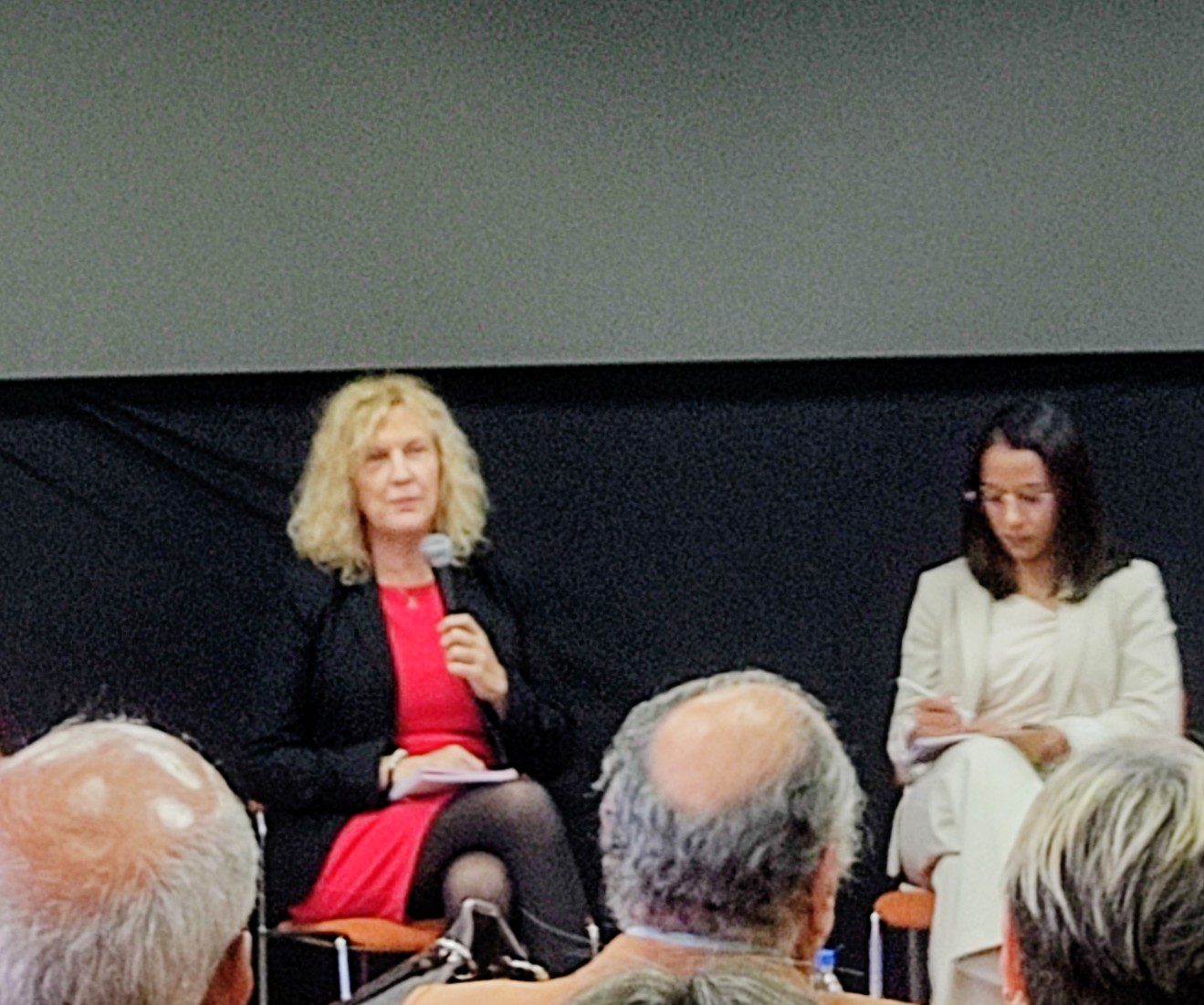
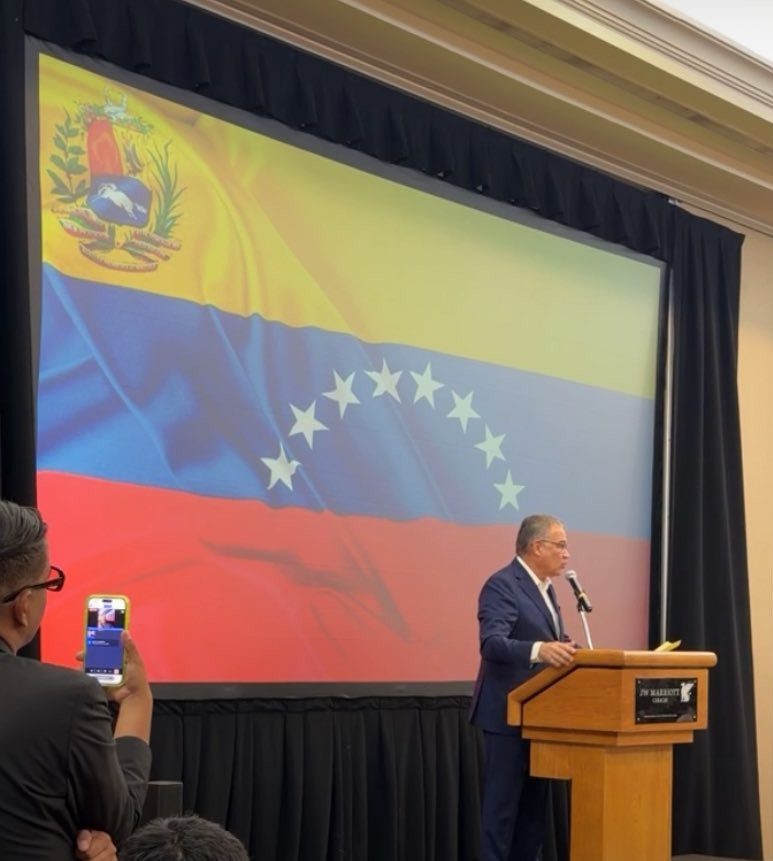
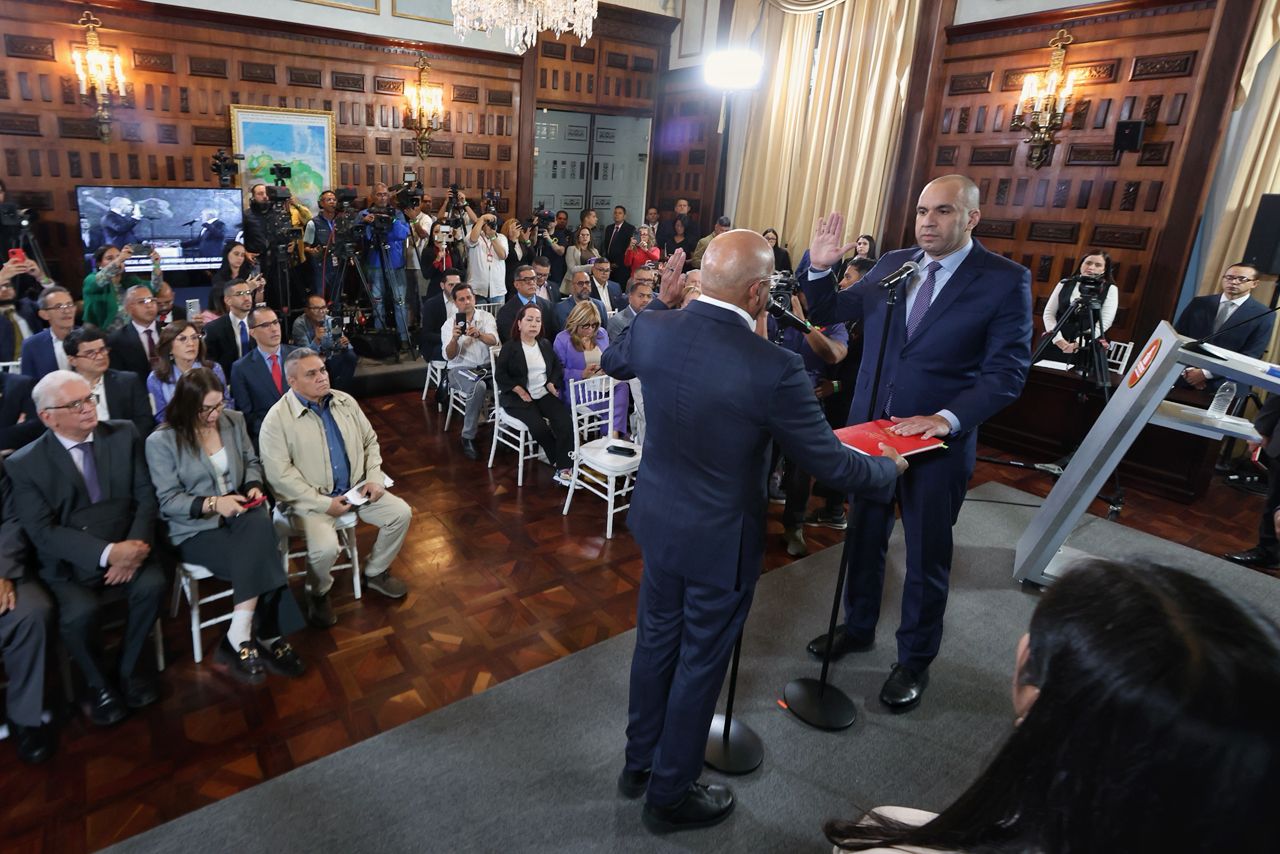
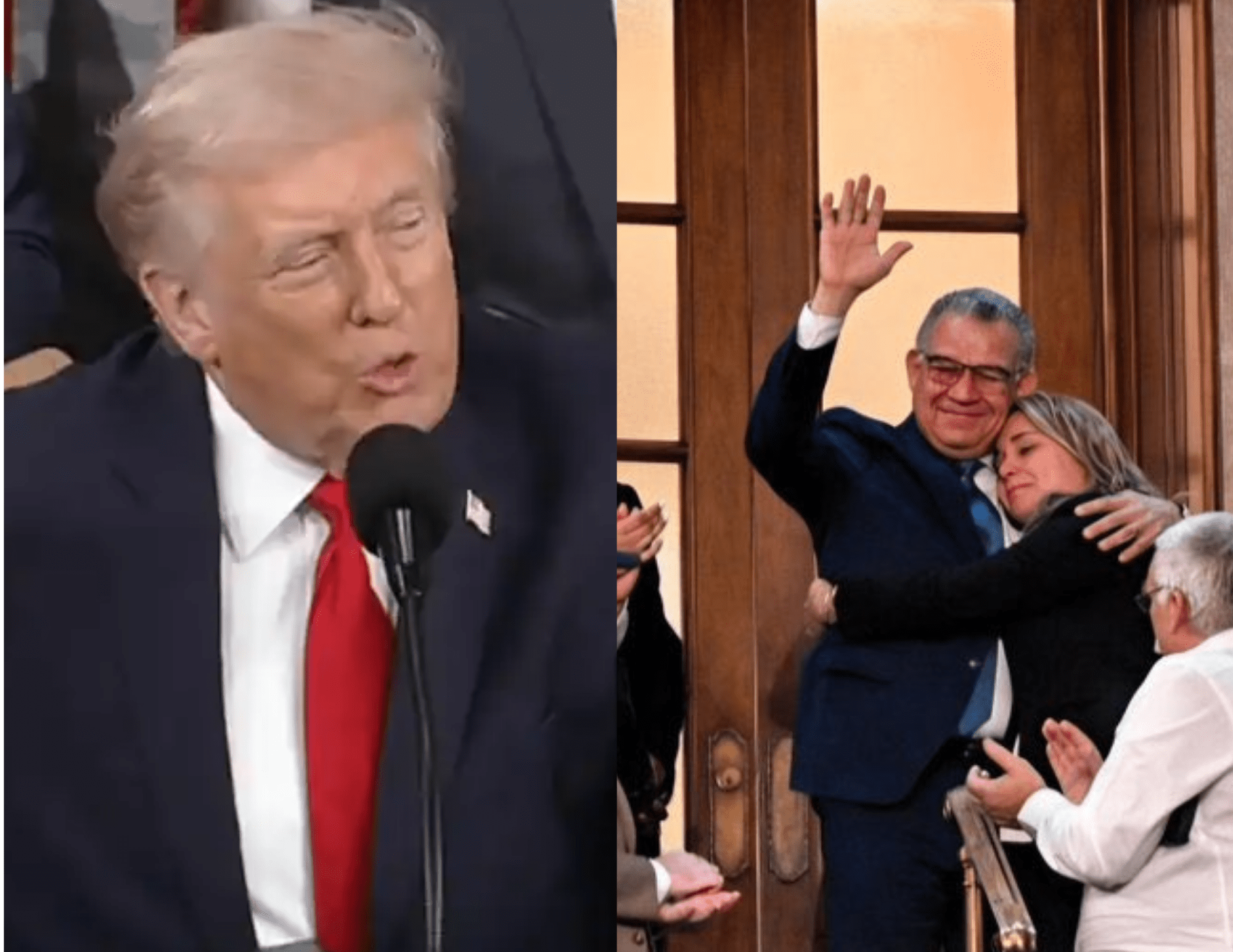
The President of the United States, Donald Trump, meeting with senior executives of oil companies. Photograph: X / David Alandete
Guacamaya, January 9, 2026. U.S. President Donald Trump led a high-level meeting at the White House on Thursday with leading executives from the international energy sector to address the future of the commercialization, exploitation, and control of Venezuelan oil, in a context marked by U.S. intervention in Venezuela, the installation of interim authorities in Caracas, and the reshaping of the hemispheric energy map.
During the meeting, Trump said his administration maintains a positive relationship with Venezuela, stating: “We’re getting along very well with the people of Venezuela, the Venezuelan people, and those who are running the country.” He also underscored the strategic weight of the South American country’s resources: “These are enormous reserves, among the largest in the world. Some say they are the largest in the world.” He added that the United States “is going to work with Venezuela” and that Washington will decide “which oil companies we will allow to enter.”
The executives invited
The roundtable included senior executives from the world’s leading oil companies, oilfield services firms, and crude traders. The list of attendees included:
Darren Woods, ExxonMobil
Maryann Mannen, Marathon
Jeff Miller, Halliburton
Jeff Hildebrand, Hilcorp
Alex Cranberg, Aspect Holdings
Matt Sheehy, Tallgrass
Lane Riggs, Valero
Harold Hamm, Continental Resources
Richard Holtum, Trafigura
John Addison, Vitol
Mark Nelson, Chevron
Ryan Lance, ConocoPhillips
Wael Sawan, Shell
Claudio Descalzi, Eni
Olivier Le Peuch, SLB (Schlumberger)
Bill Armstrong, Armstrong Oil & Gas
Ross Perot Jr., HKN
Ben Marshall, Vitol
Josu Jon Imaz, Repsol
Which companies did have licenses to operate in Venezuela?
Within the group of companies present, only a limited number had, in the recent past, licenses or formal authorizations to operate in Venezuela, mainly under the U.S. sanctions regime and permits granted by the Office of Foreign Assets Control (OFAC):
Chevron was the only major U.S. oil company to maintain continuous operations in Venezuela under specific U.S. licenses since 2019. These authorizations allowed limited production, crude exports, and the management of joint ventures with PDVSA under strict conditions.
Halliburton, an oilfield services company, held an OFAC license allowing technical and maintenance transactions with PDVSA until its expiration in 2025.
Schlumberger (SLB) also operated under similar licenses, authorized to provide technical services and maintain existing assets until the permits expired.
Baker Hughes and Weatherford International—although not directly represented at this meeting—were part of the same group of service companies authorized under limited licenses through late 2024 or mid-2025.
These licenses did not allow new investments or significant expansion, but rather minimal operations aimed at preserving assets, collecting debts, or preventing the technical collapse of facilities.
Companies without recent operating licenses
Most of the executives seated at the table did not have current or recent licenses to operate in Venezuela, despite their historical or strategic interest:
ExxonMobil has not had a license to operate in Venezuela in recent years. The company was expropriated twice and maintains legal disputes with the Venezuelan state. It has also had political tensions with Venezuela due to its presence in the territory of Guayana Esequiba, claimed by Caracas and controlled by Guyana.
ConocoPhillips left the country following expropriations and international litigation, without authorization to resume operations.
Shell explored gas projects, such as the Dragón field shared by Venezuela and Trinidad and Tobago, but never obtained a full operational license.
Repsol had limited authorizations to receive crude as debt repayment and operate certain fields, but its license was revoked in 2025. Its presence in Venezuela is considered strategic for Spain amid tensions with Morocco and Algeria.
Eni participated in associations with PDVSA, but did not hold a valid OFAC license following the most recent revocations.
Trafigura, Vitol, Valero, Continental Resources, Hilcorp, Tallgrass, HKN, Aspect Holdings, and Armstrong Oil & Gas do not have records of licenses for direct production or extraction in Venezuela; most are traders, refiners, or companies without upstream operations in the country under sanctions.
The seized vessel and the “major energy deal”
Trump also referred to the seizure of an oil tanker that occurred earlier that same day, stating that, “in coordination with the Provisional Authorities of Venezuela,” the vessel will be returned and the crude sold to North America through a “major energy deal created for this type of sale,” under U.S. supervision.
Chevron, the “only one that held on”
The president devoted special remarks to Mark Nelson, vice president of Chevron, highlighting that it was the only company that endured through the toughest years of sanctions:
“Here we have Chevron—where’s Chevron? Where are you? You were the only one who held on. All that time I would call you and ask, ‘What the hell is going on with Venezuela?’ You held on. I don’t know if you made money or not, but you held on.”
ExxonMobil and the conditions for investment
ExxonMobil, for its part, reiterated its critical stance on Venezuela’s legal framework, particularly in light of its confrontation with Caracas over oil operations in the Guayana Esequiba territory, controlled de facto by Guyana. The company stated:
“Our philosophy is that there must be stable, long-term investment. It has to benefit the people. With respect to Venezuela, we’ve been expropriated twice. If you look at the current legal situation in Venezuela, it’s impossible to invest. Significant changes have to be made for it to be a durable investment.”
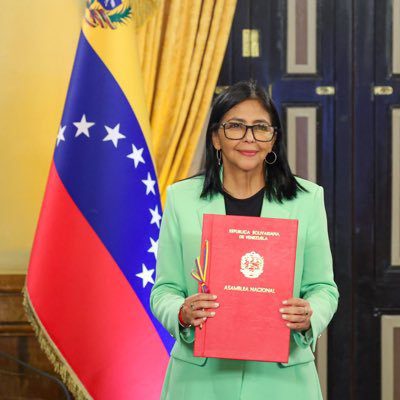
In recent days, the Venezuelan government has announced that it will promote a series of reforms in the National Assembly at the request of Delcy Rodríguez.
Delcy Rodríguez, María Corina Machado, and political tensions
Trump also said he is considering a meeting with the interim authorities led by Delcy Rodríguez, and claimed that María Corina Machado will visit the White House “as someone coming to pay her respects to the country,” possibly on Tuesday or Wednesday. At the same time, he warned that the interim authorities must act with “caution and docility,” and that if they do not, he “would attack again.”
However, Venezuela’s Ministry of Communication denied this version, stating that the acting president has no plans to travel abroad and is focused on the domestic agenda.
The meeting makes clear that the future of Venezuelan oil is now being discussed in Washington, with the United States assuming a decisive role in the selection of companies, the destination of crude, and the redefinition of the South American country’s energy sector.