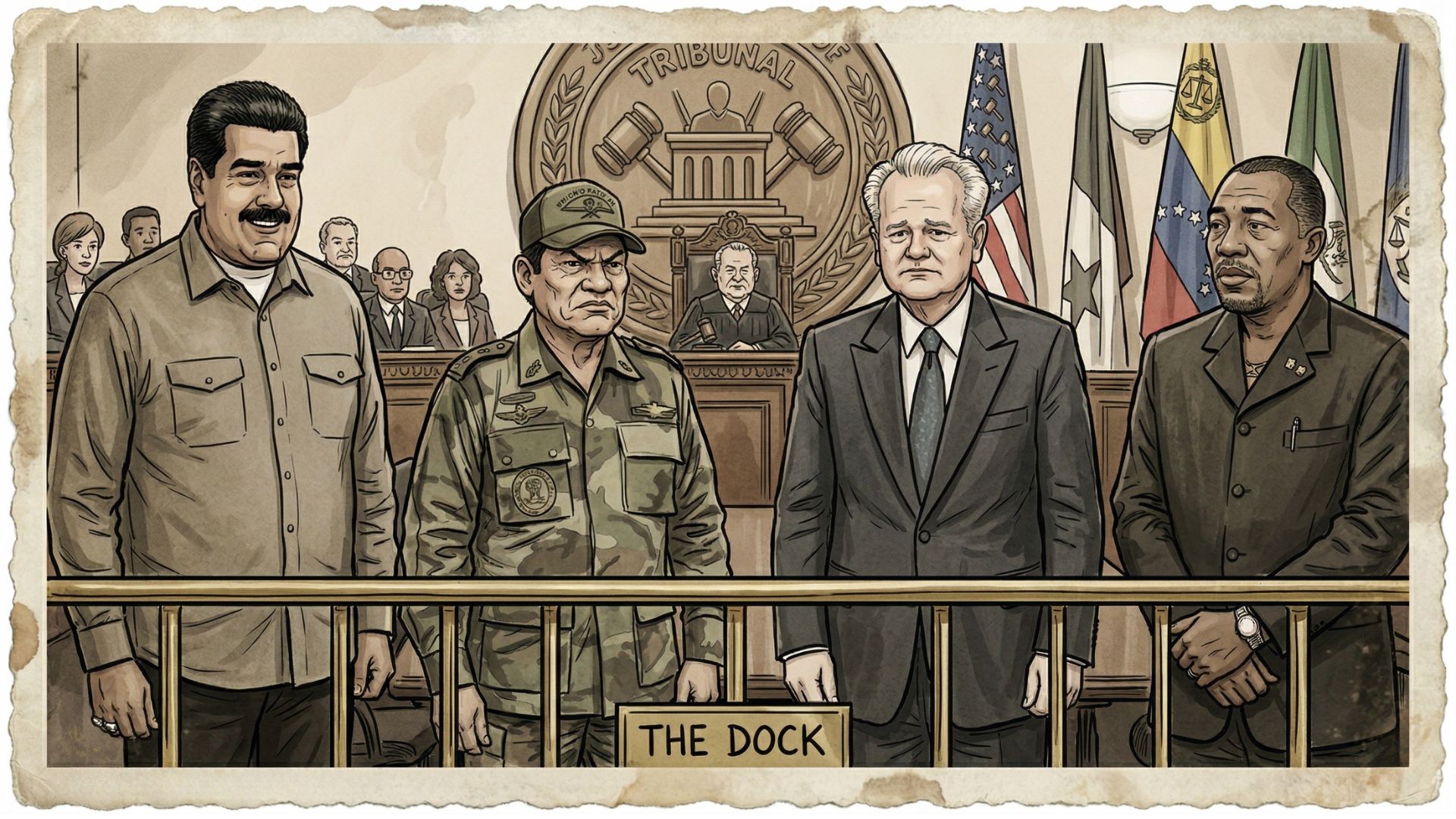
Guacamaya, March 26, 2026. The court appearance of Nicolás Maduro this March 26 before a federal court in New York, on charges of narco-terrorism, has reignited the debate over the international judicialization of sitting leaders. The case—marked by political tensions, sanctions, and disputes over the right to defense—fits into a complex tradition that includes precedents such as Manuel Antonio Noriega, Slobodan Milošević, and Charles Taylor.
The opening of judicial proceedings against Nicolás Maduro in the United States—following his capture and transfer to New York—marks a moment of significant geopolitical and legal impact. Accused of leading a network linked to drug trafficking and terrorism, the Venezuelan leader has pleaded not guilty, while his defense argues that sanctions prevent him from adequately funding his legal representation. Still in its preliminary phase, the case could extend for years and already raises questions about the scope of U.S. jurisdiction and the use of the judicial system as a tool of foreign policy.
Far from being an isolated event, the Maduro case fits within a broader historical pattern of proceedings against heads of state in foreign or international courts. From the transfer of Manuel Antonio Noriega to Miami after the 1989 invasion, to the landmark trial of Slobodan Milošević in The Hague, and the conviction of Charles Taylor for war crimes, these precedents demonstrate how international justice has gradually expanded its reach over political leaders.
These cases share key features: accusations of serious crimes such as drug trafficking, genocide, or war crimes; contexts of conflict or international intervention; and complex disputes over sovereignty, legitimacy, and due process. They also reflect a growing trend: the erosion of head-of-state immunity before foreign and international judicial mechanisms.
In this context, the trial of Nicolás Maduro will not only determine individual responsibility but may also redefine the boundaries between justice, politics, and sovereignty in the 21st century, potentially becoming—like previous cases—a new reference point in the study of international criminal justice applied to sitting leaders.
Manuel Antonio Noriega and Operation Just Cause: a key Latin American precedent
The case of Manuel Antonio Noriega is one of the most significant precedents of prosecuting former heads of state abroad. Following the U.S. invasion of Panama in 1989, Noriega surrendered in January 1990 and was transferred to Miami, where he stood trial before a federal court. In 1992, he was convicted of drug trafficking, organized crime, and money laundering, in a process supported by testimony from figures such as Carlos Lehder.
The trial was marked by tensions between national security and due process. Noriega’s defense argued that he had acted as a collaborator with U.S. agencies such as the CIA, but the court restricted the use of classified information. Controversy also arose over the decision to unfreeze millions of dollars attributed to Noriega to finance his defense, despite questions regarding the legitimacy of those funds.
Noriega was initially sentenced to 40 years in prison, later reduced to 30, and was granted prisoner-of-war status—an unusual designation that later influenced debates over his repatriation. After serving his sentence in the United States, he was extradited to France in 2010, where he received another sentence for money laundering, before being returned to Panama in 2011.
In his home country, he had already been convicted of human rights violations, including the murder of opposition figure Hugo Spadafora. His multi-jurisdictional legal trajectory illustrates the legal and political complexities of extraterritorial prosecution, as well as the tensions between sovereignty and international justice.
Slobodan Milošević: international justice against a sitting head of state
The case of Slobodan Milošević represents one of the most important precedents in the prosecution of a sitting head of state before an international tribunal. In 1999, during the Kosovo war, he was indicted by the Tribunal Penal Internacional para la ex Yugoslavia for crimes against humanity. The indictment was later expanded to include crimes committed in Croatia and Bosnia and Herzegovina, totaling 66 charges including genocide, war crimes, and grave breaches of international humanitarian law.
The tribunal itself, established in 1993 by the UN Security Council, marked a turning point in international criminal justice by asserting jurisdiction over individuals—including sitting leaders—for mass atrocities. Milošević’s trial began in 2002 in La Haya and lasted more than four years. He chose to defend himself, maintaining a defiant stance while the prosecution presented hundreds of witnesses and extensive evidence to demonstrate his responsibility in systematic campaigns of violence.
A central issue in the case was command responsibility and participation in a joint criminal enterprise. The prosecution argued that Milošević planned, instigated, or failed to prevent crimes committed by forces under his control. However, the trial ended abruptly when he died of a heart attack in detention in 2006, leaving the case without a final verdict.
Despite this, the case set a major precedent. In 2016, in the separate trial of Radovan Karadžić, the tribunal found insufficient evidence to prove Milošević’s direct participation in a joint criminal plan of ethnic cleansing, although it acknowledged his political and material support to Bosnian Serb forces.
Charles Taylor: the first former head of state convicted by modern international justice
The case of Charles Taylor marked a historic milestone, as he became the first former head of state convicted by an international tribunal since the Juicios de Núremberg. Taylor ruled Liberia from 1997 to 2003 after leading a rebel movement that triggered the First Liberian Civil War in 1989. His election victory reflected widespread fear of renewed conflict.
As president, Taylor played a central role in regional destabilization, particularly in Sierra Leone, where he supported the Frente Revolucionario Unido in exchange for “blood diamonds.” His government was also linked to widespread abuses, including political persecution, massacres, and the use of child soldiers.
In 2003, amid the collapse of his regime, Taylor was indicted by the Tribunal Especial para Sierra Leona and went into exile in Nigeria. He was later arrested in 2006 while attempting to flee and transferred to La Haya, where he stood trial. In 2012, he was found guilty of 11 counts, including murder, rape, slavery, and the recruitment of child soldiers, and was sentenced to 50 years in prison, a sentence upheld in 2013.
His conviction reinforced the principle that even heads of state can be held criminally accountable at the international level, strengthening the global architecture of justice against war crimes and crimes against humanity.
However, it is pertinent to clarify that, unlike Taylor and Milošević, Maduro is not being tried in a multilateral tribunal; in his case, he is subject to the U.S. justice system, in accordance with the charges brought by that country.