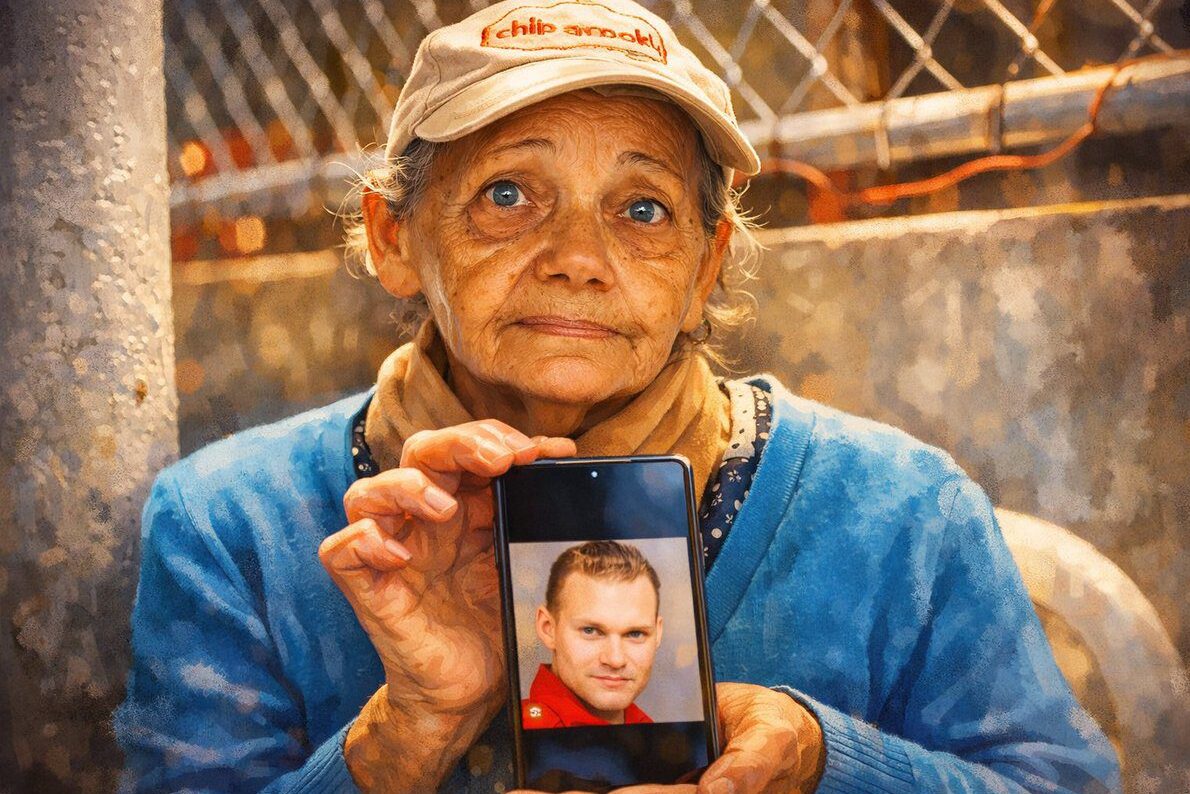
The contradictions in official dates, the failure to notify his mother, and the delayed response from institutions have prompted an investigation, while civil organizations demand an independent inquiry and clear accountability. / Image: Elizabeth Sanchez Vegas (X/ @elhabito).
Guacamaya, May 8, 2026. Víctor Hugo Quero Navas, a 51-year-old merchant, died on July 24, 2025, while in custody of the Venezuelan State. But his mother, 82-year-old Carmen Teresa Navas, did not learn of it until nine months later, when the Ministry of Penitentiary Services officially confirmed his death. Víctor Hugo’s remains now presumably lie in a grave at the Memorial Cemetery of La Vega.
In response, the Public Prosecutor’s Office has ordered a criminal investigation, including the exhumation of the body, to clarify the facts. Even so, for Carmen, the pain of learning belatedly of her son’s death—without explanations, without accountability, and with such prolonged institutional silence that it may hurt even more than death itself—will not easily fade.
The Quero Navas case has been documented by human rights organizations as part of a broader pattern. According to the Venezuelan Prison Observatory (OVP), at least 26 people have died in State custody over the past decade, and 22 political prisoners have died since 2015. As of April 30, 2026, Foro Penal counted 454 political prisoners, of whom 2 were disappeared, including Víctor Hugo Quero Navas.
A merchant who became a prisoner
Víctor Hugo Quero Navas, 51, was a merchant living in Caracas. He had no visible political activity, nor did he appear in any media records prior to his detention. His only “offense,” according to sources in the case, may have been having performed military service in 2023, which could have been the technical trigger for being charged with “treason against the homeland, conspiracy, and terrorism.”
His mother, 82-year-old Carmen Teresa Navas, described him in statements to international media as her only financial support for medicine, expenses, and condominium fees. He was not an activist, nor was he a visible opposition figure. He was just a middle-class Venezuelan who fell under suspicion of the military intelligence apparatus.
His detention took place on January 3, 2025, in Caracas, near the headquarters of the Vice Presidency of the Republic, by officials identified as members of the General Directorate of Military Counterintelligence (DGCIM). According to his mother’s account, the agents took him without a court order. He was initially held at the agency’s headquarters in Boleíta and later at the Rodeo I Judicial Internment Center, a detention facility that has been subject to complaints of prolonged isolation, lack of medical care, and mistreatment.
From that moment on, Carmen Navas began making inquiries with the Public Prosecutor’s Office and the Office of the Ombudsperson, seeking information about her son, but received no relevant answers. The search intensified over the last four months, within the framework of the Amnesty Law approved in February 2026. During that time, she tirelessly demanded proof of life, again without receiving a pertinent response.
The official version of the death
According to a statement from the Ministry of Penitentiary Services, issued on May 7, Víctor Hugo Quero Navas died on July 24, 2025, at 11:25 PM at the Dr. Carlos Arvelo Military Hospital. The cause of death was “acute respiratory failure secondary to pulmonary thromboembolism” resulting from an “upper gastrointestinal hemorrhage,” for which he received care for 10 days.
The statement claimed that during his imprisonment, Quero did not provide information about family ties, and no relative came forward to request a formal visit. For that reason, they alleged that due to the absence of family members, the death could not be notified, and they proceeded to formal burial on July 30, 2025, in compliance with “legal protocols.”
Despite the arguments of the Executive branch, Carmen Navas had been making inquiries since January 2025 to various State agencies. More recently, in March 2026—nine months after the reported date of death—she went to the Ministry of Penitentiary Affairs to ask about her son and was told they knew nothing about his case.
However, one of the most significant facts dates to October 24, 2025, when the Office of the Ombudsperson, through Ombudsperson III of the Investigation, Mediation and Conciliation Unit, issued an appearance record stating that, as of that date, Quero was alive and held in Rodeo I—exactly three months after the date later announced as his death.
Another important detail is that the grave marker at the Memorial Cemetery of La Vega lists the date of death as July 27, 2025, three days after the official date stated in the Ministry of Penitentiary Services’ communiqué. These contradictions have aroused skepticism among human rights organizations.
The investigation opened
Hours after the statement from the Ministry of Penitentiary Services, the Public Prosecutor’s Office announced the opening of a criminal investigation, assigned to the 80th National Prosecutor’s Office with competence in the protection of Human Rights. At the same time, it ordered the exhumation of the body with a forensic team from the General Directorate of Criminal Investigation Support, which took place on Friday, May 8.
Previously, the Office of the Ombudsperson was one of the first institutions to issue a public statement, calling for an “exhaustive, independent and transparent” investigation. On May 3, 2026, the new head of the office, Eglée González Lobato, received Víctor Quero’s mother in her office and had committed to activating institutional mechanisms to provide answers in the case.
It is worth noting that, according to Article 15 of the Organic Law of the Ombudsperson’s Office and Article 123 of the Organic Criminal Procedure Code, the Ombudsperson’s Office also has the authority to initiate ex officio investigations, file legal actions, and act before any jurisdiction in cases of human rights violations.
Human rights organizations, for their part, demand that the investigation be independent. Justicia, Encuentro y Perdón (Justice, Encounter and Forgiveness) stated that the investigation cannot remain under the control of the same State institutions responsible for the victim’s custody. They request the application of the Minnesota Protocol on the Investigation of Potentially Unlawful Deaths.
In turn, the Committee for the Freedom of Political Prisoners (CLIPPVE) demands that the autopsy be performed by independent specialists, with chain-of-custody safeguards, and that legal representatives and family members have access to all relevant documentation. They also call for determining the individual responsibilities of officials who, by action or omission, were linked to the case.
PROVEA, for its part, demanded that Attorney General Larry Devoe initiate an ex officio investigation to “establish the truth of the facts and determine responsibilities.” It said that the current Minister of Penitentiary Services, Julio García Zerpa; former Attorney General Tarek William Saab; and former Ombudsperson Alfredo Ruiz, as well as authorities at El Rodeo, should be investigated.
Meanwhile, after placing a floral offering on the alleged burial site of Víctor Hugo, the 81-year-old mother requested a DNA test to confirm the identity of the remains, according to information from AFP. On Thursday afternoon, officials from the Ministry of Penitentiary Services had taken her to the Memorial Garden La Puerta Park in La Vega, where the grave is said to be.
Reactions from political leadership
The Libertad Parliamentary Group called the event an act of “institutional cruelty” that must be eradicated, pointing to a serious violation of human rights and due process in Venezuela. In a statement, they asserted that the State “failed twice over”—by not guaranteeing the physical integrity of a citizen in its custody and by subjecting his family to a months-long search.
They also highlighted individual statements from members of that opposition legislative faction. Deputy Henrique Capriles pointed out that the death cannot go unpunished and that “these atrocities” in the country must cease. Meanwhile, Deputy Antonio Ecarri described the event as “an inexplicable horror that must be the subject of an open and transparent investigation.”
Leaders in exile also spoke out. Former presidential candidate Edmundo González Urrutia questioned the Executive’s characterization of the outcome as “compliance with protocols.” Meanwhile, María Corina Machado urged the international community to focus its eyes on Venezuela, highlighting what she called a “tragedy” and “systematic horror” against the nation.
Previous actions
On April 18, 2026—almost three weeks before the State confirmed the death—the Inter-American Commission on Human Rights (IACHR) adopted Resolution 27/2026 and granted precautionary measures in favor of Víctor Hugo Quero Navas and his mother. The IACHR warned of an imminent risk to the detainee’s life due to the lack of information about his location, legal situation, and health condition.
However, on May 6, 2026—one day before the State confirmed the death—the Second Control Court rejected an amnesty request for Víctor Quero Navas. The court considered that the charges of “treason against the homeland, conspiracy, and terrorism” did not fit within the provisions of the Amnesty Law promoted by the government since the beginning of the year.
Moisés Gutiérrez, Quero Navas’s attorney and a member of the Coalition for Human Rights and Democracy, who had requested the precautionary measures before the IACHR, described the Venezuelan judicial ruling as a new obstacle. With the death confirmed, the denial of amnesty loses practical relevance, but it raises even more forcefully questions about the Venezuelan judicial process.
A pattern worth reflecting on
On May 7, 2026, Carmen Teresa Navas received the news she did not want to hear but had feared for 16 months: her son, Víctor Hugo Quero Navas, had died in State custody, and months ago. The 82-year-old mother was able to see for the first time the grave where her son’s remains lie, in a scenario of inconsistencies that leaves more doubts than certainties.
The Quero Navas case fits a repetitive pattern that human rights organizations have documented in other cases of political prisoners in Venezuela. The initial stage is arbitrary detention without a court order, generally based on personal conflicts or serious charges without evidence, followed by total incommunicado detention in which the family receives no response for months.
The case highlights Venezuela’s institutional weaknesses. The very institutions that should have protected Quero are now tasked with investigating his death. The new heads of the Public Prosecutor’s Office and the Ombudsperson’s Office face their first major challenge: to achieve truth, justice, and reparation in favor of the coexistence and peace so widely proclaimed in the country’s new political moment.