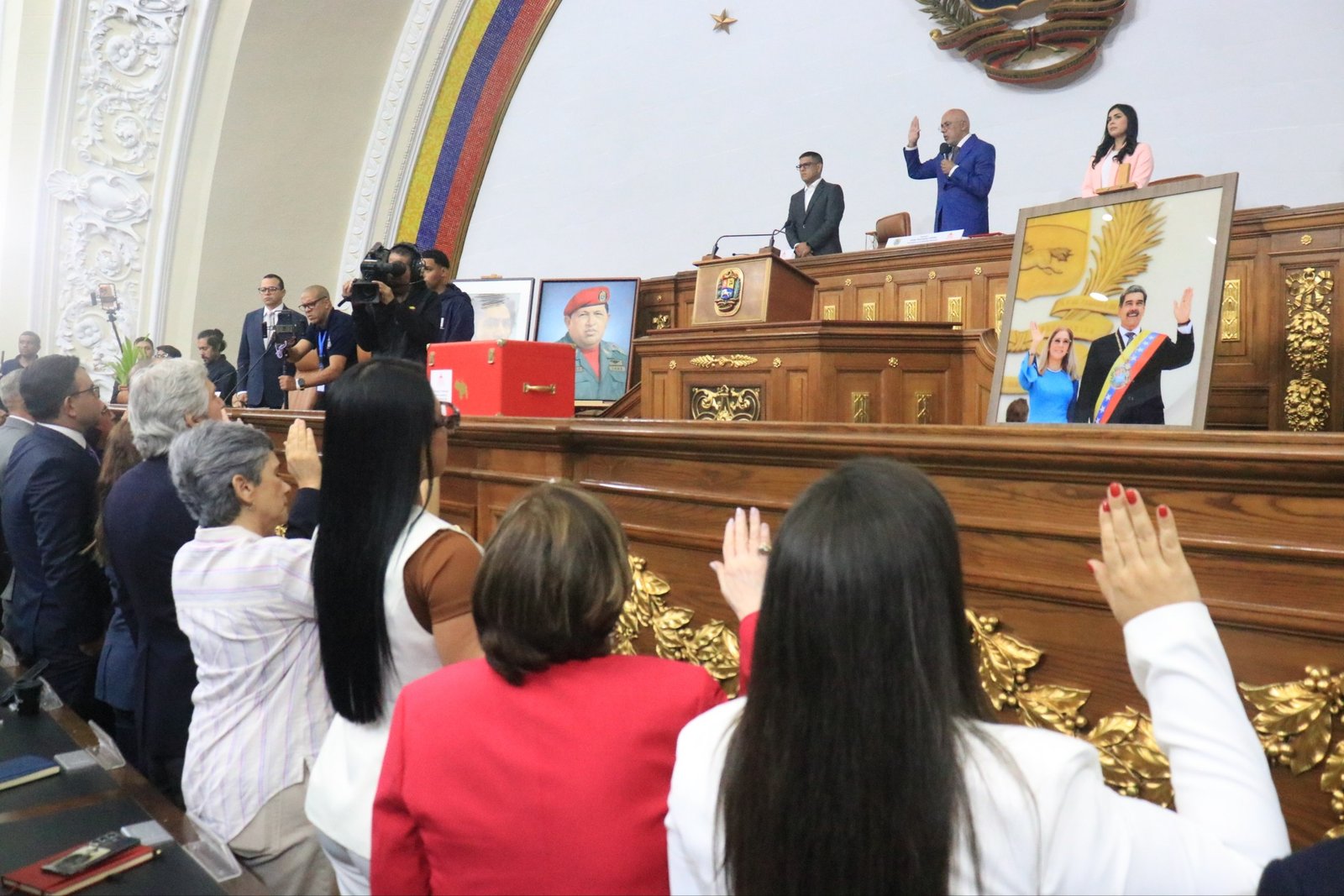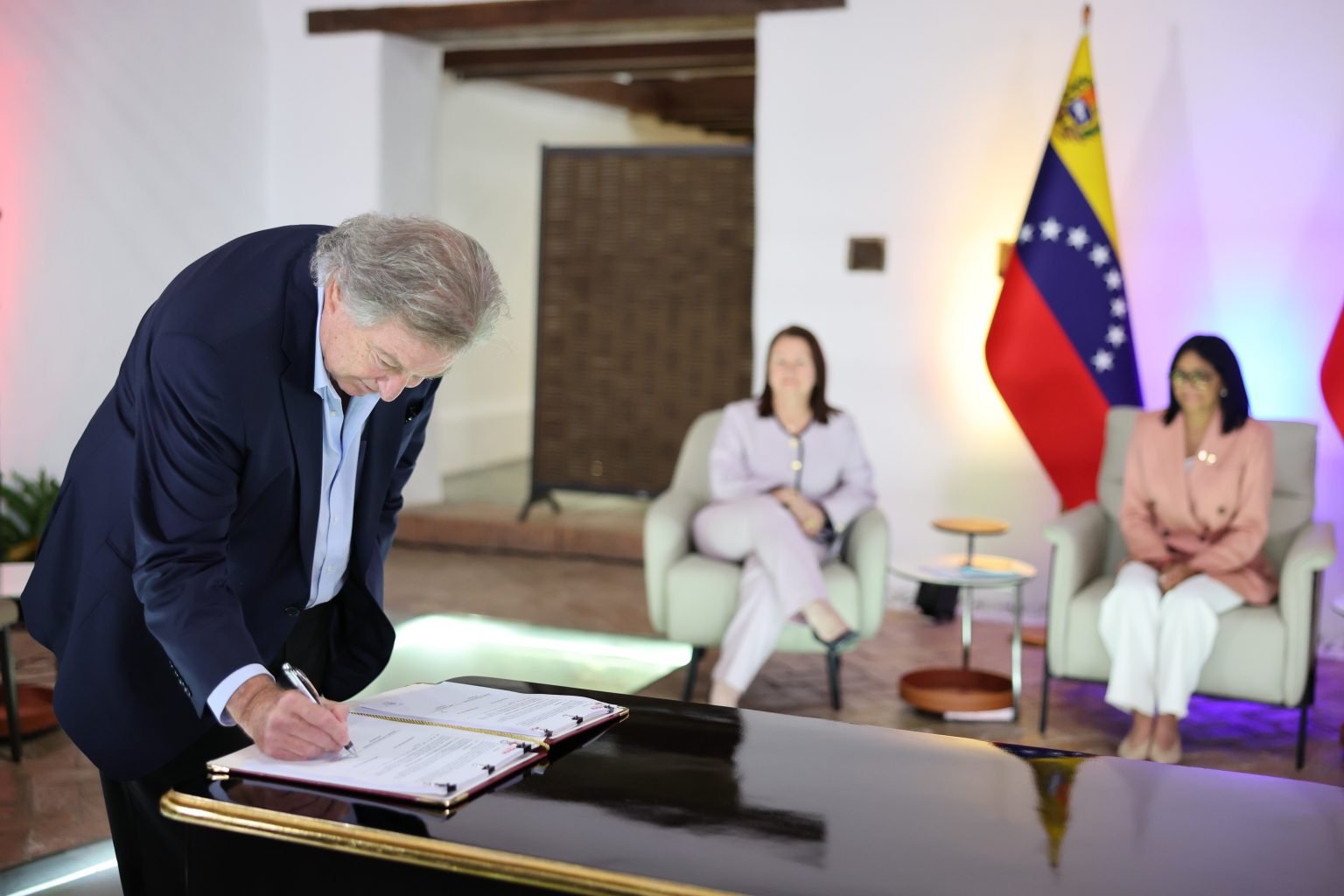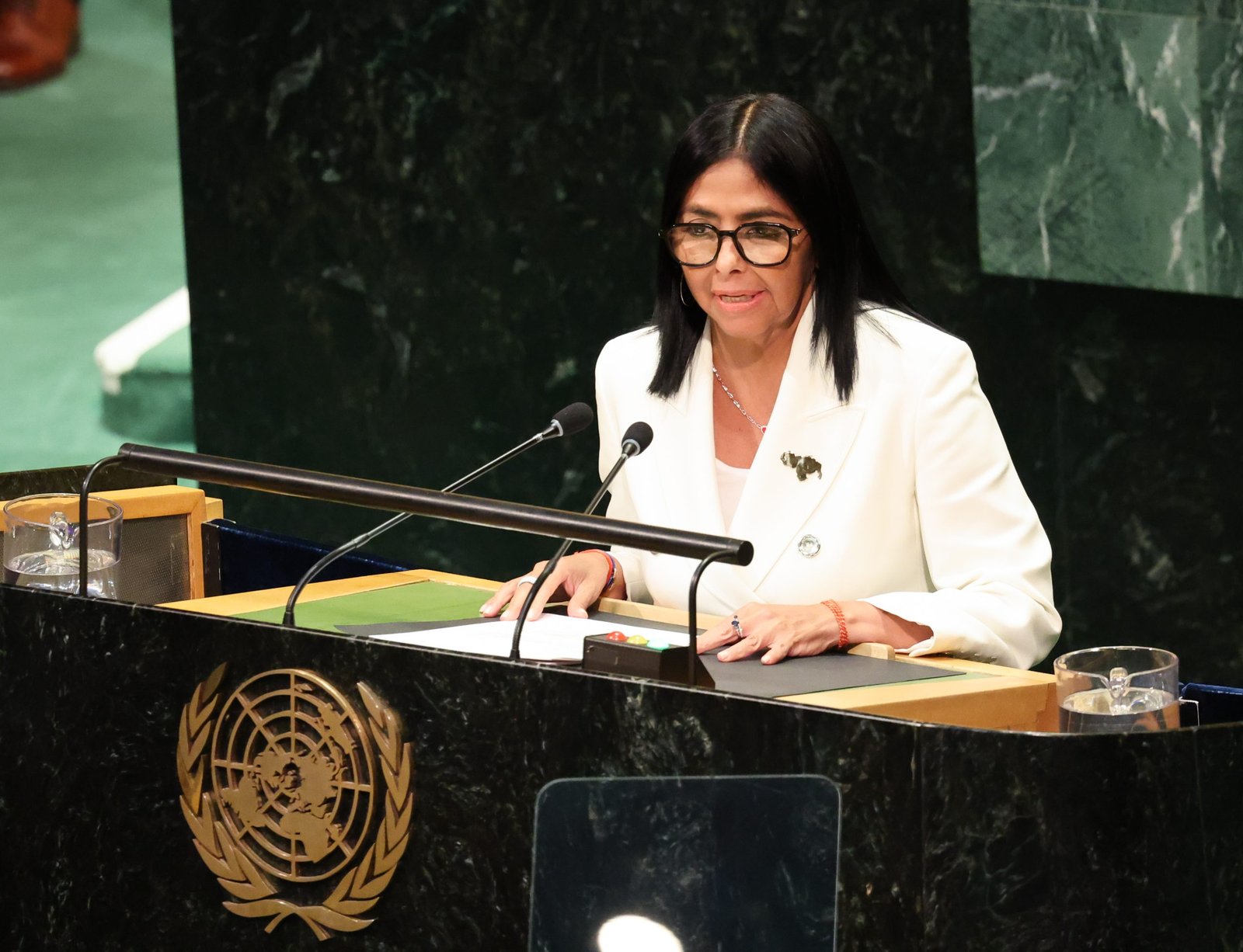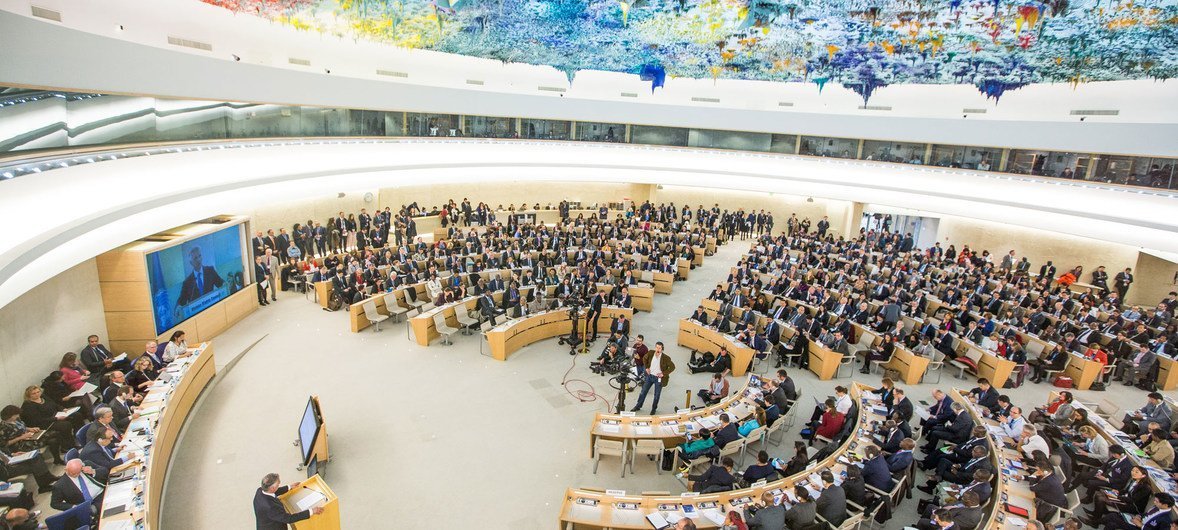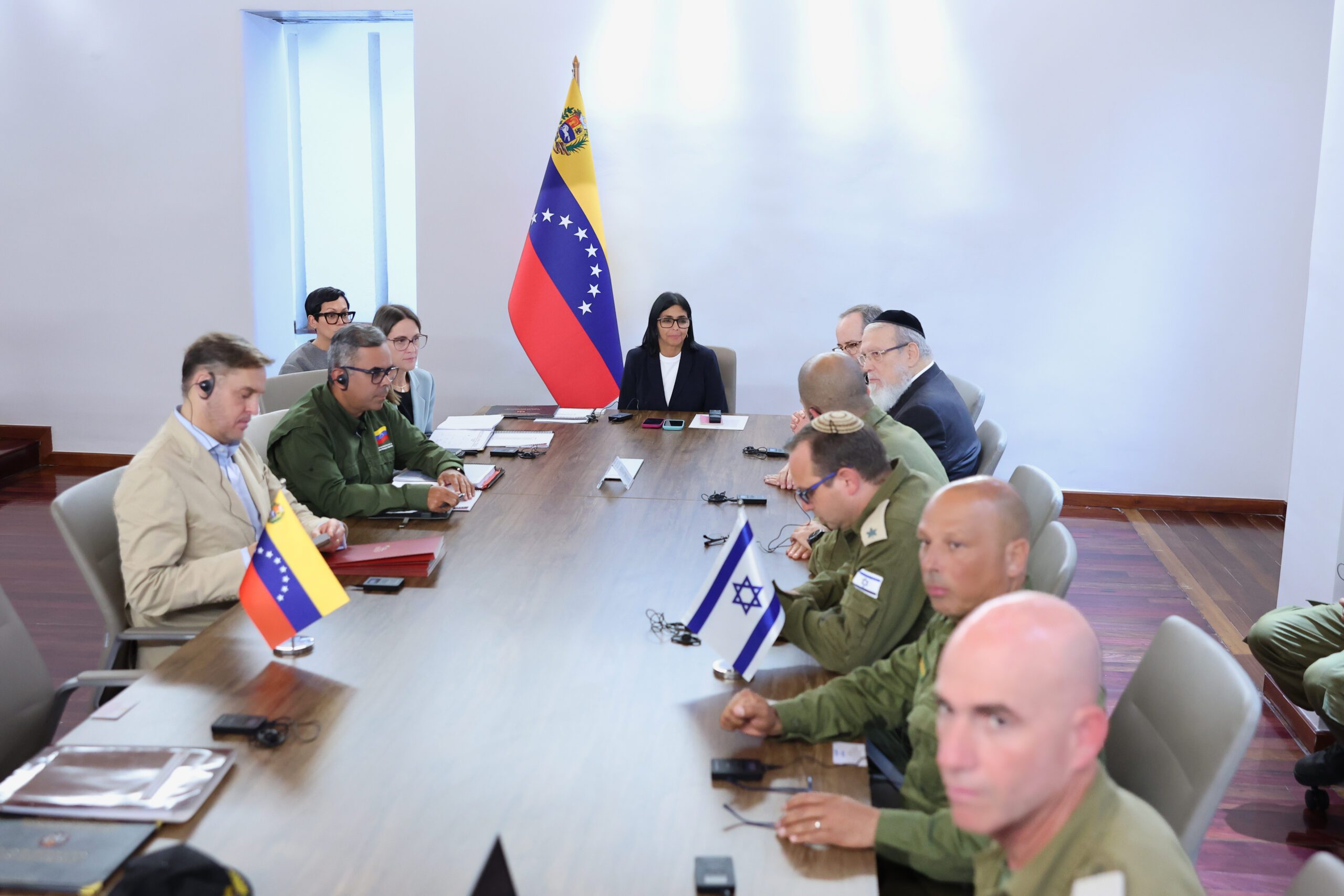
Israel sends its first official civic-military delegation amid a context of international legitimacy loss due to its actions in Gaza. In the image, acting president Delcy Rodríguez meets with members of the Israeli mission on July 21. Photo: Presidential Press.
Guacamaya, July 25, 2026. In Orthodox Jewish tradition, the shidduch is a process of seeking and forming a marital union based on identifying compatibilities between two people. The Hebrew word traditionally implies the involvement of family members, friends, or a shadchan —an intermediary tasked with facilitating the encounter— who evaluates aspects such as values, character, family background, education, and life goals before fostering a relationship. More than a spontaneous meeting, the shidduch represents a carefully considered union between two parties that, in principle, might seem distant but share sufficient interests to build a lasting bond.
In geopolitics, there are moments when external actors play a role similar to that of a shadchan, identifying strategic affinities, reducing distances, and creating conditions for an improbable rapprochement. The unexpected reunion between Israel and Venezuela following the earthquakes of June 24 can be read through this logic. A relationship frozen for 17 years embarks on a new stage due to the influence of a central actor: the United States, which occupies the role of shadchan in this case.
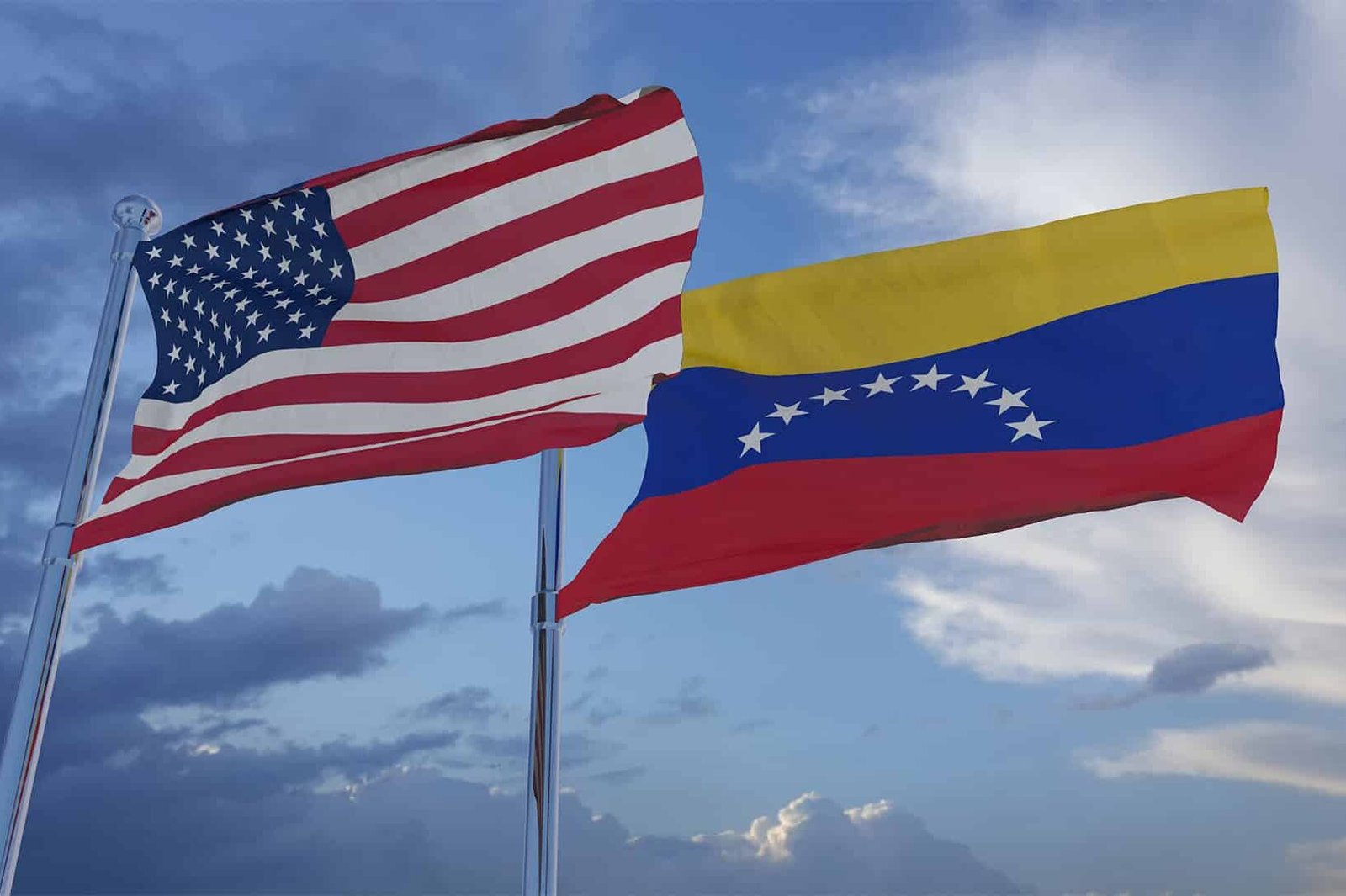
After January 3, President Donald Trump has promoted a new political architecture where the roles of friends and adversaries are reversed. The United States has functioned as a convergence factor between Caracas and Tel Aviv, which for years stood in opposing positions on the international chessboard. Venezuela’s opening toward the West and Israel’s interest in strengthening its presence in Latin America thus found a meeting point facilitated by a new strategic reality.
As in a shidduch, the first meeting does not mean the relationship is consolidated or that differences have disappeared. The parties still need to define common interests, limits, and conditions for broader cooperation. The Israeli humanitarian mission in Venezuela represents that first rapprochement, as it is a space where reconstruction, technical assistance, and public diplomacy function as initial elements of a possible new relationship.
Notably, the delegation was primarily military, with several representatives from the General Staff. While it is common for a country’s armed forces to send contingents after a natural disaster, it is not frequent to see senior commanders, much less meeting with heads of state. The Israel Defense Forces, at the same time, are in a crisis of international legitimacy due to their actions, mainly in Palestine.
In December 2023, South Africa filed a lawsuit against Israel before the International Court of Justice, alleging violations of the 1948 Genocide Convention in Gaza. In November 2024, another court, the International Criminal Court, issued arrest warrants against Prime Minister Netanyahu and former Defense Minister Yoav Gallant for alleged war crimes. The Israeli government has vehemently denied these accusations. At the same time, several countries from the “Global South,” such as Colombia, Brazil, South Africa, and Turkey, broke or reduced relations with Tel Aviv, while others, such as Spain, Norway, and Slovenia, began to formally recognize the State of Palestine.
The resumption of relations with Venezuela is therefore of strategic relevance for Israel. It is not returning to just any country, but to a former ally of its rivals in the Middle East, with significant hydrocarbon and mineral reserves. Moreover, Caracas is now under the influence of the United States, which is also Israel’s main backer. In an increasingly adverse international environment, the shidduch with Venezuela could be established on solid foundations, sponsored by Washington.
Key Historical Background: From Chávez to January 3
Relations between Israel and Venezuela have undergone a profound transformation in recent times, moving from close cooperation during much of the second half of the 20th century to 17 years of estrangement. The arrival in Caracas of an official Israeli mission in July 2026, sent after the devastating earthquakes, acquires a relevance that transcends the humanitarian sphere. It is the first Israeli governmental deployment on Venezuelan territory since the rupture of relations in 2009 and reflects an interest in strengthening its influence in the region.
Venezuela was one of the first Latin American countries to recognize the State of Israel following its founding in 1948. For decades, both countries maintained stable diplomatic ties and developed cooperation in areas such as agriculture, technology, health, trade, and water management, favored by the presence of a significant Venezuelan Jewish community and by a foreign policy traditionally oriented toward balance and multilateralism. However, this dynamic changed radically with the arrival of Hugo Chávez to power in 1999, when Caracas reoriented its foreign policy toward a more pronounced confrontation with the United States and a strategic rapprochement with countries like Iran, Libya, and Syria.
Relations with Israel deteriorated progressively when Venezuela withdrew its ambassador from Tel Aviv during the war between Israel and Hezbollah in 2006 and officially broke diplomatic relations in January 2009, following the Israeli offensive in Gaza known as “Operation Cast Lead.” Since then, both countries have maintained a relationship without formal diplomatic ties.
A new chapter began to open after the U.S. military operation of January 3, 2026, paving the way for a redefinition of Caracas’s foreign policy. In that context, Nicolás Maduro Guerra, son of the former president, publicly raised the need for Venezuela to establish relations with all countries, including the United States and Israel. His statements, made during a meeting of the Network of Jurists in Caracas, reflected a significant shift in the Chavista discourse of recent decades and coincided with a moment when Venezuela seeks to rebuild its international ties.
In the new Venezuelan political scenario, Israel expressed its support for the U.S. action against the structure of the Chavista government and expressed its interest in strengthening its ties with Latin America, in a context of redefinition of alliances in Caracas.
That possibility began to materialize after the earthquakes of June 24, 2026, when Caracas accepted an Israeli humanitarian mission made up of diplomats, officers from the IDF Home Front Command, structural engineering specialists, search and rescue teams, and representatives of humanitarian organizations.
The composition of the Israeli delegation reflected a carefully structured strategy: Ambassador Yoed Magen provided the political and institutional leadership of the mission; Brigadier General Elad Edri, Chief of Staff of the IDF Home Front Command, headed the technical component of infrastructure assessment, search, and rescue; and Rabbi Yosef Garmon, president of the Humanitarian Coalition and director for Latin America of the ZAKA search and rescue organization, incorporated the humanitarian, communicational, and public diplomacy dimension.
Caracas’s acceptance of the deployment constituted an unprecedented event since the rupture of relations in 2009, although both parties emphasized its technical nature. Far from being an improvised delegation, each of its main members responds to a specific objective, which we will analyze below.
Yoed Magen, the Ambassador Who Spent His Childhood in Venezuela
Ambassador Yoed Magen represents one of the most technical profiles of Israel’s Ministry of Foreign Affairs. His role at the head of the diplomatic mission responds to a combination of humanitarian and strategic factors. A career diplomat since 1992, Magen holds training as a programming engineer from ORT Singalowsky and a bachelor’s degree in Political Science and Criminology from Bar-Ilan University. Over more than three decades of service, he has developed experience in strategic planning, international cooperation, crisis management, and civil-military coordination.
His time at the Ministry’s North America Division gave him a deep knowledge of U.S. politics and the coordination mechanisms between Washington and Tel Aviv, a relevant aspect in the Venezuelan case due to the weight the United States maintains over Caracas’s relationship with the political West. He also worked in the Ministry’s Economic Cooperation Directorate, participating in international trade initiatives and bilateral ties, and was a policy advisor for the Strategic Planning Directorate of the IDF General Staff, where he acquired experience in logistics, critical infrastructure protection, and emergency response.
However, the element that especially distinguishes Magen is his personal connection to Venezuela, as during his childhood and youth he resided in the country, is fluent in Venezuelan Spanish, and possesses direct knowledge of its culture, society, and institutions. This connection represents a diplomatic asset in a context marked by years of political estrangement, as it facilitates trust-building and reduces communication barriers.
His technical and discreet profile also allows Caracas to present the cooperation as a humanitarian initiative, removed from ideological disputes or political pressures. At the same time, his experience in Washington and in strategic planning makes him an interlocutor capable of understanding the regulatory and diplomatic limits that condition any rapprochement between Venezuela, Israel, and the United States.
Elad Edri, Home Front Commander
Brigadier General Elad Edri, current Chief of Staff of the IDF Home Front Command, represents one of Israel’s most specialized operational profiles in civil protection, urban rescue, and emergency management. His career combines initial training as an infantry officer in the Paratroopers Brigade, an elite IDF unit, with subsequent specialization in critical infrastructure assessment and civil-military coordination. His experience in complex scenarios, especially in Gaza and the West Bank, marked his evolution from the combat sphere toward comprehensive crisis management.
Throughout his career, Edri participated in security operations and urban combat, and as commander of the Rescue and Training Brigade of the Home Front Command, he led units dedicated to debris removal, assessment of damaged structures, and support in high-complexity areas.
Subsequently, as commander of the Haifa District and then chief of staff of the Home Front Command, he assumed responsibilities over civil preparedness, disaster response, coordination with emergency agencies, and protection of the population against military and natural threats.
His designation to lead the operational component of the Israeli mission in Venezuela after the earthquakes of June 24, 2026, reflects the strategic importance of his capabilities in rescue, engineering, and infrastructure stabilization.
The “Rabbi Influencer” Yosef Garmon
Rabbi Yosef Garmon has become one of the most visible figures of Israeli humanitarian diplomacy in Latin America, combining religious leadership, social action, and international coordination. Born in Jerusalem and with rabbinic and legal training, he practiced as a lawyer in Mexico, Colombia, and Guatemala before dedicating himself to community work.
He is the founder of the Humanitarian Coalition and director for Latin America of ZAKA, an Israeli organization specialized in search, rescue, and victim recovery. His career includes assistance operations following earthquakes, floods, and other disasters, as well as experience in crisis scenarios as an IDF reservist. As a reservist, he was mobilized after the attacks of October 7, 2023, and subsequently participated in tasks linked to the Israeli national effort during the war.
One of the most relevant scenarios in which Garmon participated before his arrival in Venezuela was Somaliland, an autonomous territory in the Horn of Africa seeking international recognition as an independent state from Somalia. Garmon’s presence in the region is part of Israel’s efforts to strengthen its strategic ties in the Red Sea, an area of growing geopolitical importance, particularly given the activity of the Houthi rebels in Yemen, allies of Iran.
In the Israeli mission in Venezuela after the earthquakes of June 24, 2026, Garmon contributed the humanitarian, community, and spiritual dimension. He was one of the first Israeli representatives to arrive in the country, coordinating the entry of volunteers and rescue teams, and subsequently integrating into the official delegation alongside ZAKA. His command of Spanish and his extensive network of contacts in Latin America facilitated interaction with local communities and authorities.
Beyond technical assistance, his presence reinforced Israel’s humanitarian diplomacy strategy, using aid and social cooperation as a communication bridge in the absence of formal diplomatic relations with Caracas. Garmon has been key in attempting to show “a human face” and has had a presence in the country’s main media during his stay, being crucial in showcasing the mission’s fieldwork on social networks.
A Mission Under Netanyahu’s Direct Oversight
It should be emphasized that Prime Minister Benjamin Netanyahu’s statements constitute one of the main indications that the Israeli mission in Venezuela after the earthquakes transcends the strictly humanitarian sphere. By stating that Israeli specialists are “rebuilding ruins and also rebuilding relationships,” Netanyahu explicitly linked technical assistance with a broader diplomatic strategy: using the emergency to open spaces for dialogue with a country with which Israel has had suspended relations since 2009.
The operation reflects a recurrent feature of Israeli foreign policy: the use of humanitarian diplomacy as a tool for international projection. Through the deployment of rescue teams, engineers, and disaster specialists, Israel seeks to respond to humanitarian crises, but also to strengthen its international image, build trust with recipient governments, and establish communication channels in contexts where deep political differences exist.
The reference to showing “the true face of the State of Israel” also reveals a component of public diplomacy and soft power, aimed at projecting before Venezuelan authorities and society an image of cooperation, technology, and assistance beyond political disputes. It was also a propaganda message to a world that today questions Israel.
The Economic Dimension Beyond the Humanitarian
The interest shown by Israeli companies such as Dream in expanding their operations toward Latin America allows for an analysis of the potential that Venezuela could represent in a scenario of economic opening and rapprochement with the United States and Israel. After more than two decades of technological cooperation with Russia, China, and Iran in areas such as telecommunications, surveillance, defense, and cybersecurity, a potential Venezuelan strategic reorientation would imply modernizing part of that architecture, especially in data protection, critical networks, government communications, and digital security.
In that context, Venezuela could become an attractive market for companies specialized in cybersecurity, artificial intelligence, and critical infrastructure protection. The country’s reconstruction would require not only rebuilding roads, hospitals, or electrical systems but also developing digital capabilities to face hybrid threats and attract international investment.
Beyond cybersecurity, a potential rapprochement with the United States and Israel could open opportunities in the physical infrastructure necessary for artificial intelligence. Global technological competition is shifting toward the capacity to build data centers, high-speed networks, and energy systems capable of sustaining large processing volumes. Venezuela possesses potential advantages in this area, as it has abundant energy resources, natural gas reserves, hydroelectric capacity, land availability, and a strategic location between North America, the Caribbean, and South America.
This scenario coincides with the growing convergence between artificial intelligence, national security, and defense. U.S. companies such as Palantir Technologies, linked to Peter Thiel’s technological ecosystem and cooperating with Israeli institutions, reflect this trend. At the same time, Israeli companies specialized in artificial intelligence and cyber defense seek to expand their international presence. If Venezuela manages to consolidate political stability, legal security, reliable energy, and sufficient connectivity, it could aspire to integrate into value chains linked to the digital economy, moving from being a technology recipient to a potential regional hub.
Another strategic dimension is Venezuela’s potential in critical minerals for the technological transition and the defense industry. The country possesses significant resources of iron, bauxite, nickel, gold, copper, coltan, and other minerals whose potential requires further exploration and industrial development. Several of these materials are essential for sectors such as semiconductors, batteries, electronic systems, telecommunications, artificial intelligence, and advanced military technologies. In a context where the United States and its allies seek to diversify supply chains largely dominated by China, Venezuela could acquire geoeconomic relevance if it develops these resources under transparency and sustainability standards.
The Latin American regional landscape is undergoing a political transformation that has generated a more favorable environment for Israel in several countries on the continent. The arrival of governments with positions closer to Washington and the Trump administration —such as Javier Milei in Argentina, Daniel Noboa in Ecuador, emerging political sectors in Colombia such as those led by Abelardo de la Espriella, and U.S.-allied governments in Central America like Honduras— has opened greater spaces to strengthen ties with Jerusalem in areas such as security, technology, innovation, and trade. This trend represents a change from the last decade, when several governments in the region maintained more critical positions toward Israel, especially within the framework of the Palestinian-Israeli conflict.
This new context coincides with a growing discussion about the increase in defense spending promoted by the United States within regional initiatives such as the so-called Shield of the Americas, aimed at reinforcing security capabilities, military cooperation, territorial control, and response to transnational threats. Although Venezuela is not directly part of these schemes, a potential deepening of cooperation between Washington and Caracas within the framework of Venezuelan stabilization could generate a comprehensive review of the country’s defense capabilities. After years of technological dependence on Russian, Chinese, and Iranian suppliers, Venezuela would face the challenge of modernizing its military, communications, and intelligence systems under new interoperability standards with the West, especially with the United States and its allies such as Israel.
In that context, Israeli defense, cybersecurity, and intelligence companies could find a strategic opportunity. Israel possesses extensive experience in surveillance systems, border protection, electronic warfare, data analysis, and cooperation against hybrid threats —capabilities that could prove relevant for Venezuela in rebuilding its security institutions and in the fight against armed organizations such as the ELN, which maintain a presence in border areas.
Israel’s Role in Venezuela’s Reconstruction After the Earthquakes
The Israeli delegation led by Brigadier General Elad Edri presented to the Venezuelan government a technical plan for the recovery of La Guaira, one of the areas most affected by the earthquakes. The document reflects the experience accumulated by Israel in emergency management, combining structural engineering, risk assessment, urban planning, and civil-military coordination. More than an immediate rescue response, the plan proposes a comprehensive recovery strategy based on six stages: damage diagnosis, debris removal, controlled demolition, waste management, stabilization, and resilient reconstruction.
The experience of the IDF Home Front Command is key due to its specialization in civil protection against armed conflicts, earthquakes, and other emergencies. In the Venezuelan case, the delegation’s continued presence at the request of Delcy Rodríguez’s government to Israeli Foreign Minister Gideon Sa’ar shows that cooperation surpassed the initial symbolic phase. Technical inspections of buildings and structures aim to determine habitability conditions, reduce secondary risks, and establish priorities for reconstruction.
From a geopolitical perspective, Israel’s participation in Venezuela’s reconstruction occurs at a particularly complex moment for its international image. Following the war in Gaza and the deep divisions generated around its military operations in the Middle East, Israel faces growing diplomatic challenges, pressure in multilateral bodies, and a deterioration of its public perception in various sectors of the international community.
The operation in Venezuela thus functions as an expression of humanitarian diplomacy, propaganda, and soft power, through which Israel seeks to keep international channels open, build ties with new interlocutors, and counteract the image exclusively associated with conflict.
For a country whose international legitimacy is under intense scrutiny, demonstrating capacity to respond to natural disasters and willingness to cooperate even with historically distant governments represents a tool to expand its diplomatic margin, recover spaces of global influence, and have key elements for its propaganda —and perhaps there is no better way to do so than reestablishing relations with the country that possesses the world’s largest oil reserves, whose reconstruction can represent a business opportunity for Israeli entrepreneurs and which has interesting potential reserves of minerals key to the global defense industry, where companies from that nation are a key source of income for its government at a time of boycotts and conflict.
It will be pertinent to follow the evolution of exchanges that depend on broader political factors, such as Venezuela’s relationship with Iran, the position of the United States, and the future decisions of both governments. Even so, Israeli participation in the recovery of a strategic area like La Guaira represents a significant change, since a relationship marked by political distance found a meeting point in engineering, risk management, and humanitarian response.
If the current dynamic evolves favorably, the next step could be the institutionalization of that kesher, which means “bond” in Hebrew, through permanent dialogue mechanisms, representative offices, or even the eventual reopening of embassies in Caracas and Tel Aviv.