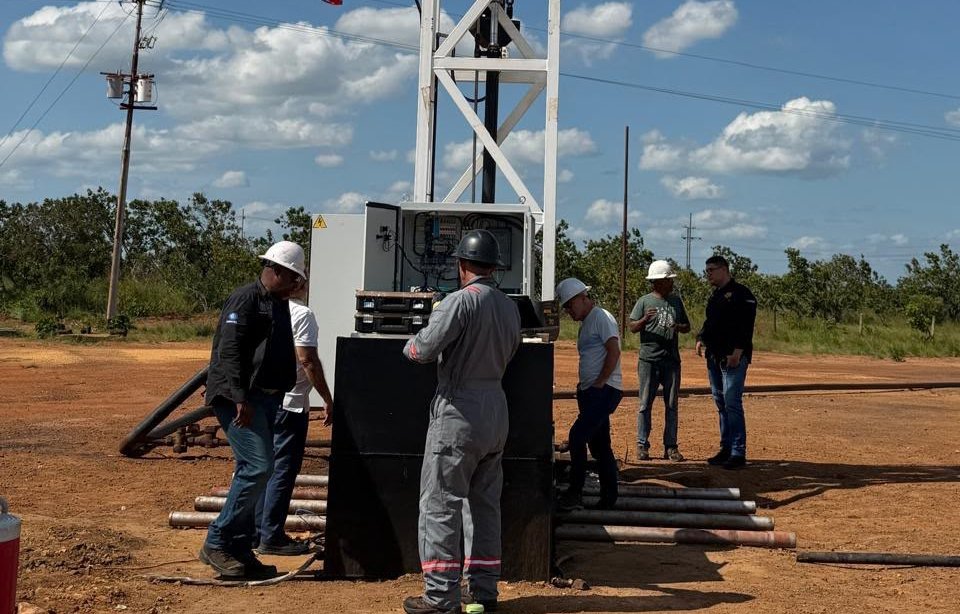
The technology, developed and manufactured in Venezuela, reduces electricity consumption by up to 50%, according to company information. Photo: Alvorada Oil & Gas.
Guacamaya, October 23, 2026. The alliance asserts that the equipment, designed and manufactured in the country, uses up to half the electricity of a conventional system and marks a step forward in the sector’s industrialization. Alvorada, a Brazilian-origin oil company operating three blocks on the northeastern edge of the Orinoco Belt, seeks to raise its production from about 4,000 to 20,000 barrels per day.
Alvorada Oil & Gas, in a strategic alliance with Dinatel Group, reported that it built and installed the first oil pumping unit made entirely in Venezuela. The company presents the project as part of an effort to strengthen domestic production of technology for the hydrocarbon industry.
The equipment was developed using local engineering and manufacturing processes. According to the announcement, its technology cuts electricity costs by up to 50%, operates at depths of up to 13,000 feet, and handles both light and heavy crude oils.
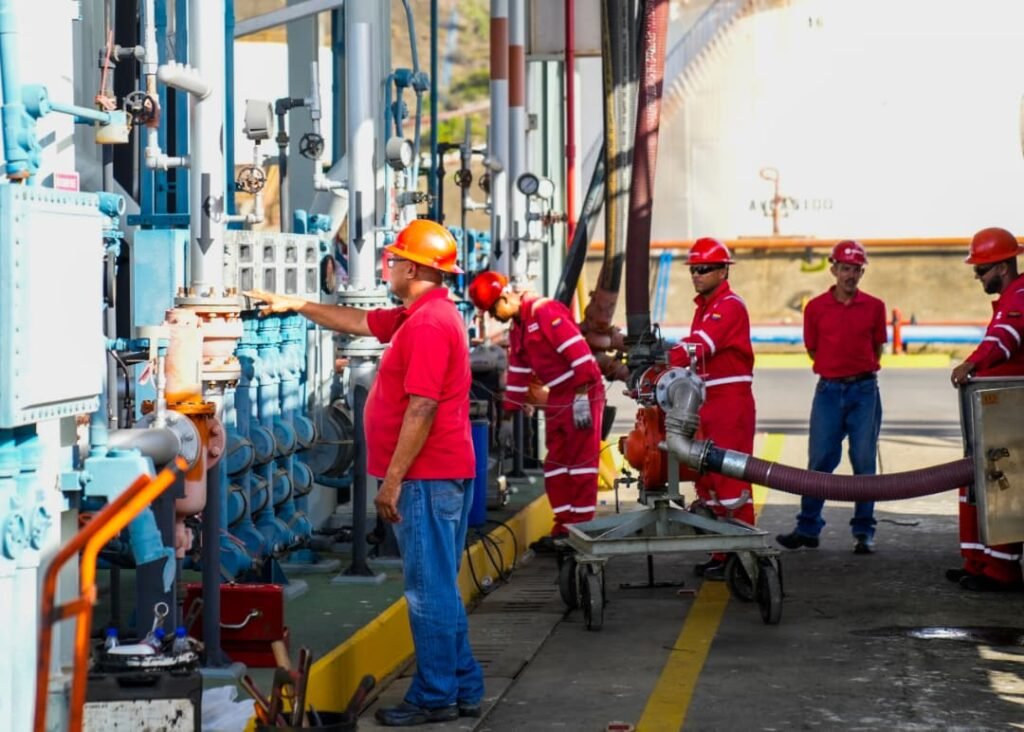
The first unit is already operating in the Boca, Guara, and Guico fields, where Alvorada works alongside Consorcio ACE. The companies note that this is the first delivery of a series of units that have already been contracted and will be added gradually.
Paulo Buzanelli, chairman of Alvorada Oil & Gas, described the event as a turning point for the sector and linked it to the group’s confidence in the country. “This advance marks a before and after for the Venezuelan oil industry. We are not just talking about incorporating a new technology into our operations, but proving that Venezuela has the talent, engineering, and industrial capacity to manufacture oilfield equipment meeting international standards of quality and competitiveness.”
“That this unit carries the 100% ‘Made in Venezuela’ stamp represents a point of pride and, above all, a concrete demonstration of the Alvorada Group’s confidence and long-term commitment to the country’s energy and industrial development,” Buzanelli added.
According to the company, the initiative stems from a strategic decision to commit to technology transfer, the strengthening of the Venezuelan metalworking industry, and the building of national capacity to manufacture oilfield equipment. Through the alliance, both companies aim to demonstrate that developing the country’s energy resources can go hand in hand with industrial investment, local engineering, and value creation inside Venezuela.
What is Alvorada, and what does it do in Venezuela?
Alvorada is an independent oil company of Brazilian origin founded in 2023, according to Bloomberg. Its arrival in the country predates the fall of Nicolás Maduro and can be pinned down to 2024, when, in the outlet’s words, “tudo era mato”—that is, when almost no one was willing to bet on Venezuela. Bloomberg indicates that the company acquired its production contracts about three years ago, driven by Buzanelli’s premise that Venezuela could experience an opening comparable to the one following the collapse of the Soviet Union.
The company produces in three blocks in the far northeastern area of the Orinoco Oil Belt. In April 2026, its production hovered around 4,000 barrels per day, with a target of reaching 20,000 in two years, per Bloomberg. Buzanelli added at the time that another project under evaluation could bring the total to 30,000 barrels per day within a few months.
The blocks were inactive and belonged to PDVSA. Alvorada took them over under a “productive participation” contract, committing $30 million in investment to reactivate them, and pays royalties to the state in barrels (the percentage was not disclosed). The same media outlet counts 844 wells across roughly 580 square kilometers, all onshore. The crude is mostly light or medium quality—unusual for the Belt—and can serve as a diluent for heavier crudes from other projects, Buzanelli explained to Bloomberg.
Financial backing comes from Galapagos Capital, an asset management firm created in 2019 by Carlos Fonseca, former head of venture capital at BTG Pactual, with approximately $4.2 billion in assets under management. Alvorada is also looking into oilfield services, logistics, and processing, and acquired the small U.S. firm Calistoga, which serves as a Texas-registered vehicle to operate in Venezuela.
The Context: Mature fields and a reopening sector
Boca and Guara are among the historical fields of eastern Venezuela. Guara was discovered in 1942, and Boca—part of the greater Oficina area—has been producing since 1945, according to Global Energy Monitor. They are reservoirs with decades of extraction, where artificial lift, such as mechanical pumping, plays a central operational role. No public information was found regarding the Guico field, Consorcio ACE, or Dinatel Group.
Alvorada belongs to a group of Brazilian companies positioning themselves in Venezuela following the capture of Maduro by the United States in January 2026 and the subsequent easing of sanctions. InvestNews also cites Fluxus—the oil arm of J&F, which purchased A&B Oil and Gas and thereby a 49% stake in the Petrolera Roraima joint venture—and Eneva, which signed a memorandum of understanding with Halliburton in September.
The backdrop is the gap between reserves and production. Venezuela holds about 300 billion barrels in reserves, but produces around one million barrels per day—down from 3.4 million in 1997—a drop attributed to lack of investment, sanctions, and aging equipment. Against this backdrop, a locally manufactured pumping unit serves as a sign of industrialization and concrete progress.
A company that bet on Venezuela when almost no one else would
In this context, Alvorada Oil & Gas exemplifies how certain international companies are betting on Venezuelan energy potential beyond immediate production recovery. Its decision to invest in reactivating mature fields, expand operations, and develop technology alongside a local firm reflects a long-term vision of the country’s opportunities. If the initiative proves sustainable, the alliance with Dinatel Group could help not only boost crude output, but also reinforce domestic industrial capabilities, foster technology transfer, and reduce reliance on imported equipment.
The challenge will be transforming this initial milestone into a sustainable supply chain with verifiable results and increasing local participation. In an industry requiring capital, modernization, and new technical expertise, Alvorada’s move suggests that Venezuela’s potential is not limited to its hydrocarbon reserves, but also lies in its ability to build a more integrated, competitive, and value-generating domestic energy industry.
Alvorada’s bet on Venezuela began before the new political and economic landscape sparked broader interest among international investors. When much of the market still viewed the country as a high-risk destination, the company chose to enter, take on the challenge of reactivating oilfields, and establish an operation geared toward long-term growth.
Today, its alliance with Dinatel Group to produce oilfield technology within Venezuela reflects a commitment that goes beyond extracting crude; it centers on developing industrial capabilities and generating value within the country. As Venezuela seeks to regain its standing in the international energy market, initiatives like this can help lay the groundwork for a new phase of growth.
Venezuela’s economic takeoff will largely depend on its capacity to attract patient capital, establish conditions that sustain investment, and turn natural resources into domestic production, jobs, technology, and industry. Along that path, Alvorada stands as an example of a company that chose to bet on Venezuela’s potential before many others began to do so, and whose progress will help show to what extent that confidence can translate into concrete results for the country’s economic recovery.