William Serafino is a political scientist graduated from the Universidad Central de Venezuela, and Luis Alejandro Ruiz is a senior international affairs journalist at Guacamaya, with a degree in Social Communication from the Universidad Católica Andrés Bello. Photo: Prensa Presidencial.
Guacamaya, October 13, 2026. The foreign policy of Venezuela governed by Delcy Rodríguez demands fundamental attention due to the regional and global implications that its configuration will have. On January 3, 2026, a U.S. military operation in Caracas and three other states ended with the capture of Nicolás Maduro and Cilia Flores, transferred to the United States to be prosecuted. Two days later, the Supreme Tribunal of Justice ruled that Delcy Rodríguez “assume” the acting presidency given the “forced absence” of the head of state, invoking Article 233 of the Constitution, making her the first woman to exercise executive power in Venezuelan history, although she and Maduro himself insisted that he remained the legitimate holder of the office.
Rodríguez’s first public gesture was not toward Washington, but toward her historical allies. At her swearing-in she greeted the ambassadors of China, Russia, and Iran, who offered her support despite having denounced the U.S. “armed aggression” before the UN. Days later she received Chinese Ambassador Lan Hu. China is Venezuela’s main bilateral creditor.
Moscow condemned the operation as “illegal” and demanded Maduro’s release, although the Kremlin avoided military backing; weeks later, Dmitri Peskov confirmed that Russia would maintain its investments—including weapons plants—and that Moscow “knows very well” Rodríguez, reaffirming its interest in remaining in Venezuela.
Despite Washington’s intention to displace Russia and China, in statements to the press, Venezuela’s Minister of Hydrocarbons, Paula Henao, stated that the country will honor the production agreements signed with Chinese and Russian companies and that these will continue operating normally. Beijing, for its part, asked that its relationship with Venezuela not be affected by agreements or understandings with third parties, in a signal that it seeks to preserve its strategic interests in the country while Caracas deepens its new international ties.
Oil shipments to Cuba have also stopped, a fact that has been presented by Washington as a victory.
Washington: the sequence of visits and the appointment of Plasencia as hinge
Read together, the U.S. visits do not appear to be isolated episodes, but rather the execution of the “three-phase plan”—stabilization, recovery, transition—that Marco Rubio presented as a bilateral framework. On March 4, Interior Secretary Doug Burgum arrived with businessmen interested in energy and mining exchange. Shortly after, Energy Secretary Chris Wright sealed energy commitments for productive recovery. And on June 4, already in the security arena, General Dan Caine, chairman of the Joint Chiefs of Staff, made the highest-ranking military visit in years, while Rodríguez was traveling through India.
The appointment of Félix Plasencia as foreign minister, on July 14, fits into the same architecture. It was not an improvised replacement: a career diplomat since 1991, he had already been foreign minister (2021-2022), ambassador to China, and ambassador to Colombia during the normalization with Gustavo Petro. But above all he is a personal link to Rodríguez from when they coincided at the Venezuelan embassy in London, under Rafael Caldera; it was she who designated him, in February, as chargé d’affaires in Washington to reopen the diplomatic mission, a task he completed upon assuming the Foreign Ministry. Plasencia is known for moving comfortably in Western diplomatic circles, a quality that generates confidence before the United States just when chavismo seeks to consolidate ties with Trump. His arrival coincided with the merger of Foreign Affairs and Foreign Trade and the displacement of Yván Gil to Science and Technology; the move was designed to manage simultaneously the Washington, Beijing, and Gulf tables, which months later he himself would tour.
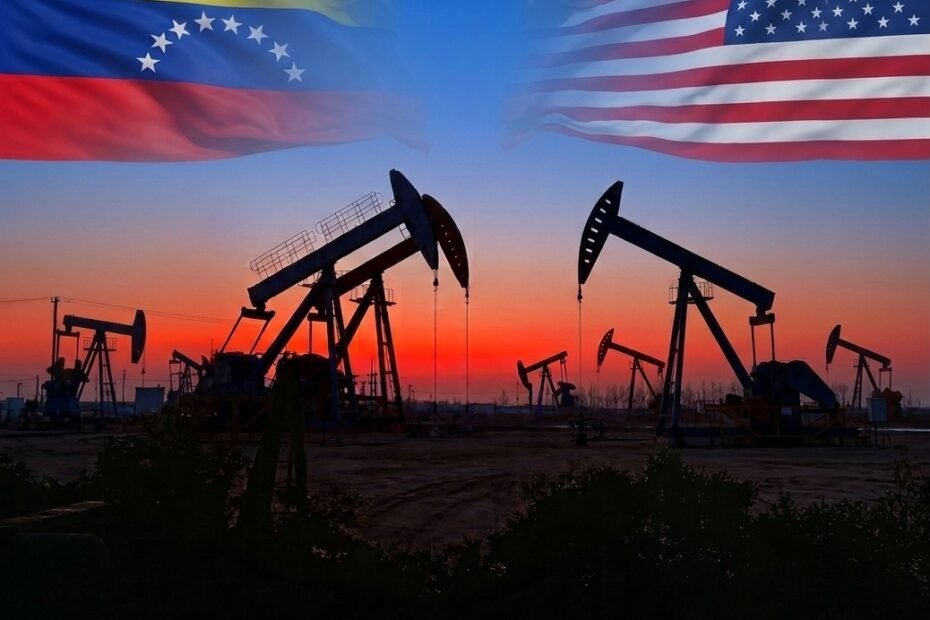
The point of greatest tension and benefit came in August, with the announcement of a 25-year oil agreement. According to U.S. officials cited by CBS and AP—figures not officially confirmed—the pact would grant a hundred-year concession to a joint venture in which the United States would control 55% of production at cost price. Rodríguez defended the scheme by stating that Venezuela would retain “ownership and sovereignty” over its reserves, while Washington would contribute “capital, technology, and operational capacity.”
In parallel, Caracas recomposed its relationship with multilateral banking, suspended since 2019. The IMF and World Bank announced its resumption on April 16, the IDB on June 24, and in July the country accessed 346 million dollars of its SDRs at the IMF. On September 21, in New York, Rodríguez met with Goldfajn (IDB), Georgieva (IMF), and Banga (World Bank) to discuss a debt restructuring with the IDB close to 2.5 billion dollars.
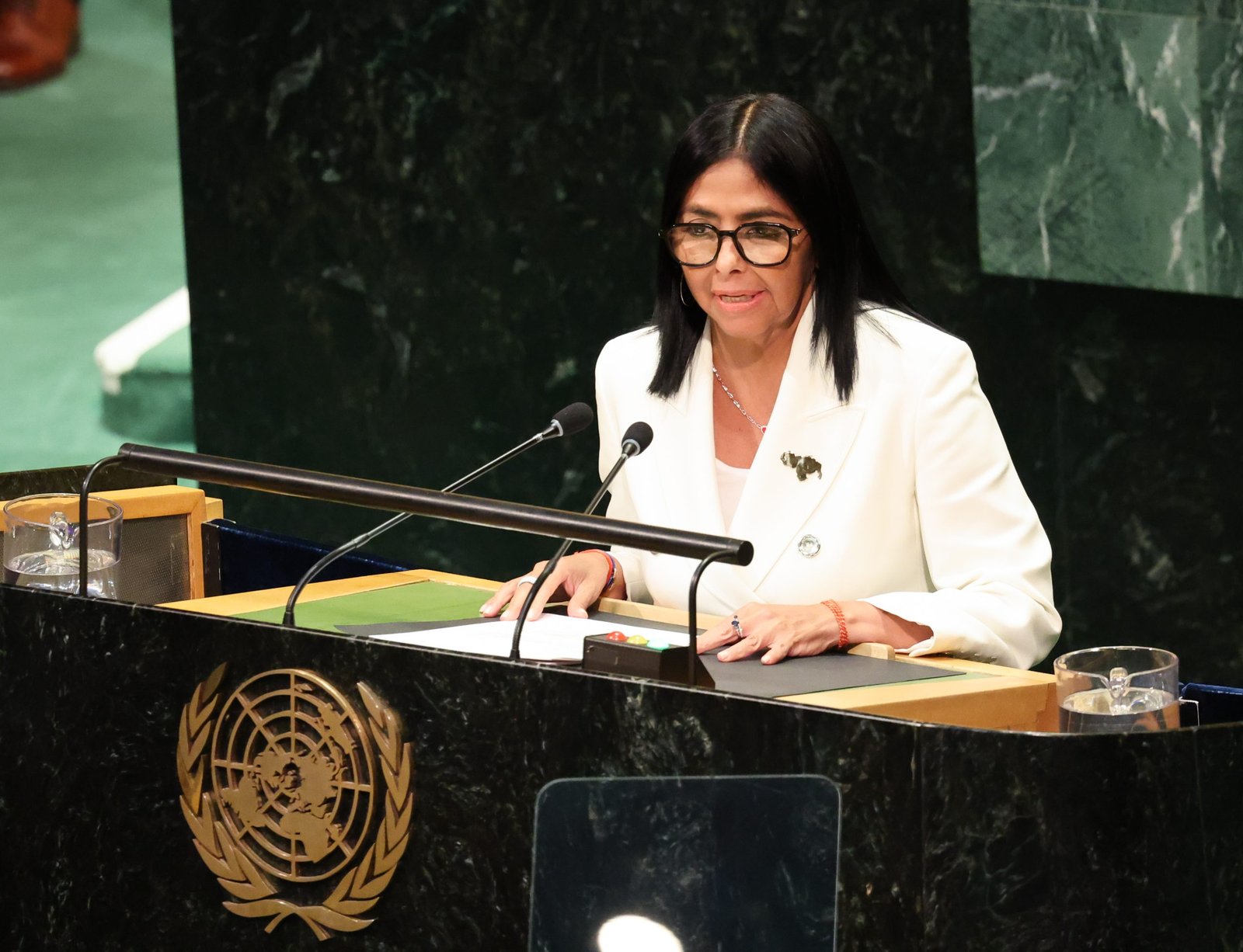
Rodríguez also deployed an active presidential diplomacy, unusual in recent times. Her most relevant tour was the five-day visit to India, from June 3 to 7, where Modi received her in New Delhi to discuss energy, trade, and renewables. The trip reflected a notable commercial shift: in just two months, Venezuela went from not selling oil to India to becoming its fourth supplier, driven by restrictions on the Strait of Hormuz and sanctions on Iran and Russia. Washington’s interest was for India to diversify its energy sources to reduce sanctioned crude from those two countries by using Venezuelan oil. From there she flew, surprisingly, to Turkey, and in September she attended the UN General Assembly, where she held the first meeting between a U.S. president and a Venezuelan leader in more than eleven years.
The flip side was the arrival of foreign officials in Caracas. Just ten days after Maduro’s capture, Rodríguez received ambassadors and later high-ranking envoys from the European Union, Spain, the United Kingdom, and Switzerland to “advance a new agenda.” On April 24, Petro was the first head of state to visit Miraflores after January 3, focused on border security in Catatumbo. In July, a U.S. congressional delegation with several members linked to AIPAC, the pro-Israeli lobby platform in the United States, traveled to Caracas, adding to the visits of Burgum, Wright, and Caine already reviewed.
Rodríguez also visited Caribbean nations such as Grenada, Barbados, and Suriname.
The turn toward the Gulf
In parallel to Washington, Caracas developed an active rapprochement with the Gulf monarchies, largely as an indirect channel of interlocution with the United States. Plasencia made his first international tour through Qatar and Saudi Arabia. In Doha he met with Emir Tamim bin Hamad Al Thani, continuity of a link that Rodríguez cultivated since the vice presidency; the Qatari capital is evaluating investments in the Los Pijiguaos bauxite mine. In Riyadh he discussed investment in agriculture, tourism, infrastructure, and oil. The United Arab Emirates has also been central after the June earthquakes; Abu Dhabi provided financing for reconstruction.
Israel
No turn is as revealing of the government’s learning as the Israeli one. Venezuela had downgraded its relations with Israel in 2006 and broke them completely in 2009 after the offensive on Gaza.
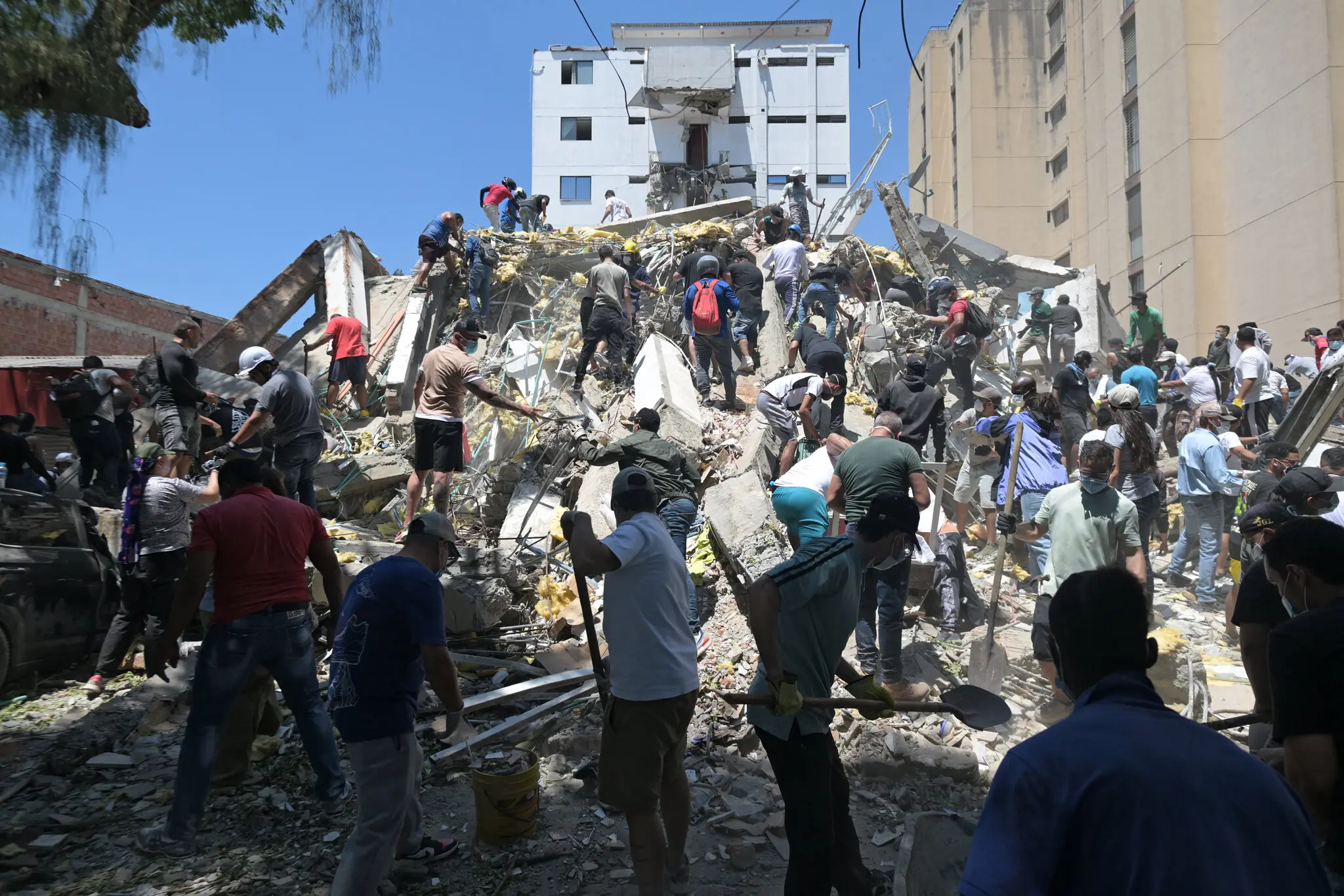
That pillar cracked after the June 2026 earthquakes. Caracas accepted an official Israeli mission—Ambassador Yoed Magen, General Elad Edri, and Rabbi Yosef Garmon—the first Israeli government deployment in Venezuelan territory since 2009. Netanyahu anticipated the political reading: “they are rebuilding ruins, and they are also rebuilding relations.” On August 11 both governments formalized the turn with the reestablishment of consular relations, agreed between Gideon Sa’ar and Félix Plasencia—again, the same figure as the point of contact. The statement avoided all reference to Palestine and appealed to the Venezuelan Jewish community as “an important historical bridge of friendship.” A few days later there was also an impasse between Venezuela and Iran over statements by the Persian foreign minister.
The fact gains relief if one remembers that Nicolás Maduro Guerra, son of the former president, proposed reestablishing relations “with all countries, including the United States and Israel”—a notable rupture within chavismo itself. Beyond the symbolic, the opening connects with the economic: Venezuela possesses reserves of iron, bauxite, nickel, gold, copper, and coltan, essential for semiconductors and defense, while companies such as Palantir Technologies—linked to Peter Thiel and with Israeli cooperation—reflect the convergence between artificial intelligence, national security, and critical minerals.
Reference frameworks to consider
There are in this case small reference frameworks that would be worth looking at. For example, if anything distinguishes Turkey, Qatar, or Brazil, it is their refusal to treat alignment as a binary choice. Ankara is in NATO but buys Russian defense and preserves channels with Tehran; Doha hosts a key U.S. base and at the same time mediates with Hamas, Iran, and the Taliban; Brasilia cultivates its membership in BRICS without renouncing a close commercial relationship with Washington. None is neutral in the classical sense; they have turned strategic ambiguity into a source of power.
Read with that mirror, Rodríguez’s trajectory stops seeming erratic. The ambiguity toward China, Russia, and Iran replicates the Turkish or Qatari calculation of not closing doors while negotiating with Washington. The turn toward the Gulf builds intermediaries—Qatar, Saudi Arabia, the Emirates—that cushion the asymmetry before the United States, as those countries have done between Washington and its adversaries. And the opening toward Israel follows the same logic that has led Ankara or Brasilia to sustain functional ties with ideologically uncomfortable actors when interest justifies it. A single foreign minister—Plasencia—capable of operating in Washington, Beijing, and Doha summarizes, in a cabinet decision, the entire model.
In recent days, Delcy Rodríguez has intensified her contacts with Latin American leaders within the framework of a strategy of diplomatic reopening of Venezuela. Paraguayan President Santiago Peña visited Caracas and agreed to initiate a process to progressively reestablish diplomatic and consular relations, with emphasis on economic cooperation, trade, and the fight against transnational crime. The possible return of Venezuela to Mercosur was also addressed. In New York, Rodríguez also advanced a rapprochement with Chilean President José Antonio Kast, initially oriented toward reactivating consular ties and bilateral dialogue. These movements suggest that Rodríguez seeks to build her own channels of interlocution with Donald Trump’s allies in the region, while developing contacts with other influential actors in Washington, such as the Gulf countries and India.
That pragmatism has, however, a ceiling that Turkey, Qatar, and Brazil do not face, and that is that in none of them does the government rule under such direct influence of a foreign power over its cabinet and its foreign policy. The Bolivarian Revolution aspired to an alternative pole to U.S. power; twenty-five years and a military intervention later, the lesson learned seems to be different and is based on the fact that in a multipolar world, political survival does not depend on choosing sides, but on becoming indispensable to several at once, within the margins that the dominant power tolerates.
Analytical hypotheses for understanding the present
The accelerated changes in diplomatic management have configured a landscape in which reality advances much faster than theory. But this does not automatically imply that work is being done in a vacuum or improvised.
Although not entirely explicitly, each step in the new geopolitical path undertaken by Rodríguez finds echoes and underlying references in theoretical approaches to international relations.
Starting from there, some categories from the field of international relations could shed light on the confusions that prevail in understanding the country’s new diplomatic moment.
Before entering the subject, it is worth saying that there is an undeniable truth: the analytical coordinates available in the scenario, due to their marked interpretive deficit, do not manage to answer the most unsettling questions of the present. The complexity of a novel panorama is reduced to binary, Manichaean approaches, colonized by markedly ideological views.
In other words, it seems an obligation to decide between extremes when analyzing geopolitics from Venezuela: either the acting government is assuming a sotto voce capitulation before Washington; or, rather, it manages a tactical realignment toward the U.S. through pragmatism to gain time, without fully clarifying its ulterior objectives.
In both cases, what is hierarchized is how the ideological conditions geopolitical calculation, with analysis being replaced by speculation and particular biases. Luis Vicente León, president of Datanalisis, was partly right when he stated, in the context of the Washington-Caracas oil agreement established at the end of August, that it is difficult to understand the derivations of what was agreed by taking as absolute concepts “sovereignty, legitimacy, and constitutionality.”
Thinking these categories autonomously from reality sharpens the phenomenon of incomprehension. Not because they are not important, but because it limits evaluating the scale of grays in which the actors are moving, operating, and projecting their respective calculations.
Let us ground the argument. The thesis of the surrender of sovereignty, first, does not incorporate into its limited characterization the material aspects that sustain it. Furthermore, it underestimates Caracas’s vision and cancels all possible debate around the potential economic benefits of the renewed bilateral relationship with the U.S.
The same cancellation effect is evident at the other extreme: considering that in the growing ties with the northern power there is only a tactical readjustment seems to run counter to the powerful influence that the Trump administration exercises over the country and its international development.
The two “theories,” on which a limited interpretive consensus has been forged, do not seem to respond to the evolution of reality as it presents itself to us, but to purely partisan conveniences. Thus, positioning oneself at one extreme or the other facilitates transit through an exceptional conjuncture that damages the positions prior to the military intervention of January 3 of the entire political arc.
In general, seeing Rodríguez’s government surrendered before the White House instills hope in opposition sectors that aspire for North American tutelage to reward them in the near future. But, at the same time, it victimizes Rodríguez before her followers, who see in her decisions an involuntary course of action.
Paradoxically, this reading has a problematic reverse side: the conviction of chavismo that the notion of sovereignty has not been altered coexists with the opposition’s fear of an eventual improvement in Rodríguez’s governmental image before the population.
It is difficult, using such a narrow diagram, to effectively capture the reconfiguration in process of Venezuelan foreign policy and its dominant calculations.
What is undeniable is that Trump has the strong hand at the table and that the relationship with Caracas has in its DNA that asymmetry of power and influence. But this premise does not exhaust reality, nor in one sense or the other of the conveniences at stake.
A more realistic appreciation would imply holding that there are strategic convergences between Washington and Caracas. While the former delimits the playing field and has a superior margin of maneuver to impose its interests, the latter seeks to exploit the economic and political opportunities that are generated.
The configuration of a communion of shared interests is increasingly evident, in which Miraflores and the White House extract advantages of varied dimensions according to their immediate possibilities.
The intersection between North American energy needs and Venezuelan economic needs after a decade of sanctions has resulted in a Trump-Rodríguez alliance, dominated by short-term bets that encompass stability and business.
As this convergence advances, the destinies of both actors become one. In Rodríguez, Trump has placed his main foreign policy triumph. In Trump, Rodríguez obtains the stability and legitimacy she would not obtain by her own means. The dependence is mutual, although favorable to Washington strategically.
Even though the U.S. is the elephant at the table, as León says, within the framework of an asymmetric relationship both actors interact measuring costs, benefits, and sacrifices programmatically. And it is clear that Rodríguez seeks, within the limits of asymmetry, to take advantage of the relationship with Trump for economic purposes and the return to world politics derived from it to build margins of relative autonomy, triangulating her own influences among the Gulf, Beijing, New Delhi, and Caribbean countries.
How does this translate in terms of the new foreign policy that Rodríguez implements? In ideological and partisan discourse we will hardly find satisfactory answers.
Theoretically, the new managements in this field could be framed in the articulation of three general categories of international relations: Carlos Escudé’s peripheral realism, Juan Carlos Puig’s category of heterodox autonomy, and Stephen Walt’s premise of bandwagoning.
Although they were developed in contexts different from each other, the general principles of each hypothesis serve as a navigation chart.
Carlos Escudé, an Argentine political scientist who died in 2021, promoted the concept of peripheral realism as the foreign policy doctrine for weak and peripheral states. Making a risky summary of his ideology, the core of his approach lies in the fact that a confrontational foreign policy issued by a vulnerable state, with reduced power projection capacity, would bring unbearable costs in most cases.
This should not automatically be interpreted as an apology for geopolitical subordination. For Escudé, autonomy must be pursued, but by prudently selecting its objectives and scope to avoid generating negative impacts on the country’s economic and social life. In synthesis, for the Argentine it was a mistake to rival a great power when there are no material conditions to absorb the damages.
Also from Argentina, Juan Carlos Puig, theorist and foreign minister of President Héctor José Cámpora, who promoted the concept of heterodox autonomy to describe a foreign policy orientation where the mandate of the dominant center is accepted regarding its strategic interests, but keeping distances and even disagreeing on aspects considered non-vital.
This specific sense of autonomy (circumscribed to a broader typology that includes colonial, paracolonial dependence and secessionist autonomy) seeks internal development without entering into direct conflict with the powers.
Finally, the theory of bandwagoning (in plain Spanish, climbing onto the strong man’s cart) developed by Stephen Walt in his 1987 text The Origins of Alliances. Taking the summary to the extreme, according to the North American author bandwagoning opposes balancing, and supposes a measure of appeasement to avoid attacks from a power, assuming asymmetric concessions on the part of the weak state.
Although these theories were developed in different national contexts and in a geopolitical scenario traversed by the Cold War, they serve as references to understand the foreign policy actions of the Venezuelan government, whose springs of national power to sustain a foreign policy of defiance toward the U.S. were strategically weakened in the last decade by the deep negative impact of sanctions promoted by Washington.
In the growing strategic coupling toward the U.S. one can observe a calculation that involves exchanging the diminished global prestige associated with building multipolarity for opportunities for U.S. investment that translate into internal economic development, following Escudé’s theoretical framework.
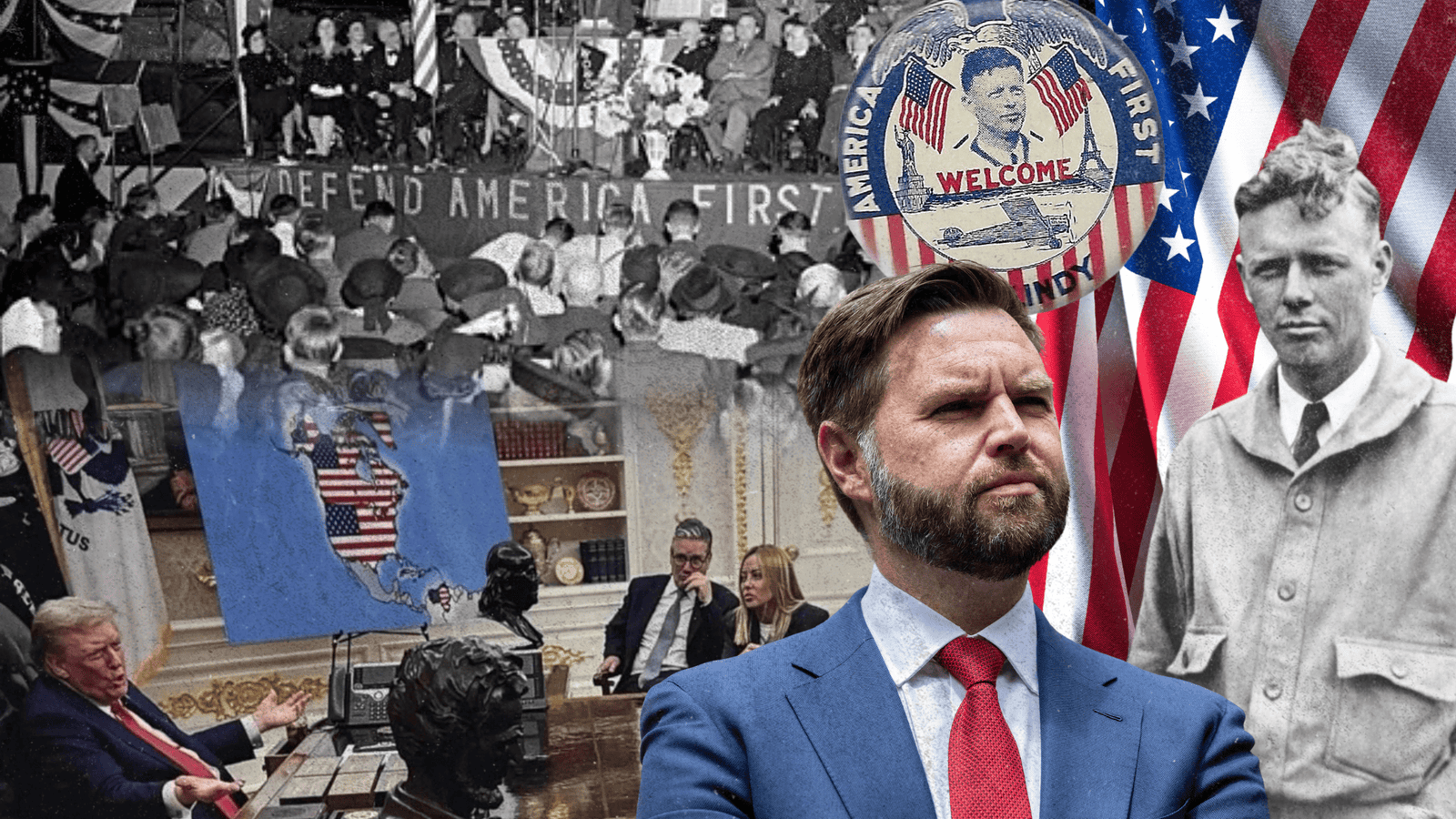
Along with this, the objective of appeasing a Washington determined to use military force in Latin America is easily identifiable, while it attempts to economically capitalize on the effects of a U.S. refocused on the region. Climbing onto the cart of a Trump who rides the imperial imaginary of Monroeism has as an immediate effect regional validation, with Santiago Peña breaking the cellophane of Caracas’s isolation and traveling to the country to meet with Rodríguez.
The triangulation between analytical hypotheses allows us to approach with greater effectiveness an exceptional conjuncture, in which Washington seems satisfied with domesticating a rebellious state to reinsert it into its sphere of influence. The acting government, oscillating between bandwagoning and peripheral realism, also seems to be comfortable admitting that its geopolitical aspirations of a decade ago no longer correspond to its power capabilities to face the challenge, and opts to build influence in a more limited framework in search of margins of autonomy.
It remains to be seen what future factors of discrepancy with Washington would bring Caracas closer to heterodox autonomy or, rather, to colonial dependence following Puig’s categorization.
Implications and a call for reflection
It is impossible to evade the general context of struggle between powers and hegemonic transition of the world order in which the ongoing turn in Venezuelan foreign policy develops.
From a general perspective, China continues to outpace the U.S. in the sectors of greatest competition in global geopolitics (technological development, rare earth processing, energy transition, etc.).
The negative entropy of chronic indebtedness and loss of global geopolitical influence has strategically undermined the hegemonic position of the northern power, which has resorted to the Monroe Doctrine to avoid a clumsy landing of its imperial project of a global nature.
In the short term, the reconfiguration of Venezuelan foreign policy hopes to harvest economic successes of profound depth, which revert into salary recovery, public services, and infrastructure for internal development, underpinned by growth in the hydrocarbon sector.
In the long term, the systemic effects may not be so encouraging, insofar as Venezuela is shaping up as a trusted partner of the losing side of a new global order characterized by economic multipolarization and geopolitical regionalization.
However, it is still too early to make a complete balance of that future, especially if one attends to a chaotic and unstable world dynamic.
Finally, beyond the interpretive effort, this article is a call to begin laying the foundations of our own paradigms in foreign policy, from academies, institutions, and the citizenry in general.
The country, in the midst of the complex era of reconstruction it is going through, needs to produce categories and hypotheses with a national perspective, with the purpose of correctly analyzing its diplomatic performance and thus identifying, with greater effectiveness, areas of opportunity to enhance the national interest and shore up its power and negotiation capacities, overcoming the mediocre filters of over-ideologization and excessive partisanship.
The time has come to retrace our steps, recover the lessons of our diplomatic history, and conduct with our own gaze our presence in the world, for the benefit of the nation. No one will do it for us.
Article by William Serafino and Luis Alejandro Ruiz.