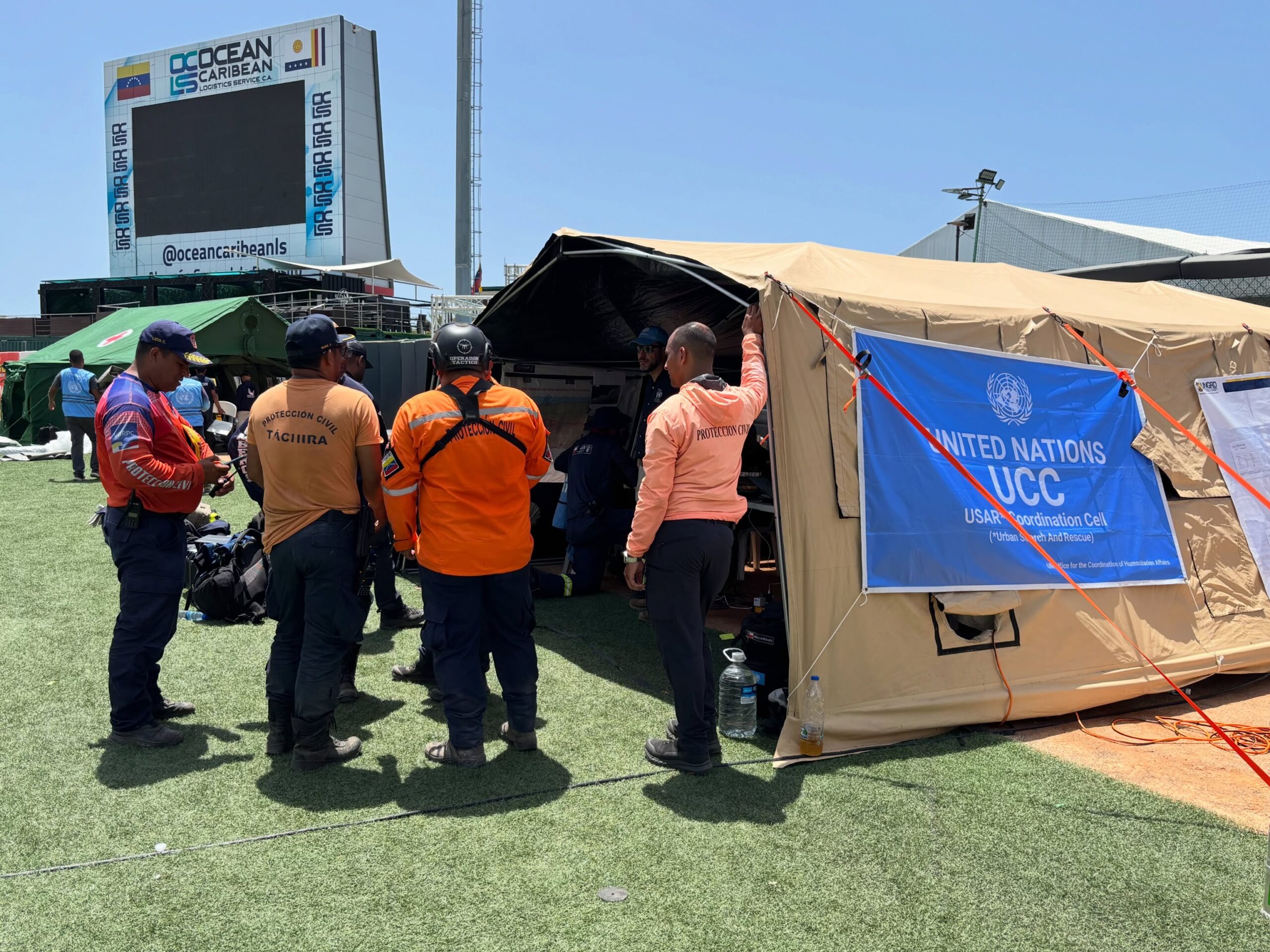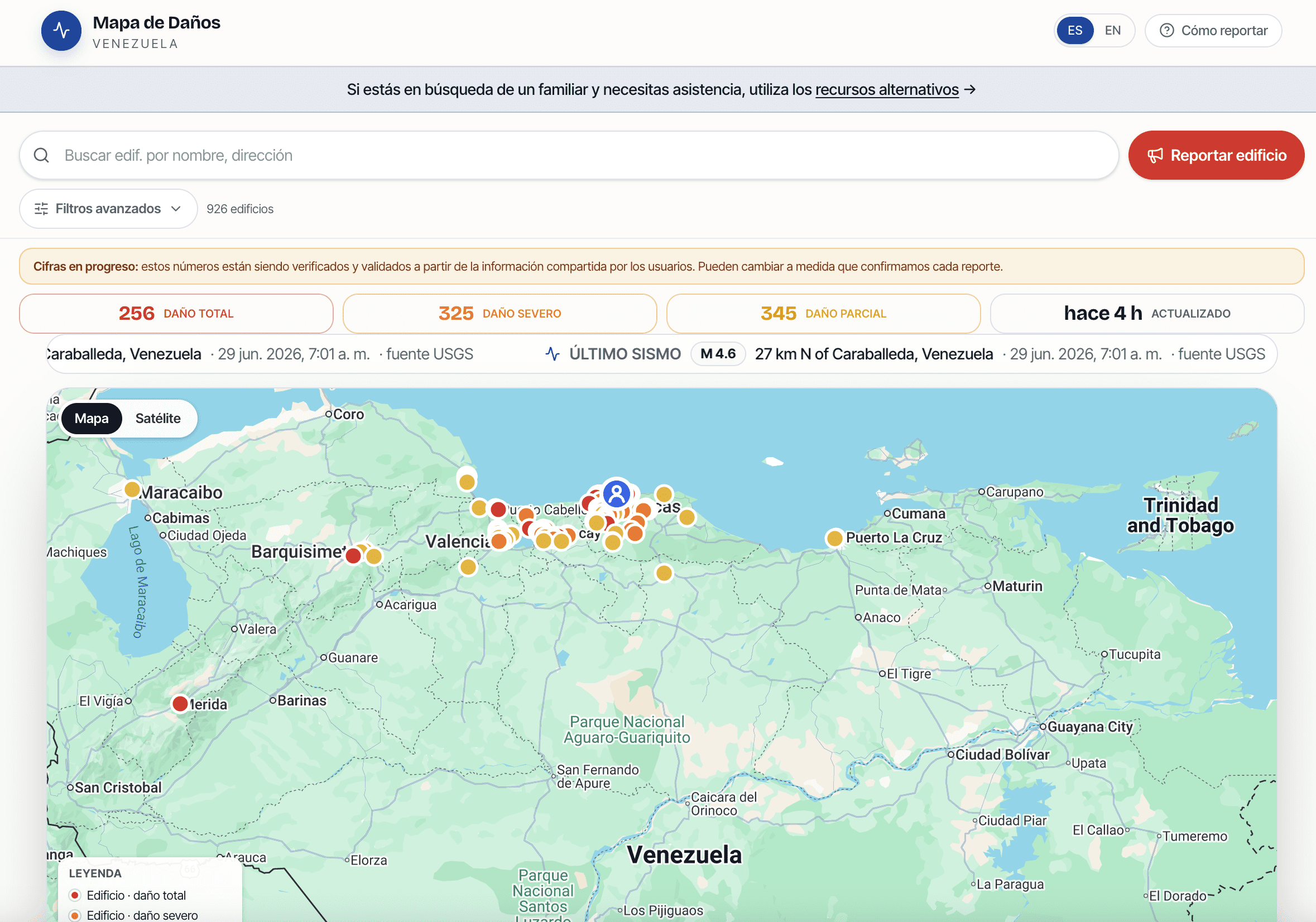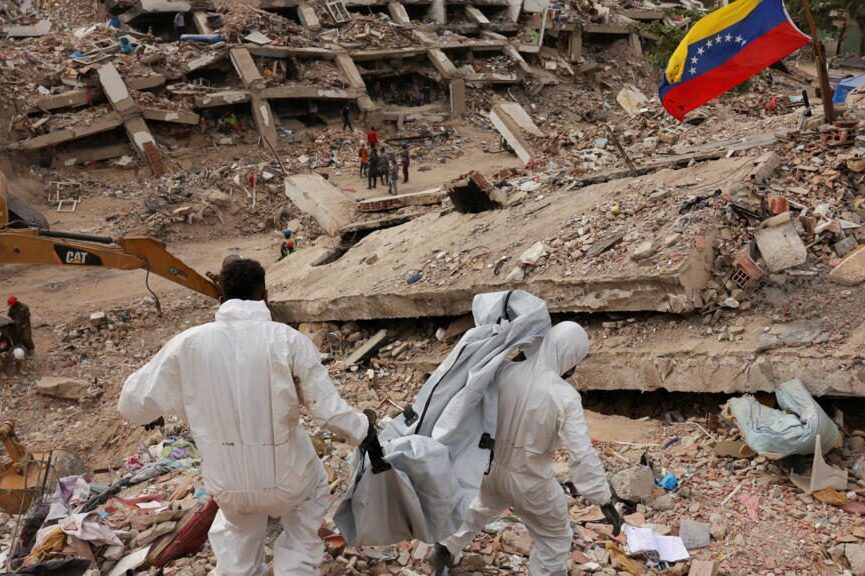
There is strong controversy over the accuracy of state figures, as government data contrasts with estimates from NGOs and the UN that suggest a tragedy even greater than officially projected. | Photo: Reuters – Gaby Oraa
Guacamaya, August 4, 2026. In the wake of the devastating seismic double-hit of last June 24, Venezuela remains mired in statistical uncertainty. This Monday, August 3, the National Government released a new official update under the heading “Weekly Information Bulletin.” This report puts an end to a 10-day information silence, as the last daily report had been issued on July 24, exactly one month after the tragic natural phenomenon.
The official death toll rose to 6,125 victims. An analytically relevant detail is that the report on injuries (frozen at 16,740 since early July) no longer appears in the latest bulletin, suggesting that the “biological window” for survival has closed and efforts are now focused on body recovery. In these and other data points, opacity continues to mark information management.
The Enigma of the Missing
The biggest question concerns the number of missing persons, as the Government—at least from the central administration—still has not published data on that registry. Faced with official silence, civil society has turned to projections from international organizations and independent initiatives to navigate the uncertainty.
To understand the magnitude of the information vacuum regarding the missing, it is necessary to cross-reference data provided by government spokespersons themselves and contrast it with the current reality on the ground. Analysis of these figures reveals a “statistical limbo” between what the Executive indirectly suggests and what local authorities admit.
Based on statements made on June 30 by the appointed Chief of Staff for Transitional Camps, Jorge Rodríguez, the total number of people (residents and tourists) present in the critical areas of Caraballeda and Catia La Mar at the time of the double-hit was placed at 30,000. This calculation can be broken down using complementary estimates and subsequent official announcements.
From that number, according to Rodríguez, between 13,400 and 13,500 people managed to leave on their own, while another 6,461 were rescued (a figure later officially consolidated at 6,462). If the 6,125 confirmed deaths from the latest bulletin are subtracted from the remaining roughly 10,000, about 4,000 people are still unaccounted for—neither rescued nor officially confirmed dead.
However, there is a marked difference between this calculation derived from Jorge Rodríguez’s data and the information provided by the governor of La Guaira, José Alejandro Terán. The local authority declared this Monday, August 3, that the number of missing persons in his state amounts to 1,579, leaving a gap—based on the central estimate—of more than 2,400 people without a unified registry.
If international organizations’ projections are taken into account, the magnitude of the tragedy could be estimated as even greater. After the earthquakes, the USGS warned of a 44% probability of exceeding 10,000 deaths and a 30% chance of reaching 100,000. Meanwhile, OCHA (UN) considers it “terrifyingly plausible” that there are 50,000 missing persons nationwide.
At the same time, the UN confirmed the delivery of 10,000 body bags, a batch to which another 3,600 bags donated by the company Yummy were added, totaling at least 13,600 units intended for the disposal of human remains. This massive provision of funerary supplies may confirm projections about the real scale of the disaster.
In parallel, citizen platforms have emerged that try to map the trail of those who have not yet been located. Among them are Venezuela Te Busca, which registers some 17,793 people “to be located,” and Desaparecidos Terremoto Venezuela, which counts about 29,514 “to be contacted.” These initiatives, though vital, face limitations inherent to their collaborative nature.
Experts and developers of these platforms warn that these numbers should be read with caution. Many of these initiatives lack automated deduplication processes, and their verification depends on direct calls to relatives or citizen reports that may be duplicated. Nevertheless, these registries provide a sense of the scale of social distress.
The Other Data That the Figures No Longer Reveal
When comparing the July 24 report with that of August 3, the omissions are notable. There is no trace in the weekly report of the number of displaced persons or those in transitional camps, last placed at 17,907 and 23,811, respectively. Meanwhile, a record from the Social and Territorial Vice Presidency dated July 26 raised that figure to 24,477 citizens distributed across 107 centers.
The new registry also does not detail the 856 affected buildings and 190 collapsed structures previously reported. It now focuses on evaluated homes, counting a total of 43,679: 25,325 of them habitable, 9,866 restricted, and 6,433 at “high risk.” As new data, 287 homes have been delivered to date, though this does not allow for a precise determination of the beneficiaries reached.
Also noticeable is the omission of data on the provision of basic supplies. The record of food (10.9 million tons) and water (51.2 million liters) delivered up to July 24 has disappeared. These metrics are especially useful for measuring the reach of government assistance, but also for auditing transparency in the distribution of humanitarian aid.
The Government also stopped reporting aftershocks, although according to data from the VolcanoDiscovery monitor, 142 earthquakes have been recorded in the country over the last 7 days, with magnitudes up to 4.5. Feliciano De Santis, president of the Venezuelan Society of Geologists, warns that fault readjustment could last “up to 5 months” due to a 2-meter submarine deformation.
Additionally, the USGS rectified the epicenter of the second main earthquake, locating it off the coast of La Guaira and not in Yaracuy as initially indicated and supported by Funvisis. The proximity of both events overlapped the seismic waves, complicating the initial measurement by local and satellite instruments. This new development highlights the importance of permanent monitoring.
Nevertheless, the Government reported having collected 346,755 tons of debris as of August 3. However, this figure represents only 16.51% of the total projected by authorities, raising the official estimate to about 2.1 million tons. This volume significantly exceeds the initial UNDP projection, which estimated 1.2 million tons in affected localities.
Is It Possible to Know the Truth?
The reliability of official data can certainly be questioned due to institutional precariousness and the lack of updated censuses. However, international projections are based on risk models and health alerts that may suffer from imprecision by failing to assess factors such as migration and the lack of updated official data.
The most solid conclusion, based on the sources consulted, is that, for now, there is a large gap between what is reported and what may have actually occurred. The final figures will only be reliable when there is independent cross-referencing of data and institutional verification.
In his final days as UN resident coordinator in Venezuela, Gianluca Rampolla stated that he had “total confidence” that the official numbers are real, although he specified that they are “within the limits of a non-definitive crisis.”