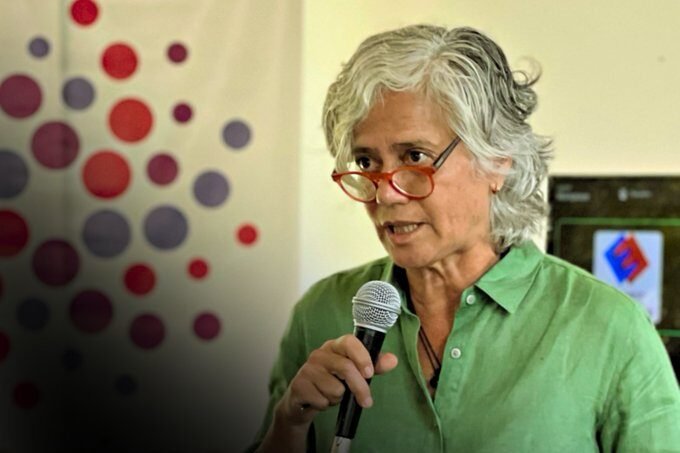
The Foro Cívico and various media outlets confirmed her death on October 15. Her career left an indelible legacy in the search for negotiated solutions and in the defense of human rights in Venezuela. Photo: Foro Cívico.
Guacamaya, October 16, 2026. The activist, human rights defender and Venezuelan architect Mariela Ramírez died this October 15, 2026, as confirmed by the account of the civil society organization Foro Cívico. The organization reacted with deep sorrow to the loss of its co-founder and spokesperson, whom it described as a “relentless engine, heart and hands always ready for the task of imagining and building a different country.”
Born in Caracas in 1965, Ramírez graduated as an architect from the Universidad Central de Venezuela (UCV) and complemented her technical training with the practice of carpentry. From that convergence was born her concept of “social architecture,” through which she shifted her work toward building support networks and bridges of understanding in a deeply divided country.
Her work gained public notoriety in 2017 when she co-founded the Movimiento Ciudadano Dale Letra amid intense street protests. Its flagship proposal was the “mobile alphabet”—individual letters carried by citizens to assemble messages on the asphalt—a tool for peaceful mobilization aimed at demanding constitutional compliance and opening spaces for encounter through nonviolence.
The articulation of the Foro Cívico and social dialogue
Since 2018, Ramírez joined the drive behind the Diálogo Social platform, collaborating in 2019 with jurist Pedro Nikken in organizing the Jornadas de Entendimiento at the Palacio de las Academias and the Mesa de Entendimiento Electoral.
This effort culminated in the formation of the Foro Cívico, formally announced on February 6, 2021, which came to articulate more than 100 civil society organizations, professional associations, unions, academics and human rights defenders.
As one of the coalition’s main spokespersons, Ramírez took on a leading role in defending civic space, democratic reinstitutionalization and the promotion of negotiated solutions to the national crisis. In that work, she joined international delegations on tours through Europe and Latin America between 2021 and 2024 to promote electoral and peaceful paths.
Until her final days, Mariela Ramírez insisted on understanding and recognition between opposing sectors. Among her most widely shared reflections is the premise that “we are obliged to meet” and the conviction that “all Venezuelans are necessary, from A to Z, no matter their political or ideological position, in order to build the language of that common future to which we aspire.”
From Guacamaya we express our most heartfelt words of condolence to her family, friends and the entire community of civil organizations that today honor her memory and commit to carrying on her legacy.